
Matting Agents Market Outlook: Size, Share, Trends, Growth Analysis, Competitive Landscape & Forecast, 2026–2033

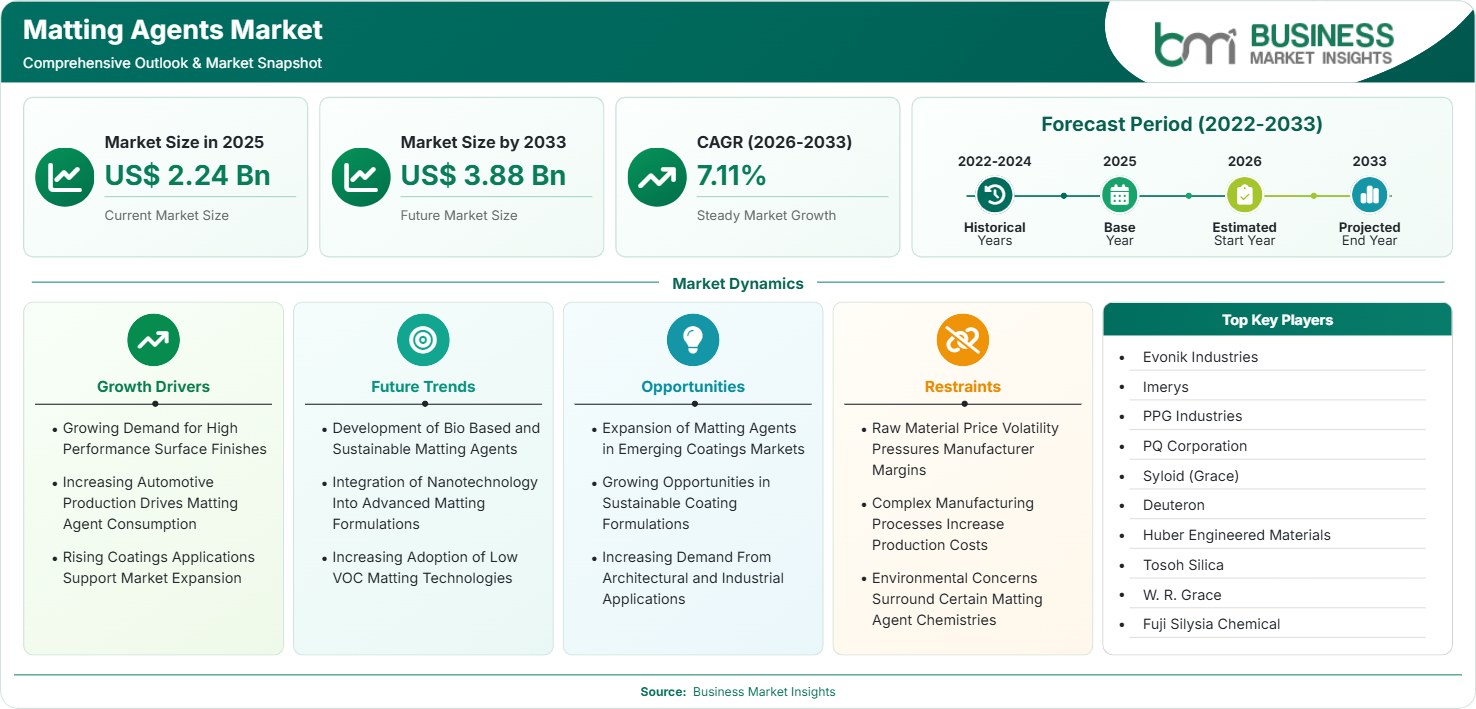
The Matting Agents Market size was valued at US$ 2.24 billion in 2025 and is projected to reach US$ 3.88 billion by 2033, growing at a CAGR of 7.11% during 2026–2033, driven by increasing demand for premium surface finishes, expanding coatings applications, automotive production growth, and rising adoption of sustainable coating technologies.

Report Coverage
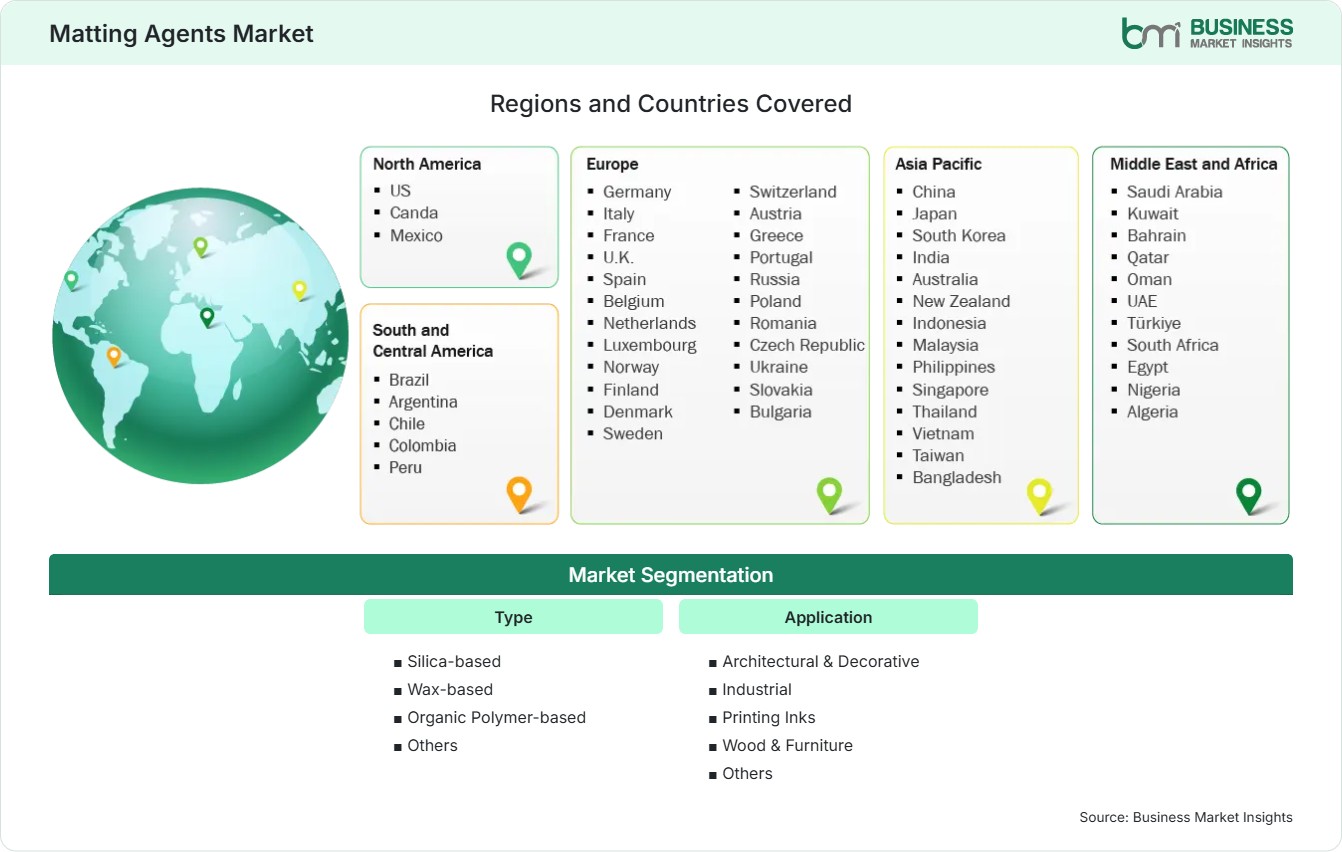
  • Type: Silica-based, Wax-based, Organic Polymer-based, Others
  • Application: Architectural & Decorative, Industrial, Printing Inks, Wood & Furniture, Others
US$ 2.24 Bn Market size in 2025
US$ 3.88 Bn Market Size by 2033
7.11% CAGR, 2026 - 2033
2026-2033 Forecast Period

AI Overview

Matting Agents Market Summary

  • North America Region: North America holds 26%–30% market share in 2025 and is expected to grow at a 6%–8% CAGR during 2026–2033. Growth is supported by advanced coatings industries, increasing architectural renovation activities, automotive manufacturing demand, and rising preference for durable low-gloss surface solutions.
  • Fastest Growing Region: Asia Pacific accounts for 38%–42% market share in 2025 and is projected to grow at a 8%–10% CAGR through 2033. Growth is driven by expanding construction activities, industrial development, automotive production, and increasing demand for decorative and protective coating applications.
  • Leading Segment: Silica-based matting agents represent 55%–59% market share in 2025 due to superior efficiency, compatibility with different coating systems, and extensive adoption across architectural, industrial, and printing applications.
  • High Growth Segment: Organic Polymer-based matting agents are expected to grow at a 9%–11% CAGR during 2026–2033 due to increasing demand for sustainable formulations, improved coating performance, and advanced surface appearance requirements.
  • Key Market Opportunity: Expansion of sustainable coating formulations, increasing architectural applications, and rising demand for high-performance industrial finishes are creating opportunities for matting agent manufacturers.
  • Major Market Players: Evonik Industries AG, Imerys S.A., PPG Industries, Inc., PQ Corporation, W. R. Grace & Co., Deuteron GmbH, Huber Engineered Materials, Tosoh Corporation, Fuji Silysia Chemical Ltd., and Grace Silica Technologies.
Strategic Insights

Matting Agents Market: Strategic Insights

Matting Agents Market Strategic Framework
FREE PDF
Request your free sample
Request free sample
Stakeholder View

Key Takeaways

  • The Matting Agents Market ecosystem includes raw material suppliers, specialty chemical manufacturers, coating formulators, and end-use industries working together to improve surface finishing performance.
  • Architectural coatings, industrial finishes, automotive coatings, and furniture applications represent important growth opportunities due to increasing demand for durable and visually appealing surfaces.
  • Innovation is focused on sustainable matting solutions, improved dispersion technologies, multifunctional additives, and enhanced compatibility with advanced coating systems.
  • Asia Pacific offers significant investment opportunities due to expanding construction activities, manufacturing growth, and increasing adoption of modern coating technologies.
  • Strategic collaborations among specialty chemical companies and coating manufacturers are shaping competitive positioning through product development and application expertise.
  • Sustainability trends are encouraging manufacturers to develop environmentally friendly matting agents with improved performance and reduced environmental impact.
Geographic Outlook

Matting Agents Market Regional Highlights

North America Matting Agents Market

North America maintains a significant position due to established coatings industries, strong automotive manufacturing activities, and increasing demand for premium surface finishes. The region holds 26%–30% Matting Agents Market share in 2025 and is projected to grow at a 6%–8% CAGR during 2026–2033. The United States represents the major contributor, supported by construction activities, industrial coatings demand, and increasing adoption of advanced coating technologies across multiple applications.

  • The US coatings industry is adopting advanced matting solutions for decorative and protective surface applications.
  • Automotive manufacturers are increasing demand for high-quality coatings with controlled gloss characteristics.
  • Industrial sectors are adopting durable finishes to improve product appearance and performance.
  • Sustainable coating developments are encouraging innovation in specialty matting formulations.
  • Manufacturers are expanding product portfolios to address changing customer requirements.

US Matting Agents Market

The US market is supported by strong demand from architectural coatings, industrial applications, automotive production, and furniture finishing sectors. The country represents 22%–26% share within North America in 2025 and is expected to grow at a 6%–8% CAGR during 2026–2033. The Matting Agents Market growth is influenced by increasing renovation activities, coating innovation, and demand for improved surface aesthetics.

  • Architectural coating manufacturers are adopting matting agents for premium interior and exterior finishes.
  • Automotive coating producers are developing low-gloss solutions for enhanced vehicle appearance.
  • Industrial applications are increasing usage of performance-focused surface additives.
  • Specialty chemical companies are investing in advanced coating additive technologies.

Europe Matting Agents Market

Europe demonstrates steady growth due to advanced coating manufacturing capabilities, strong sustainability focus, and increasing demand for environmentally friendly surface solutions. The region accounts for 27%–31% market share in 2025 and is projected to grow at a 6%–8% CAGR during 2026–2033. Germany, France, Italy, and the UK are major contributors due to automotive manufacturing, industrial coatings, and construction applications.

  • Germany is supporting demand through automotive coatings and industrial finishing applications.
  • France is increasing adoption of sustainable coating technologies across architectural sectors.
  • Italy is expanding usage in furniture and decorative coating applications.
  • The UK is focusing on advanced coating solutions for industrial and construction markets.
  • European manufacturers are developing low-emission and environmentally responsible formulations.

Asia Pacific Matting Agents Market

Asia Pacific represents the largest regional market due to rapid industrialization, expanding construction activities, and growing automotive production. The region accounts for 38%–42% market share in 2025 and is expected to grow at a 8%–10% CAGR during 2026–2033. China, Japan, South Korea, and India are major contributors due to increasing coating consumption and manufacturing expansion.

  • China is increasing demand through construction growth and industrial coating applications.
  • India is expanding adoption with infrastructure development and manufacturing investments.
  • Japan is focusing on advanced automotive and electronics coating technologies.
  • South Korea is increasing specialty coating usage across industrial applications.
  • Regional manufacturers are expanding production capacity to support growing demand.

Rest of World Matting Agents Market

Latin America, the Middle East, and Africa represent emerging opportunities due to increasing construction development, industrial expansion, and improving manufacturing capabilities. The region holds 6%–10% market share in 2025 and is projected to grow at a 7%–9% CAGR during 2026–2033. Rising infrastructure investments and increasing demand for decorative coatings are supporting market development.

  • Latin American countries are increasing coating consumption through construction and industrial projects.
  • Middle Eastern markets are adopting advanced finishes for commercial and infrastructure developments.
  • African economies are gradually expanding industrial coating applications.
  • International suppliers are strengthening distribution networks across emerging markets.
  • Growing urbanization is supporting future demand for surface finishing technologies.
Global Market Geography
FREE PDF
Request your free sample
Request free sample
Segment Analysis

Matting Agents Market Segmentation

Type

The type segment includes Silica-based, Wax-based, Organic Polymer-based, and Others. Silica-based matting agents represent the leading segment due to strong performance, compatibility, and widespread adoption across coating systems. The segment accounts for 55%–59% market share in 2025 and is expected to grow at a 6%–8% CAGR during 2026–2033. Increasing demand for durable and controlled finishes supports continued adoption.

  • Silica-based: Silica-based agents provide efficient gloss reduction, excellent dispersion, and broad compatibility across architectural and industrial coatings.
  • Wax-based: Wax-based matting agents enhance surface texture, slip properties, and durability in specialized coating applications.
  • Organic Polymer-based: Organic polymer-based solutions support sustainable formulations with improved performance characteristics and application flexibility.
  • Others: Other matting technologies address specialized coating requirements across niche industrial and decorative applications.

Application

The application segment includes Architectural & Decorative, Industrial, Printing Inks, Wood & Furniture, and Others. Architectural and decorative applications represent major demand areas due to increasing focus on aesthetic finishes and durable surfaces. Coating manufacturers are adopting matting agents to improve appearance and performance across residential, commercial, and industrial environments.

  • Architectural & Decorative: These applications use matting agents to achieve premium finishes, controlled gloss, and enhanced visual appeal.
  • Industrial: Industrial coatings utilize matting agents for improved durability, appearance, and protective performance.
  • Printing Inks: Printing applications use matting additives to improve texture, appearance, and functional properties.
  • Wood & Furniture: Furniture manufacturers adopt matting solutions for attractive finishes and improved surface quality.
  • Others: Other applications include specialized coatings requiring customized gloss control and surface enhancement.
Market Forces

Matting Agents Market Dynamics

Key Market Drivers

Growing Demand for High Performance Surface Finishes

The growing need for high-quality surface finishes is driving greater use of superior matting agents in the coatings industry. There has been an increasing effort to improve the performance of coated surfaces in terms of appearance, texture, and functionality. Matting agents help achieve desired gloss levels and superior visual performance on surfaces. The Matting Agents Market trend is driven by the increasing preference for sophisticated coating solutions that offer both aesthetic appeal and protection. Coatings manufacturers have begun producing specialized coatings to meet the changing demands of customers.

Increasing Automotive Production Drives Matting Agent Consumption

Increasing automotive manufacturing is driving demand for matting agents in automotive coatings and surface-finishing applications. Automobile manufacturers require coatings that ensure durability, enhance appearance, and protect against environmental conditions. Matting agents are now widely used to create unique surface textures and high-end appearances on automobiles. Increasing vehicle manufacturing operations are also creating new business opportunities for specialty chemicals companies. Companies providing coatings are investing more in developing coatings that perform well during application and last longer. Development in the automobile industry continues to be a significant driver of market growth.

Rising Coatings Applications Support Market Expansion

Demand for matting agents has been increasing due to expanding applications in construction, industrial manufacturing, furniture, and printing segments. Matting agents are essential components for enhancing coating properties such as aesthetics, performance, and applicability. Increasing construction activity is driving demand for architectural coatings with improved aesthetic qualities. Advanced coating technologies are being implemented by manufacturers to enhance product durability and quality. Matting Agents Market growth can be attributed to the increased use of specialty additives in different types of coatings. Companies are developing new products suitable for use in waterborne and environmental coatings.

Key Market Opportunities

Expansion of Matting Agents in Emerging Coatings Markets

New coatings market trends present growth opportunities for companies in the matting agents segment, driven by industrialization and infrastructure development. Emerging economies have begun investing in construction, automobiles, and other manufacturing sectors, thereby increasing demand for better coatings. These players are trying to capitalize on the growth prospect by adopting strategies that include local manufacturing, distribution, and application-based products. Growing awareness of superior surface finishes is fueling adoption among new industrial consumers. According to the Matting Agents Market Forecast, increasing opportunities from growing consumption of coatings in emerging economies are anticipated.

Growing Opportunities in Sustainable Coating Formulations

Growing interest in eco-friendly coatings is spurring the development of sustainable matting agents. Eco-friendly coatings that reduce environmental impact without compromising performance and aesthetics are being developed by coating formulators. There is growing demand for water-based coatings and better-formulated coatings using bio-based ingredients, and therefore for innovations from specialty chemical companies. Innovations in matting agent technologies are being developed to enhance compatibility with sustainable coatings. The regulatory push to reduce emissions is helping drive environmentally friendly solutions. Companies manufacturing environmentally friendly additives with consistent performance properties are likely to have a competitive edge.

Increasing Demand From Architectural and Industrial Applications

The rising demand for applications in architecture and industry has generated new opportunities for providers of matting agents. Building projects, commercial establishments, and industries require coatings that provide durability, aesthetics, and long-term protection. Matting agents are used to achieve the desired surface finish and improve the performance of the coatings. Rising renovation activity is generating new opportunities for decorative coatings. Industries are looking forward to performance-oriented coatings that provide both aesthetics and functionality.

Market Restraints and Challenges

Raw Material Price Volatility Pressures Manufacturer Margins

Factor: Variations in the prices of raw materials, such as silica, waxes, and specialty chemicals used as inputs, create uncertainties in production costs for matting agents. Impact: Increased input costs can lead to reduced profit margins, higher product prices, and greater supply chain instability within the coatings industry. It is imperative that companies have an effective purchasing and production strategy to offset increased cost pressures. Unstable commodity markets can make it difficult to maintain stable prices for customers. Cost management is an issue these companies are tackling.

Complex Manufacturing Processes Increase Production Costs

Factor: Complex manufacturing processes required for achieving consistent particle size, dispersion properties, and performance characteristics increase production requirements. Impact: Higher manufacturing complexity can raise operational expenses and limit cost efficiency for producers. Matting agents require precise formulation control to deliver reliable coating performance across different applications. Manufacturers must invest in advanced processing technologies and quality control systems to maintain product consistency. Technical challenges associated with formulation development can increase research and production expenses. Companies are focusing on process optimization and innovation to improve manufacturing efficiency. These challenges continue to influence pricing strategies and competitive positioning within the industry.

Company Analysis

Competitive Landscape

The Matting Agents Market analysis highlights competition among specialty chemical manufacturers, silica producers, and coating additive suppliers focused on developing advanced solutions for surface finishing applications. Companies are investing in product innovation, sustainable formulations, and application-specific technologies to strengthen their positions across architectural, industrial, automotive, and decorative coating markets.

Company Name

Overview

Products and Services relevant to this market

Evonik Industries AG

Specialty chemicals company providing advanced additives and material solutions for coating applications worldwide.

Silica-based matting agents, coating additives, surface modifiers, and specialty solutions for industrial and decorative coatings.

Imerys S.A.

Global mineral-based solutions provider supplying functional materials for industrial applications.

Mineral additives, performance-enhancing materials, and coating solutions supporting gloss control and surface improvement.

PPG Industries, Inc.

Global coatings company developing advanced paint and surface technologies across multiple industries.

Coating formulations, specialty finishes, architectural coatings, and surface solutions using matting technologies.

PQ Corporation

Specialty chemical manufacturer providing silica and performance materials for industrial applications.

Silica-based matting agents, specialty chemicals, and additives for coatings and surface finishing.

W. R. Grace & Co.

Materials science company offering advanced silica and specialty chemical solutions.

Syloid silica matting agents, coating additives, and performance materials for industrial applications.

Deuteron GmbH

Specialty additive manufacturer focused on coating and surface technology solutions.

Matting agents, wax additives, and functional additives for coatings and printing applications.

Huber Engineered Materials

Engineered materials company supplying mineral-based additives for industrial markets.

Silica products, specialty minerals, and coating additives supporting surface performance enhancement.

Tosoh Corporation

Japanese chemical company providing advanced materials and specialty chemical products.

Silica materials, specialty chemicals, and additives for coating and industrial applications.

Fuji Silysia Chemical Ltd.

Manufacturer specializing in synthetic silica and functional material solutions.

Silica-based matting agents, porous silica materials, and coating performance additives.

Grace Silica Technologies

Technology provider specializing in silica-based solutions for industrial applications.

Synthetic silica matting agents, coating additives, and surface modification technologies.

Trust & Transparency

Research Methodology

The market analysis combines proprietary research with secondary data from government agencies, company disclosures, regulatory filings, industry databases and expert interviews. Market estimates are validated through data triangulation, cross-market benchmarking and analyst review.

View Full Research Methodology

Questions Answered

Frequently Asked Questions

What does the Matting Agents Market report indicate about future competition?

The report indicates that competition will focus on sustainable additive technologies, customized coating solutions, improved formulation performance, and expansion into emerging coatings markets. Companies developing efficient, environmentally compatible, and application-specific matting agents are expected to strengthen their positions as demand for advanced surface finishes increases.

Why are silica-based matting agents widely used across coating applications?

Silica-based matting agents are widely used because they provide effective gloss reduction, strong compatibility with multiple coating systems, consistent performance, and suitability across architectural, industrial, automotive, and decorative applications. Their versatility supports broad adoption among coating manufacturers seeking reliable surface finishing solutions.

How are sustainable coating technologies influencing matting agent adoption?

Sustainable coating technologies are increasing adoption by encouraging development of environmentally responsible matting agents compatible with water-based and low-emission formulations. Manufacturers are focusing on additives that maintain surface quality while supporting regulatory requirements and changing preferences for greener coating solutions.

Which applications present the strongest opportunity in the market?

Architectural coatings, automotive finishes, industrial coatings, wood and furniture applications, and sustainable coating formulations represent strong opportunities. These applications require efficient matting solutions to achieve controlled gloss levels, improved aesthetics, enhanced durability, and better performance across different environmental conditions.

What factors are improving Matting Agents Market return on investment?

Increasing demand for premium coatings, rising adoption of advanced surface finishes, expansion of architectural applications, and growing industrial coating requirements are improving return on investment. Matting agents help manufacturers enhance coating appearance, improve product differentiation, and deliver functional surface properties across automotive, construction, furniture, printing, and industrial applications.

Access the Full Matting Agents Market Report

Get segment-level forecasts, regional estimates, competitive benchmarking, company profiles and downloadable Excel datasets.

Access the full Matting Agents Market Report
350 pages PDF & Excel | 2026-08-31
Similar Research

Related Market Reports