
Lead Acid Battery Market Outlook: Size, Share, Trends, Growth Analysis, Competitive Landscape & Forecast, 2026-2033

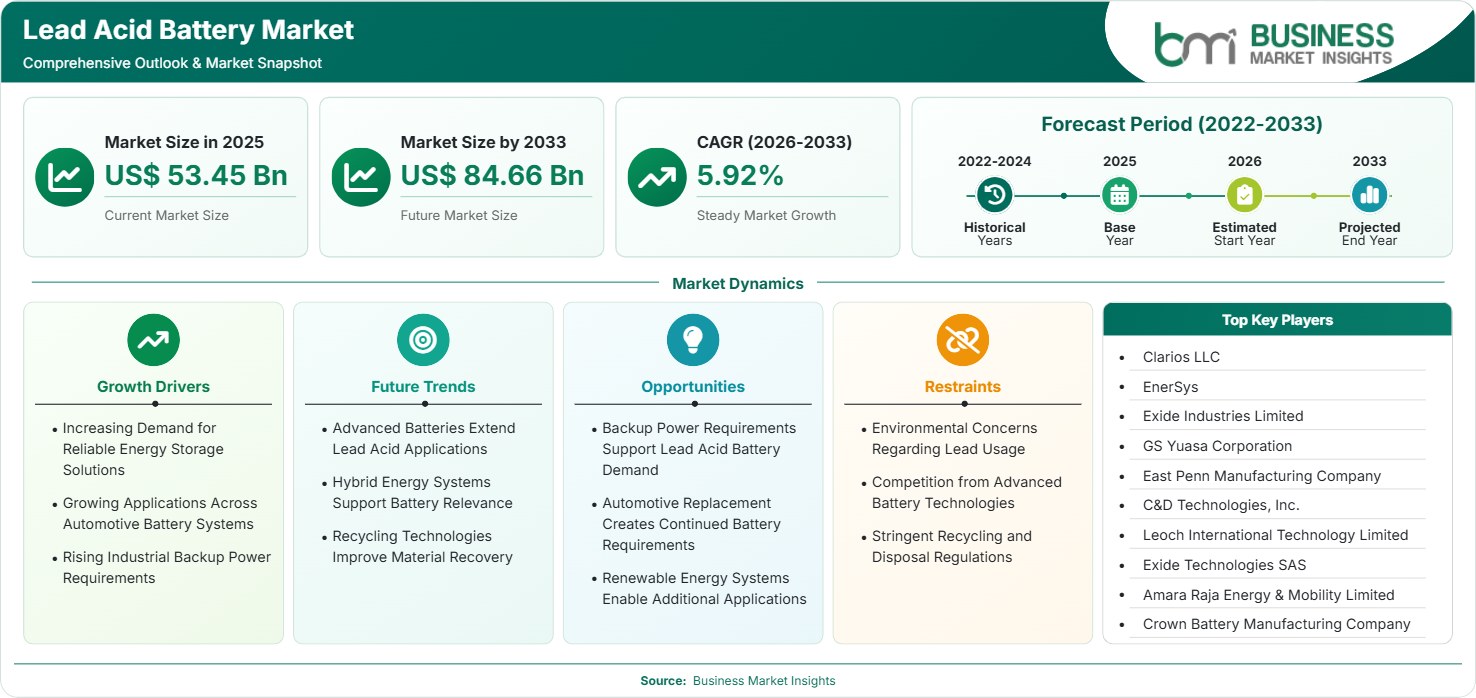
The Lead Acid Battery Market size was valued at US$ 53.45 Billion in 2025 and is projected to reach US$ 84.66 Billion by 2033, growing at a CAGR of 5.92% during 2026–2033, driven by replacement battery demand, telecom backup power deployment, renewable integration, micro-hybrid vehicle adoption, and opportunities across e-bikes, stationary storage, and emerging-grid electrification.

Report Coverage
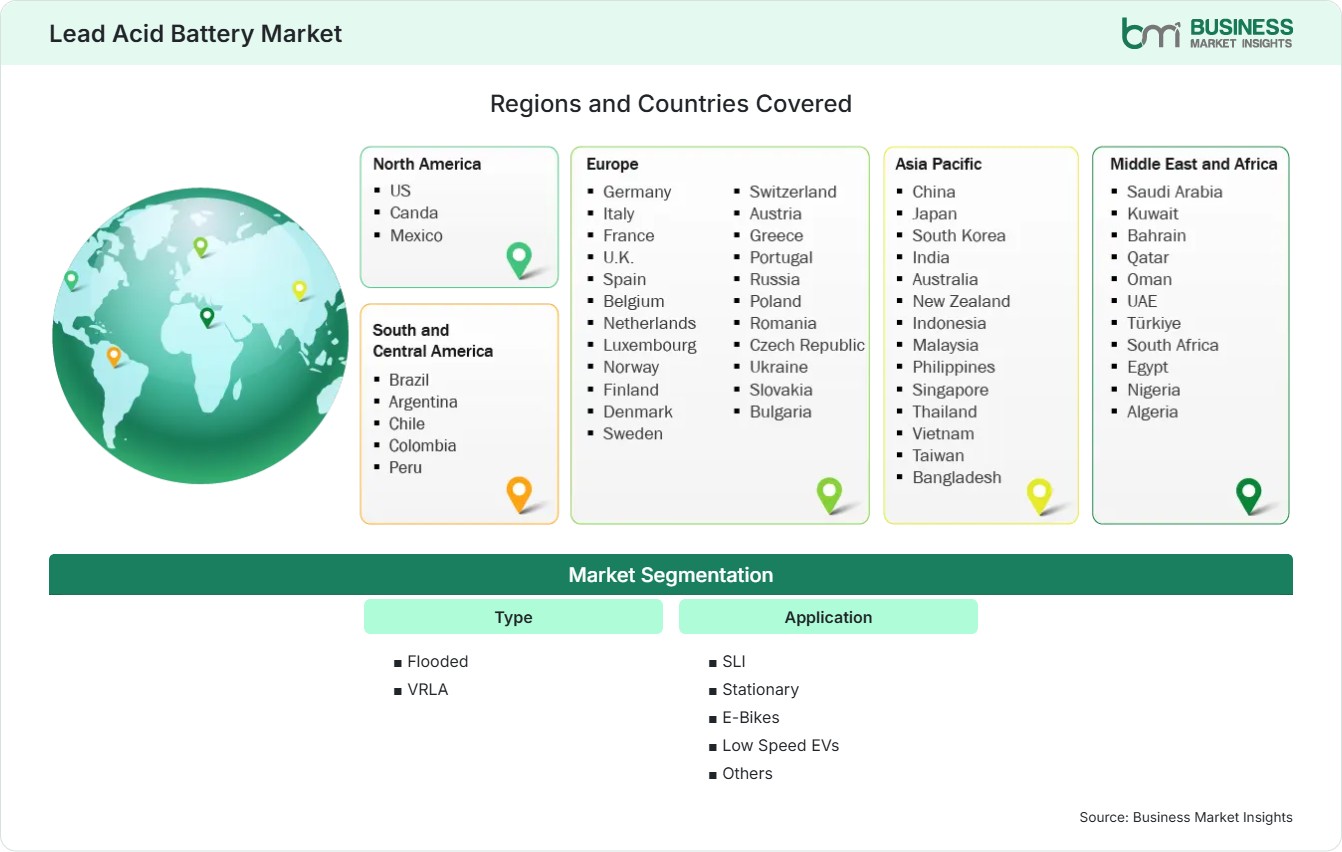
  • Type: Flooded, VRLA
  • Application: SLI, Stationary, E-Bikes, Low Speed EVs, Others
US$ 53.45 Bn Market size in 2025
US$ 84.66 Bn Market Size by 2033
5.92% CAGR, 2026 - 2033
2026-2033 Forecast Period

AI Overview

Lead Acid Battery Market Summary

  • North America Region: North America holds a 32%–35% share in 2025, growing at a CAGR of 4.8%–5.3% during 2026–2033, supported by telecom resilience investments, data center expansion, battery recycling leadership, aftermarket demand, and utility backup modernization. US market benefits from vehicle parc replacement demand and data-center infrastructure, advancing at roughly 4.9%–5.4%.
  • Fastest Growing Region: Asia Pacific accounts for 36%–39% share in 2025 and expands at 6.8%–7.4% CAGR, supported by industrialization, two-wheeler electrification, renewable storage demand, expanding manufacturing capacity, telecom network growth, and cost-sensitive energy storage requirements.
  • Leading Segment: SLI holds 42%–46% share in 2025 with a CAGR of 4.7%–5.2%, driven by automotive replacement cycles, vehicle ownership growth, start-stop functionalities, extensive distribution channels, affordability advantages, and established recycling ecosystems.
  • High Growth Segment: Stationary applications hold 22%–26% share in 2025 and advance at 6.8%–7.5% CAGR due to telecom infrastructure upgrades, UPS deployment, renewable integration projects, data-center backup demand, and grid reliability investments.
  • Key Market Opportunity: Renewable-energy storage and hybrid microgrid deployments create demand for cost-effective storage systems, enabling manufacturers to leverage recyclability advantages, localized production networks, and long-duration backup requirements across developing economies.
  • Major Market Players: Clarios LLC, EnerSys, Exide Industries Limited, GS Yuasa Corporation, East Penn Manufacturing Company, C&D Technologies, Inc., Leoch International Technology Limited, Exide Technologies SAS, Amara Raja Energy & Mobility Limited, Crown Battery Manufacturing Company.
Strategic Insights

Lead Acid Battery Market: Strategic Insights

Lead Acid Battery Market Strategic Framework
FREE PDF
Request your free sample
Request free sample
Stakeholder View

Key Takeaways

  • The industry benefits from a highly developed recycling ecosystem where recovered lead supports raw-material circularity and improves supply security.
  • Stationary power systems linked to telecom towers, UPS installations, and renewable-storage projects offer some of the strongest medium-term expansion opportunities.
  • Product innovation is increasingly focused on AGM, enhanced flooded batteries, and digital battery-monitoring capabilities that extend operating life and improve reliability.
  • Asia Pacific presents the strongest investment case due to manufacturing scale, two-wheeler penetration, telecom expansion, and energy-access initiatives.
  • Competitive activity increasingly centers on capacity expansions, technology partnerships, and distribution-network strengthening rather than large-scale transformational acquisitions.
  • Sustainability credentials and recycling performance are becoming major procurement criteria among automotive OEMs, utilities, and enterprise customers.
Geographic Outlook

Lead Acid Battery Market Regional Highlights

North America Lead Acid Battery Market

North America represented 32%–35% Lead Acid Battery Market share in 2025 and is expected to expand at 4.8%–5.3% CAGR through 2033. Demand remains supported by automotive aftermarket replacement cycles, utility backup applications, and data-center reliability requirements. Advanced battery recycling infrastructure strengthens cost advantages and supply stability. Telecom operators and industrial facilities continue investing in resilient power systems, reinforcing regional consumption. The United States accounts for the largest regional contribution, while Canada benefits from telecommunications and energy infrastructure modernization initiatives.

  • Automotive replacement demand remains a primary revenue source because vehicle fleets across the region maintain significant dependence on SLI battery systems.
  • Data-center investments are elevating demand for stationary storage and backup-power installations supporting uptime requirements.
  • Established recycling networks recover substantial lead volumes, improving material availability and sustainability performance.
  • Telecom infrastructure modernization continues stimulating procurement of dependable backup-power solutions.

US Lead Acid Battery Market

The United States accounts for approximately 74%–78% of North American share and is projected to grow at 4.9%–5.4% CAGR. Automotive aftermarket demand, industrial backup systems, and expanding digital infrastructure remain key growth engines. Large-scale recycling facilities strengthen supply-chain resilience and support circular-economy objectives. Utility operators are increasingly adopting energy-storage configurations for resilience and grid-support functions, creating incremental opportunities for advanced VRLA products.

  • Vehicle replacement battery demand remains resilient due to a large installed vehicle base.
  • Data-center construction continues creating demand for dependable backup-energy systems.
  • Telecom reliability requirements support procurement of stationary battery platforms.
  • Recycling investments reinforce long-term raw-material availability and sustainability objectives.

Europe Lead Acid Battery Market

Europe accounted for a 24%–27% share in 2025 and is forecast to expand at 4.6%–5.1% CAGR. Germany leads regional demand due to industrial activity and vehicle production, while Poland and Eastern European markets demonstrate faster expansion. Backup power, industrial energy systems, and automotive replacements sustain market momentum. Strict environmental regulations encourage recycling and manufacturing efficiency, maintaining competitiveness across regional supply chains despite rising energy-transition investments.

  • Germany remains the leading national market supported by automotive and industrial sectors.
  • Poland is among the faster-growing countries with estimated growth above the regional average.
  • Telecom and UPS deployments continue supporting stationary application demand.
  • Circular-economy regulations encourage efficient battery collection and recycling infrastructure.

Asia Pacific Lead Acid Battery Market

Asia Pacific held 36%–39% share in 2025 and records the highest regional CAGR of 6.8%–7.4%. China dominates regional manufacturing and consumption, while India represents one of the fastest-growing markets. Two-wheeler demand, telecom expansion, industrialization, and energy-access initiatives drive adoption. Production scale advantages enhance affordability and export competitiveness. The region remains central to global supply chains for automotive, stationary, and mobility-related battery applications.

  • China leads regional demand through manufacturing scale and automotive production.
  • India delivers strong growth driven by telecom, mobility, and infrastructure investments.
  • E-bike and low-speed electric vehicle adoption increases battery consumption across multiple countries.
  • Renewable integration projects support deployment of stationary backup systems.
  • Cost competitiveness continues attracting manufacturing investments.

Rest of World Lead Acid Battery Market

Rest of World accounts for 8%-10% market share and is anticipated to grow at a CAGR of 5.8%-6.4%. South and Central America will capitalize on demand for vehicle replacements and industry investments, while Brazil will lead regional consumption. The Middle East and Africa will see growth driven by developments in telecoms, mining, and electrification. Energy access requirements and off-grid power solutions support continued deployment in remote and underserved locations.

  • Brazil remains the leading market within South & Central America.
  • Gulf countries increasingly invest in backup power and telecommunications infrastructure.
  • Mining applications support industrial battery demand in several African economies.
  • Rural electrification initiatives create opportunities for stationary installations.
  • Cost-effective storage remains attractive where grid reliability is limited.
Global Market Geography
FREE PDF
Request your free sample
Request free sample
Segment Analysis

Lead Acid Battery Market Segmentation

Type

This segment accounted for nearly 100% market distribution across flooded and VRLA technologies, with VRLA recording faster adoption. The Lead Acid Battery Market scope within this segment continues expanding through maintenance-free designs, telecom deployment, and enhanced reliability. Type-based demand is projected to grow between 5.5% and 6.5% CAGR through the forecast period.

  • Flooded: Widely used in automotive, industrial, and backup applications due to affordability, established servicing networks, strong recyclability, and dependable performance under varied operating conditions.
  • VRLA (AGM): Increasing adoption in start-stop vehicles, UPS systems, and telecom infrastructure because of maintenance-free operation, improved cycle performance, and compact installation requirements.
  • VRLA (GEL): Preferred in deep-cycle and renewable applications where discharge resilience, vibration resistance, and lower maintenance requirements create operational advantages.

Application

Diversified applications, wherein SLI forms a major portion of 42%–46%, while the Stationary application segment registers the highest growth rate of 6.8%–7.5% CAGR, can be noted. The term Lead Acid Battery Market trends is well represented by applications in telecom backup, electric mobility, and energy storage diversification, among others.

  • SLI: Dominates revenue generation through passenger vehicles, commercial fleets, replacement demand, and broad global distribution networks supporting dependable automotive starting performance.
  • Stationary: Benefits from expanding telecom infrastructure, data-center deployment, UPS installations, and renewable-energy backup requirements.
  • E-Bikes: Supported by affordability-sensitive consumers and short-distance mobility requirements in developing economies.
  • Low Speed EVs: Utilized in neighborhood vehicles, utility vehicles, and industrial transportation where cost remains a primary purchasing factor.
Market Forces

Lead Acid Battery Market Dynamics

Key Market Drivers

Expansion of Automotive Replacement Battery Demand

The global fleet of vehicles will provide substantial replacement opportunities in the coming years, as lead-acid batteries continue to dominate in starting, lighting, and ignition functions. According to industry estimates, hundreds of millions of replacement batteries are sold annually through dealers and aftermarket channels. The sustainability of the recycling process, along with the servicing channels, helps in increasing their acceptance rate. With the advancement of vehicle electrification, most passenger and commercial vehicles require low-voltage battery systems to support auxiliary functions. This structural requirement supports recurring consumption patterns and enhances long-term revenue visibility across developed and emerging markets alike.

Growth of Telecom and Data Center Backup Infrastructure

The need for continuous service has made telecommunications firms give preference to the installation of power backup solutions. Increased mobile connections, 5G, and data center expansion create constant demand for stationary batteries. The improved VRLA and AGM batteries provide low-maintenance, reliable operation. The unstable state of the electricity grid in many developing countries has contributed to reliance on backup energy systems, thereby boosting demand. This application offers good income opportunities, as installations will always need to be maintained and monitored, with replacement cycles throughout their operating lives.

High Recycling Rates and Circular Supply Chains

Lead-acid batteries possess one of the most developed recycling systems in the energy storage sector. In countries like the US and Europe, recycling rates for these batteries exceed those for other battery types, helping ensure raw material availability. The efficiency of the lead recycling process reduces reliance on virgin raw materials and improves environmental performance. Such a circular economy system enables companies to gain an edge over competitors from both cost and sustainability perspectives. Recyclability becomes a key feature as procurement considerations increasingly incorporate environmental performance metrics.

Key Market Opportunities

Renewable Energy Storage and Hybrid Microgrids

The proliferation of solar and hybrid energy systems creates opportunities for batteries for low-cost storage applications. The inclusion of the Lead Acid Battery Market Forecasts in rural electrification models reflects sustained demand, with price, recyclability, and familiarity remaining important determinants. The need for reliable storage systems in hybrid microgrids across Africa, Asia, and Latin America means that manufacturers of superior deep-cycle and GEL batteries could gain an advantage by installing new units associated with distributed generation projects, particularly where lifecycle economics outweigh high-energy-density requirements.

Rapid Expansion of E-Bikes and Low-Speed EVs

Developing nations still prioritize affordability when considering mobility. Lead-acid batteries have been found useful for certain electric bicycles and electric vehicles due to their lower initial cost. Urbanization, local transportation needs, and the logistics industry are expected to drive demand for such products. Companies will be able to enhance competitiveness through performance, digital tracking, and regional distribution channels. Market players that develop a product suitable for regional mobility will be able to leverage an installed customer base and recurring replacement cycles.

Industrial Infrastructure Development Across Emerging Markets

There is a need for energy storage in industrial plants, logistics operations, utility services, and telecommunications infrastructure in emerging nations. New investment in manufacturing across Southeast Asia, South Asia, Africa, and selected Middle Eastern nations will create future demand for batteries. Businesses that expand their capacity for distribution and service may benefit from the demand generated by industrialization. Localized production can further improve cost competitiveness while reducing supply-chain risks.

Market Restraints and Challenges

Competition from Lithium-Ion Technologies

Factor: Reduction in the cost of lithium-ion batteries and the benefits of higher energy density. Impact: When selecting advanced energy storage systems, customers may opt for alternatives to other chemicals for lighter designs, longevity, and fast-charging capability. This factor is especially prominent in mobility and renewable energy storage projects. Even as the lead-acid system has its own strengths, including cost-effectiveness and a mature recycling process, it must improve performance to remain relevant and protect its share in evolving energy-storage ecosystems.

Environmental Compliance and Raw Material Volatility

Factor: Environmental regulations that are stringent on the use of lead, emissions, and the recycling process, along with price fluctuations in lead. Effect: Compliance costs will be higher, impacting profit margins. Manufacturers with operations in multiple locations must comply with different environmental regulations while ensuring their supply chains are safe. Price fluctuations in the commodities market will also impact production economics and buying decisions. Companies having vertical integration in their recycling process fare well in such circumstances.

Company Analysis

Competitive Landscape

The competitive environment reflects ongoing consolidation, recycling investments, and product innovation. This Lead Acid Battery Market analysis indicates competition centers on aftermarket strength, industrial storage expertise, geographic reach, and advanced VRLA portfolios.

Company Name

Overview

Products and Services relevant to this market

Clarios LLC

Global leader serving automotive OEM and aftermarket channels with extensive manufacturing and recycling footprint.

Flooded batteries, AGM batteries, automotive SLI solutions, recycling services.

EnerSys

Major industrial energy-storage provider serving telecom, utility, logistics, and infrastructure customers worldwide.

VRLA batteries, motive power systems, stationary batteries, energy solutions.

Exide Industries Limited

Leading Indian battery manufacturer with strong automotive and industrial presence.

Automotive batteries, industrial batteries, telecom and inverter solutions.

GS Yuasa Corporation

Japanese battery producer with broad regional reach and strong technology portfolio.

AGM, GEL, automotive, industrial, and backup power batteries.

East Penn Manufacturing Company

Privately held U.S. manufacturer with integrated recycling and large production capacity.

Flooded, VRLA, motive power, reserve power batteries.

C&D Technologies, Inc.

Specialist provider focused on reserve-power and critical infrastructure markets.

Stationary batteries, telecom power solutions, UPS batteries.

Leoch International Technology Limited

International battery supplier serving telecom and industrial sectors.

VRLA batteries, reserve-power products, energy-storage solutions.

Exide Technologies SAS

Established European energy-storage supplier focused on transportation and industrial applications.

Automotive SLI, AGM, GEL, industrial battery products.

Amara Raja Energy & Mobility Limited

Large Indian manufacturer with growing industrial and mobility footprint.

Automotive batteries, industrial storage systems, telecom solutions.

Crown Battery Manufacturing Company

U.S.-based specialist recognized for industrial and deep-cycle applications.

Deep-cycle batteries, motive power batteries, backup-power products.

Trust & Transparency

Research Methodology

The market analysis combines proprietary research with secondary data from government agencies, company disclosures, regulatory filings, industry databases and expert interviews. Market estimates are validated through data triangulation, cross-market benchmarking and analyst review.

View Full Research Methodology

Questions Answered

Frequently Asked Questions

What does a Lead Acid Battery Market Report typically evaluate?

It assesses demand patterns, technology developments, regional opportunities, competitive positioning, regulatory factors, application trends, and long-term industry outlook.

Which technology segment is expanding most rapidly?

VRLA batteries, particularly AGM configurations, are growing faster because they offer maintenance-free operation, reliability, and suitability for telecom and UPS environments.

Why is Asia Pacific the fastest-growing region?

The region combines large-scale manufacturing, rising vehicle ownership, telecom expansion, affordable mobility demand, and increasing energy-access investments.

What application area offers the strongest growth potential?

Stationary energy storage for telecom networks, UPS systems, and distributed energy infrastructure presents some of the strongest growth prospects through 2033.

What factors sustain demand despite battery technology competition?

Lead-acid systems retain advantages in cost, recyclability, safety familiarity, and extensive service infrastructure, supporting continued use in automotive, telecom, industrial, and backup-power applications.

Access the Full Lead Acid Battery Market Report

Get segment-level forecasts, regional estimates, competitive benchmarking, company profiles and downloadable Excel datasets.

Access the full Lead Acid Battery Market Report
350 pages PDF & Excel | 2026-09-16
Similar Research

Related Market Reports