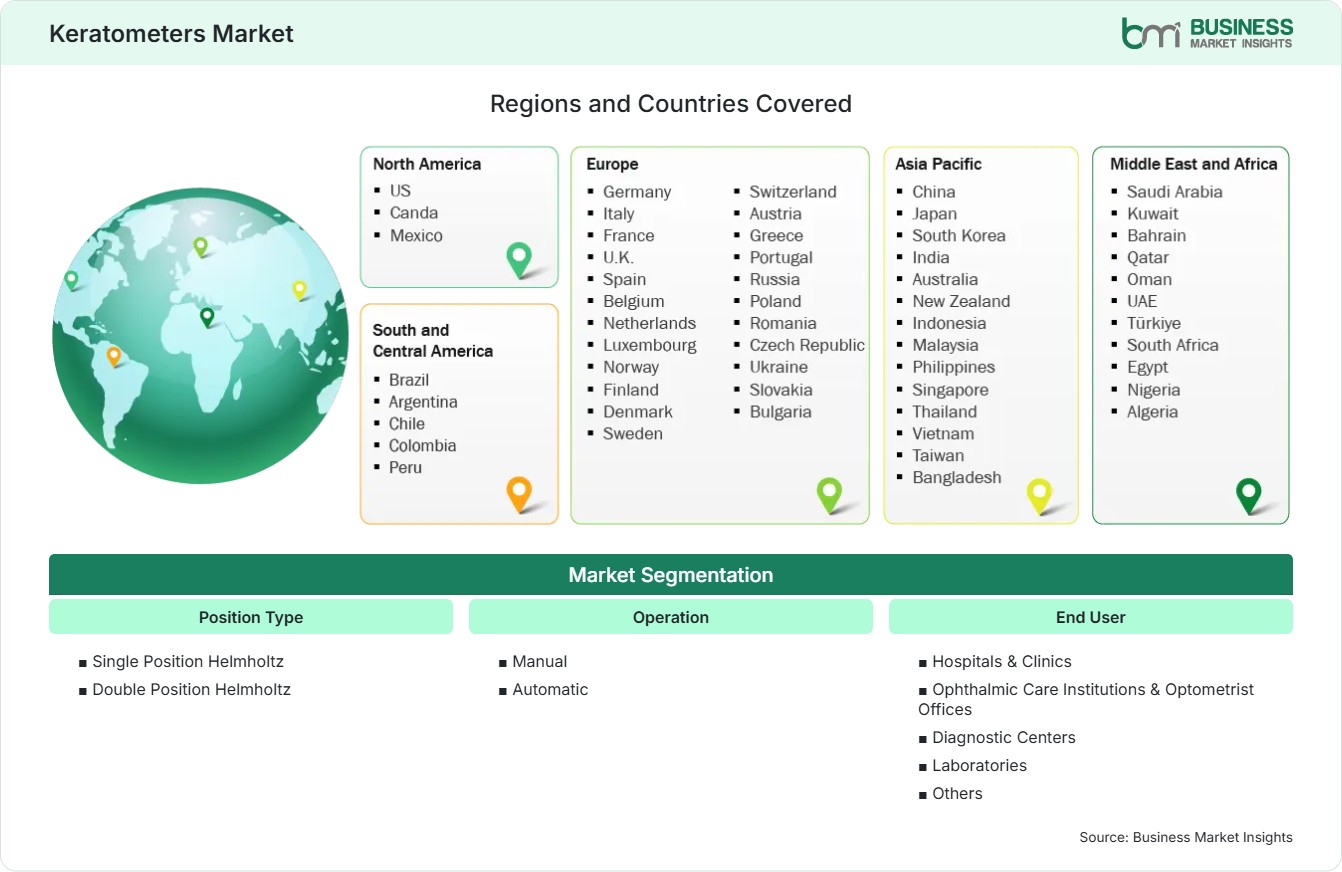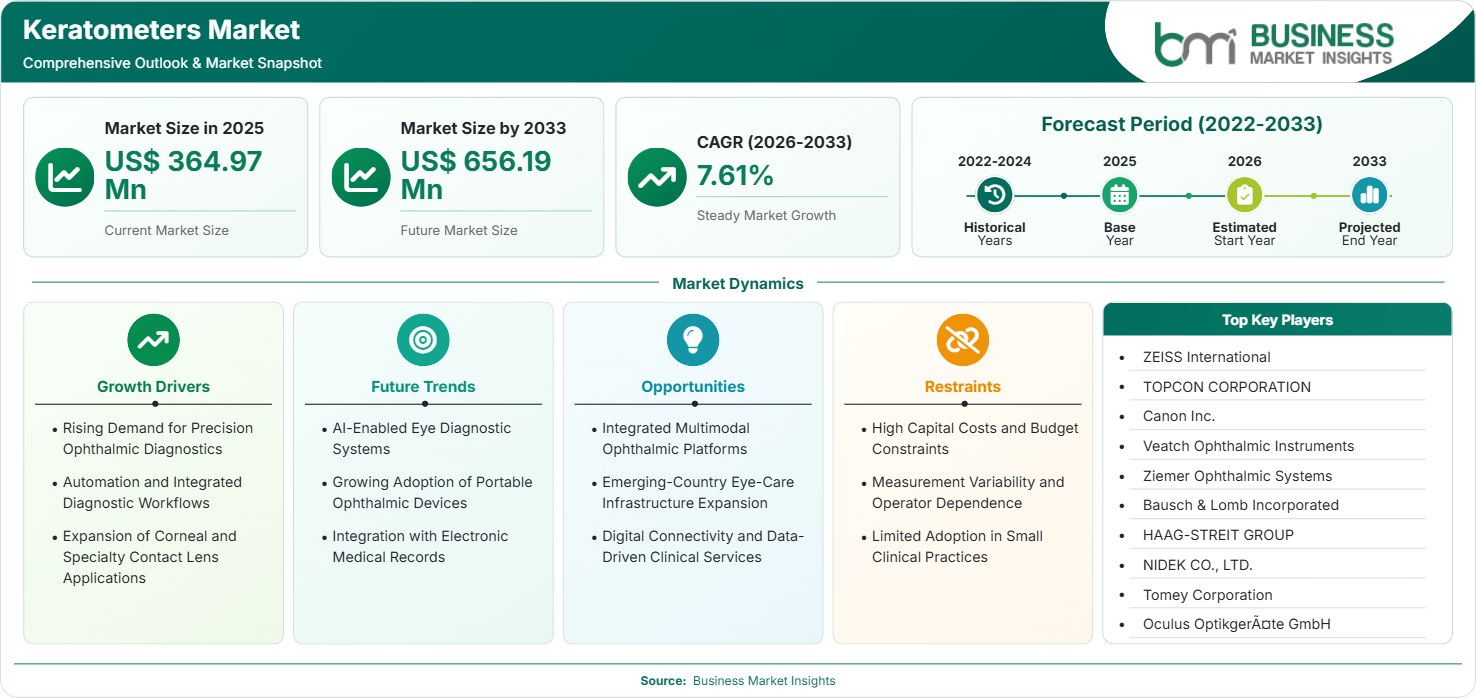
Keratometers Market Regional Highlights
North America Keratometers Market
North America accounts for a 34%–37% keratometers market share in 2025 and is projected to expand at a CAGR of 6.8%–7.2% during 2026–2033. Demand is supported by mature ophthalmic infrastructure, cataract surgery volumes, premium refractive procedures, replacement cycles, and digital workflow adoption. The United States remains the regional anchor, while Canada contributes through specialty optometry and ophthalmology practices.
- High demand for replacements necessitates automated machines with increased connectivity and small size as well as simple interface in order to handle large amounts of patients.
- Cataracts and refractive surgery planning increases the need for more accurate corneal measurements since doctors nowadays need such information in order to customize their treatment.
- Special contact lens fitting services require more corneal examination especially if dealing with keratoconus patients.
US Keratometers Market
The US represents 72%–76% of North American revenue in 2025 and is expected to grow at a CAGR of 6.7%–7.1% through 2033. The country benefits from advanced ambulatory surgical centers, established optometry networks, high technology penetration, and strong replacement demand. Adoption increasingly favors automated devices capable of supporting delegated pretesting and connected workflows. Topcon's OMNIA launch in 2025, integrating objective refraction, keratometry, tonometry, and pachymetry, illustrates the commercial emphasis on consolidated diagnostic workflows.
- The Keratometers Market is witnessing increasing adoption of multifunctional systems by independent optometry practices to expand diagnostic capabilities while reducing equipment footprint, improving workflow efficiency, and minimizing staff training requirements.
- Cataract and refractive surgery centers emphasize repeatability and connectivity, thus providing a window of opportunity for manufacturers that can provide automated alignment and data management solutions.
- The business case for reimbursement makes it important for surgeons to consider cost-effectiveness, services offered, and efficiency when choosing the equipment.
Europe Keratometers Market
Europe holds a 27%–30% share in 2025 and is forecast to register a CAGR of 7.0%–7.5% during 2026–2033. Germany, the United Kingdom, France, Italy, and Spain remain leading national markets, while Poland and selected Central European economies represent higher-growth opportunities. The keratometers market forecast suggest that an aging population, cataract treatment demand, established ophthalmic centers, and sophisticated diagnostic practices support adoption.
- Germany sets the pace for regional demand with regard to the infrastructure set up for ophthalmology, medical technologies, and use of advanced diagnostic tools in hospitals and clinics.
- The United Kingdom and France have replacement demand due to their developed ophthalmic networks, whereas automated diagnostic equipment becomes relevant when clinics need more efficiency in performing eye examinations.
- Poland is identified as an opportunity market with modernizing health care, growth of private ophthalmology and availability of advanced diagnostic equipment.
- Proximity to the clinical research network and ophthalmic centers in Europe is beneficial for European manufacturers.
Asia Pacific Keratometers Market
Asia Pacific holds a 24%–27% share in 2025 and is projected to expand at a CAGR of 8.7%–9.3%, making it the fastest-growing regional opportunity. China, Japan, South Korea, and India lead current demand, while India and Southeast Asian economies offer stronger growth prospects. Rising ophthalmic infrastructure, increasing myopia prevalence, cataract care requirements, urbanization, and private hospital expansion are accelerating investment in diagnostic equipment and automated clinical workflows.
- China leads regional scale through extensive hospital infrastructure, expanding private eye-care networks, and demand for technologies supporting cataract and refractive procedures.
- Japan remains a mature technology keratometers market with strong demand for precision instruments, replacement equipment, and compact systems suited to sophisticated ophthalmic practices.
- India represents a high-growth opportunity as healthcare infrastructure expands and providers address gaps in eye-care workforce and diagnostic capacity.
- South Korea combines advanced healthcare infrastructure with technology-oriented clinical environments, supporting adoption of integrated imaging and measurement platforms.
Rest of World Keratometers Market
South and Central America account for a growing portion of demand as private hospitals, ophthalmology chains, and specialty clinics modernize diagnostic capabilities. Brazil leads regional adoption, while Mexico and Colombia provide additional opportunities. The broader regional CAGR is estimated at 6.5%–7.2%, supported by cataract care, refractive services, and improved access to specialized eye-care technologies.
- Brazil benefits from a large patient base, established ophthalmic practices, and expanding private healthcare investment in advanced diagnostic equipment.
- Mexico and Colombia offer opportunities through private clinic modernization, increasing specialty care capacity, and broader distribution of imported ophthalmic technologies.
- South Africa remains an important regional keratometers market for specialist eye care, with opportunities linked to private healthcare networks and advanced diagnostic service delivery.