Kaolin Market Regional Highlights
North America Kaolin Market
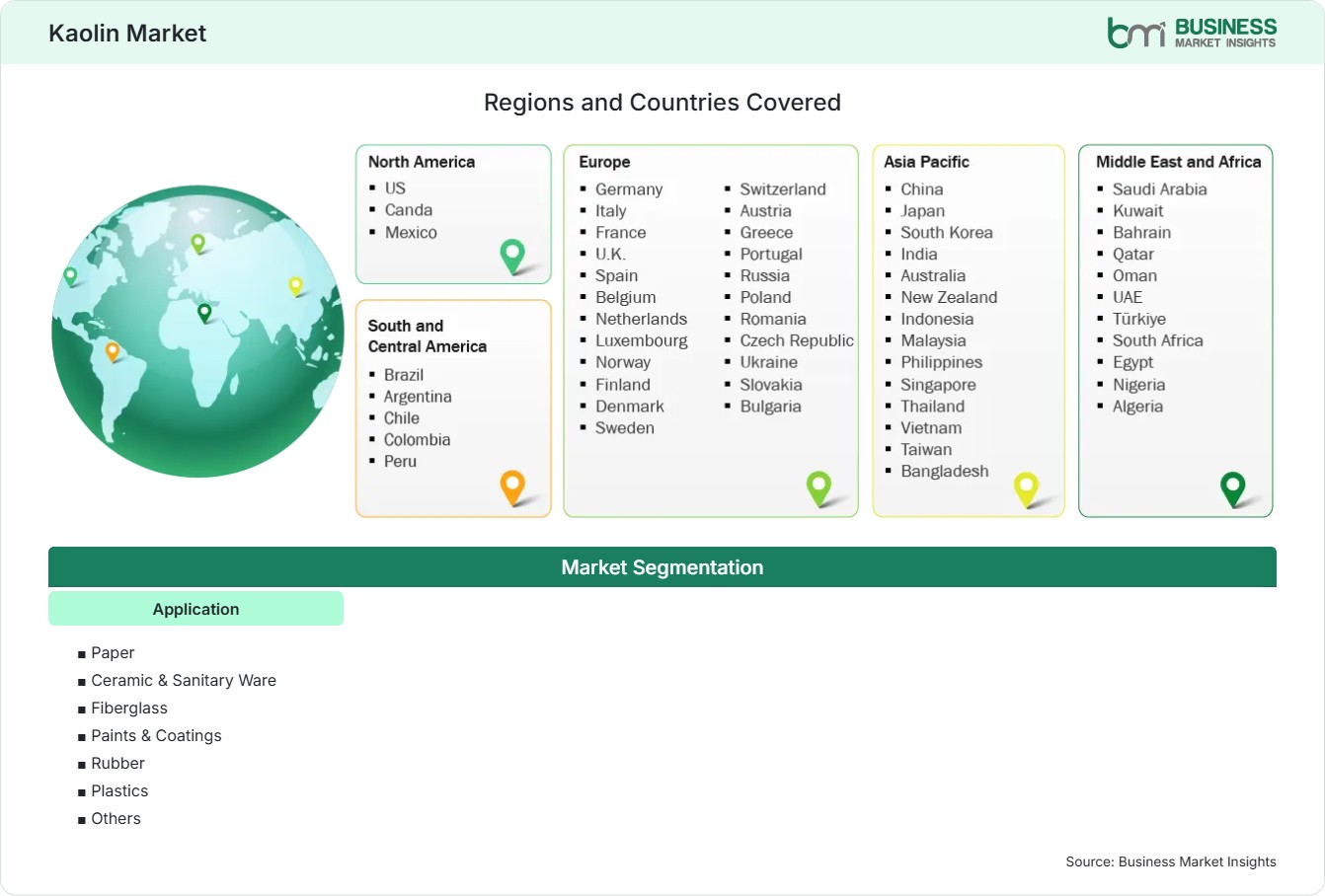
North America accounted for a 24%–27% share in 2025 and is projected to grow at a CAGR of 5.10%–5.80% during 2026–2033. The region benefits from established mineral processing infrastructure, strong paper manufacturing capabilities, and increasing demand for specialty fillers. Kaolin Market share expansion is supported by packaging trends, construction coatings, and technological improvements in processing facilities across the United States and Canada.
- The United States remains the dominant contributor due to established paper coating industries, rising demand for sustainable packaging materials, and continuous investments in advanced mineral processing technologies.
- Canada supports regional growth through abundant mineral resources, improved extraction capabilities, and increasing adoption of refined clay products in industrial manufacturing applications.
- Specialty-grade kaolin demand is increasing among coating manufacturers seeking enhanced brightness, dispersion properties, and performance improvements for premium industrial formulations.
- Sustainable mining initiatives and regulatory compliance investments are encouraging producers to optimize resource utilization and reduce environmental impacts across extraction operations.
US Kaolin Market
The US accounted for a 19%–22% share in 2025 within North America and is estimated to expand at a CAGR of 5.20%–5.60% during 2026–2033. The country benefits from strong paper, ceramics, and coatings industries supported by domestic mineral processing capabilities. Kaolin Market growth in the US is driven by packaging demand, infrastructure development, and adoption of high-performance mineral additives.
- Domestic paper manufacturers continue adopting refined kaolin grades for coating applications that improve printability, surface quality, and product durability across packaging and publishing sectors.
- Construction activity supports demand for kaolin-based paints and coatings, particularly in applications requiring improved opacity, texture control, and weather resistance.
- Research investments in mineral modification technologies are enabling suppliers to develop customized kaolin solutions for plastics, rubber, and industrial applications.
- The US market is witnessing increased focus on responsible sourcing practices and efficient processing methods to align with environmental expectations.
Europe Kaolin Market
Europe represented a 21%–24% share in 2025 and is expected to register a CAGR of 5.40%–6.10% during 2026–2033. Germany, the United Kingdom, and the Czech Republic remain important markets due to ceramic manufacturing, paper production, and advanced industrial applications. Market share growth is supported by specialty mineral demand, sustainable mining approaches, and regional manufacturing capabilities.
- Germany demonstrates strong demand from ceramic, coating, and industrial material producers requiring consistent-quality mineral inputs for advanced manufacturing processes.
- The Czech Republic maintains a significant position through established kaolin extraction activities and applications in ceramics, sanitary ware, and construction materials.
- The United Kingdom supports demand through packaging, specialty coatings, and industrial filler applications requiring high-performance mineral characteristics.
- European producers are adopting cleaner processing technologies to comply with stricter environmental standards and improve operational efficiency.
- Innovation in engineered mineral products is creating opportunities for suppliers targeting premium-value industrial applications.
Asia Pacific Kaolin Market
Asia Pacific held the largest share of 38%–41% in 2025 and is projected to expand at a CAGR of 6.80%–7.40% during 2026–2033. China, India, and Southeast Asian countries drive demand through ceramic production, infrastructure expansion, and industrial manufacturing growth. The region’s Kaolin Market trends reflect increasing consumption of refined mineral products across construction, paper, and coatings sectors.
- China remains a major consumer due to extensive ceramic manufacturing capacity, paper production volumes, and expanding industrial coating applications.
- India is experiencing rising demand from construction, paints, ceramics, and fiberglass industries supported by infrastructure development and manufacturing expansion.
- Southeast Asian economies are increasing kaolin utilization through growing construction activities, urbanization, and industrial production investments.
- Regional producers are expanding processing facilities to supply higher-purity grades for specialized applications and reduce dependency on imports.
- Technological improvements in mineral beneficiation are supporting quality enhancement and broader industrial adoption across emerging markets.
Rest of World Kaolin Market
South and Central America, along with the Middle East and Africa, accounted for a 10%–13% share in 2025 and are expected to grow at a CAGR of 5.70%–6.50% during 2026–2033. Brazil, Mexico, Saudi Arabia, and South Africa contribute through ceramic manufacturing, construction development, and industrial material demand. Growing infrastructure investments are strengthening regional consumption.
The Rest of World segment is benefiting from increasing construction activity, expanding manufacturing bases, and rising investments in mineral processing capabilities. Market share improvement in these regions is supported by domestic resource availability, industrial diversification, and adoption of advanced mineral applications.
- Brazil demonstrates growth potential due to ceramic production capacity, construction expansion, and availability of mineral resources supporting local industries.
- Middle Eastern countries are increasing demand through infrastructure projects, decorative coatings, and construction material applications requiring mineral fillers.
- South Africa contributes through industrial applications, mineral processing expertise, and growing demand from manufacturing sectors.
- Mexico benefits from automotive coatings, construction materials, and industrial production requiring high-quality mineral additives.
- Regional investments in processing infrastructure are improving supply capabilities and enabling access to specialized kaolin grades.