Insulated Concrete Form Market Outlook (2022-2033)

Historic Data: 2022-2024   |   Base Year: 2025   |   Forecast Period: 2026-2033
Report Content: Market Scope, Market Segmentation, Market Dynamics, and Competitive Analysis

Report Coverage:
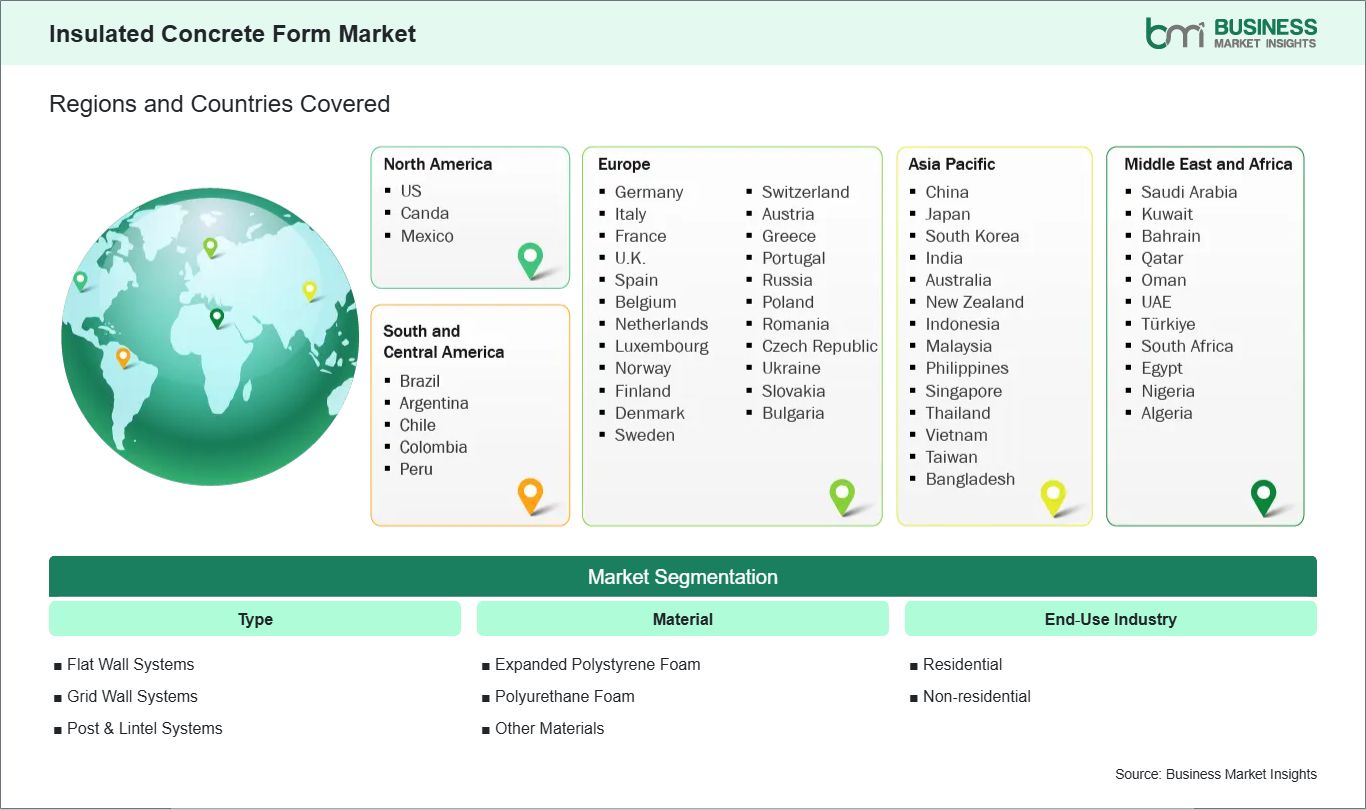
  • Type (Flat Wall Systems, Grid Wall Systems, Post & Lintel Systems)
  • Material (Expanded Polystyrene Foam, Polyurethane Foam, Other Materials)
  • End-Use Industry (Residential, Non-residential)

No. of Pages: 386
Report Code: BMIPUB00033995
Category: Chemicals and Materials
Insulated Concrete Form Market

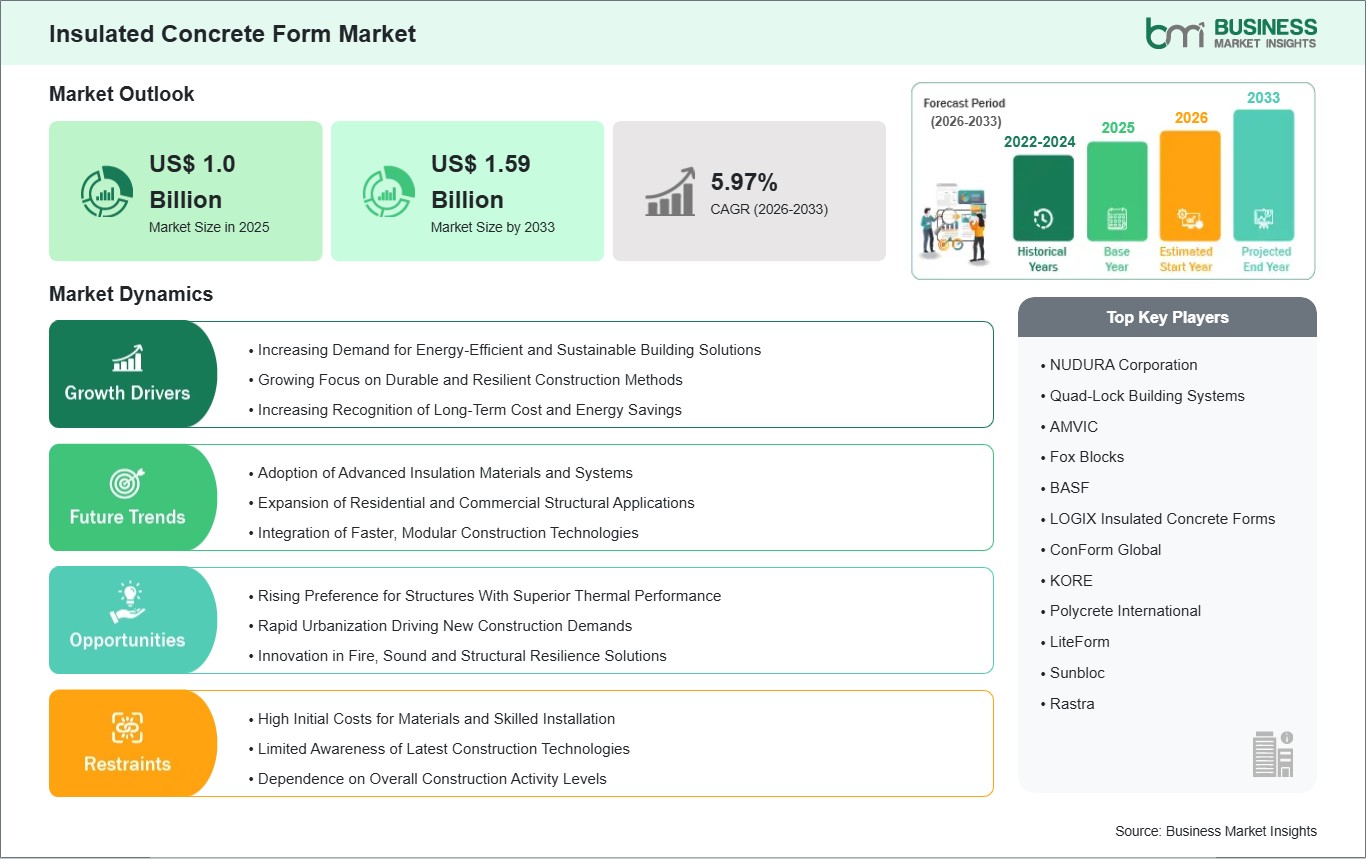
The Insulated Concrete Form Market size is expected to reach US$ 1.59 Billion by 2033 from US$ 1.0 Billion in 2025. The market is estimated to record a CAGR of 5.97% from 2026 to 2033.

Executive Summary and Global Market Analysis:

The global insulated concrete form market is an advanced form of modern construction technology, which offers structural benefits of concrete with thermal benefits of rigid insulation. ICF stands for Insulated Concrete Forms, which are blocks used to construct buildings. These blocks are permanent molds for concrete. They provide superior energy efficiency, sound insulation, and durability compared to other building materials. This advanced construction technology is increasingly being used in building residential, commercial, and institutional buildings, as it meets the growing demands of energy efficiency, sustainability, and building performance. What attracts people to ICF is not only its ability to provide structurally strong buildings, but also its potential to provide energy savings and comfort. In addition, with sustainability and green building practices becoming an integral part of modern construction globally, ICF is being considered an advanced technology with its focus on sustainability, which aligns with modern architectural trends and construction techniques.

Nonetheless, there are a number of challenges that may affect the growth of the market in certain regions. To start with, the initial cost of ICF products is considered higher than that of conventional construction products. This may, in turn, affect the adoption of ICF products in certain regions where costs are a major concern. In addition, the ICF construction technique requires specialized labor skills for proper installation. However, there are concerns that a lack of skilled labor may affect the adoption of ICF products, especially in regions where conventional construction techniques are dominant. Although there have been significant improvements in the designs of ICF products, this may not be compatible with conventional construction. Therefore, there may be a number of challenges that may affect the growth of the global insulated concrete form market. The balance between the initial and long-term benefits of ICF products will continue to influence the growth of the global insulated concrete form market.

Insulated Concrete Form Market - Strategic Insights:

global-market-strategic-framework
Get more information on this report

Insulated Concrete Form Market Segmentation Analysis:

Key segments that contributed to the derivation of the insulated concrete form market analysis are type, material, and end‑use industry.

  • By type, the insulated concrete form market is segmented into flat wall systems, grid wall systems, and post & lintel systems. The flat wall systems subsegment dominated the market in 2025.
  • Based on material, the insulated concrete form market is classified into expanded polystyrene foam, polyurethane foam, and other materials. The expanded polystyrene foam subsegment dominated the market in 2025.
  • In terms of end‑use industry, the insulated concrete form market is divided into residential and non‑residential sectors. The residential subsegment dominated the market in 2025.

Insulated Concrete Form Market Drivers and Opportunities:

Increasing Demand for Energy-Efficient and Sustainable Building Solutions

The insulated concrete form market has been expanding rapidly as the construction sector prioritizes energy efficiency and sustainability in both residential and commercial projects. ICF systems, which combine reinforced concrete with high-performance insulation, are increasingly recognized for their ability to reduce energy consumption throughout a building’s lifecycle. In regions where energy costs are high and environmental regulations are stringent, developers and architects are turning to ICFs to achieve buildings that minimize heating and cooling demands while providing long-term operational savings. This demand is particularly strong in areas with a focus on green building certifications and sustainable urban development initiatives, where energy-efficient construction materials are actively incentivized.

The sustainability trends are also increasing the adoption of ICFs. In developing countries in the process of rapid urbanization, there is an increasing focus on building structures that are long-lasting and require little maintenance. ICFs are helping in this direction because they offer the structural strength of reinforced concrete and the insulation of rigid foam. The buildings constructed with ICFs are not only energy-efficient but also long-lasting. Furthermore, the adoption of ICFs is also in line with the increasing focus on reducing the carbon footprint in the construction industry because the materials used in ICFs can actually minimize the environmental impact.

The global push toward environmentally conscious construction is also reflected in building codes and policy incentives that encourage the use of energy-efficient building materials. Governments, industry associations, and sustainability-focused organizations are increasingly promoting the adoption of ICF technology through certification programs, tax incentives, and technical guidelines. These initiatives have boosted market confidence, leading contractors, developers, and investors worldwide to consider ICF as a preferred material for modern construction projects. As energy efficiency remains a primary concern in building design, the market for insulated concrete forms is expected to continue growing, driven by both environmental objectives and economic advantages over traditional construction techniques.

Rising Preference for Structures With Superior Thermal Performance

Thermal performance is becoming a key factor influencing construction material selection, and insulated concrete forms have emerged as a leading solution for creating buildings with superior insulation and indoor comfort. ICFs offer continuous insulation without thermal bridging, which enhances energy efficiency while providing consistent indoor temperatures. In regions with extreme climatic conditions whether very hot or very cold the demand for buildings that maintain comfortable interior environments year-round has driven the adoption of ICFs. Developers and designers are increasingly leveraging ICF systems to meet stringent thermal performance standards in residential, commercial, and institutional construction.

The ability of ICFs to enhance both thermal and acoustic performance has contributed to their rising preference in modern construction. Beyond reducing energy usage, ICF walls offer sound insulation and structural integrity, making them ideal for multifamily housing, schools, hospitals, and other high-performance buildings. In urban centers with high-density development, buildings constructed with ICFs can significantly reduce noise pollution and improve occupant comfort, giving this construction method a competitive edge over traditional masonry or wood-frame structures. As awareness of building performance metrics grows, designers are specifying ICF systems to achieve both energy efficiency and enhanced occupant experience.

In addition to thermal benefits, the versatility of ICFs has contributed to their global adoption. The modular nature of these forms allows for faster construction, reduced labor costs, and greater design flexibility, all while maintaining high thermal performance. Developers seeking resilient, low-maintenance, and energy-efficient solutions are increasingly integrating ICFs into new construction and retrofit projects. As building codes evolve to prioritize energy efficiency and sustainability, the global construction market is expected to continue embracing insulated concrete forms as a reliable method for delivering superior thermal performance and long-term value in both commercial and residential developments.

Insulated Concrete Form Market Size and Share Analysis:

The insulated concrete formmarket is experiencing steady growth, with market size and share analysis reflecting evolving treatment preferences and competitive dynamics among key players. The report evaluates important subsegments categorized within type, material, and end‑use industry, highlighting their respective contributions to overall market performance.

By type, the flat wall systems subsegment dominated the insulated concrete form market in 2025. Flat wall systems offer ease of construction, structural stability, and efficient thermal insulation, driving their widespread adoption in building projects.

Based on material, the expanded polystyrene foam subsegment dominated the insulated concrete form market in 2025. Expanded polystyrene foam provides excellent insulation, lightweight properties, and cost-effectiveness, supporting strong demand in the construction sector.

In terms of end-use industry, the residential subsegment dominated the insulated concrete form market in 2025. Residential construction benefits from enhanced energy efficiency, durability, and faster building times, reinforcing the prominence of this segment.

Insulated Concrete Form Market Report Highlights:

Report Attribute Details
Market size in 2025 US$ 1.0 Billion
Market Size by 2033 US$ 1.59 Billion
Global CAGR (2026 - 2033)5.97%
Historical Data 2022-2024
Forecast period 2026-2033
Segments Covered By Type
  • Flat Wall Systems
  • Grid Wall Systems
  • Post & Lintel Systems
By Material
  • Expanded Polystyrene Foam
  • Polyurethane Foam
  • Other Materials
By End-Use Industry
  • Residential
  • Non-residential
Regions and Countries Covered
North America US, Canada, Mexico
Europe Belgium, Austria, Finland, Denmark, Greece, Poland, Romania, Russia, Ukraine, Czech Republic, Slovakia, Bulgaria, Italy, Luxembourg, Germany, Switzerland, France, Netherlands, Norway, Portugal, Spain, Sweden, United Kingdom
Asia-Pacific Australia, China, India, Japan, South Korea, Indonesia, Malaysia, Philippines, Singapore, Thailand, Vietnam, Bangladesh, New Zealand, Taiwan
South and Central America Brazil, Argentina, Peru, Chile, Colombia
Middle East and Africa Bahrain, Kuwait, Oman, Qatar, Saudi Arabia, United Arab Emirates, Turkiye, South Africa, Egypt, Algeria, Nigeria
Market leaders and key company profiles
  • NUDURA Corporation
  • Quad-Lock Building Systems
  • AMVIC
  • Fox Blocks
  • BASF
  • LOGIX Insulated Concrete Forms
  • ConForm Global
  • KORE
  • Polycrete International
  • LiteForm
  • Sunbloc
  • Rastra
  • SuperForm Products
  • Durisol
  • Beco Products
Get more information on this report

Insulated Concrete Form Market Report Coverage and Deliverables:

The "Insulated Concrete Form Market Size and Forecast (2022 - 2033)" report provides a detailed analysis of the market covering below areas:

  • Insulated Concrete Form market size and forecast at global, regional, and country levels for all the key market segments covered under the scope
  • Insulated Concrete Form market trends, as well as drivers, restraints, and opportunities
  • Insulated Concrete Form market analysis covering key trends, regional framework, major players, regulations, and recent developments
  • Industry landscape and competition analysis covering market concentration, heat map analysis, prominent players, and recent developments for the Insulated Concrete Form market
  • Detailed company profiles, including SWOT analysis

Insulated Concrete Form Market Geographic Insights:

The geographical scope of the Insulated Concrete Form market report is divided into five regions: North America, Asia Pacific, Europe, Middle East & Africa, and South & Central America. The Insulated Concrete Form market in North America is expected to grow during the forecast period.

The regional market that is dominated by insulated concrete form construction is North America. This is attributed to both technology adoption and industry demand. The United States and Canada have been at the forefront in adopting insulated concrete form construction. This is attributed to increasing knowledge about energy-saving construction techniques, eco-friendly construction, and the need for construction that is resistant to climatic changes. Insulated concrete form construction is widely used in building residential homes, commercial buildings, and other infrastructure in North America. The preference for energy-efficient materials, combined with stringent building standards and codes, has strengthened the appeal of ICF as a solution that delivers both immediate and long-term benefits in building performance and operational cost savings.

Another significant driver of North America’s market leadership is the region’s focus on disaster-resilient construction. ICF structures provide exceptional durability, fire resistance, and impact resistance, making them well-suited for areas prone to extreme weather events such as hurricanes, heavy snow, and high winds. Advances in product design, including improved interlocking systems, lightweight insulating materials, and ease of installation, have further reinforced adoption. Additionally, training programs for contractors, broader availability of skilled labor, and strong distribution networks make North America a hub for innovation in ICF applications. The combined effect of regulatory emphasis, performance advantages, and growing expertise in installation positions the region not only as the largest market but also as a benchmark for global best practices in insulated concrete form construction.

global-market-geography
Get more information on this report

Insulated Concrete Form Market Research Report Guidance:

  • The report includes qualitative and quantitative data in the Insulated Concrete Form market across type, material, end‑use industry, and geography.
  • The report starts with the key takeaways (chapter 2), highlighting the key trends and outlook of the Insulated Concrete Form market.
  • Chapter 3 focuses on the research methodology of the study.
  • Chapter 4 includes ecosystem analysis.
  • Chapter 5 highlights the major industry dynamics in the Insulated Concrete Form market, including factors that are driving the market, prevailing deterrents, potential opportunities, as well as future trends. Impact analysis of these drivers and restraints is also covered in this section.
  • Chapter 6 discusses the Insulated Concrete Form  market scenario, in terms of historical market revenues, and forecast till the year 2033.
  • Chapters 7 to 10 cover the Insulated Concrete Form market segments by type, material, end‑use industry, and geography across North America, Europe, Asia Pacific, Middle East and Africa, and South and Central America. They cover the market volume, revenue forecast, and factors driving the market.
  • Chapter 11 describes the competitive analysis with the heat map analysis for the key players operating in the market.
  • Chapter 12 describes the industry landscape analysis. It provides detailed descriptions of business activities such as market initiatives, new developments, mergers, and joint ventures globally, along with a competitive landscape.
  • Chapter 13 provides detailed profiles of the major companies operating in the Insulated Concrete Form market. Companies have been profiled on the basis of their key facts, business descriptions, products, financial overview, SWOT analysis, and key developments.
  • Chapter 14, i.e., the appendix, is inclusive of a brief overview of the company, list of abbreviations, and disclaimer.

Insulated Concrete Form Market News and Key Development:

The insulated concrete form market is evaluated by gathering qualitative and quantitative data post primary and secondary research, which includes important corporate publications, association data, and databases. A few of the key developments in the insulated concrete form market are:

  • In October 2023, Amvic Inc. published a new Environmental Product Declaration (EPD) for its insulated concrete formwork products, disclosing lifecycle environmental impacts (production, transport, assembly, end‑of‑life) for key ICF panel sizes and reinforcing its commitment to sustainability and transparency in energy‑efficient construction materials.
  • In January 2023, Amvic Inc. announced that it had joined the Insulating Concrete Forms Manufacturers Association (ICFMA) as a primary member, bringing its years of ICF expertise to a broader industry advocacy and collaboration platform aimed at increasing awareness about energy‑efficient ICF construction technologies globally.

Key Sources Referred:

  • World Bank
  • World Health Organization (WHO)
  • S. Occupational Safety and Health Administration (OSHA)
  • European Commission - Construction & Built Environment
  • International Trade Centre (ITC)
  • Engineering News-Record (ENR)
  • Building Design + Construction (BD+C)
  • Company Websites
  • Company Annual Reports
  • Company Investor Presentations
The List of Companies - Insulated Concrete Form Market
  • NUDURA Corporation
  • Quad-Lock Building Systems
  • AMVIC
  • Fox Blocks
  • BASF
  • LOGIX Insulated Concrete Forms
  • ConForm Global
  • KORE
  • Polycrete International
  • LiteForm
  • Sunbloc
  • Rastra
  • SuperForm Products
  • Durisol
  • Beco Products
Frequently Asked Questions
How big is the Insulated Concrete Form Market?

The Insulated Concrete Form Market is valued at US$ 1.0 Billion in 2025, it is projected to reach US$ 1.59 Billion by 2033.

What is the CAGR for Insulated Concrete Form Market by (2026 - 2033)?

As per our report Insulated Concrete Form Market, the market size is valued at US$ 1.0 Billion in 2025, projecting it to reach US$ 1.59 Billion by 2033. This translates to a CAGR of approximately 5.97% during the forecast period.

What segments are covered in this report?

The Insulated Concrete Form Market report typically cover these key segments-

  • Type (Flat Wall Systems, Grid Wall Systems, Post & Lintel Systems)
  • Material (Expanded Polystyrene Foam, Polyurethane Foam, Other Materials)
  • End-Use Industry (Residential, Non-residential)

What is the historic period, base year, and forecast period taken for Insulated Concrete Form Market?

The historic period, base year, and forecast period can vary slightly depending on the specific market research report. However, for the Insulated Concrete Form Market report:

  • Historic Period : 2022-2024
  • Base Year : 2025
  • Forecast Period : 2026-2033
  • Who are the major players in Insulated Concrete Form Market?

    The Insulated Concrete Form Market is populated by several key players, each contributing to its growth and innovation. Some of the major players include:

  • NUDURA Corporation
  • Quad-Lock Building Systems
  • AMVIC
  • Fox Blocks
  • BASF
  • LOGIX Insulated Concrete Forms
  • ConForm Global
  • KORE
  • Polycrete International
  • LiteForm
  • Sunbloc
  • Rastra
  • SuperForm Products
  • Durisol
  • Beco Products
  • Who should buy this report?

    The Insulated Concrete Form Market report is valuable for diverse stakeholders, including:

    • Investors: Provides insights for investment decisions pertaining to market growth, companies, or industry insights. Helps assess market attractiveness and potential returns.
    • Industry Players: Offers competitive intelligence, market sizing, and trend analysis to inform strategic planning, product development, and sales strategies.
    • Suppliers and Manufacturers: Helps understand market demand for components, materials, and services related to concerned industry.
    • Researchers and Consultants: Provides data and analysis for academic research, consulting projects, and market studies.
    • Financial Institutions: Helps assess risks and opportunities associated with financing or investing in the concerned market.

    Essentially, anyone involved in or considering involvement in the Insulated Concrete Form Market value chain can benefit from the information contained in a comprehensive market report.

    Available Report Formats

    pdf-format excel-format pptx-format
    Buy Now
    Sales Assistance
    +1 646 791 7070 (US & UK)
    Customization Form

    Please tell us your area of interest
    (Market Segments/ Regions and Countries/ Companies)