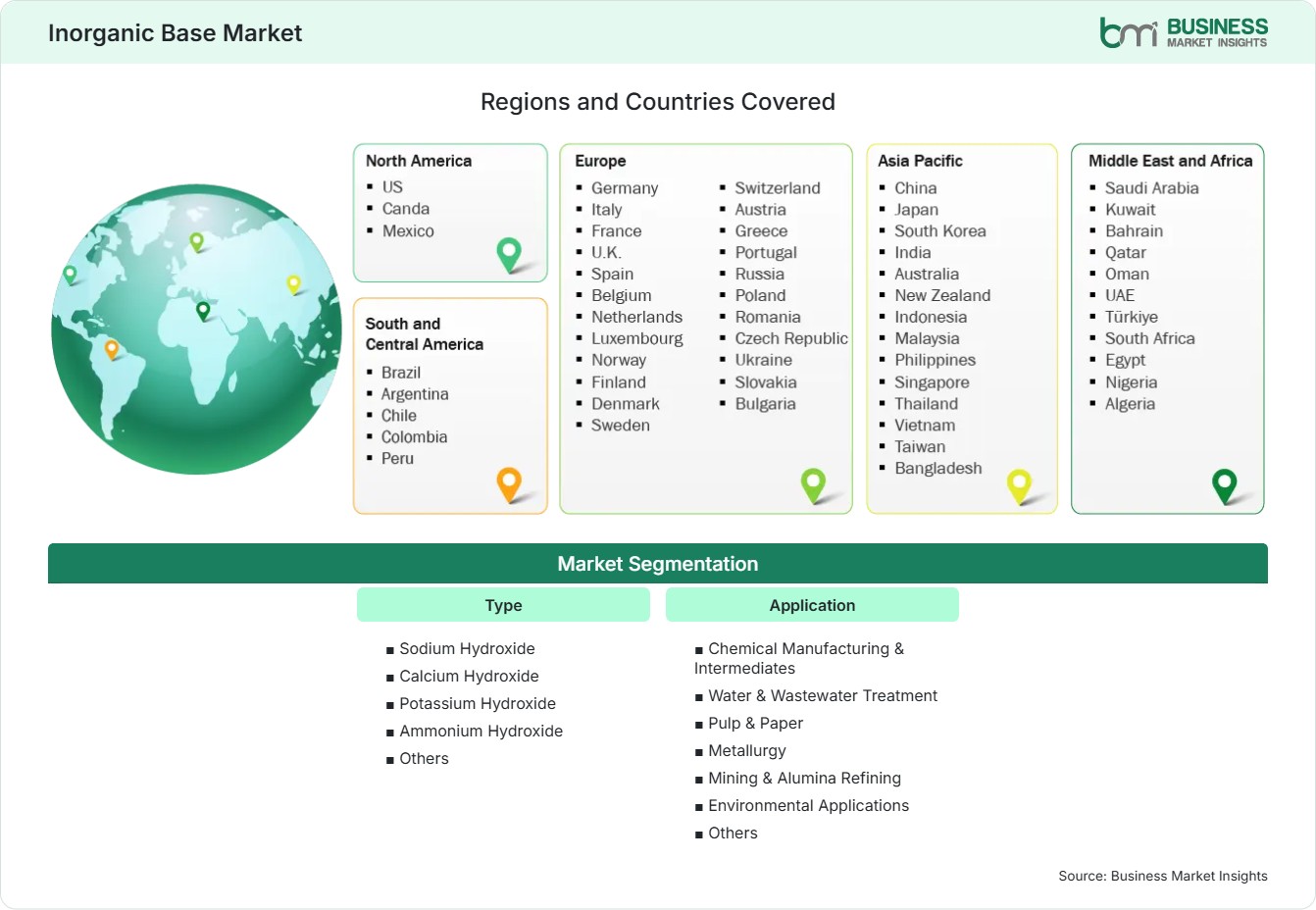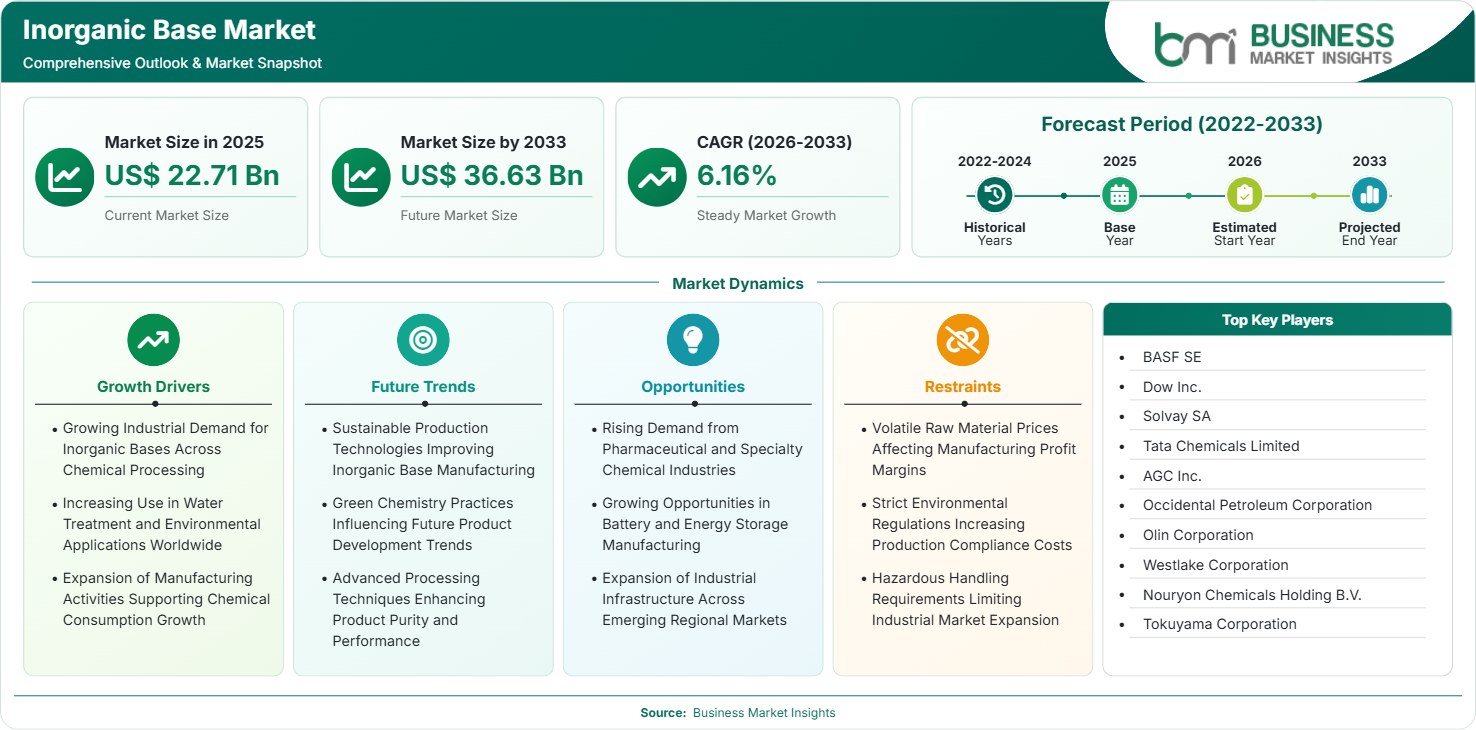
Inorganic Base Market Regional Highlights
North America Inorganic Base Market
North America accounted for a 24%–28% share in 2025 and is projected to grow at a 5.5%–6.5% CAGR during 2026–2033. The US dominates regional consumption through chemical manufacturing, water treatment, pulp and paper, and industrial processing. Canada contributes through mining, metallurgy, pulp and paper, and resource industries. The region also benefits from investment in domestic manufacturing, battery materials, and infrastructure modernization, supporting long-term chemical demand.
- Established chemical production clusters create consistent consumption of sodium hydroxide, potassium hydroxide, and other inorganic bases used across intermediates, specialty chemicals, and industrial processing.
- Aging water infrastructure and stricter wastewater requirements support demand for alkaline treatment chemicals used in pH adjustment, neutralization, sludge processing, and contaminant management.
- Expanding battery supply chains are creating emerging demand for inorganic bases in material processing, chemical preparation, recycling, and associated industrial production activities.
- Domestic manufacturing investment is supporting demand from metals, machinery, pharmaceuticals, and advanced materials industries, strengthening localized chemical supply requirements.
US Inorganic Base Market
The US inorganic base market represented a 20%–24% share in 2025 and is expected to expand at a 5.5%–6.5% CAGR through 2033. Demand is supported by large-scale chemical production, water and wastewater treatment, pulp and paper, petroleum processing, and industrial manufacturing. Pharmaceutical and specialty chemical expansion provides opportunities for higher-purity products. Battery manufacturing investment is creating additional downstream demand, while domestic supply chain development supports localized production and distribution.
- A large domestic chemical manufacturing base creates broad demand for inorganic bases across intermediates, processing operations, pH control, and industrial formulation applications.
- Municipal and industrial wastewater treatment requirements support recurring consumption of alkaline chemicals for neutralization, pH adjustment, and treatment process optimization.
- Increasing investment in domestic battery manufacturing and material processing is creating emerging opportunities for high-purity inorganic base applications across production and recycling processes.
Europe Inorganic Base Market
Europe held a 20%–24% share in 2025 and Europe inorganic base market forecast to register a 4.5%–5.5% CAGR through 2033. Germany leads regional demand through chemicals, manufacturing, pharmaceuticals, and industrial processing. France and Italy remain important consumers, while Poland is projected to grow at a 6.0%–7.0% CAGR as industrial development and manufacturing localization continue. Environmental compliance and energy efficiency increasingly influence production investments and product sourcing.
- Germany's extensive chemical and industrial manufacturing base supports steady consumption across chemical intermediates, water treatment, pharmaceuticals, and specialized processing applications.
- European pharmaceutical manufacturing requires reliable supplies of high-purity inorganic bases, supporting specialized product opportunities and encouraging stronger quality and traceability standards.
- Poland's expanding manufacturing and industrial infrastructure are creating incremental demand for inorganic bases across chemical production, water treatment, metals, and industrial processing.
- Stringent environmental policies encourage producers to improve energy efficiency, emissions management, waste reduction, and process optimization throughout inorganic chemical production.
Asia Pacific Inorganic Base Market
Asia Pacific captured a 43%–47% share in 2025 and is expected to achieve a 7.0%–8.0% CAGR through 2033, making it the largest and fastest-growing regional market. China leads consumption through chemicals, alumina refining, pulp and paper, and manufacturing. India is projected to grow at a 8.0%–9.0% CAGR, supported by industrial expansion, pharmaceuticals, water infrastructure, and specialty chemical production. Southeast Asia provides additional growth opportunities.
- China's extensive chemical, alumina, pulp and paper, mining, and manufacturing industries generate substantial consumption of sodium hydroxide and other inorganic bases.
- India's expanding chemical, pharmaceutical, textile, water treatment, and manufacturing sectors are increasing demand for inorganic bases across diverse industrial applications.
- Indonesia, Vietnam, and Thailand are attracting manufacturing investment, supporting incremental demand for chemical processing, water treatment, pulp and paper, and industrial applications.
- Expanding regional battery and energy storage ecosystems are creating new opportunities for inorganic bases used in material preparation and associated manufacturing processes.
Rest of World Inorganic Base Market
South and Central America represented a 6%–9% share in 2025 and are expected to grow at a 5.5%–6.5% CAGR through 2033, supported by mining, pulp and paper, agriculture, and water treatment. Middle East and Africa accounted for a 5%–8% share, expanding at a 5.0%–6.0% CAGR. Brazil leads regional demand, while Saudi Arabia and the UAE benefit from industrial diversification and infrastructure investment.
- Brazil's mining, pulp and paper, chemicals, and industrial processing sectors provide consistent demand for inorganic bases used across production and environmental applications.
- Mining and metals processing across Latin America and Africa support consumption of alkaline chemicals for mineral processing, pH control, and metallurgical operations.
- Saudi Arabia and the UAE are expanding downstream chemical and industrial manufacturing capabilities, creating opportunities for localized inorganic base consumption.
- Water scarcity and infrastructure development across the Middle East support demand for treatment chemicals used in municipal and industrial water management.