
Industrial Solvents Market Outlook: Size, Share, Trends, Growth Analysis, Competitive Landscape & Forecast, 2026-2033

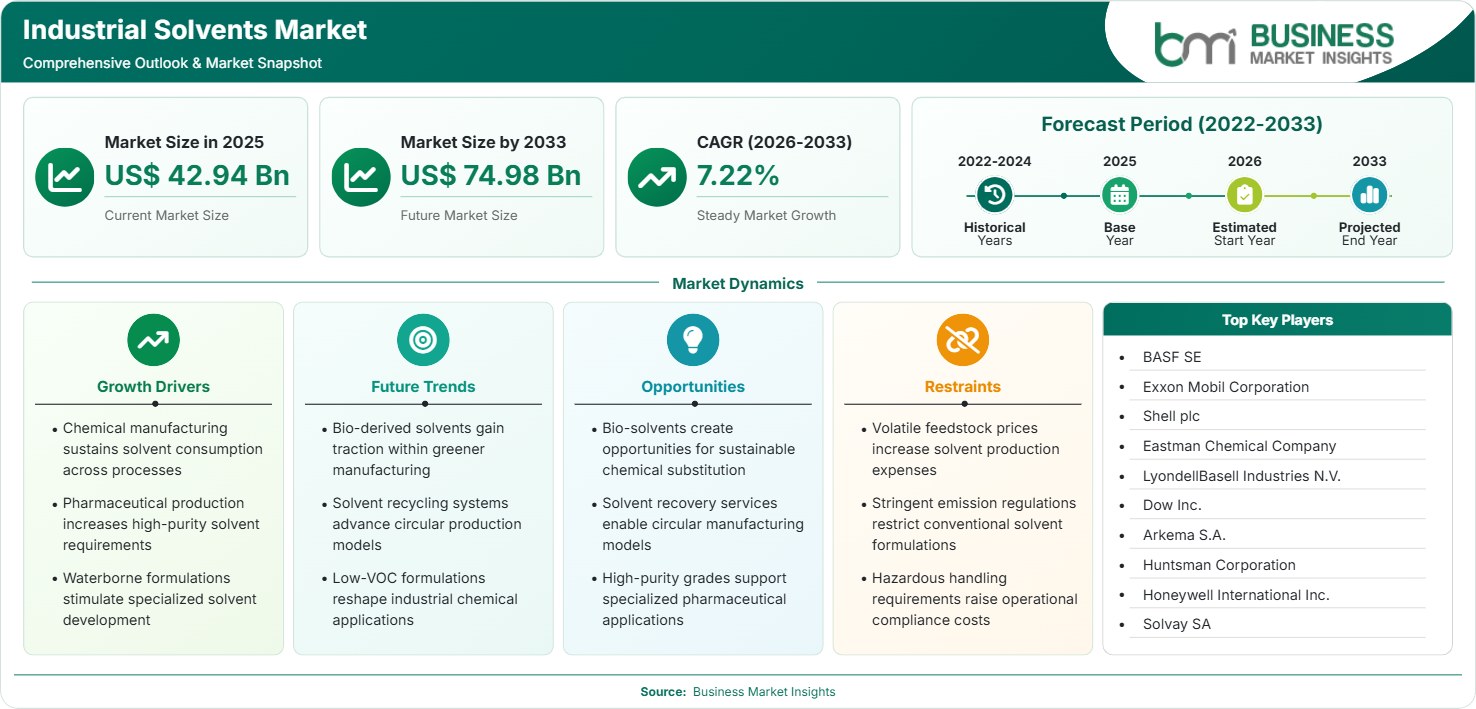
The Industrial Solvents Market size was valued at US$ 42.94 Billion in 2025 and is projected to reach US$ 74.98 Billion by 2033, growing at a CAGR of 7.22% during 2026–2033. Growth is supported by expanding paints and coatings demand, rising industrial production, increasing adoption of specialty cleaning formulations, bio-based solvent innovation, and infrastructure investments creating long-term consumption opportunities.

Report Coverage
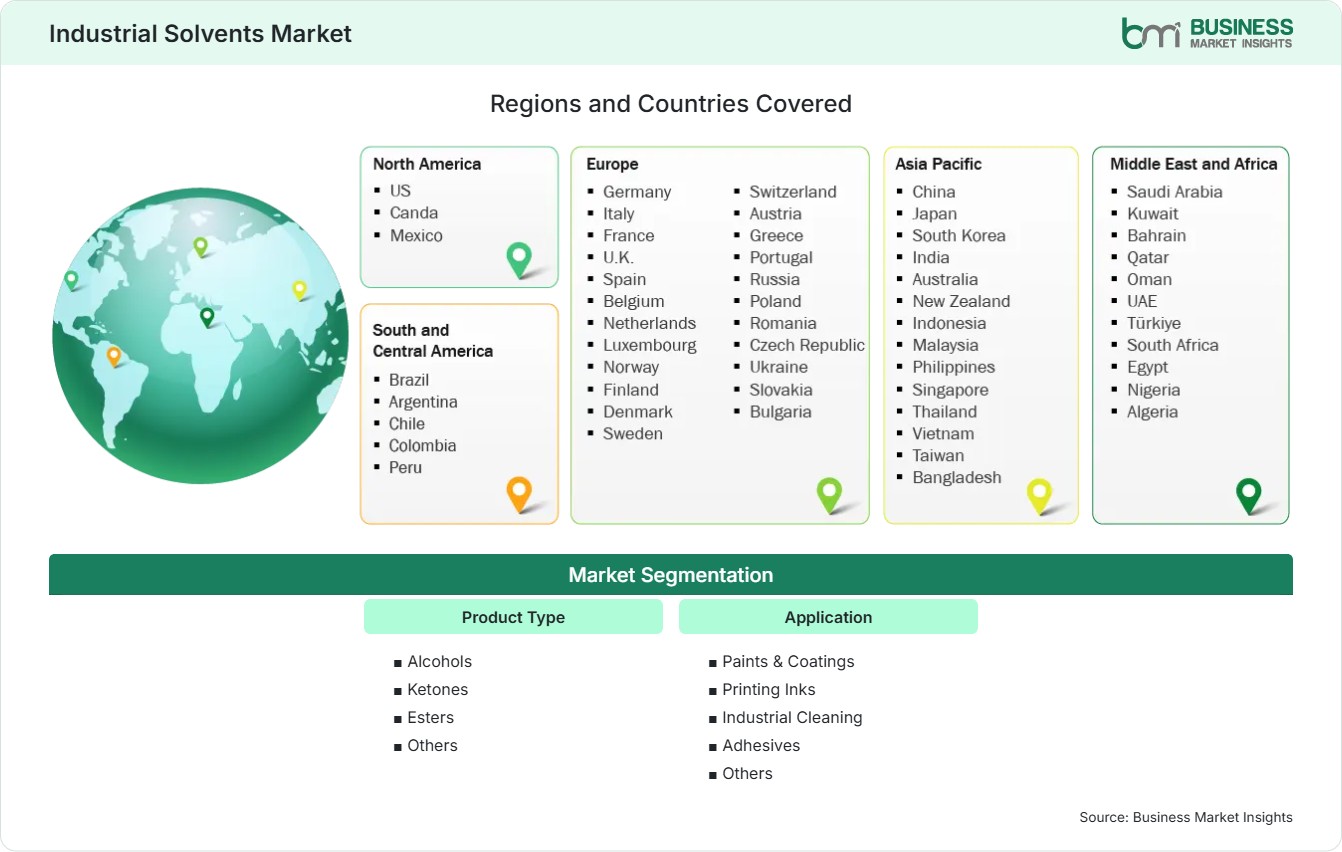
  • Product Type: Alcohols, Ketones, Esters, Others
  • Application: Paints & Coatings, Printing Inks, Industrial Cleaning, Adhesives, Others
US$ 42.94 Bn Market size in 2025
US$ 74.98 Bn Market Size by 2033
7.22% CAGR, 2026 - 2033
2026-2033 Forecast Period

AI Overview

Industrial Solvents Market Summary

  • North America Region: North America holds a market share of 24%–27% in 2025 and is projected to grow at a 5.8%–6.4% CAGR during 2026–2033. Demand is supported by coatings, industrial maintenance, specialty chemicals, reshoring activities, and adoption of sustainable low-VOC formulations across manufacturing ecosystems. US market benefits from strong chemical production investments and advanced downstream industries, expanding at approximately 5.9%–6.5% CAGR.
  • Fastest Growing Region: Asia Pacific accounts for 40%–44% share in 2025 and is expected to expand at 8.4%–9.1% CAGR during 2026–2033. Industrialization, construction growth, automotive output, electronics manufacturing, and increasing chemical capacities continue creating substantial demand across diverse solvent-consuming applications.
  • Leading Segment: Paints & Coatings represents 38%–42% share in 2025 and is forecast to grow at 7.1%–7.8% CAGR through 2033. Infrastructure modernization, protective coatings demand, automotive refinishing needs, corrosion prevention requirements, and urban development projects strengthen consumption levels globally.
  • High Growth Segment: Industrial Cleaning captures 17%–20% share in 2025 and is anticipated to grow at 8.1%–8.8% CAGR during 2026–2033. Manufacturing hygiene standards, precision equipment maintenance, electronics production expansion, regulatory compliance requirements, and efficiency improvement programs support sustained adoption.
  • Key Market Opportunity: Bio-based and low-emission solvent platforms enable manufacturers to improve sustainability compliance, serve premium applications, reduce VOC exposure concerns, and unlock long-term differentiation in regulated industrial environments.
  • Major Market Players: BASF SE, Exxon Mobil Corporation, Shell plc, Eastman Chemical Company, LyondellBasell Industries N.V., Dow Inc., Arkema S.A., Huntsman Corporation, Honeywell International Inc., and Solvay SA.
Strategic Insights

Industrial Solvents Market: Strategic Insights

Industrial Solvents Market Strategic Framework
FREE PDF
Request your free sample
Request free sample
Stakeholder View

Key Takeaways

  • The value chain in this industry is still closely tied to petrochemical feedstocks, specialty chemical processing, distribution networks, and the downstream manufacturing sectors, which means that the availability of feedstocks is a key element in determining competitiveness.
  • The greatest potential for gain lies in industrial cleaning and the use of advanced coatings, since manufacturers are aiming to increase productivity, ensure greater equipment reliability, and meet more stringent environmental compliance standards.
  • More attention is being paid to product innovation involving bio-based chemistries, low-VOC formulations, recyclable solvents, and various advanced blends which manage to balance performance with sustainability goals.
  • Asia Pacific offers the most compelling expansion opportunity due to rapid industrialization, investment in manufacturing capacity, and rising consumption across the automotive, electronics, and construction industries.
  • Strategic partnerships, capacity expansion, and portfolio changes remain common practices as major producers broaden their range of specialty products and increase their presence across different areas.
  • The process of digitizing chemical manufacturing and the optimization of supply chains is increasing the efficiency of operations, improving inventory management, and enhancing customers' responsiveness throughout industrial solvent systems.
Geographic Outlook

Industrial Solvents Market Regional Highlights

North America Industrial Solvents Market

North America accounts for approximately 24%–27% of global demand in 2025 and is projected to register a 5.8%–6.4% CAGR through 2033. Regional growth is supported by manufacturing reshoring, strong coatings consumption, industrial maintenance spending, and advanced specialty chemical capabilities. Environmental regulations continue encouraging adoption of low-emission products. The region benefits from established feedstock infrastructure and high-value end-use industries requiring consistent solvent performance. The Industrial Solvents Market share remains significant due to extensive chemical production and innovation capabilities.

  • Modernization projects and infrastructure rehabilitation efforts require robust coatings to ensure stable solvent usage.
  • Efforts aimed at sustainability are leading to increased investment in low-VOC and alternative formulations in various industrial sectors.
  • The expansion of the specialty chemical manufacturing sector increases demand for premium-grade solvent products.
  • Strategies for localizing the supply chain enhance both the resilience of production in a region and its competitiveness in the market.

US Industrial Solvents Market

The United States represents approximately 72%–76% of North American demand and advances at a 5.9%–6.5% CAGR. High spending on industrial maintenance, manufacturing upgrades, aerospace production, and chemical processing supports robust consumption. Investments in advanced manufacturing facilities and specialty chemicals are creating incremental opportunities. Regulatory emphasis on workplace safety and environmental stewardship encourages adoption of innovative and sustainable solvent technologies across multiple end-use sectors.

  • Since industrial automation is growing, there is an increased demand for precise cleaning formulations.
  • Investment in the chemical industry enhances the country's ability to produce domestically and increases demand in the downstream sectors.
  • Increased manufacturing activity helps boost consumption in the areas of adhesives and coatings.
  • Innovation in the development of sustainable formulations enhances competitiveness in regulated markets.

Europe Industrial Solvents Market

Europe maintains a 22%–25% Industrial Solvents Market share in 2025 and is expected to grow at a 5.4%–6.1% CAGR through 2033. Regulatory frameworks emphasizing safer chemicals and lower emissions influence purchasing decisions. Germany leads regional demand with growth near 5.5%–6.0%, while Eastern European manufacturing hubs demonstrate faster expansion. Demand remains concentrated in coatings, industrial production, automotive applications, and specialty chemical manufacturing supported by technological innovation and environmental compliance initiatives.

  • Germany still holds the position of the largest market as a result of its extensive industrial and chemical manufacturing activities.
  • Poland along with the other economies of Eastern Europe offer better-than-average chances for growth.
  • Programs in sustainable chemistry help to speed up the move towards low-emission solvent systems.
  • Use of automotive coatings and in industrial maintenance is still responsible for consumption.
  • The need to comply with regulations promotes innovation when it comes to developing specialty solvent formulations.

Asia Pacific Industrial Solvents Market

Asia Pacific represents 40%–44% of global demand in 2025 and records the strongest expansion at 8.4%–9.1% CAGR through 2033. China remains the largest regional consumer, while India demonstrates some of the fastest growth rates. Industrial output expansion, infrastructure investment, urbanization, and manufacturing relocation trends support consumption. Electronics, automotive, adhesives, and paints applications remain important demand generators. Regional Industrial Solvents Market growth continues to outperform global averages due to broad industrial expansion.

  • China meets the demand in the region by means of large-scale manufacturing and chemical production.
  • India gains as a result of infrastructure development and the expansion of industrial investment.
  • The manufacturing of electronics meets the demand for precision cleaning applications.
  • The construction industry leads in the use of paints and coatings.
  • Expanding capacity increases the availability of supply in the region and improves its competitiveness.

Rest of World Industrial Solvents Market

The Rest of World region accounts for approximately 10%–13% market share and is forecast to grow at 6.7%–7.4% CAGR through 2033. South and Central America benefit from industrial and construction activity, particularly in Brazil and Mexico. Middle East and Africa markets gain support from petrochemical investments, manufacturing diversification, and infrastructure projects. Demand remains concentrated in industrial cleaning, coatings, and maintenance applications as countries seek to strengthen domestic production capacity.

  • Brazil is ahead of the other South American countries in terms of consumption due to its industrial and construction activities.
  • Mexico benefits from manufacturing integration and export-oriented production.
  • The Gulf states make heavy investments in petrochemical and downstream industrial capacity.
  • The development of infrastructure leads to an increased demand for coatings and cleaning products.
  • The process of industrial diversification leads to increased long-term consumption of solvents.
Global Market Geography
FREE PDF
Request your free sample
Request free sample
Segment Analysis

Industrial Solvents Market Segmentation

Product Type

Product Type accounted for approximately 58%–62% market share in 2025 and is expected to grow at 6.9%–7.6% CAGR through 2033. The segment benefits from broad applicability across coatings, cleaning, adhesives, and printing formulations. Industrial Solvents Market scope continues expanding as manufacturers pursue specialized performance characteristics, compliance with regulations, and cost-effective processing solutions across multiple industries.

  • Alcohols: Widely used across coatings, cleaners, pharmaceuticals, and chemical synthesis because of versatility, solvency efficiency, and compatibility with multiple industrial formulations.
  • Ketones: Preferred for fast evaporation rates and strong cleaning performance in coatings, electronics, and manufacturing applications requiring precision processing.
  • Esters: Increasingly adopted for coatings and specialty formulations due to favorable performance characteristics and regulatory acceptance in various applications.

Application

Application categories define end-use demand patterns, with this segment holding approximately 38%–42% share for the leading coating category and exhibiting diverse growth trajectories. Strong industrial activity, maintenance needs, infrastructure investments, and evolving Industrial Solvents Market trends continue supporting adoption across multiple downstream industries during the forecast period.

  • Paints & Coatings: Largest application segment supported by infrastructure development, protective coatings demand, architectural usage, and transportation-related surface finishing requirements.
  • Printing Inks: Demand is influenced by packaging production, labeling requirements, and growth in consumer goods manufacturing.
  • Industrial Cleaning: Growing adoption reflects increasing focus on equipment reliability, hygiene standards, and precision manufacturing operations.
  • Adhesives: Expansion in construction, automotive assembly, packaging, and industrial manufacturing supports sustained solvent consumption.
Market Forces

Industrial Solvents Market Dynamics

Key Market Drivers

Expansion of Paints and Coatings Consumption

Paints and coatings remain one of the largest solvent-consuming applications globally, supporting steady demand across construction and industrial sectors. Rising construction activity, infrastructure upgrades, transportation production, and industrial maintenance requirements are increasing the need for performance-oriented coating formulations. The Industrial Solvents Market trends indicate continued adoption across architectural coatings, protective coatings, automotive finishing systems, and other industrial applications. Expanding urban populations and growing industrial investments across Asia Pacific are further supporting consumption volumes. At the same time, manufacturers are developing advanced solvent formulations that offer better application properties, durability, and environmental performance. These improvements allow industrial users to maintain product quality and process efficiency while managing overall formulation costs.

Industrial Manufacturing and Chemical Production Growth

Growth in global manufacturing output is increasing demand for process chemicals, industrial cleaners, adhesives, and specialty formulations, many of which depend on solvents for effective production and application. Solvents provide important dissolution, extraction, cleaning, and processing capabilities across a wide range of manufacturing operations. Industrial Solvents Market growth is therefore benefiting from factory modernization, expanding production capacity, and rising demand for high-performance materials. Investments in electronics, automotive manufacturing, packaging, renewable energy equipment, and specialty chemicals are supporting long-term consumption. As manufacturing facilities become more advanced, producers are also focusing on improving operational efficiency and product quality. This is encouraging the use of solvent technologies that can deliver consistent performance across increasingly demanding industrial processes.

Shift Toward Sustainable and Low-VOC Solutions

The push from regulators and the growing number of companies committing to sustainability are accelerating the shift towards more environmentally sound solvent products. To deal with environmental issues and respond to changing customer demands, manufacturers are putting money into bio-based alternatives, low-emission formulations, and recyclable solvent technologies. Such solutions can cut emissions and reduce environmental impact without sacrificing the performance required for industrial use. This trend is now being adopted in the areas of paints and coatings, cleaning products, adhesives, and specialty chemical formulations. Businesses that succeed in balancing performance, regulatory compliance, safety, and sustainability are thereby improving their competitive standing in the market. At the same time, there are emerging opportunities for premium products, as industrial users are becoming more interested in solvent solutions that help them achieve their environmental goals while maintaining the efficiency and quality of their current processes.

Key Market Opportunities

Commercialization of Bio-Based Solvent Portfolios

Growing environmental awareness and stricter sustainability expectations are creating significant opportunities for renewable and bio-derived solvent products. Producers investing in green chemistry capabilities can develop alternatives that help customers address emissions requirements while meeting increasing demand for more sustainable industrial materials. Industrial Solvents Market Forecasts increasingly reflect opportunities for solutions that can reduce environmental impact, improve workplace safety, and support corporate ESG objectives. Strategic partnerships with downstream manufacturers, chemical producers, and technology providers can help accelerate commercialization and improve market access. Adoption across coatings, industrial cleaning, adhesives, and specialty chemicals can further expand the addressable opportunity base. Companies able to provide bio-based solvents with reliable performance and competitive economics may gain stronger positions in premium and sustainability-focused market segments.

Growth in Electronics and Precision Manufacturing

Because of the high level of specialization needed for cleaning, processing, and surface treatment in the production of advanced electronics, there are promising opportunities for high-performance solvent suppliers. The ongoing growth of the semiconductor, battery, and precision engineering industries is leading to greater demand for formulations that satisfy rigorous standards in terms of purity, consistency, and performance. It is especially important to use high-purity solvents in delicate manufacturing settings, since contamination or inconsistent processing can affect product quality. The fact that investments are being made in local electronics manufacturing systems in Asia, North America, and Europe is expected to help maintain this demand. Manufacturers who develop distinct solvent solutions for these applications will be able to establish long-term supply relationships and meet the specialized requirements of their products. As electronics and precision manufacturing become more sophisticated, suppliers with strong technical abilities will be able to gain a competitive edge in these higher-value areas.

Emerging Industrial Capacity Across Developing Economies

The rapid industrialization in India, Southeast Asia, the Middle East, and some African markets is creating considerable growth opportunities for manufacturers and suppliers of solvents. The creation of new manufacturing estates, infrastructure initiatives, chemical plants, and downstream production units is setting up further demand centers in a variety of industries. As industrial ecosystems grow, the use of solvents is increasing across sectors such as coatings, industrial cleaning, adhesives, printing, and chemical processing. Companies can take advantage of these opportunities by forming local partnerships, setting up production facilities in the region, and providing products suited to the specific requirements of each market. Expanding into different geographic areas can also help firms decrease their reliance on any one market and improve the resilience of their supply chains. Since developing economies are still increasing their manufacturing capacity, their expanding industrial base is likely to result in wider and more diverse demand for solvents.

Market Restraints and Challenges

Feedstock Price Volatility and Margin Pressure

Many solvent products are still linked to petrochemical feedstocks whose prices can vary greatly due to changes in the energy markets and supply interruptions. This unpredictability in input costs puts pressure on manufacturers' margins, complicates long-term procurement strategies, and reduces the pricing transparency available to customers. Market volatility can also delay investment decisions and affect how downstream industries conduct their purchasing. As a result, companies have to strike a balance among operational efficiency, supply security, and pricing strategies to remain competitive during periods of market uncertainty.

Stringent Regulatory Compliance Requirements

The requirements for environmental and occupational safety are becoming increasingly stringent in major industrial areas. As a result, the costs involved in conducting research and testing, obtaining certification, making formulation changes, and carrying out operations increase for companies in the market. Products that do not comply with changing standards may be subject to restrictions on their use or replacement. Small manufacturers may have to bear disproportionately high financial burdens, which in turn hampers their ability to expand. Even though the regulations help to achieve sustainability goals, they also give rise to difficulties concerning product development timelines, market access, and portfolio management.

Company Analysis

Competitive Landscape

The following Industrial Solvents Market analysis highlights leading participants operating across petrochemicals, specialty chemicals, and sustainable solvent technologies.

Company Name

Overview

Products and Services relevant to this market

BASF SE

Global chemical producer with extensive specialty and industrial chemical operations serving multiple end-use industries.

Oxygenated solvents, specialty formulations, performance chemicals, sustainable solvent solutions.

Exxon Mobil Corporation

Integrated energy and petrochemical company supplying large-scale solvent and feedstock products globally.

Hydrocarbon solvents, process chemicals, industrial formulations, petrochemical derivatives.

Shell plc

Major energy and chemicals company with global production and distribution capabilities.

Hydrocarbon solvents, industrial fluids, specialty chemical solutions.

Eastman Chemical Company

Specialty materials company focused on innovation and higher-value chemical technologies.

Specialty solvents, green chemistry products, coatings ingredients, industrial solutions.

LyondellBasell Industries N.V.

Global chemicals producer serving manufacturing and industrial customers worldwide.

Solvent intermediates, petrochemicals, industrial processing materials.

Dow Inc.

Diversified materials science company supporting industrial and consumer applications.

Performance solvents, coatings ingredients, adhesive-related materials.

Arkema S.A.

Specialty chemicals provider emphasizing advanced materials and sustainability.

Industrial solvents, specialty additives, coating solutions.

Huntsman Corporation

Global chemical manufacturer with strong downstream industrial presence.

Specialty chemicals, formulation components, industrial solvents.

Honeywell International Inc.

Technology and industrial company engaged in specialty materials and chemicals.

High-performance solvents, cleaning solutions, specialty applications.

Solvay SA

Global specialty chemicals producer focused on advanced industrial materials.

Industrial solvents, specialty formulations, performance chemicals.

Trust & Transparency

Research Methodology

The market analysis combines proprietary research with secondary data from government agencies, company disclosures, regulatory filings, industry databases and expert interviews. Market estimates are validated through data triangulation, cross-market benchmarking and analyst review.

View Full Research Methodology

Questions Answered

Frequently Asked Questions

What does an Industrial Solvents Market Report typically evaluate?

It typically assesses market size, competitive positioning, regional demand dynamics, technology developments, regulatory influences, segmentation trends, investment activity, and future growth opportunities.

Which application dominates industry demand?

Paints and coatings remain the leading application because solvents are essential for viscosity control, formulation stability, application performance, and drying characteristics.

Why are bio-based solvents gaining attention?

Bio-based products help companies address environmental regulations, reduce emissions, support sustainability goals, and differentiate offerings in premium industrial applications.

Which region presents the strongest growth potential?

Asia Pacific offers the strongest potential due to industrialization, infrastructure spending, electronics manufacturing expansion, and rising chemical production capacities across China, India, and Southeast Asia.

What is driving demand for industrial solvents globally?

Growing coatings consumption, industrial production, manufacturing modernization, equipment cleaning requirements, and increasing use of specialty formulations are the primary demand drivers across major end-use industries.

Access the Full Industrial Solvents Market Report

Get segment-level forecasts, regional estimates, competitive benchmarking, company profiles and downloadable Excel datasets.

Access the full Industrial Solvents Market Report
350 pages PDF & Excel | 2026-09-21
Similar Research

Related Market Reports