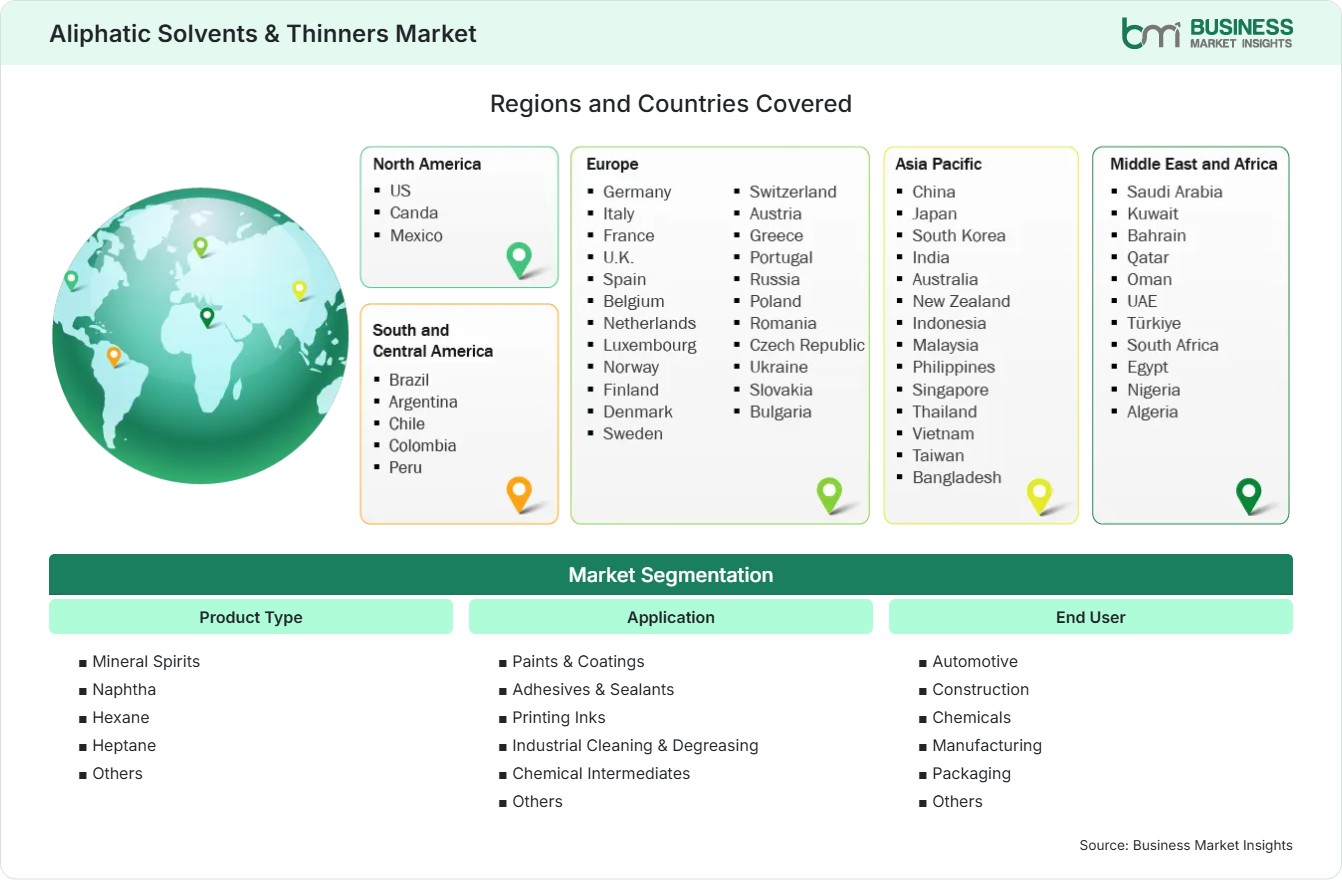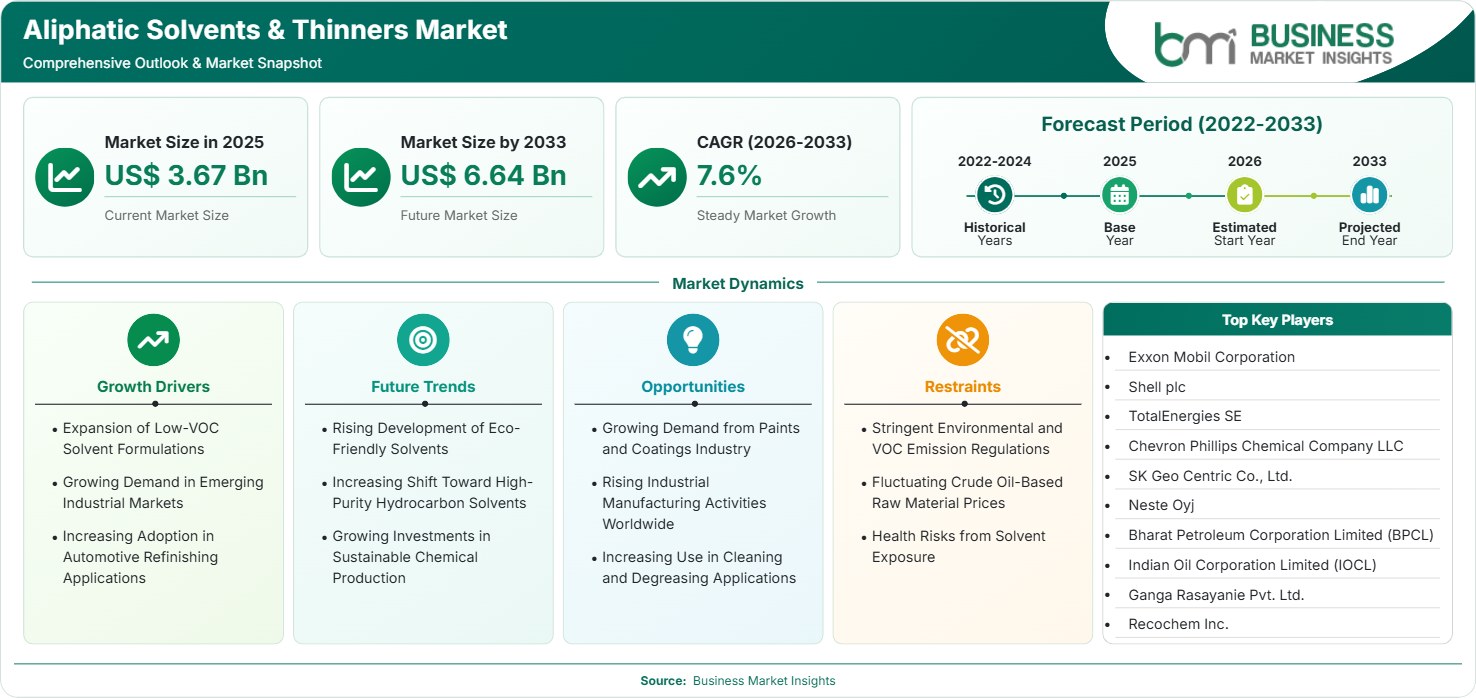
Aliphatic Solvents & Thinners Market Regional Highlights
North America Aliphatic Solvents & Thinners Market
North America accounted for approximately 32%–35% of global revenue in 2025 and is expected to register a CAGR of 7.2%–7.7% through 2033. The aliphatic solvents & thinners market share remains significant due to its mature petrochemical industry, strong coatings sector, and expanding industrial maintenance activities. Demand is further supported by technological innovation in specialty solvents and stringent product quality standards.
- Strong demand from automotive refinishing, industrial coatings, and maintenance applications continues supporting stable solvent consumption across the United States and Canada.
- Advanced refining infrastructure enables production of high-purity, low-aromatic solvent formulations that comply with increasingly stringent environmental regulations.
- Growing investment in industrial maintenance, manufacturing modernization, and specialty chemicals strengthens demand for premium solvent products with improved performance characteristics.
- Established distribution networks and long-term customer relationships support efficient supply chain operations while ensuring product availability across key industrial sectors.
- Continuous product innovation aimed at reducing VOC emissions enhances competitiveness while addressing changing regulatory and customer requirements.
US Aliphatic Solvents & Thinners Market
The United States represented approximately 25%–28% of global market revenue in 2025 and is projected to expand at a CAGR of 7.3%–7.8% during the forecast period. High demand from coatings manufacturers, automotive repair facilities, industrial cleaning companies, and specialty chemical producers continues driving market development across the country.
- Increasing infrastructure renovation projects support growing consumption of architectural and protective coatings utilizing aliphatic solvent formulations.
- Automotive refinishing activities continue expanding as vehicle maintenance and repair services increasingly utilize high-performance solvent-based coating systems.
- Rising industrial production and equipment maintenance requirements sustain demand for industrial cleaning and degreasing solvents.
- Investments in cleaner refining technologies improve production efficiency while supporting compliance with evolving environmental standards.
Europe Aliphatic Solvents & Thinners Market
Europe held approximately 24%–27% of global market revenue in 2025 and is expected to grow at a CAGR of 7.0%–7.5% through 2033. The region is characterized by strong environmental regulations, advanced chemical manufacturing capabilities, and increasing adoption of low-VOC solvent technologies. Germany leads regional demand, while Poland is forecast to achieve the fastest growth with a CAGR of 8.0%–8.5%.
- Increasing investments in sustainable coatings and specialty chemicals encourage wider adoption of environmentally compliant solvent formulations.
- Automotive manufacturing and industrial equipment production continue generating stable demand for high-quality aliphatic solvents across diverse applications.
- Advanced chemical processing technologies enable manufacturers to develop cleaner, higher-purity solvent products for industrial customers.
- Expanding industrial maintenance activities support continued demand for cleaning and degreasing solvents throughout manufacturing facilities.
- Growing emphasis on circular economy initiatives encourages solvent recovery, recycling, and resource-efficient manufacturing practices.
Asia Pacific Aliphatic Solvents & Thinners Market
Asia Pacific accounted for 35%–38% of global revenue in 2025 and is projected to record the fastest Aliphatic Solvents & Thinners Market growth with a CAGR of 8.3%–8.9% through 2033. China remains the largest regional market, while India is expected to register the highest growth at a CAGR of 8.8%–9.4%, supported by expanding petrochemical production, infrastructure investment, and manufacturing activity.
- Rapid industrialization and urban development continue increasing solvent demand across construction, automotive, packaging, and industrial manufacturing sectors.
- Expanding petrochemical refining capacity improves regional supply while supporting downstream specialty chemical production.
- Growing automotive production and vehicle refinishing activities strengthen consumption of solvent-based coatings and industrial cleaning products.
- Rising exports of specialty chemicals encourage manufacturers to expand production capacities and improve product quality standards.
- Increasing investments in sustainable manufacturing technologies support development of environmentally compliant solvent formulations.
Rest of World Aliphatic Solvents & Thinners Market
Rest of World represented approximately 8%–10% of global market revenue in 2025 and is anticipated to grow at a CAGR of 7.5%–8.1% through 2033.
South & Central America continue benefiting from industrial expansion, automotive manufacturing, and construction activities, with Brazil recording a projected CAGR of 7.7%–8.2% during the forecast period.
The Middle East & Africa are witnessing increasing investments in refining and petrochemical infrastructure, supporting higher solvent production and consumption. Saudi Arabia is expected to achieve the fastest regional growth with a CAGR of 8.1%–8.6%.
- Expanding downstream petrochemical investments improve regional production capabilities while reducing dependence on imported solvent products.
- Infrastructure development and industrial diversification initiatives continue supporting long-term solvent demand across multiple end-use industries.
- Increasing manufacturing activities stimulate consumption of industrial cleaning agents, coatings, and specialty chemical intermediates.
- Growing investments in logistics and distribution infrastructure improve product accessibility across developing industrial markets.
- Sustainability initiatives encourage adoption of cleaner production technologies and environmentally responsible solvent formulations throughout regional chemical industries.