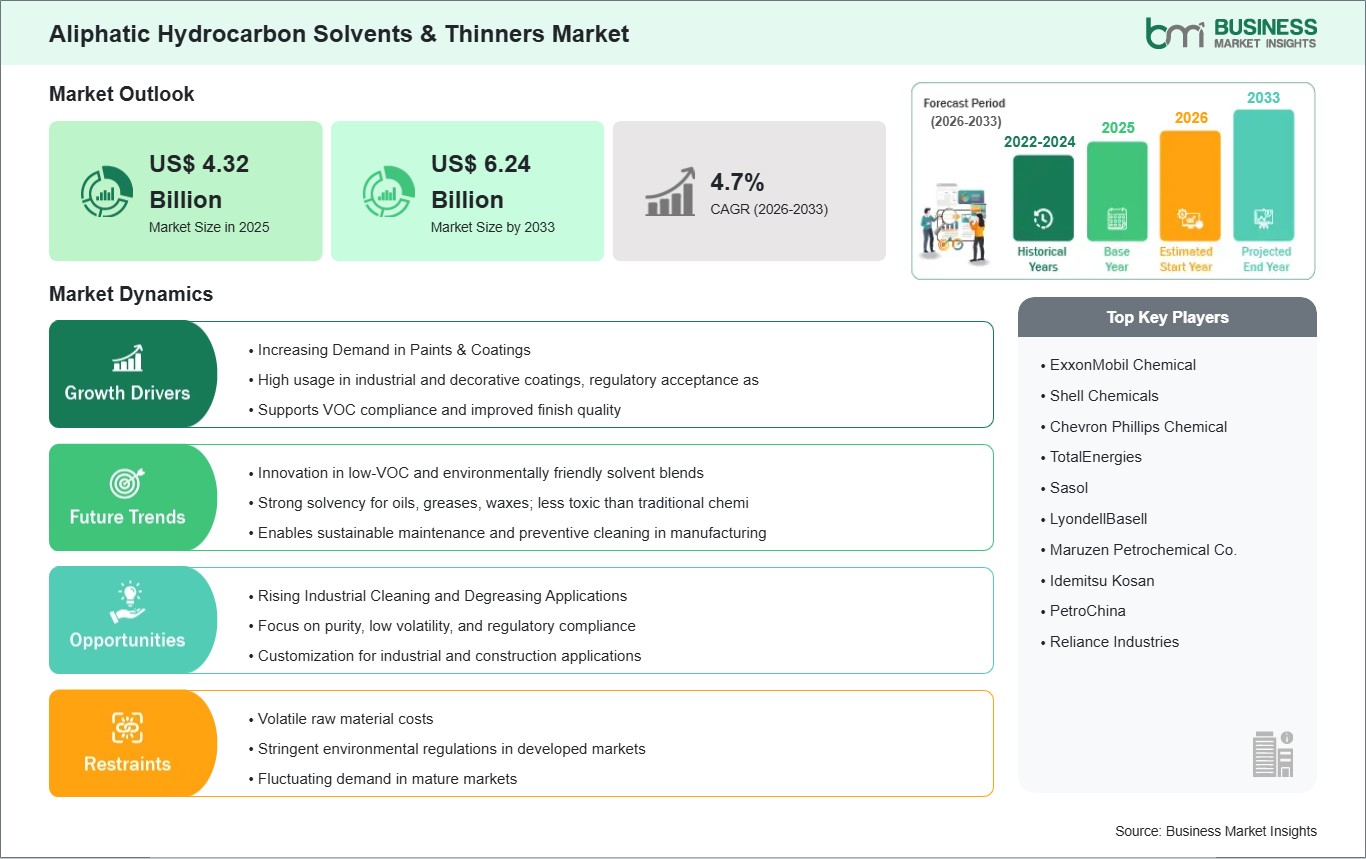
The Aliphatic Hydrocarbon Solvents & Thinners Market size is expected to reach US$ 6.24 Billion by 2033 from US$ 4.32 Billion in 2025 .The market is estimated to record a CAGR of 4.7% from 2026 to 2033.
The global aliphatic hydrocarbon solvents & thinners market is defined by increasing industrial demand for efficient solvent systems used in coatings, cleaning, and adhesive formulations. Aliphatic hydrocarbons such as mineral spirits, hexane, and heptane are favored for their excellent solvency, low toxicity compared to aromatic solvents, and compliance with evolving environmental regulations.
Rising construction activities, growth in automotive and manufacturing sectors, and increasing demand for eco-friendly solvent alternatives are key factors driving market expansion. These solvents are integral in producing paints and coatings with superior drying and finish characteristics, as well as in cleaning and degreasing applications that require effective yet safe solvents.
Competitive dynamics emphasize product purity, low volatility, and compliance with stringent VOC (Volatile Organic Compound) regulations. Innovation is focused on developing solvent blends that optimize performance while minimizing environmental impact. Additionally, growing awareness and regulatory push towards low-VOC and sustainable solvents are shaping industry strategies.

Key segments that contributed to the derivation of the aliphatic hydrocarbon solvents & thinners market analysis are type and application.
Historically, the paint and coatings sector represents a significant source of demand for aliphatic hydrocarbons, particularly in terms of their main use as a solvent and thinner for coatings. Due to the continued growth of the paints and coatings market, this will remain the primary factor for future growth within this segment. Aliphatic hydrocarbons are critical to the manufacturing of coatings due to their ability to modify such characteristics as; rate of dry, gloss and adhesion. Furthermore, aliphatic hydrocarbons serve as versatile solvents for applications as varied as decorative (e.g., household paints) to industrial (e.g., machinery, automobiles, infrastructure). Unlike aromatic hydrocarbons, aliphatic hydrocarbon solvents are recognized and valued for their relatively lower levels of toxicity and lower levels of volatile organic compound (VOC) emissions, consistent with increasing international environmental regulations, which are providing additional impetus for the replacement of traditional aromatic hydrocarbon solvents with aliphatic hydrocarbon-based solvents such as mineral spirits, in regions with stricter environmental regulations (e.g., Europe and North America). In addition to regulatory factors, global growth in construction, automotive refinishing, and the development of new infrastructure are contributing to increased usage of solvents.
As urbanization continues and demand for durable, attractive surface finishes increases, coating manufacturers will continue to turn to aliphatic hydrocarbon solvents to satisfy performance and regulatory requirements. Furthermore, new and innovative formulations that are environmentally friendly will continue to broaden the potential to utilize solvent-based coatings.
Major industry to experience growth through the increased use of aliphatic hydrocarbons and primers will be in industrial cleaning and degreasing. Businesses must continually clean and maintain machinery and other pieces of equipment used during the production process in order for operations to run efficiently - to properly perform their job - the product produced from that operation to meet required quality standards, and for all the employees of the businesses producing products to have a safe working environment. Aliphatic hydrocarbon solvents are primarily used to remove oils, greases, waxes, and other contaminants from metal parts, mechanical components, and production lines used to produce products for businesses. These solvents have very strong solvency power and are much less toxic than any of the traditional harsh cleaning chemicals; therefore, aliphatic solvents have become widely used in different industries as effective but also safer cleaning solutions. Aliphatic solvents are also compatible with most materials which means there is less of a chance of cleaning a component using a degreasing agent and damaging or compromising that component during cleaning it's another reason for the popularity of aliphatic solvents within the industrial sector. In addition, with the shift of most industries or businesses implementing sustainable maintenance practices, the demand for custom blended solvents to meet individual customers' unique cleaning needs has increased. Manufacturers have been working on products that are not only effective but also environmentally responsible; therefore, they have been developing solvent formulations that have reduced levels of volatile organic compounds (VOCs) and assist in achieving higher levels of biodegradability. The increased use of aliphatic hydrocarbons in this industrial sector can also be directly attributed to the explosion of manufacturing industries (i.e., automotive, aerospace, electronics, heavy machinery, etc.) increasing their own productivity through using precision cleaning techniques and increasing the longevity of production I equipment. Additionally, the focus on preventive maintenance within modern manufacturing operations reinforces the need for reliable degreasing chemical agents. Significant growth in global manufacturing production, as well as sustainability becoming an integral part of operations, will help ensure that aliphatic hydrocarbons continue to be used by manufacturers to create products used throughout the world.

The Aliphatic Hydrocarbon Solvents & Thinners Market demonstrates steady growth, with size and share analysis highlighting evolving trends and competitive dynamics among key players. The report examines subsegments categorized within type and application, offering insights into their contribution to overall market performance.
By type, the mineral spirits subsegment dominated the market in 2025, driven by their versatility and regulatory acceptance as low-toxicity solvents.
In terms of application, the paints & coatings subsegment dominated the market in 2025, driven by high demand for solvents in industrial and decorative coatings requiring efficient drying and finish qualities.
| Report Attribute | Details |
|---|---|
| Market size in 2025 | US$ 4.32 Billion |
| Market Size by 2033 | US$ 6.24 Billion |
| Global CAGR (2026 - 2033) | 4.7% |
| Historical Data | 2022-2024 |
| Forecast period | 2026-2033 |
| Segments Covered | By Type
|
|
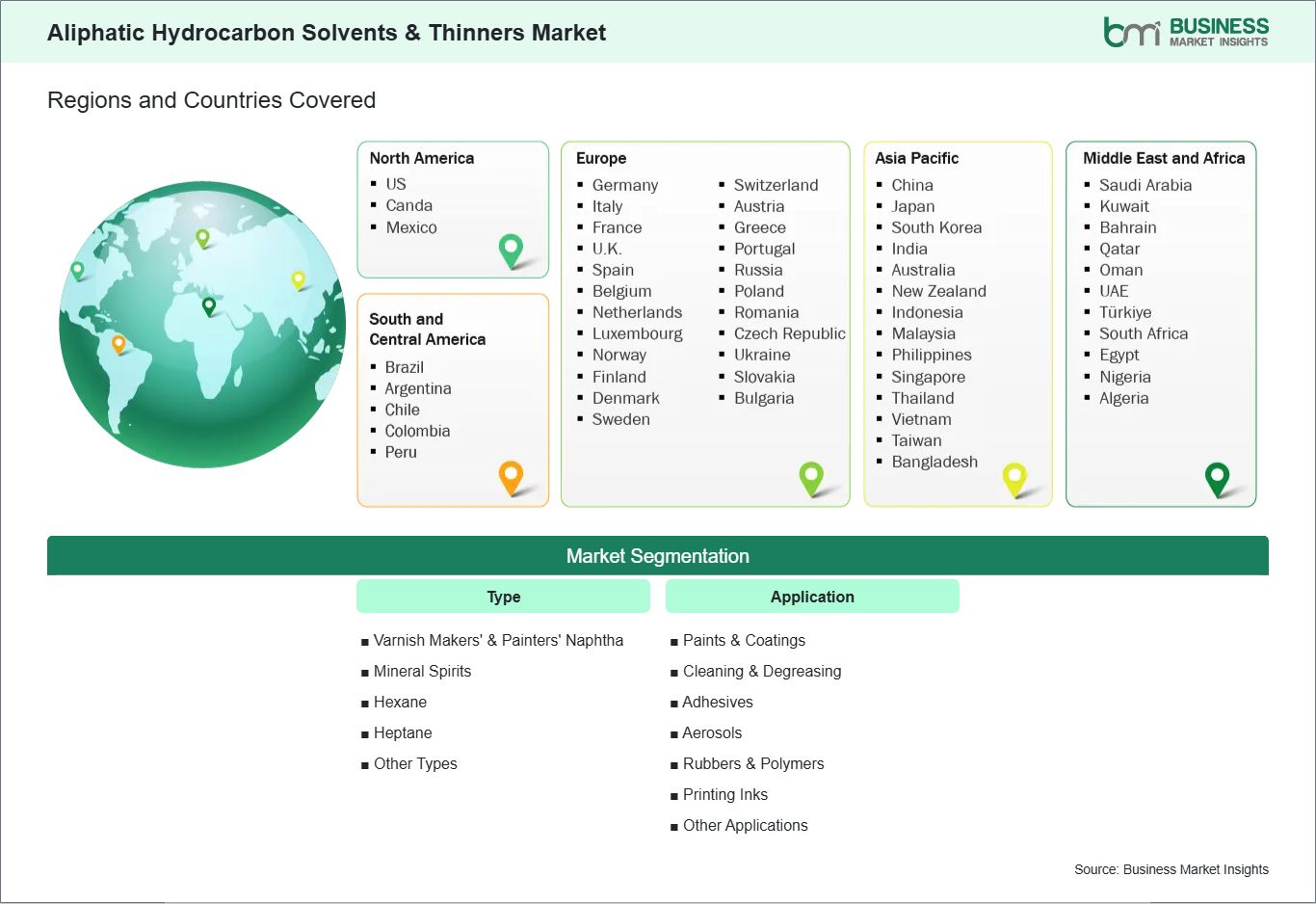
Regions and Countries Covered
| |
| North America | US, Canada, Mexico |
| Europe | Belgium, Austria, Finland, Denmark, Greece, Poland, Romania, Russia, Ukraine, Czech Republic, Slovakia, Bulgaria, Italy, Luxembourg, Germany, Switzerland, France, Netherlands, Norway, Portugal, Spain, Sweden, United Kingdom |
| Asia-Pacific | Australia, China, India, Japan, South Korea, Indonesia, Malaysia, Philippines, Singapore, Thailand, Vietnam, Bangladesh, New Zealand, Taiwan |
| South and Central America | Brazil, Argentina, Peru, Chile, Colombia |
| Middle East and Africa | Bahrain, Kuwait, Oman, Qatar, Saudi Arabia, United Arab Emirates, Turkiye, South Africa, Egypt, Algeria, Nigeria |
| Market leaders and key company profiles |
|
The "Aliphatic Hydrocarbon Solvents & Thinners Market Size and Forecast (2022 - 2033)" report provides a detailed analysis of the market covering below areas:
The geographical scope of the Aliphatic Hydrocarbon Solvents & Thinners Market report is divided into North America, Asia Pacific, Europe, Middle East & Africa, and South & Central America. North America held the largest share in 2025.
The adoption of aliphatic hydrocarbon solvents & thinners varies regionally, influenced by industrial activity, regulatory environments, and environmental compliance trends. North America leads due to stringent VOC regulations driving substitution of aromatic solvents with aliphatic variants and strong industrial coatings demand. Europe follows with growing demand for low-toxicity solvents amid strict environmental laws and increased focus on sustainable manufacturing practices. Asia Pacific is witnessing rapid growth due to expanding industrial sectors, infrastructure projects, and rising demand for paints & coatings in emerging economies like China and India. Latin America and the Middle East & Africa show steady growth supported by industrialization and increased construction activities, although regulatory frameworks are less mature. Across all regions, the push for environmentally friendly and efficient solvent solutions shapes market strategies and growth trajectories.

The Aliphatic Hydrocarbon Solvents & Thinners Market is evaluated by gathering qualitative and quantitative data post primary and secondary research, which includes important corporate publications, association data, and databases. A few of the key developments in the aliphatic hydrocarbon solvents & thinners market are:
The Aliphatic Hydrocarbon Solvents & Thinners Market is valued at US$ 4.32 Billion in 2025, it is projected to reach US$ 6.24 Billion by 2033.
As per our report Aliphatic Hydrocarbon Solvents & Thinners Market, the market size is valued at US$ 4.32 Billion in 2025, projecting it to reach US$ 6.24 Billion by 2033. This translates to a CAGR of approximately 4.7% during the forecast period.
The Aliphatic Hydrocarbon Solvents & Thinners Market report typically cover these key segments-
The historic period, base year, and forecast period can vary slightly depending on the specific market research report. However, for the Aliphatic Hydrocarbon Solvents & Thinners Market report:
The Aliphatic Hydrocarbon Solvents & Thinners Market is populated by several key players, each contributing to its growth and innovation. Some of the major players include:
The Aliphatic Hydrocarbon Solvents & Thinners Market report is valuable for diverse stakeholders, including:
Essentially, anyone involved in or considering involvement in the Aliphatic Hydrocarbon Solvents & Thinners Market value chain can benefit from the information contained in a comprehensive market report.
Please tell us your area of interest
(Market Segments/ Regions and Countries/ Companies)