
Industrial Mezzanines Market Outlook: Size, Share, Trends, Growth Analysis, Competitive Landscape & Forecast, 2026-2033

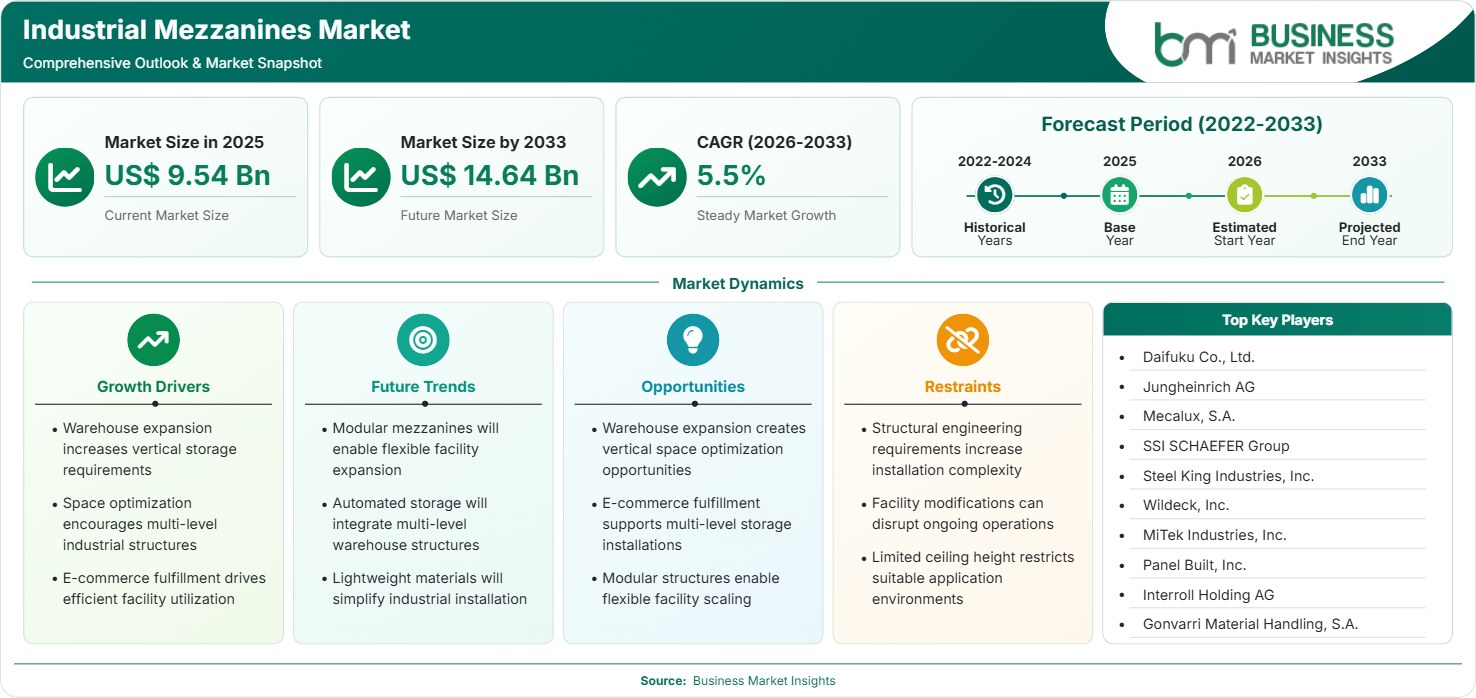
The Industrial Mezzanines Market size was valued at US$ 9.54 Billion in 2025 and is projected to reach US$ 14.64 Billion by 2033, growing at a CAGR of 5.50% during 2026–2033, driven by vertical space optimization, warehouse automation, brownfield expansion, modular construction, and logistics modernization.

Report Coverage
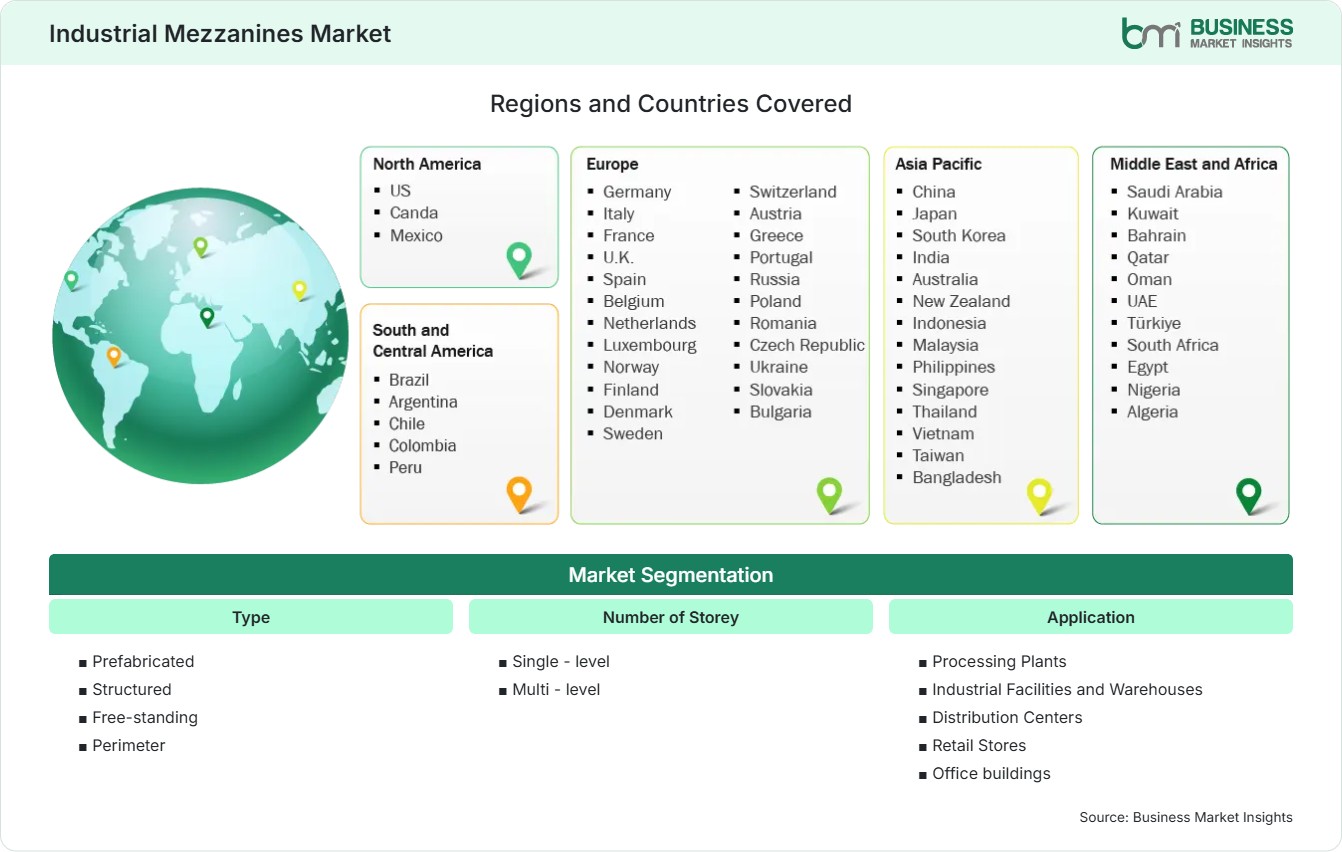
  • Type: Prefabricated, Structured, Free-standing, Perimeter
  • Number of Storey: Single - level, Multi - level
  • Application: Processing Plants, Industrial Facilities and Warehouses, Distribution Centers, Retail Stores, Office buildings
US$ 9.54 Bn Market size in 2025
US$ 14.64 Bn Market Size by 2033
5.5% CAGR, 2026 - 2033
2026-2033 Forecast Period

AI Overview

Industrial Mezzanines Market Summary

  • North America Region: North America holds a 25%–28% Industrial Mezzanines Market share in 2025, growing at a 4.8%–5.3% CAGR through 2033, driven by warehouse automation, reshoring, constrained industrial footprints, fulfillment expansion, retrofit projects, and flexible capacity investments.
  • US demand is supported by fulfillment modernization, manufacturing reshoring, and warehouse automation, producing a 4.9%–5.4% CAGR through 2033.
  • Fastest Growing Region: Asia Pacific holds a 34%–38% share in 2025, growing at a 6.1%–6.7% CAGR through 2033, supported by manufacturing diversification, e-commerce infrastructure, urban land constraints, logistics parks, automation adoption, and expanding industrial corridors
  • Leading Segment: Rigid products hold a 68%–72% Industrial Mezzanines Market share in 2025, growing at a 5.2%–5.6% CAGR through 2033, supported by heavy loads, permanent installations, manufacturing platforms, storage systems, structural durability, and compatibility with conveyors and automated handling.
  • High Growth Segment: Industrial end use holds a 61%–65% share in 2025, growing at a 6.0%–6.5% CAGR through 2033, driven by manufacturing expansion, automation integration, equipment access, production optimization, and brownfield capacity upgrades.
  • Key Market Opportunity: Integrated mezzanine platforms connecting storage, conveyors, robotics, lifts, sortation, and production equipment offer suppliers higher-value projects while enabling operators to increase throughput without acquiring additional industrial floor space.
  • Major Market Players: Daifuku Co., Ltd.; Jungheinrich AG; Mecalux, S.A.; SSI SCHAEFER Group; Steel King Industries, Inc.; Wildeck, Inc.; MiTek Industries, Inc.; Panel Built, Inc.; Interroll Holding AG; Gonvarri Material Handling, S.A.
Strategic Insights

Industrial Mezzanines Market: Strategic Insights

Industrial Mezzanines Market Strategic Framework
FREE PDF
Request your free sample
Request free sample
Stakeholder View

Key Takeaways

  • Supply chains are becoming more integrated, with structural manufacturers collaborating with rack suppliers, conveyor specialists, vertical-lift providers, engineering contractors, and automation integrators. Competitive advantage increasingly depends on project coordination rather than steel fabrication alone.
  • The strongest application upside lies in industrial facilities requiring additional production, picking, maintenance, inspection, packaging, and equipment-support areas. Multi-level configurations can address constrained sites where relocation or horizontal expansion would create substantially higher capital requirements.
  • Product development is moving toward lighter engineered sections, modular connections, configurable decking, integrated access systems, and automation-ready platforms. Digital modeling is increasingly important because structures must accommodate conveyors, robotics, utilities, fire systems, and changing layouts.
  • Asia Pacific presents the strongest investment case because manufacturing diversification, logistics infrastructure development, and urban land constraints reinforce demand for vertical capacity. India, Vietnam, Indonesia, and selected Chinese industrial clusters provide particularly attractive expansion opportunities.
  • Investment activity is increasingly centered on material-handling ecosystems rather than standalone structural fabrication. Suppliers with capabilities spanning storage, automation, conveyors, access equipment, engineering, and installation can participate in larger projects and establish recurring customer relationships.
  • Buyers are increasingly evaluating mezzanines as productivity infrastructure rather than passive floor area. Project economics therefore depend on additional storage positions, production capacity, picking throughput, labor utilization, avoided relocation costs, and preservation of existing ground-level operating space.
Geographic Outlook

Industrial Mezzanines Market Regional Highlights

North America Industrial Mezzanines Market

North America Industrial Mezzanines Market accounts for a 25%–28% share in 2025 and is projected to expand at a 4.8%–5.3% CAGR through 2033. Demand centers on distribution centers, manufacturing plants, fulfillment operations, and retrofit projects where land availability is constrained. The US represents the regional anchor, while Canada contributes through logistics modernization and industrial redevelopment. Structural steel remains preferred for heavy-duty applications requiring dependable load performance and integration with conveyors, lifts, storage, and automated handling systems.

  • Warehouse automation encourages elevated platforms supporting conveyors, sortation, picking modules, and equipment access while preserving ground-level circulation and dispatch capacity.
  • Reshoring and domestic manufacturing investment increase demand for production platforms, maintenance areas, tool storage, inspection stations, and elevated workspaces.
  • Retrofit projects remain attractive where operators can increase usable capacity without relocating, particularly across mature logistics and manufacturing corridors.
  • Engineering-led suppliers gain specification influence by combining structural design, safety systems, access equipment, and installation services into coordinated project packages.

US Industrial Mezzanines Market

The US Industrial Mezzanines Market represents 78%–82% of North American demand in 2025 and grows at a 4.9%–5.4% CAGR through 2033. Demand is supported by distribution expansion, manufacturing localization, labor productivity initiatives, and constrained warehouse footprints. Buyers increasingly favor modular systems that can be installed around operating facilities. Integration with vertical conveyors, pallet racking, automated picking, and material-handling equipment strengthens project economics while improving movement between elevated and ground-level operating zones.

  • E-commerce fulfillment facilities use elevated structures to create additional pick modules and work areas without consuming scarce ground-level circulation space.
  • Manufacturing users increasingly deploy platforms for equipment access, inspection, packaging, assembly, maintenance, and supervisory functions within established plants.
  • Code compliance, engineered load calculations, guarding, access, and egress remain decisive purchasing criteria for projects involving heavy equipment or personnel-intensive workflows.

Europe Industrial Mezzanines Market

Europe Industrial Mezzanines Market holds a 23%–26% share in 2025 and expands at a 4.6%–5.1% CAGR through 2033. Germany and the United Kingdom lead regional demand, while Poland and Spain provide higher-growth opportunities linked to logistics investment and manufacturing expansion. European buyers emphasize safety, space efficiency, building reuse, and integration with sophisticated intralogistics systems. Mature industrial estates create strong retrofit demand because redevelopment can offer better economics than relocation or major horizontal expansion.

  • Germany remains a leading market, supported by advanced manufacturing, automated warehouses, engineering-intensive facilities, and demand for high-precision material-flow infrastructure.
  • The United Kingdom benefits from fulfillment modernization and constrained industrial property availability, supporting modular vertical expansion within existing logistics buildings.
  • Poland provides a 5.8%–6.3% CAGR opportunity, supported by nearshoring, manufacturing investment, distribution infrastructure, and expanding industrial corridors.
  • Spain offers a 5.4%–5.9% CAGR opportunity as logistics networks expand around major metropolitan areas and manufacturing clusters.

Asia Pacific Industrial Mezzanines Market

Asia Pacific Industrial Mezzanines Market holds a 34%–38% share in 2025 and records the fastest regional growth at a 6.1%–6.7% CAGR through 2033. China remains the largest demand center, while India, Vietnam, and Indonesia provide stronger incremental growth. Manufacturing diversification, e-commerce penetration, logistics park development, and land constraints encourage vertical facility utilization. Buyers increasingly seek modular structures capable of accommodating future automation, storage-density changes, production-line expansion, and phased facility upgrades.

  • China remains the regional volume leader because large manufacturing and distribution facilities require adaptable platforms supporting storage, production, maintenance, and automated material movement.
  • India presents a 6.8%–7.3% CAGR opportunity as organized warehousing, manufacturing investment, fulfillment infrastructure, and industrial parks expand across major economic corridors.
  • Vietnam provides a 7.0%–7.5% CAGR opportunity, supported by electronics, consumer goods, export manufacturing, and logistics infrastructure linked to supply-chain diversification.
  • Indonesia offers a 6.7%–7.2% CAGR opportunity as industrial estates, consumer distribution, and modern warehousing expand around major population centers.

Rest of World Industrial Mezzanines Market

South and Central America Industrial Mezzanines Market accounts for approximately 7%–9% of global demand in 2025, expanding at a 4.7%–5.2% CAGR through 2033. Brazil and Mexico lead regional demand, supported by manufacturing, logistics, food processing, consumer goods, and distribution investments. Mexico benefits particularly from nearshoring and cross-border supply-chain activity, creating demand for warehouse retrofits and production platforms that can be installed without lengthy facility relocation.

Middle East and Africa represent approximately 5%–7% of global demand in 2025, growing at a 5.3%–5.9% CAGR through 2033. The United Arab Emirates and Saudi Arabia lead activity, while South Africa remains an important industrial market. Logistics hubs, industrial diversification, e-commerce fulfillment, and infrastructure programs support elevated storage and operational platforms.

  • Mexico provides a 6.0%–6.5% CAGR opportunity as nearshoring increases demand for manufacturing and distribution capacity close to North American supply chains.
  • Brazil remains the leading South American market, supported by food, beverage, consumer goods, industrial production, and logistics applications.
  • The United Arab Emirates provides a 6.1%–6.6% CAGR opportunity through logistics hubs, re-export activity, fulfillment centers, and industrial development.
  • Saudi Arabia offers a 5.9%–6.4% CAGR opportunity as industrial diversification and logistics infrastructure increase warehouse utilization requirements.
Global Market Geography
FREE PDF
Request your free sample
Request free sample
Segment Analysis

Industrial Mezzanines Market Segmentation

Product Type

Rigid products account for a 68%–72% share in 2025 and grow at a 5.2%–5.6% CAGR through 2033, supported by heavy loads, permanent installations, predictable structural performance, and automation compatibility. Flexible systems serve facilities requiring relocation, reconfiguration, phased expansion, and changing operational layouts. Product selection increasingly depends on lifecycle economics, installation disruption, load requirements, ceiling clearance, and future automation compatibility. This segmentation defines the Industrial Mezzanines Market scope across permanent and adaptable facility requirements.

  • Rigid: Rigid platforms support heavy storage, manufacturing equipment, conveyors, and personnel-intensive work areas, with structural stability and long service life making them preferred for permanent industrial installations.
  • Flexible: Flexible platforms enable phased expansion, relocation, and configuration changes, supporting businesses with variable inventory profiles, temporary capacity needs, or evolving warehouse and production workflows.

End-Use Industry

Industrial end use represents a 61%–65% share in 2025 and expands at a 6.0%–6.5% CAGR through 2033, leading demand because manufacturing and logistics operators need additional capacity without expanding building footprints. Commercial applications benefit from storage, retail backroom, and office requirements, while residential use remains more limited and design-led. The Industrial Mezzanines Market share within industrial applications is reinforced by automation integration, equipment access, production expansion, and warehouse throughput requirements.

  • Residential: Residential applications focus on loft-style storage, compact-space optimization, and customized elevated areas, with adoption constrained by structural regulations, ceiling height, building design, and household economics.
  • Commercial: Commercial installations serve retail, offices, service facilities, and mixed-use environments where operators need additional storage or workspace while preserving valuable ground-level customer and operational areas.
  • Industrial: Industrial applications support manufacturing, warehousing, distribution, maintenance, assembly, picking, and automation, making load capacity, safety compliance, integration, and operational continuity primary purchasing criteria.
Market Forces

Industrial Mezzanines Market Dynamics

Key Market Drivers

Vertical capacity optimization in constrained facilities

The Industrial Mezzanines Market growth is closely linked to the economics of vertical expansion. Industrial operators can add usable operating levels while retaining existing sites, utilities, loading arrangements, and ground-floor workflows. Rigid structures are particularly effective where operators require predictable load performance for storage, manufacturing, equipment access, or automated handling. Elevated configurations also help preserve valuable ground-level circulation, staging, dispatch, and production areas. The resulting productivity benefit can improve project economics where land acquisition or building expansion is difficult. Demand therefore increasingly reflects facility-level capacity planning rather than simple storage requirements. Suppliers that engineer platforms around existing structural conditions, ceiling heights, utilities, fire systems, and operating processes are better positioned to capture complex retrofit projects and repeat deployments across multi-site industrial networks.

Automation integration across warehouses and manufacturing plants

Specification complexity has increased due to the need for elevated structures to take care of dynamic loads, equipment interfaces, access needs, maintenance areas, and shifting of material flows. Industrial Mezzanines Market trends increasingly align with conveyors, sortation, vertical lifts, automated storage, robotic handling, and picking systems. Elevating systems can create separate equipment zones while maintaining the flow on the lower floor level. Buyers are increasingly assessing structural manufacturers based on their integration capabilities with automation system integrators and their ability to create reliable interfaces. Platforms need precisely placed openings, span lengths, stairs, safety gates, maintenance access points, and equipment loading areas. This paradigm shift enhances the importance of engineering, design coordination, installation, and lifetime support. Structural suppliers that can integrate structural and automation needs during the design phase stand to benefit greatly.

Brownfield manufacturing and logistics expansion

Brownfield expansion provides a durable demand driver because many facilities cannot easily increase their physical footprint.  Industrial Mezzanines can add productive levels inside an existing building while avoiding the disruption associated with relocation or major building extensions. This supports the use of high platforms, especially in scenarios where cost, time, and operational continuity factor into capital allocation. This will prove more important for facilities with excess clear height but lacking enough floor space. Pre-fabrication, sectioning, and assembly of structural frameworks offer further advantages, as these processes cause little to no disruption to ongoing operations and scheduling. The Industrial Mezzanines Market benefits from leveraging existing utility, loading, fire, and transport capabilities while increasing operational capacity. Incremental expansion becomes possible through retrofitting projects.

Key Market Opportunities

Automation-ready platforms for integrated material flow

Forward integration is the largest opportunity, as mezzanines can be engineered as integrated automation platforms rather than add-ons. Engineering of platforms for conveyors, vertical lifting mechanisms, robotic access, picking modules, inspection areas, and maintenance facilities could occur during the engineering phase, thereby opening up the possibility of integrated supply of the structure along with access and system integration capabilities. It will mean less interfacing for industrial customers, more high-value-added projects for manufacturing companies, and more repeat business in the form of modifications. The Industrial Mezzanines Market Forecasts report highlights vendors that can provide phased automation solutions, whereby the client builds up their capacity first and then adds conveyors, robotics, sortation, or automated storage as and when required.

Emerging manufacturing corridors in Asia and nearshoring markets

Expansion into new manufacturing corridors presents an interesting opportunity, as there is a need for dense facilities to accommodate manufacturing operations, storage, and other support activities in restricted areas. In India, Vietnam, Indonesia, Mexico, and Poland, there is a need to develop manufacturing investment alongside logistics infrastructure that requires customized platforms to cater to different tenants. Local engineering and installation expertise will help deliver faster than fabrication companies located far from the sites. There is an opportunity to develop standard platforms for multi-location manufacturing networks that will enable repeat purchases and comply with safety regulations. This is not confined to warehouses; it also extends to other industries, including electronics, automobile manufacturing plants, food processing units, consumer products, and the contract manufacturing industry.

Modular expansion models for multi-site industrial customers

Large logistics and manufacturing providers often have recurring needs across many facilities, enabling suppliers to create configurable platform designs, standard engineering packages, and modular parts sets. A standard design language enables accelerated purchasing, installation, maintenance, and even future expansion when similar operating systems are used across multiple locations. The strategy is especially effective for organizations that have standardized fulfillment or production systems in several cities or nations. Industrial Mezzanine suppliers that can turn a project-specific design into a more modular solution can increase manufacturing efficiency while accelerating implementation for customers. Modularity can be a competitive advantage and a way to create longer-term accounts through modifications, extensions, and new facilities that use the same components and engineering standards. Customers who implement automation in phases and constantly adjust their inventory configuration may find modularity helpful.

Market Restraints and Challenges

Steel input costs and project economics

Factor: Steel prices, labor for steel fabrication, transportation costs, and installation needs can significantly impact project economics from the time of the quote through implementation. Impact: In cases where the payback period is unfavorable, the client will delay making mezzanine investments, while suppliers will be forced to hold on to their margins and adhere to structural requirements. It is crucial for both parties to be mindful of costs, especially when the mezzanine structure includes many columns, beams, decking, stairwells, and safety equipment. Transportation and installation may also entail uncertain costs due to hard-to-access sites or plant activity. The supplier can avoid such problems through proper choice of materials, standardization of parts, and diversification.

Structural compliance and installation complexity

Factor: Mezzanine construction should conform to codes and standards governing structure, building, fire, access, egress, loading, and safety, which vary by location and use. Impact: Engineering assessment, permitting, surveying, and utility compatibility could increase installation time and expenses. Issues become more complicated when platforms are used to automate equipment and to operate in active work areas. It is important for suppliers to consider structural loads, access paths, fire protection, electrical facilities, conveyors, maintenance access paths, and emergency routes before fabricating the structures. If problems are found during fabrication, costly changes and schedule delays will occur. For this reason, customers prefer suppliers that excel in engineering, installation, documentation, and project management.

Company Analysis

Competitive Landscape

The Industrial Mezzanines Market analysis indicates a fragmented competitive structure combining global material-handling groups, specialized structural manufacturers, and engineered platform suppliers. Competitive differentiation centers on design capability, load performance, customization, installation reach, automation compatibility, safety systems, and the ability to deliver integrated infrastructure.

Company Name

Overview

Products and Services relevant to this market

Daifuku Co., Ltd.

Global material-handling specialist with broad automation expertise and established relationships across logistics, manufacturing, distribution, and industrial operations.

Automated storage, conveyors, sortation, material-handling systems, warehouse automation, vertical movement solutions, and integrated logistics engineering.

Jungheinrich AG

European material-handling specialist expanding from equipment into integrated warehouse solutions, with automation and digitalization supporting broader facility modernization.

Storage systems, warehouse automation, material-handling equipment, fleet solutions, logistics infrastructure, and integrated warehouse technologies.

Mecalux, S.A.

International storage-solutions provider serving warehouses and distribution facilities through engineered storage, automation, and software capabilities.

Rack-supported mezzanines, storage systems, automated warehouses, shelving, conveyors, warehouse software, and integrated engineering services.

SSI SCHAEFER Group

Global intralogistics specialist combining storage, material flow, automation, and software capabilities for complex industrial and distribution operations.

Storage structures, mezzanine-compatible systems, conveyors, picking solutions, shelving, racking, automation, and turnkey intralogistics integration.

Steel King Industries, Inc.

North American storage-system manufacturer focused on industrial storage infrastructure and engineered warehouse solutions for demanding applications.

Structural mezzanines, pallet rack systems, storage platforms, shelving, guardrails, and associated warehouse infrastructure.

Wildeck, Inc.

US manufacturer specializing in industrial work platforms, mezzanines, vertical lifts, access systems, and workplace safety products.

Steel mezzanines, work platforms, vertical lifts, safety gates, guardrails, stairs, and elevated access solutions.

MiTek Industries, Inc.

Engineering and construction technology company with steel platform capabilities serving automated logistics and industrial applications.

Mezzanine structures, multi-tier platforms, automation support structures, conveyor interfaces, and engineered steel solutions.

Panel Built, Inc.

US modular structures specialist providing customizable mezzanines for industrial, warehouse, manufacturing, office, and specialized applications.

Structural steel mezzanines, rack-supported platforms, equipment platforms, elevated offices, catwalks, decking, safety systems, and installation.

Interroll Holding AG

Global material-flow technology provider with strong expertise in conveyors, rollers, sortation, and automated movement systems.

Conveyor technology, rollers, sortation systems, material-flow components, and automation infrastructure integrated with elevated platforms.

Gonvarri Material Handling, S.A.

European material-handling specialist supplying storage and industrial infrastructure across multiple markets and operational applications.

Racking, shelving, warehouse structures, storage systems, industrial platforms, and engineered material-handling solutions.

Trust & Transparency

Research Methodology

The market analysis combines proprietary research with secondary data from government agencies, company disclosures, regulatory filings, industry databases and expert interviews. Market estimates are validated through data triangulation, cross-market benchmarking and analyst review.

View Full Research Methodology

Questions Answered

Frequently Asked Questions

What should a procurement specification include?

A specification should define dimensions, clear height, structural loads, decking, stairs, egress, guardrails, safety gates, fire protection, seismic requirements, equipment interfaces, utilities, installation constraints, and future expansion requirements. Early coordination reduces redesign risk and improves project scheduling and cost predictability.

Are flexible mezzanines appropriate for permanent industrial facilities?

They can be appropriate where production layouts, inventory profiles, or operating requirements are likely to change. Their value increases when phased expansion or relocation is anticipated, although rigid structures generally provide stronger economics for permanent heavy-duty applications requiring maximum structural stability.

How should buyers calculate mezzanine return on investment?

Companies should compare incremental usable capacity against relocation, leasing, construction, labor, and throughput costs. Strong business cases quantify additional storage positions, production output, picking capacity, avoided relocation expenses, labor utilization, and the operational value of preserving existing ground-level space.

Can mezzanines be installed while a facility remains operational?

Yes. Modular and bolt-together systems can often be installed in phases around active operations. Successful deployment requires coordinated deliveries, lifting activities, pedestrian routes, emergency access, temporary barriers, and carefully sequenced installation windows that minimize disruption to production and fulfillment.

What determines the appropriate mezzanine load capacity?

As per the Industrial Mezzanines Market report, load capacity depends on stored materials, equipment, personnel, decking, dynamic loads, column spacing, and intended operating configuration. Engineering should account for both current requirements and potential future equipment, particularly where conveyors, lifts, robotics, or machinery could be introduced.

Access the Full Industrial Mezzanines Market Report

Get segment-level forecasts, regional estimates, competitive benchmarking, company profiles and downloadable Excel datasets.

Access the full Industrial Mezzanines Market Report
350 pages PDF & Excel | 2026-10-05
Similar Research

Related Market Reports