
Industrial Motor Market Outlook: Size, Share, Trends, Growth Analysis, Competitive Landscape & Forecast, 2026-2033

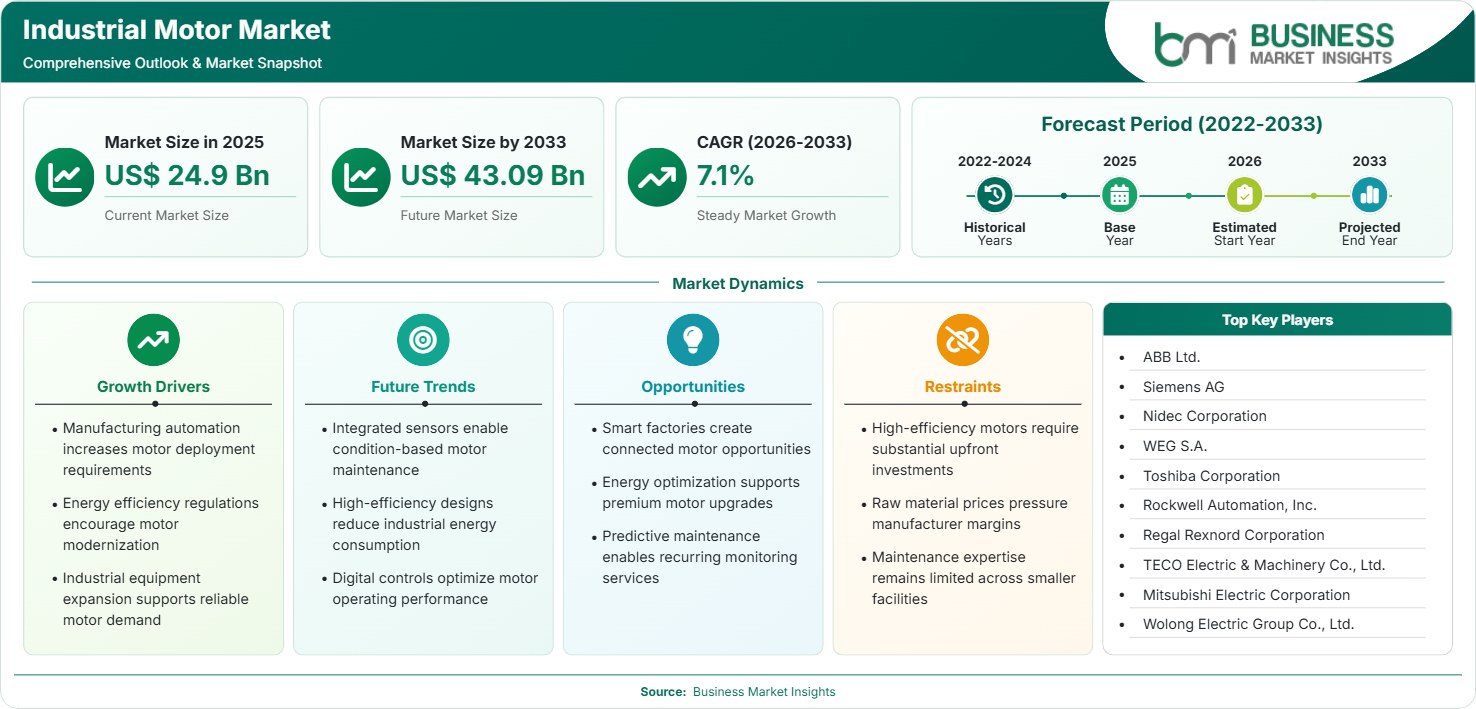
The Industrial Motor Market size was valued at US$ 24.9 Billion in 2025 and is projected to reach US$ 43.09 Billion by 2033, growing at a CAGR of 7.1% during 2026–2033, driven by industrial automation, energy efficiency, equipment modernization, and electrification across process and discrete manufacturing.

Report Coverage
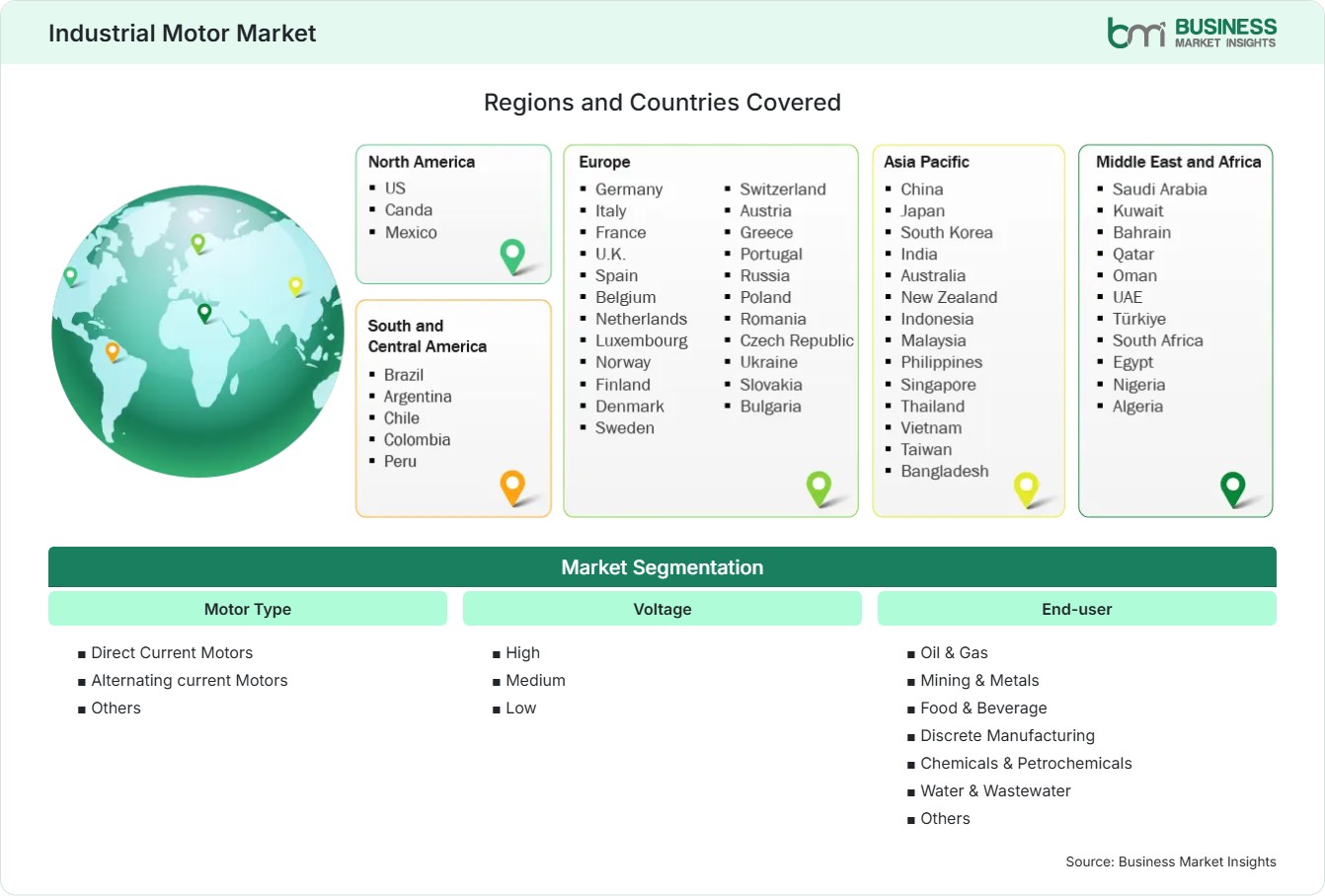
  • Motor Type: Direct Current Motors, Alternating current Motors, Others
  • Voltage: High, Medium, Low
  • End-user: Oil & Gas, Mining & Metals, Food & Beverage, Discrete Manufacturing, Chemicals & Petrochemicals, Water & Wastewater, Others
US$ 24.9 Bn Market size in 2025
US$ 43.09 Bn Market Size by 2033
7.1% CAGR, 2026 - 2033
2026-2033 Forecast Period

AI Overview

Industrial Motor Market Summary

  • North America Region: Holds a modeled  Industrial Motor market share range of 24%–28% in 2025, with a CAGR range of 6.2%–7.1% during 2026–2033. Industrial automation, replacement demand, energy-efficiency investments, and modernized manufacturing infrastructure create opportunities for advanced motor systems. The US market benefits from factory automation and infrastructure modernization, with modeled growth of 6.3%–7.2%.
  • Fastest Growing Region: Asia Pacific, with a modeled share range of 39%–43% in 2025 and a CAGR range of 8.0%–9.0% during 2026–2033. Manufacturing expansion, industrial electrification, automation investments, and infrastructure development support demand for efficient motors across emerging and established production economies.
  • Leading Segment: Alternating Current (AC) Motors, with a modeled share range of 68%–74% in 2025 and a CAGR range of 6.8%–7.6% during 2026–2033. Industrial compatibility, broad power ratings, established supply chains, and variable-speed drive integration support adoption across process and discrete manufacturing applications.
  • High Growth Segment: Medium-voltage motors, with a modeled share range of 28%–33% within voltage applications in 2025 and a CAGR range of 7.4%–8.4% during 2026–2033. Mining, water infrastructure, and heavy industrial applications support demand for reliable high-power motor systems.
  • Key Market Opportunity: Energy-efficient motors, connected monitoring, variable-frequency drives, and aftermarket replacement services create opportunities for suppliers offering lower operating costs, predictive maintenance, and integrated industrial solutions.
  • Major Market Players: ABB Ltd., Siemens AG, Nidec Corporation, WEG S.A., Toshiba Corporation, Rockwell Automation, Inc., Regal Rexnord Corporation, TECO Electric & Machinery Co., Ltd., Mitsubishi Electric Corporation, and Wolong Electric Group Co., Ltd.
Strategic Insights

Industrial Motor Market: Strategic Insights

Industrial Motor Market Strategic Framework
FREE PDF
Request your free sample
Request free sample
Stakeholder View

Key Takeaways

  • The value chain spans motor manufacturers, component suppliers, drive-system providers, original equipment manufacturers, distributors, system integrators, and aftermarket service companies. Motor selection increasingly considers total lifecycle cost rather than purchase price alone.
  • AC motors remain central to industrial applications, while medium-voltage systems offer opportunities in heavy industries requiring reliable power transmission, process continuity, and robust operating performance.
  • Motor suppliers are developing more efficient designs, digital monitoring capabilities, improved thermal management, and drive compatibility to support energy optimization and condition-based maintenance.
  • Asia Pacific combines manufacturing capacity, industrial infrastructure development, and automation investment. Demand varies across countries according to factory construction, local equipment production, and industrial modernization priorities.
  • Strategic activity across industrial automation, electrification, and motor technologies can broaden product portfolios and distribution reach. Investors should examine integration capabilities, service revenue, and exposure to cyclical industries.
  • Reliability, efficiency, operating environment, maintenance access, and compatibility with existing control systems influence purchasing decisions across oil and gas, mining, food processing, and water infrastructure.
Geographic Outlook

Industrial Motor Market Regional Highlights

North America Industrial Motor Market

North America held a modeled 24%–28% Industrial Motor Market share in 2025, with a 6.2%–7.1% CAGR range through 2033. Demand is supported by manufacturing modernization, energy infrastructure, industrial automation, and equipment replacement. The US remains the region’s principal market, while Canada contributes through resource processing, utilities, and industrial facilities. Motor suppliers compete on reliability, service coverage, efficiency, and integration with automation systems. Retrofit opportunities are relevant where aging equipment requires improved energy performance or monitoring without complete production-line replacement. Purchasing decisions vary by industry and operating environment.

  • Manufacturing modernization supports replacement of legacy motors and integration with efficient drive systems.
  • Oil and gas operators require dependable motors for demanding operating conditions and process continuity.
  • Water infrastructure projects create opportunities for pump, blower, and treatment equipment applications.
  • Connected monitoring solutions support maintenance planning and reduce unplanned equipment interruptions.

US Industrial Motor Market

The US accounted for a modeled 18%–22% global share in 2025, with a 6.3%–7.2% CAGR range through 2033. Industrial automation, data center infrastructure, manufacturing investment, and utility modernization support demand. Motor suppliers address customers seeking improved efficiency, equipment reliability, and compatibility with existing industrial controls. The market includes both new installations and replacement projects, with demand influenced by capital expenditure cycles, industrial production, and the operating requirements of sectors such as chemicals, food processing, and water treatment. Local service capabilities remain important.

  • Factory automation increases demand for motors compatible with variable-frequency drives and industrial control systems.
  • Industrial facilities evaluate replacement projects through energy consumption, maintenance requirements, and lifecycle economics.
  • Utility and water infrastructure modernization creates opportunities for motors used in pumping and auxiliary equipment.

Europe Industrial Motor Market

Europe is projected to represent a modeled 20%–24% Industrial Motor market share in 2025, with a 5.8%–6.8% CAGR range through 2033. Energy efficiency requirements, industrial electrification, and machinery modernization influence procurement. Germany and Italy remain important manufacturing markets, while Poland and selected Eastern European economies offer opportunities linked to production expansion and industrial investment. Country-level growth varies by equipment demand, energy costs, and industrial policy. Suppliers compete through efficient designs, engineered configurations, service networks, and integration with automation and process-control systems. Industrial customers increasingly assess total ownership cost.

  • Germany’s machinery and automotive ecosystems support demand for precision-engineered motor and drive systems.
  • Italy’s manufacturing base creates applications across packaging, food processing, pumps, and industrial equipment.
  • Poland offers opportunities from industrial production investments and the modernization of manufacturing facilities.
  • Energy efficiency requirements encourage assessment of motor performance during replacement and equipment upgrades.

Asia Pacific Industrial Motor Market

Asia Pacific held a modeled 39%–43% share in 2025, with a CAGR range of 8.0%–9.0% through 2033. China, Japan, South Korea, and India represent major industrial demand centers, while Southeast Asian economies offer expansion opportunities. Manufacturing capacity, infrastructure projects, automation, and process industries support motor adoption. India’s industrial investment and local manufacturing development create opportunities for domestic production and global supply chains. Demand differs across countries based on factory construction, equipment standards, energy costs, and industrial modernization. Suppliers need scalable products and regional service capabilities.

  • China’s extensive manufacturing ecosystem supports high-volume demand across machinery and industrial equipment.
  • India offers opportunities in manufacturing, infrastructure, water treatment, metals, chemicals, and energy-related applications.
  • Japan and South Korea support advanced industrial equipment demand and automation-oriented applications.
  • Southeast Asian manufacturing expansion creates opportunities for motors used in production equipment and industrial utilities.

Rest of World Industrial Motor Market

Rest of World modeled at 9%–13% Industrial Motor market share in 2025, with a 5.5%–6.7% CAGR through 2033. South and Central America provide opportunities through mining, food processing, water infrastructure, and industrial replacement applications. Brazil is still a significant market for manufacturing and resource processing operations. In the Middle East and Africa, oil and gas, desalination, mining, and infrastructure development activities affect demand. Market growth will depend on project funding, import needs, operating conditions, and the availability of technical support.

  • Brazil’s industrial and resource-processing activities support motor applications across multiple end-user industries.
  • Mining projects require motors designed for demanding operating environments and equipment reliability.
  • Middle Eastern water and desalination infrastructure creates demand for pumping and auxiliary systems.
  • African mining and infrastructure investments provide project-based opportunities, subject to financing and implementation schedules.
Global Market Geography
FREE PDF
Request your free sample
Request free sample
Segment Analysis

Industrial Motor Market Segmentation

Motor Type

The Alternating Current (AC) Motors accounted for 68% to 74% of the Industrial Motor market share in 2025, at a CAGR from 6.8% to 7.6% till 2033. AC motor technology serves a wide range of industrial applications, whereas DC technology caters to specific control needs.

  • Direct Current (DC) Motors: DC motors support applications requiring specific speed and torque control. Industrial uses include legacy equipment, specialized machinery, and applications where existing electrical architectures influence replacement decisions.
  • Alternating current (AC) Motors: AC motors serve broad industrial applications across pumps, compressors, fans, conveyors, and processing equipment. Compatibility with variable-frequency drives supports speed control and energy management.

Voltage

Voltage selection depends on the needs of the equipment for power, installation conditions, safety considerations, and electrical system facilities. Low-voltage motors power all types of industrial equipment, whereas medium- and high-voltage systems serve higher loads and process requirements. The need depends on project size and equipment configuration.

  • High: High-voltage motors support large industrial loads and demanding continuous-duty operations. Their use is linked to major process equipment, power-intensive facilities, and applications requiring suitable electrical integration.
  • Medium: Medium-voltage motors address applications requiring substantial power capacity and reliable operation. Mining, water infrastructure, and heavy industrial equipment provide relevant demand opportunities.
  • Low: Low-voltage motors are widely used in machinery, pumps, fans, conveyors, and auxiliary systems. Broad availability, installation flexibility, and drive compatibility support adoption.

End-user

The end-user requirements will vary depending on the operating conditions, operational continuity, equipment duty cycle, and maintenance considerations. Industries such as oil & gas, mining, and chemicals prioritize performance, whereas the food & beverage and water industries focus more on hygiene and reliability.

  • Oil & Gas: Motors serve pumps, compressors, fans, and process equipment. Hazardous-area requirements, reliability, and continuous operation influence product selection.
  • Mining & Metals: Heavy-duty machinery, conveyors, pumps, and processing equipment require motors designed for demanding environments and substantial operating loads.
  • Food & Beverage: Production and packaging equipment uses motors selected for operational reliability, suitable enclosure designs, sanitation requirements, and maintenance accessibility.
  • Discrete Manufacturing: Automated machinery, conveyors, machine tools, and assembly equipment support demand for motors with precise control and integration capabilities.
  • Chemicals & Petrochemicals: Process plants require motor solutions compatible with demanding operating conditions, safety requirements, and continuous-duty equipment.
  • Water & Wastewater: Pumps, blowers, and treatment systems create demand for reliable motors that support continuous operation and efficient facility management.
Market Forces

Industrial Motor Market Dynamics

Key Market Drivers

Industrial Automation and Equipment Modernization

The use of automation in industry is another factor driving demand for motors compatible with variable-frequency drives, control systems, and digital monitoring systems. Companies upgrading manufacturing lines consider motor performance, accuracy, maintenance, and automation upgrades. Demand for both new machinery and motor replacements is rising, creating opportunities for suppliers offering a wide range of products. AC motors are used in conveyors, pumps, fans, and processing machinery due to their proven track record in industrial applications. The industrial motor market growth is also driven by the need to ensure the continuity of production processes, control energy usage, and upgrade equipment to meet changing production needs.

Energy Efficiency and Lifecycle Cost Management

Energy use is an important factor to consider when buying an industrial motor, since these motors operate in both continuous and discontinuous production processes. Energy savings can help reduce operating costs when equipment operates continuously or under heavy loads. Industrial buyers evaluate motor efficiencies along with the drive system, load matching, maintenance issues, and operation schedule. Regulatory efficiency standards and corporate sustainability policies affect the decisions of industrial buyers in certain markets. The industrial motor market trends include advancements in motor design, drives, and equipment monitoring. The buyers need proof of the equipment's suitability rather than efficiency figures. Replacement options exist when the existing equipment is expensive to operate, lacks control, or poses maintenance challenges.

Expansion of Process Industries and Infrastructure

Industrial motors provide power to vital machinery in water treatment, chemical, oil & gas, mining, metals, and food processing applications. Growth and modernization of these sectors drive demand for motors in pumping, conveying, compressing, ventilating, and processing. The need for motors varies with the type of environment in which they will be used, the nature of the loads, safety requirements, and continuity of operations. Investments in infrastructure create demand for big equipment installations, while maintenance and renovation create demand for repeat purchases. The industrial motor industry is advantageous due to its diverse applications, but purchasing decisions may depend on approvals from funding bodies and project schedules. Manufacturers with application-specific engineering, service facilities, and certification will be able to cater to diverse needs. The reliability of the machines, energy efficiency, and maintenance costs are considered by buyers.

Key Market Opportunities

Connected Motors and Predictive Maintenance Solutions

There are potential benefits to using digital monitoring to increase motor value through condition assessment, maintenance scheduling, and performance monitoring. There could be an option to use sensors and platforms to monitor temperature, vibration, and operating conditions in industrial settings, where appropriate. Customers will be able to use these features to identify equipment issues and schedule necessary maintenance. The adoption level will depend on the motor's criticality to the customer, the state of the customer’s digitalization infrastructure, cybersecurity needs, and the importance of the monitoring activity itself. This application is highly relevant for installations with numerous motors or those that can afford the high costs of downtime. Yet, for adoption to be possible, the monitoring system must deliver valuable insights to the customers.

High-Efficiency Motor Replacement and Retrofit Programs

Replacement schemes for industrial applications offer an avenue of improving old machines without having to reconstruct the whole production system. The customers may be interested in buying machines that operate for many hours, perform poorly, require frequent maintenance, and have limited capability to interact with modern control systems. Replacement programs could be used by suppliers to offer replacement services, motor selection, installation, and drives. Industrial Motor Market Forecasts need to account for the distinction between new equipment purchases and replacements, as both drive market growth but have distinct purchase cycles. Retrofitting can also help generate sales for aftermarket services such as parts and maintenance.

Application-Specific Motor Solutions for Emerging Industrial Demand

Industrial growth in water systems, renewable energy, data center infrastructure, and manufacturing automation provides opportunities for specialized motors tailored to the particular demands of the application. Supplier differentiation can be achieved through thermal efficiency, enclosures, hazardous-area capability, corrosion protection, and controllers. Different needs are met by different applications, and application engineering plays a crucial role in the selling process. It is possible to increase supplier relevance in projects with special needs that cannot be satisfied using conventional products. Market participants can also develop their manufacturing and service networks locally to shorten delivery times and provide more technical assistance. The potential will depend on the pace of industrial investments and specifications.

Market Restraints and Challenges

Raw Material Costs and Supply Chain Volatility

Factor: The manufacture of industrial motors involves materials and components such as copper, electrical steel, aluminum, insulating material, bearings, and electronic components. Price uncertainty, logistical challenges, and limited supply could pose production and logistical issues.

Impact: The manufacturer will experience margin pressure, inventory management challenges, and pressure on quotations due to price uncertainty. Customers could postpone purchasing decisions or reassess equipment design specifications due to limited budgets. Procurement practices, diversification, and inventory management will be important for dealing with potential disruptions. In addition, some motor designs will require specific components, and the availability of these components will determine production schedules. The effect varies depending on product design complexity, manufacturing locations, types of contracts, and the ability to pass the cost of changes in inputs to selling prices.

Technical Integration and Replacement Complexity

Factor: Motor replacement in industrial applications often requires consideration of compatibility with mounting sizes, loading, electrical systems, controls, operating conditions, and equipment downtime. A motor with an adequate power rating might still require further engineering prior to installation.

Impact: Integration difficulties will lead to extended timeframes and additional installation costs. Customers will delay replacing existing motors when the potential efficiency savings are not deemed sufficient to offset the production interruption or engineering costs. The suppliers will need to consider the overall equipment configuration and cannot recommend products solely based on their power ratings. Engineering, documentation, commissioning, and compatibility testing could minimize installation risks. The issue will be much greater in the case of old facilities lacking documentation or custom equipment. Although digital monitoring and advanced drives will improve performance, their integration will require additional costs and staff training.

Company Analysis

Competitive Landscape

The competitive environment includes global electrification companies, dedicated motor manufacturers, industrial automation providers, and regional specialists. Industrial Motor Market analysis indicates that suppliers compete through product efficiency, application engineering, distribution coverage, service capabilities, and manufacturing scale. The Indian market also demonstrates participation from multinational and domestic manufacturers, with the SEBI-published industry exhibit identifying several key suppliers.

Company Name

Overview

Products and Services relevant to this market

ABB Ltd.

Global electrification and automation supplier with industrial motor manufacturing and service capabilities.

Low-voltage and medium-voltage motors, synchronous reluctance solutions, drives, monitoring, and maintenance services.

Siemens AG

Industrial technology company with established motor and automation capabilities.

Industrial motors, drives, automation systems, and lifecycle support.

Nidec Corporation

Global motor manufacturer with industrial and automation product portfolios.

Industrial motors, motor systems, automation solutions, and specialized motor technologies.

WEG S.A.

Electrical equipment manufacturer serving industrial and infrastructure customers.

AC and DC motors, industrial drives, generators, and integrated electrical solutions.

Toshiba Corporation

Technology and industrial equipment provider with motor-related capabilities.

Industrial motors, electrical equipment, and solutions for industrial applications.

Rockwell Automation, Inc.

Industrial automation supplier with motor control and integrated automation offerings.

Motor control systems, drives, automation platforms, and industrial control solutions.

Regal Rexnord Corporation

Manufacturer of motion control and power transmission products.

Industrial motors, electric motion products, power transmission, and related services.

TECO Electric & Machinery Co., Ltd.

Electrical equipment manufacturer with motor and industrial system offerings.

AC motors, industrial electrical equipment, drives, and engineered motor solutions.

Mitsubishi Electric Corporation

Industrial automation and electrical technology provider.

Motors, drives, automation systems, and control technologies for manufacturing applications.

Wolong Electric Group Co., Ltd.

Electric motor and drive manufacturer serving industrial and commercial applications.

Industrial motors, generators, motor systems, and electrical equipment.

Trust & Transparency

Research Methodology

The market analysis combines proprietary research with secondary data from government agencies, company disclosures, regulatory filings, industry databases and expert interviews. Market estimates are validated through data triangulation, cross-market benchmarking and analyst review.

View Full Research Methodology

Questions Answered

Frequently Asked Questions

What does an Industrial Motor Market Report typically examine?

A Market Report typically examines market size, growth outlook, motor technologies, voltage categories, end-user applications, regional demand, competitive participants, and industry developments. The depth of coverage depends on the report methodology and scope.

What services complement industrial motor sales?

Common supporting services include equipment selection, installation assistance, commissioning, maintenance, repair, spare parts, diagnostics, and retrofit engineering. Service requirements depend on motor criticality and the customer’s maintenance strategy.

Which industries use industrial motors?

Industrial motors are used in oil and gas, mining and metals, food and beverage, discrete manufacturing, chemicals and petrochemicals, and water and wastewater applications. Equipment requirements differ across industries.

How do industrial motors support energy efficiency?

Efficient motor designs, suitable sizing, variable-frequency drives, and optimized operating schedules can support lower energy consumption. The actual benefit depends on load profile, operating hours, equipment condition, and system configuration.

What factors influence industrial motor selection?

Motor selection depends on power requirements, load characteristics, speed control, efficiency, operating conditions, electrical infrastructure, installation requirements, and maintenance considerations. Application-specific factors influence whether a low-, medium-, or high-voltage motor is suitable.

Access the Full Industrial Motor Market Report

Get segment-level forecasts, regional estimates, competitive benchmarking, company profiles and downloadable Excel datasets.

Access the full Industrial Motor Market Report
350 pages PDF & Excel | 2026-09-28
Similar Research

Related Market Reports