
Industrial Lasers Market Outlook: Size, Share, Trends, Growth Analysis, Competitive Landscape & Forecast, 2026-2033

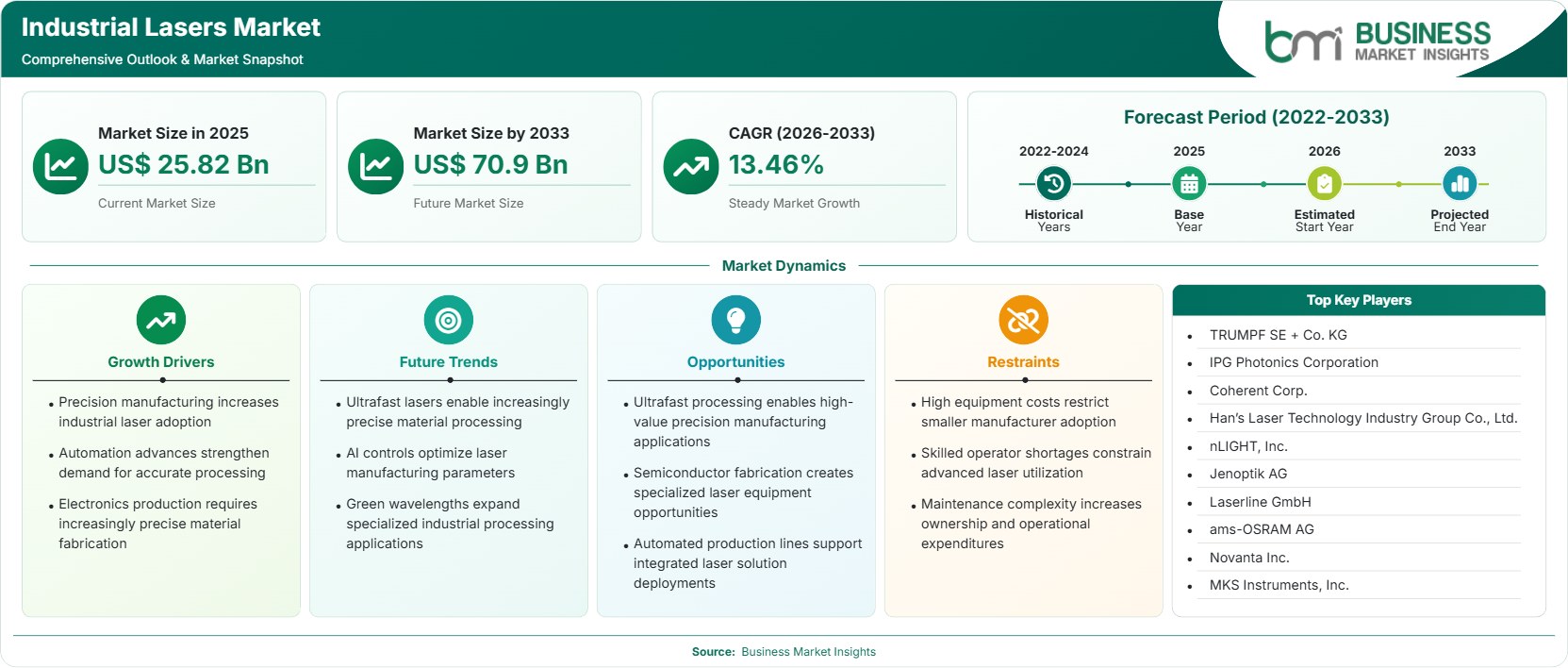
The Industrial Lasers Market size was valued at US$ 25.82 Billion in 2025 and is projected to reach US$ 70.9 Billion by 2033, growing at a CAGR of 13.46% during 2026–2033. Rising factory automation, precision manufacturing adoption, electric vehicle production expansion, and semiconductor fabrication investments are accelerating demand, while advanced materials processing and Industry 4.0 initiatives create new opportunities.

Report Coverage
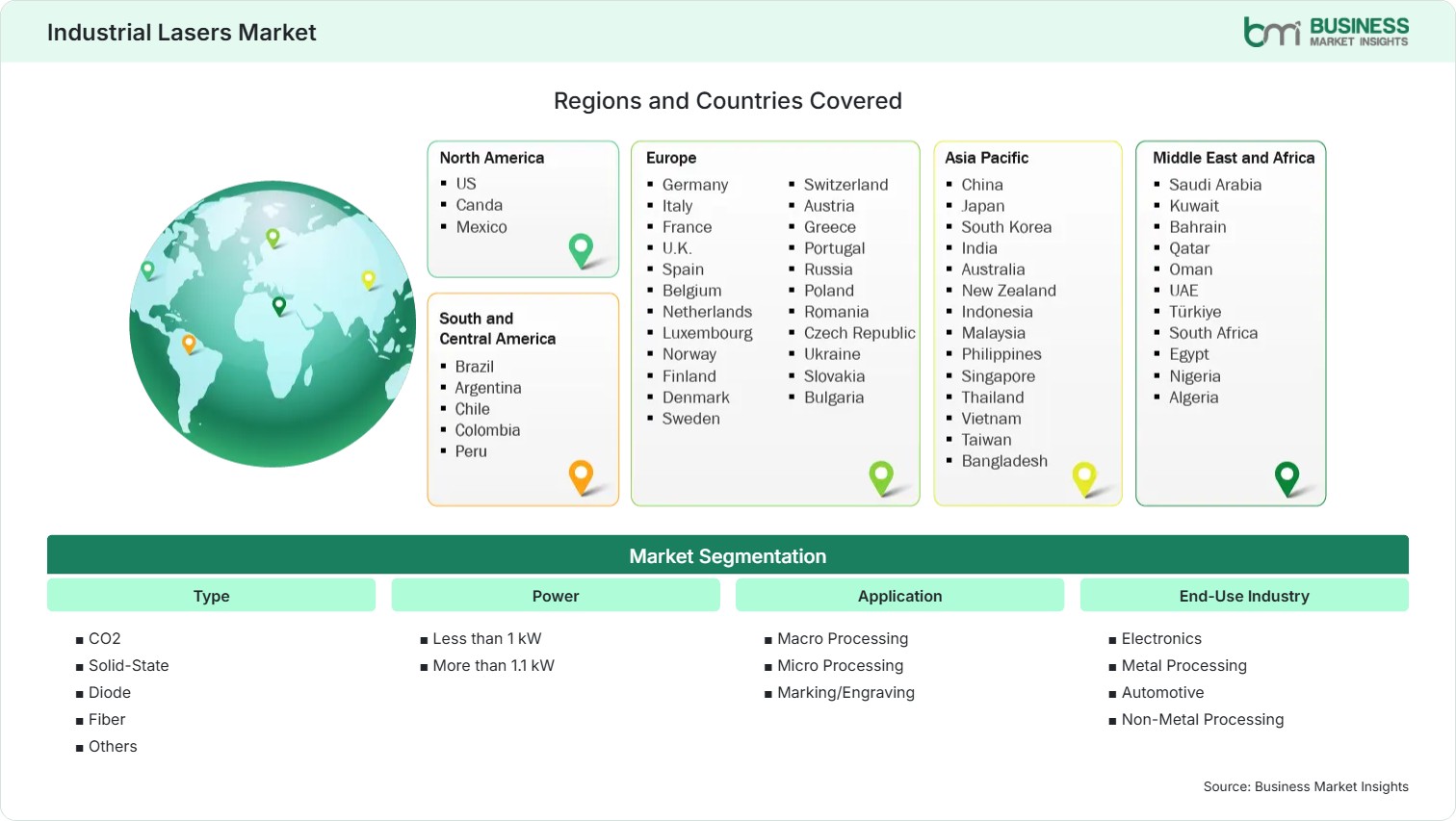
  • Type: CO2, Solid-State, Diode, Fiber, Others
  • Power: Less than 1 kW, More than 1.1 kW
  • Application: Macro Processing, Micro Processing, Marking/Engraving
  • End-Use Industry: Electronics, Metal Processing, Automotive, Non-Metal Processing
US$ 25.82 Bn Market size in 2025
US$ 70.9 Bn Market Size by 2033
13.46% CAGR, 2026 - 2033
2026-2033 Forecast Period

AI Overview

Industrial Lasers Market Summary

  • North America Region: North America holds a market share of 31%–34% in 2025, growing at a CAGR of 11.8%–13.2% during 2026–2033. Demand is supported by aerospace manufacturing, semiconductor investments, EV production scaling, defense modernization programs, digital factories, additive manufacturing deployment, reshoring strategies, precision fabrication requirements, productivity goals, sustainability initiatives, and advanced industrial automation adoption. US market benefits from semiconductor investment programs and automotive innovation, expanding at approximately 12.0%–13.5% CAGR.
  • Fastest Growing Region: Asia Pacific holds a market share of 39%–42% in 2025, expanding at a CAGR of 14.8%–16.5% during 2026–2033. Strong electronics manufacturing, growing EV production, semiconductor capacity expansion, industrial automation investments, export-oriented manufacturing growth, infrastructure development, smart factory programs, precision processing demand, and government-supported advanced manufacturing initiatives accelerate market expansion.
  • Leading Segment: Fiber Lasers account for 38%–42% share in 2025 and are expected to expand at a CAGR of 14.2%–15.8%. Superior energy efficiency, lower maintenance requirements, higher beam quality, compatibility with automated production environments, versatile materials processing capabilities, operational cost advantages, productivity improvements, and precision cutting applications sustain robust adoption globally.
  • High Growth Segment: Electronics represents 27%–31% share in 2025 and is anticipated to advance at a CAGR of 15.5%–17.2%. Rising semiconductor fabrication, miniaturized electronics production, battery manufacturing investments, precision micromachining requirements, smartphone component processing, display manufacturing expansion, AI hardware demand, and advanced packaging technologies create strong growth prospects.
  • Key Market Opportunity: Expanding investment in battery manufacturing, semiconductor fabrication facilities, and advanced electronics production creates substantial opportunities for precision beam technologies supporting micron-level processing accuracy, speed improvements, reduced waste generation, and automated manufacturing integration.
  • Major Market Players: TRUMPF SE + Co. KG, IPG Photonics Corporation, Coherent Corp., Han’s Laser Technology Industry Group Co., Ltd., nLIGHT, Inc., Jenoptik AG, Laserline GmbH, ams-OSRAM AG, Novanta Inc., MKS Instruments, Inc.
Strategic Insights

Industrial Lasers Market: Strategic Insights

Industrial Lasers Market Strategic Framework
FREE PDF
Request your free sample
Request free sample
Stakeholder View

Key Takeaways

  • As a result, supply chains are becoming more localised because manufacturers want to increase resilience, reduce lead times, and gain better control over key components such as laser sources, optics, motion systems, and precision automation equipment.
  • The greatest near-future scope for expansion lies in the field of electronics manufacturing, in the production of batteries, in semiconductor fabrication and in precision micro-processing applications since the tolerance requirements are still becoming more stringent.
  • Innovation in technology is now focusing on intelligent beam control, AI-assisted process optimization, real-time monitoring software, and more efficient fibre-based structures which increase productivity at the same time as they lower operating costs.
  • The investment environment in Asia Pacific is highly attractive because of the region's concentration in electronics production, the government's support for manufacturing initiatives, the expansion of semiconductor projects, and the increasing adoption of industrial automation.
  • People in the industry are carrying out acquisitions, forming strategic partnerships, and launching moves towards vertical integration to enhance their software capabilities, application expertise, service networks, and specialized processing solutions.
  • The increasing demand for additive manufacturing and hybrid production systems is leading suppliers to create integrated solutions that combine cutting, welding, marking, inspection, and monitoring functions within the same production environment.
Geographic Outlook

Industrial Lasers Market Regional Highlights

North America Industrial Lasers Market

North America accounted for approximately 31%–34% Industrial Lasers Market share in 2025 and is projected to register a CAGR of 11.8%–13.2% through 2033. Investment in semiconductor plants, aerospace manufacturing, battery manufacturing, and modern automobile production keeps boosting demand for copper. Manufacturers have started using automatic fabrication techniques in order to improve productivity, cut cost, and ensure accuracy.

  • Investments in semiconductor manufacturing are still leading to greater demand for precision cutting, drilling, and micro-processing technologies which are used in wafer fabrication, packaging, and component assembly applications.
  • Aerospace suppliers are using advanced welding and cutting systems to work with lightweight alloys and high-performance materials while still meeting their strict quality requirements.
  • Increasingly, car manufacturers are incorporating automated processing cells to support the production of EV batteries, the fabrication of lightweight components, and scalable manufacturing operations.
  • The defence modernisation programmes promote the use of advanced manufacturing systems for the production of precise components, for materials processing, and for industrial applications which are essential to the mission.
  • The growth of additive manufacturing facilities is leading to greater demand for integrated process technologies that enable production flexibility and shorter development times.

US Industrial Lasers Market

The United States represented approximately 72%–76% of North American Industrial Lasers Market revenue in 2025 and is projected to grow at a CAGR range of 12.0%–13.5% through 2033. Strong investments in semiconductor fabrication plants, aerospace manufacturing, EV supply chains, and defense-related production facilities continue driving equipment deployments.

  • The projects involving the fabrication of semiconductors are causing a great deal of demand for equipment to meet the requirements for precise manufacturing and to support the aim of expanding domestic chip production.
  • Aerospace and defence manufacturers are still going ahead with modernising their production capabilities by means of automation, digital manufacturing systems and advanced fabrication technologies.
  • The increase in investment in the manufacture of EV batteries leads to the deployment of welding and precision processing systems which enable scalable and efficient production environments.
  • The growth in the production of medical technology promotes the adoption of high-precision micro-processing solutions, which are needed for manufacturing complex devices.

Europe Industrial Lasers Market

Europe accounted for approximately 22%–25% of Industrial Lasers Market revenue in 2025 and is projected to expand at a CAGR of 11.5%–12.8% during 2026–2033. The region benefits from strong automotive, aerospace, manufacturing equipment, and high-tech industries. Germany continues to be the largest contributor because of its technical expertise and industrial automation capabilities, but Eastern Europe is also becoming a preferred place for manufacturing.

  • Germany has the highest level of demand in the region at a compound annual growth rate of 11.8% to 13.0%, due to its automotive production, machine tools, industrial automation, and advanced engineering ecosystems.
  • France is still making investments in the modernisation of its aerospace manufacturing and in precision fabrication technologies to support high-value industrial applications and to improve productivity.
  • Italy is still a major market for metalworking equipment, the manufacturing of industrial machinery, and precision fabrication technologies aimed at serving industries that rely on exports.
  • Poland is one of the fastest-growing foreign markets, with a compound annual growth rate ranging from 13.5% to 15.0%, due to industrial expansion and foreign direct manufacturing investment.
  • There is an increasing focus on energy efficiency and on sustainable manufacturing methods, which is causing more European production sites to adopt advanced processing systems.

Asia Pacific Industrial Lasers Market

Asia Pacific represented approximately 39%–42% of global revenue in 2025 and is expected to achieve a CAGR of 14.8%–16.5% through 2033, making it the fastest-growing regional market. The growth in the manufacture of electronics, batteries, semiconductors and the use of automation in industries continues to create demand. China is the main consumer in the region with India and Southeast Asian countries undergoing fast industrialization.

  • China is still the biggest regional market, with high demand coming from the electronics, automotive, battery, semiconductor, and industrial equipment manufacturing sectors.
  • India is one of the fastest-growing country markets, with a compound annual growth rate ranging from 15.5% to 17.5%, due to manufacturing incentives and industrial modernization initiatives.
  • Because it has a leading position in both semiconductor and display manufacturing, South Korea benefits from continued demand for precise micro-processing technologies.
  • Japan is still concentrating on advanced automation, the integration of robotics, and its application in high-value manufacturing areas which require sophisticated fabrication capabilities.
  • Southeast Asia is seeing a growing amount of foreign investment being directed towards electronics production and the expansion of industrial manufacturing capacity.

Rest of World Industrial Lasers Market

In 2025 the Rest of World region made up about 8% to 11% of global revenue and is expected to achieve a compound annual growth rate of 12.5% to 14.0% through to 2033. In South and Central America, industrial modernization and investments in automotive manufacturing are providing benefits. At the same time, the markets in the Middle East and Africa are being supported by economic diversification strategies, industrial development programs, and infrastructure expansion.

  • Brazil is still the largest market in South and Central America, due to investments in automotive manufacturing, metal processing, and industrial production.
  • Mexico benefits from the advantages of the nearshoring trend, the growth in export-oriented manufacturing, and the increasing use of advanced fabrication technologies.
  • Saudi Arabia is becoming a high-growth market, with a compound annual growth rate between 13.5% and 15.0%, as a result of its industrial diversification initiatives.
  • The United Arab Emirates is still making investments in advanced manufacturing, aerospace, and technology-driven industrial development strategies.
  • The expansion of industrial infrastructure and the implementation of modernization plans increase the demand for equipment in rapidly developing manufacturing economies.
Global Market Geography
FREE PDF
Request your free sample
Request free sample
Segment Analysis

Industrial Lasers Market Segmentation

Type

The type segment plays a critical role in defining technology adoption patterns. Fiber-based solutions held the largest share of approximately 38%–42% in 2025 and are expected to record a CAGR of 14.2%–15.8% through 2033. The Industrial Lasers Market scope continues expanding as manufacturers prioritize efficiency, precision, lower maintenance requirements, and compatibility with automated production systems across diverse industrial applications.

  • CO2: Widely utilized in cutting, engraving, and processing non-metallic materials. Strong adoption across packaging, woodworking, plastics, and textile manufacturing supports continued demand despite increasing competition from newer technologies.
  • Solid-State: Preferred for high-precision applications requiring concentrated energy delivery. Adoption remains strong in electronics processing, medical device manufacturing, aerospace applications, and advanced materials fabrication environments.
  • Diode: Compact designs, high electrical efficiency, and integration flexibility support increasing deployment in pumping applications, welding processes, and industrial manufacturing operations requiring controlled energy output.
  • Fiber: Superior beam quality, lower maintenance requirements, and exceptional energy efficiency drive broad deployment across metal cutting, welding, additive manufacturing, and automated production environments.

Power

Power classification influences performance suitability across industrial applications. Systems exceeding 1.1 kW account for an estimated 58%–62% share in 2025 and are anticipated to expand at a CAGR of 13.8%–15.2%. Increasing demand for thicker material processing, heavy industrial applications, and high-throughput manufacturing environments continues to support adoption across major industrial sectors globally.

  • Less than 1 kW: Commonly adopted for marking, engraving, electronics processing, and precision micro-fabrication applications where high accuracy is prioritized over deep penetration capabilities.
  • More than 1.1 kW: Favored for industrial cutting, welding, large-scale fabrication, automotive manufacturing, and heavy-duty production processes requiring increased productivity and material processing depth.

Application

Application diversity remains a key strength of the market. Macro processing represented approximately 46%–50% share in 2025 and is projected to grow at a CAGR of 12.8%–14.2%. Expanding demand from metal fabrication, automotive production, industrial machinery manufacturing, and infrastructure-related applications continues to support broad deployment across global production ecosystems.

  • Macro Processing: Supports high-volume cutting, welding, drilling, and fabrication activities across automotive, machinery, construction equipment, and industrial manufacturing sectors.
  • Micro Processing: Gains momentum through semiconductor production, electronics miniaturization, precision medical devices, and advanced component manufacturing requiring micron-level accuracy and consistency.
  • Marking/Engraving: Adoption continues rising due to traceability requirements, product identification standards, anti-counterfeiting measures, and regulatory compliance needs across manufacturing industries.

End-Use Industry

End-use demand increasingly reflects investments in digital manufacturing and advanced production capabilities. Electronics accounted for approximately 27%–31% market share in 2025 and is forecast to achieve a CAGR of 15.5%–17.2% through 2033. Growing semiconductor fabrication, battery manufacturing expansion, and increasing device miniaturization continue shaping Industrial Lasers Market trends across major manufacturing economies.

  • Electronics: Precision micromachining, semiconductor production, display fabrication, and advanced packaging requirements continue driving strong equipment demand from technology manufacturers.
  • Metal Processing: Extensive use in cutting, welding, drilling, and fabrication applications supports steady demand across construction, machinery, aerospace, and industrial manufacturing sectors.
  • Automotive: Growing electric vehicle production, lightweight material adoption, and automated manufacturing investments support increasing deployment of advanced processing technologies.
  • Non-Metal Processing: Applications across plastics, wood, composites, textiles, ceramics, and packaging industries contribute to diversified market demand patterns.
Market Forces

Industrial Lasers Market Dynamics

Key Market Drivers

Expansion of Electric Vehicle and Battery Manufacturing

The accelerating transition toward electric mobility is creating substantial demand for advanced cutting, welding, drilling, and marking technologies across battery and vehicle manufacturing facilities. Global automotive manufacturers continue investing in battery gigafactories, requiring precision processing solutions for electrode fabrication, battery cell assembly, and power electronics production. Industrial Lasers Market growth is increasingly linked to the ability of manufacturers to improve battery performance while reducing production defects and material waste. High-energy processing systems enable narrow weld seams, improved consistency, and faster throughput compared with conventional manufacturing methods.

Growing Semiconductor and Electronics Manufacturing Investments

Demand for precision micro-processing technologies continues rising as semiconductor manufacturers expand fabrication capacity and electronics producers pursue miniaturization. Advanced integrated circuits, display components, sensors, and electronic assemblies require micron-level processing accuracy that conventional fabrication methods struggle to achieve efficiently. Industrial Lasers Market growth is strengthened by increasing investments in semiconductor facilities across Asia Pacific, North America, and Europe. Growing adoption of artificial intelligence hardware, high-performance computing systems, and advanced consumer electronics is generating sustained demand for production technologies capable of delivering repeatable precision, reduced defects, and scalable manufacturing performance.

Increasing Adoption of Smart Manufacturing and Automation

Manufacturers worldwide are incorporating advanced automation technologies to improve efficiency, quality control, and operational flexibility. Automated fabrication cells equipped with robotics, machine vision, and digital monitoring systems increasingly rely on precision processing equipment capable of seamless integration into Industry 4.0 environments. Industrial Lasers Market trends reflect this shift toward intelligent manufacturing ecosystems where productivity, traceability, and data-driven process optimization are critical competitive factors. Modern manufacturing facilities prioritize equipment capable of supporting real-time monitoring, predictive maintenance, and high-volume production requirements.

Key Market Opportunities

Expansion of Additive Manufacturing Applications

Additive manufacturing is moving beyond prototyping toward large-scale production environments, creating attractive opportunities for suppliers. Aerospace, medical, automotive, and industrial equipment manufacturers are adopting metal additive manufacturing technologies to reduce material waste and improve design flexibility. Precision beam-processing systems remain central to these production approaches. Industrial Lasers Market Forecasts increasingly reflect growing investments in industrial-scale additive manufacturing infrastructure. As manufacturers pursue lightweight components, customized production, and shorter design cycles, demand for high-performance processing solutions is expected to increase.

Industrial Digitalization Across Emerging Economies

Emerging manufacturing economies continue investing heavily in factory modernization, automation deployment, and production efficiency initiatives. Governments across India, Southeast Asia, the Middle East, and Latin America are promoting advanced manufacturing capabilities through incentive programs and industrial development policies. These initiatives provide significant opportunities for technology suppliers seeking expansion beyond mature markets. Rising labor costs and increasing global competitiveness are encouraging manufacturers to adopt advanced production systems capable of improving consistency and throughput.

Rising Demand for Precision Medical Device Manufacturing

Medical device manufacturers increasingly require advanced processing technologies capable of producing highly precise and repeatable components. Applications involving implants, surgical instruments, diagnostic devices, and microfluidic systems often require intricate geometries and tight dimensional tolerances. Expenses in healthcare and advancements in medical technology are fueling growth in production all over the world. With the aid of precision manufacturing technology, manufacturers are able to not only comply with regulations but also enhance efficiency and reduce wastage in production. With the rising popularity of minimally invasive procedures and improved diagnostic options, the demand for efficient manufacturing systems will grow immensely.

Market Restraints and Challenges

High Initial Capital Investment Requirements

Factor: Advanced manufacturing systems require significant upfront investments involving equipment acquisition, software integration, facility modifications, automation infrastructure, and workforce training. Impact: These costs can limit adoption among small and medium-sized manufacturers operating under restricted capital budgets. Although long-term productivity benefits are often compelling, investment payback periods remain a critical purchasing consideration. Additional spending associated with maintenance, integration services, and application development further increases total ownership costs.

Shortage of Skilled Technical Workforce

Factor: Effective deployment and operation of sophisticated fabrication systems require experienced technicians, engineers, programmers, and process specialists capable of managing complex manufacturing environments. Impact: Workforce shortages can constrain implementation timelines and reduce operational efficiency. Many manufacturers struggle to recruit qualified personnel with expertise in automation, precision processing, software integration, and process optimization. This challenge is particularly evident within rapidly industrializing economies where technology adoption frequently outpaces workforce development.

Company Analysis

Competitive Landscape

Industrial Lasers Market analysis highlights competition among established global manufacturers emphasizing innovation, automation integration, precision processing expertise, and application-specific solutions.

Company Name

Overview

Products and Services relevant to this market

TRUMPF SE + Co. KG

German industrial technology leader recognized for advanced manufacturing systems and extensive global service capabilities.

Laser cutting systems, welding solutions, marking equipment, automation technologies, and smart manufacturing platforms.

IPG Photonics Corporation

Pioneer in high-performance fiber technologies with strong presence across industrial manufacturing applications.

Fiber laser sources, amplifiers, welding systems, cutting technologies, and industrial processing solutions.

Coherent Corp.

Global photonics provider serving industrial, electronics, medical, and scientific manufacturing industries.

Industrial laser systems, optics, semiconductor processing solutions, and precision manufacturing technologies.

Han's Laser Technology Industry Group Co., Ltd.

Major Asian manufacturer with broad portfolio targeting diverse industrial processing applications.

Laser cutting, welding, engraving, marking, and automation-integrated manufacturing systems.

nLIGHT, Inc.

Specialist in semiconductor and fiber technologies supporting advanced industrial applications.

High-power laser solutions, beam-control systems, and precision manufacturing equipment.

Jenoptik AG

Technology company offering photonic solutions for industrial processing and advanced manufacturing sectors.

Laser modules, photonic systems, metrology technologies, and industrial processing solutions.

Laserline GmbH

Recognized provider specializing in high-power diode technologies for industrial production environments.

Diode laser systems, cladding solutions, welding technologies, and manufacturing process support.

ams-OSRAM AG

Global photonics and semiconductor company supporting industrial processing applications.

Laser emitters, optical components, sensing technologies, and photonic solutions.

Novanta Inc.

Precision technology supplier serving industrial automation and advanced manufacturing markets.

Laser subsystems, motion control technologies, vision systems, and automation solutions.

MKS Instruments, Inc.

Diversified technology provider supporting advanced manufacturing and semiconductor industries.

Laser systems, optics, process control solutions, and advanced manufacturing technologies.

Trust & Transparency

Research Methodology

The market analysis combines proprietary research with secondary data from government agencies, company disclosures, regulatory filings, industry databases and expert interviews. Market estimates are validated through data triangulation, cross-market benchmarking and analyst review.

View Full Research Methodology

Questions Answered

Frequently Asked Questions

What does an Industrial Lasers Market Report typically evaluate?

An Industrial Lasers Market Report generally assesses market size, competitive dynamics, technology evolution, regional demand patterns, investment opportunities, supply-chain developments, segmentation performance, and future growth prospects.

Which region offers the most attractive investment opportunities?

Asia Pacific remains the most attractive growth region because of strong electronics manufacturing capacity, industrial automation expansion, government incentives, and ongoing semiconductor and electric vehicle investments.

How does fiber technology differ from traditional alternatives?

Fiber-based systems generally provide higher energy efficiency, improved beam quality, reduced maintenance requirements, and better suitability for automated manufacturing compared with several conventional processing technologies.

What application area offers the strongest future demand potential?

Electronics and semiconductor manufacturing present particularly strong opportunities due to increasing miniaturization, advanced packaging requirements, battery production expansion, and rising demand for AI-enabled hardware systems.

What factors are driving adoption across manufacturing industries?

Growing automation, electric vehicle production, semiconductor investments, precision fabrication requirements, and demand for energy-efficient manufacturing solutions are accelerating adoption across multiple industrial sectors worldwide.

Access the Full Industrial Lasers Market Report

Get segment-level forecasts, regional estimates, competitive benchmarking, company profiles and downloadable Excel datasets.

Access the full Industrial Lasers Market Report
350 pages PDF & Excel | 2026-09-22
Similar Research

Related Market Reports