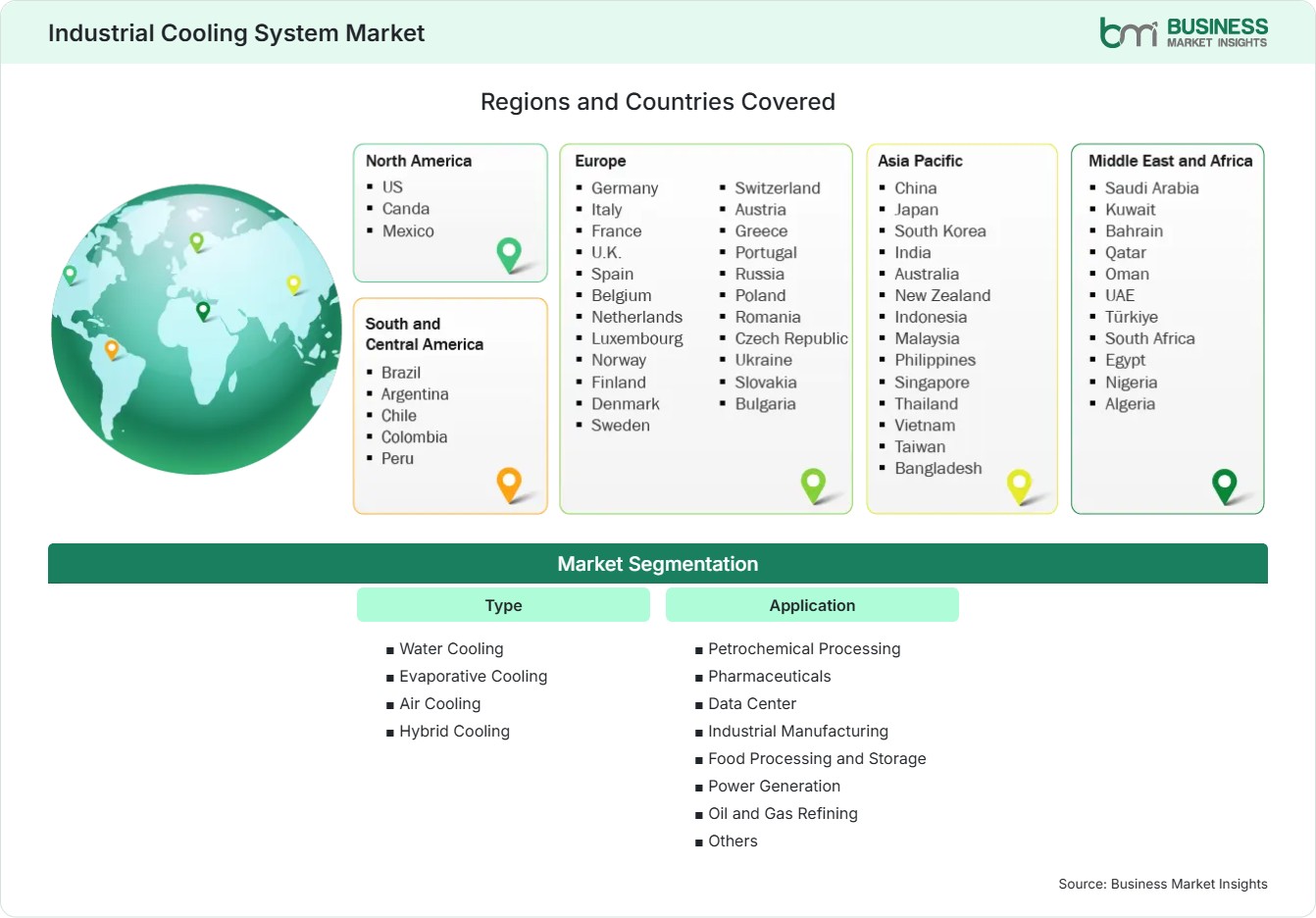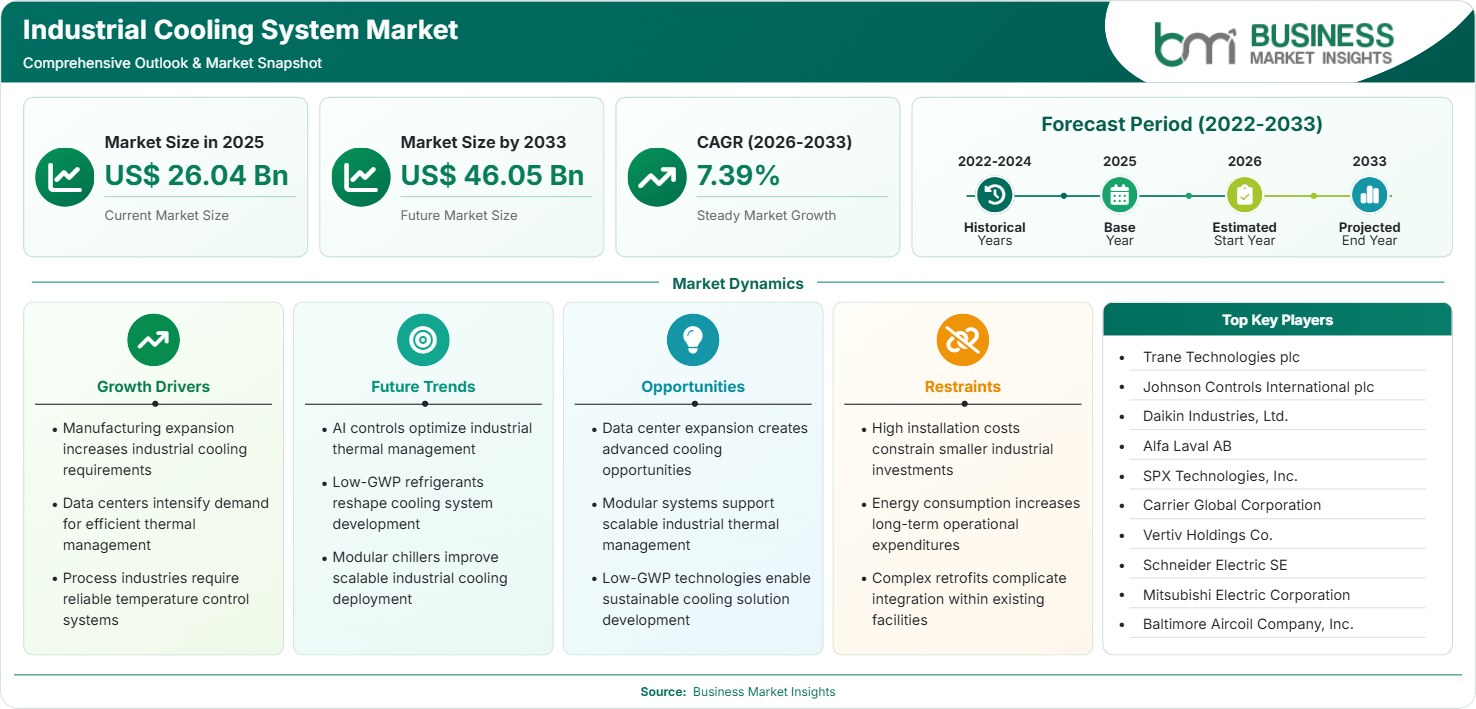
Industrial Cooling System Market Regional Highlights
North America Industrial Cooling System Market
North America accounted for 34%–37% of global revenue in 2025 and is projected to grow at a 6.5%–7.0% CAGR through 2033. Strong demand originates from data centers, petrochemical complexes, pharmaceutical facilities, and advanced manufacturing operations. The region benefits from established industrial infrastructure, increasing retrofits of aging thermal systems, and the adoption of intelligent cooling technologies. The Industrial Cooling System Market share remains supported by large-scale technology investments and efficiency regulations encouraging the deployment of advanced cooling equipment across major industrial sectors.
- Operators of data centers are still installing liquid and hybrid cooling systems to handle AI computing workloads and improve energy efficiency in large-scale facilities.
- The industrial modernisation programmes are promoting the substitution of old equipment with digitally connected cooling systems which increase reliability and reduce maintenance costs.
- The process industry is placing greater emphasis on water-efficient cooling technologies as a result of its sustainability objectives and the need to comply with environmental regulations.
- The sectors that are energy-intensive are incorporating predictive analytics and automation features to optimize their cooling infrastructure and cut down on operational disruptions.
US Industrial Cooling System Market
The United States contributes approximately 78%–82% of North American Industrial Cooling System Market revenue and is expected to expand at 6.7%–7.2% CAGR. High investment in cloud infrastructure, semiconductor manufacturing, pharmaceuticals, and industrial automation supports continued demand. The country's advanced service ecosystem enhances equipment lifecycle management and technology adoption.
- The expansion of data centres with a focus on AI greatly increases the demand for precise thermal management, high-capacity chillers, and liquid cooling systems.
- Incentives offered by the federal and state governments encourage investment in semiconductor and advanced production facilities that need reliable cooling systems.
- The sustainability initiatives promote the use of methods in industrial applications that consume less energy and less water.
- The prominent involvement of the major equipment manufacturers promotes advances in technology and growth in the aftermarket service sector.
Europe Industrial Cooling System Market
Europe held 25%–28% Industrial Cooling System Market share in 2025 and is anticipated to record 6.8%–7.4% CAGR during the forecast period. Germany remains the leading market, while Poland and Eastern European countries demonstrate faster expansion. Stringent environmental regulations drive adoption of energy-efficient cooling systems. Industrial users increasingly deploy heat recovery technologies alongside cooling infrastructure, improving overall operational efficiency and supporting decarbonization targets across multiple industries.
- Germany ranks at the top of regional demand due to its strong performance in manufacturing, its production of chemicals, and its investments in industrial automation.
- Poland has great potential for growth due to the expansion of its industrial output and the development of its logistics infrastructure.
- The aim of reducing carbon emissions promotes the use of advanced cooling towers, heat exchangers, and intelligent process management systems.
- The demand for highly controlled thermal environments is kept up by investments in pharmaceutical manufacturing.
- Industrial digitalization efforts speed up the use of monitoring and predictive maintenance technologies.
Asia Pacific Industrial Cooling System Market
Asia Pacific accounted for 28%–31% share in 2025 and represents the fastest-growing region with 8.5%–9.2% CAGR through 2033. China leads regional demand, while India records the highest growth rate. Industrial Cooling System Market growth is supported by expanding manufacturing capacity, electronics production, chemicals investments, and large-scale data center development. Governments continue supporting industrial expansion through infrastructure spending, special manufacturing zones, and investment incentives, creating substantial demand for thermal management solutions.
- China is still the biggest market, due to its extensive industrial production and large capacity in process manufacturing.
- India sees the highest rate of growth due to the acceleration of manufacturing expansion, investments in the pharmaceutical sector, and digital infrastructure.
- The fact that semiconductor production is growing means that there is an increased demand for advanced process cooling systems.
- Increased investment in food processing and in cold chains is leading to higher demand for equipment in emerging economies.
- The construction of data centres is still a major driver of the development of high-efficiency cooling technologies.
Rest of World Industrial Cooling System Market
The Rest of World region represented 10%–12% Industrial Cooling System Market share in 2025 and is expected to expand at 7.5%–8.2% CAGR. The Middle East benefits from refining, petrochemical, and industrial diversification projects, while Brazil leads South and Central America. Large industrial facilities increasingly adopt modern cooling solutions to improve efficiency and reliability. Growing energy investments, industrial expansion programs, and modernization initiatives continue supporting demand across developing economies.
- Saudi Arabia and the UAE are promoting adoption by means of industrial diversification and large-scale infrastructure projects.
- Brazil is leading the way in terms of demand in the region through its involvement in food processing, mining, manufacturing, and the petrochemical industry.
- The refining and energy industries have large demands for high-capacity cooling systems.
- Because of concerns regarding water scarcity, hybrid and closed-loop cooling technologies are being used.
- Ongoing industrial investment schemes are still drawing in global suppliers of equipment and technology providers.