
Industrial Image Processing Hardware Market Outlook: Size, Share, Trends, Growth Analysis, Competitive Landscape & Forecast, 2026-2033

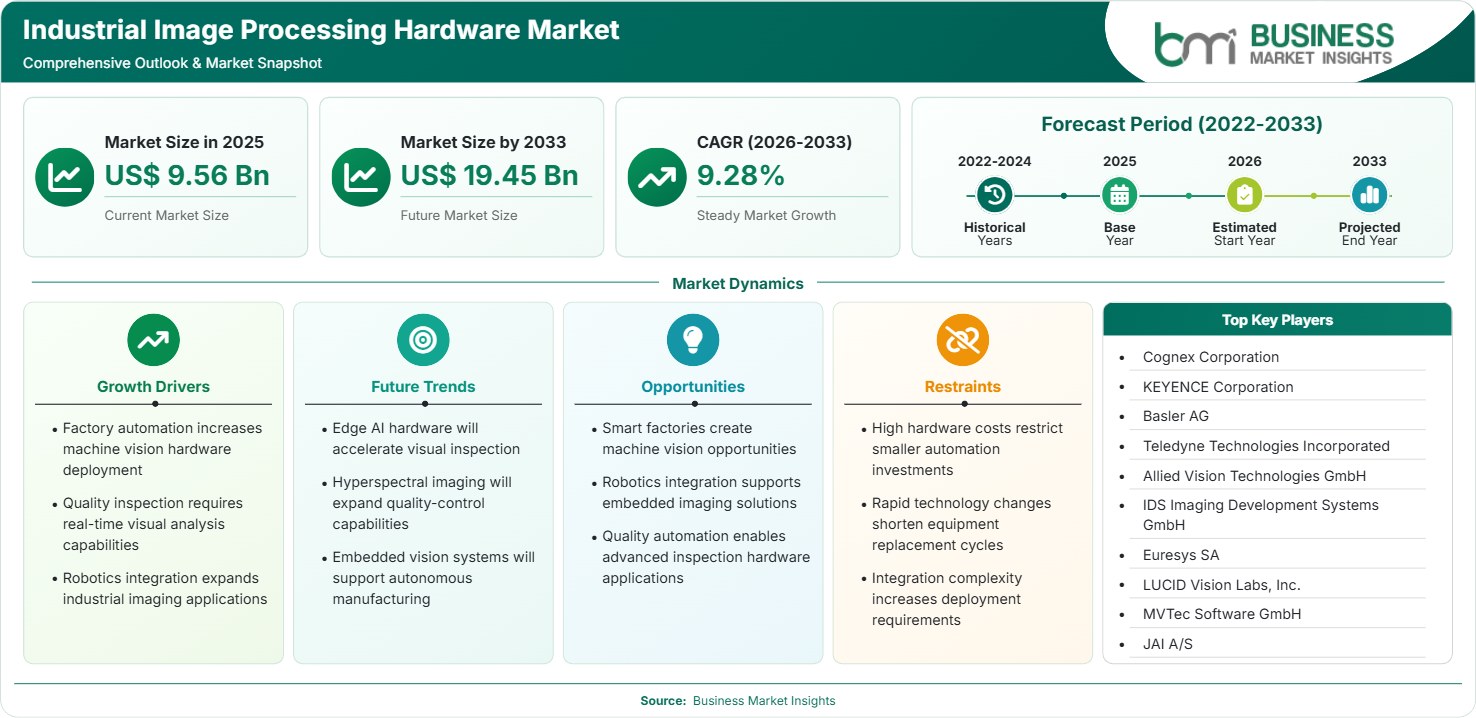
The Industrial Image Processing Hardware Market size was valued at US$ 9.56 Billion in 2025 and is projected to reach US$ 19.45 Billion by 2033, growing at a CAGR of 9.28% during 2026–2033, driven by AI-enabled inspection, factory automation, semiconductor expansion, robotics, edge processing, and smart manufacturing.

Report Coverage
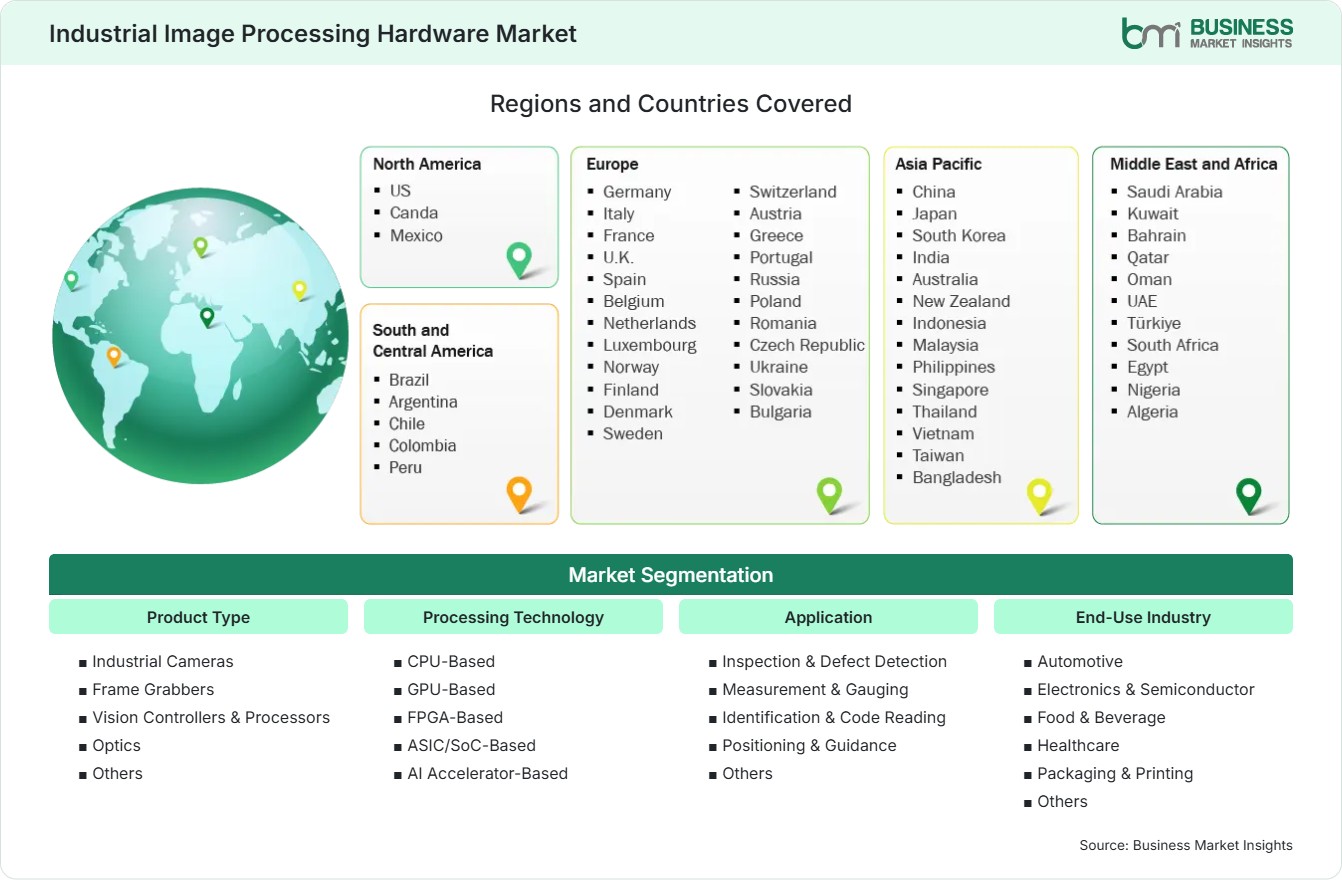
  • Product Type: Industrial Cameras, Frame Grabbers, Vision Controllers & Processors, Optics, Others
  • Processing Technology: CPU-Based, GPU-Based, FPGA-Based, ASIC/SoC-Based, AI Accelerator-Based
  • Application: Inspection & Defect Detection, Measurement & Gauging, Identification & Code Reading, Positioning & Guidance, Others
  • End-Use Industry: Automotive, Electronics & Semiconductor, Food & Beverage, Healthcare, Packaging & Printing, Others
US$ 9.56 Bn Market size in 2025
US$ 19.45 Bn Market Size by 2033
9.28% CAGR, 2026 - 2033
2026-2033 Forecast Period

AI Overview

Industrial Image Processing Hardware Market Summary

  • North America Region: North America holds a 23%–26% Industrial Image Processing Hardware Market share in 2025, growing at a 9.40%–10.00% CAGR, supported by semiconductor reshoring, smart factories, logistics automation, aerospace production, AI inspection, and edge computing. The U.S. remains the regional anchor, supported by semiconductor expansion, automotive automation, aerospace production, logistics modernization, and AI-enabled inspection, with a 9.60%–10.20% CAGR during 2026–2033.
  • Fastest Growing Region: Asia Pacific holds a 44%–48% share in 2025, expanding at a 9.00%–9.70% CAGR, supported by electronics manufacturing, semiconductor fabrication, electric-vehicle production, robotics, smart factories, warehouse automation, and accelerating industrial investment.
  • Leading Segment: Industrial Cameras hold a 40%–44% share in 2025, expanding at an 8.80%–9.30% CAGR, supported by higher resolution, faster acquisition, global-shutter sensors, three-dimensional imaging, embedded intelligence, and increasingly demanding inspection environments.
  • High Growth Segment: AI Accelerator-Based processing represents a 6%–9% Industrial Image Processing Hardware Market share in 2025, expanding at an 11.00%–12.50% CAGR, supported by edge inference, low-latency inspection, deep-learning deployment, reduced network traffic, compact architectures, and autonomous production decisions.
  • Key Market Opportunity: Integrated edge platforms combining cameras, processors, optics, connectivity, and AI inference can reduce commissioning complexity while expanding adoption across inspection, robotics, logistics, electronics, and smaller automated factories.
  • Major Market Players: Cognex Corporation; KEYENCE Corporation; Basler AG; Teledyne Technologies Incorporated; Allied Vision Technologies GmbH; IDS Imaging Development Systems GmbH; Euresys SA; LUCID Vision Labs, Inc.; MVTec Software GmbH; JAI A/S.
Strategic Insights

Industrial Image Processing Hardware Market: Strategic Insights

Industrial Image Processing Hardware Market Strategic Framework
FREE PDF
Request your free sample
Request free sample
Stakeholder View

Key Takeaways

  • Value is moving toward integrated ecosystems linking cameras, optics, frame grabbers, processors, interfaces, software, and system integration. Suppliers addressing multiple layers can strengthen differentiation and customer retention.
  • Inspection and defect detection provide the broadest demand base, while AI-enabled processing, three-dimensional imaging, robotic guidance, semiconductor inspection, and automated logistics offer stronger incremental opportunities.
  • Hardware development increasingly emphasizes edge inference, higher-bandwidth connectivity, improved sensor sensitivity, embedded processing, thermal optimization, and compact architectures that reduce dependence on centralized computing.
  • India and Southeast Asia present compelling investment cases as electronics, automotive, semiconductor, warehouse, and industrial automation projects expand machine vision installations.
  • Competitive activity is increasingly centered on AI capabilities, platform integration, complementary imaging technologies, software compatibility, and application expertise rather than standalone camera portfolios.
Geographic Outlook

Industrial Image Processing Hardware Market Regional Highlights

North America Industrial Image Processing Hardware Market

North America Industrial Image Processing Hardware Market holds a 23%–26% share in 2025 and is projected to grow at a 9.40%–10.00% CAGR through 2033. Demand is anchored by advanced manufacturing, semiconductor investment, logistics automation, aerospace, pharmaceuticals, and automotive production. The region favors integrated systems combining high-speed cameras, edge processors, and AI inference. U.S. reshoring strengthens equipment demand, while Canada contributes aerospace and manufacturing demand. Mexico adds automotive and electronics assembly opportunities as manufacturers diversify production footprints across the continent.

  • AI-enabled inspection is gaining adoption where manufacturers require repeatable quality decisions, faster changeovers, reduced manual inspection, and consistent defect classification.
  • Semiconductor and advanced electronics investments are increasing requirements for high-resolution cameras, precision optics, deterministic acquisition, and specialized processing architectures.
  • Warehouse automation is expanding vision applications for identification, code reading, dimensioning, robotic guidance, parcel verification, and automated exception handling.
  • Aerospace and pharmaceutical manufacturing prioritize traceability and validated inspection processes, supporting reliable imaging hardware with extended operating lifecycles.

US Industrial Image Processing Hardware Market

The U.S. Industrial Image Processing Hardware Market represents approximately 65%–69% of North American demand in 2025 and is projected to expand at a 9.60%–10.20% CAGR through 2033. Semiconductor capacity expansion, automotive electrification, logistics automation, aerospace production, and pharmaceutical manufacturing provide diversified demand. Investment favors edge AI, smart cameras, and high-speed controllers that operate without extensive centralized computing infrastructure. The country also maintains a mature ecosystem of automation developers, integrators, manufacturers, technology companies, and industrial imaging specialists.

  • Semiconductor capacity expansion increases demand for wafer, package, component, and process inspection using high-resolution and deterministic imaging platforms.
  • Logistics operators increasingly deploy vision for parcel identification, robotic picking, sorting, dimensional verification, inventory tracking, and automated exception management.
  • Automotive and battery facilities use machine vision for weld inspection, component verification, assembly guidance, surface inspection, and traceability.

Europe Industrial Image Processing Hardware Market

Europe Industrial Image Processing Hardware Market holds a 19%–22% share in 2025 and is projected to expand at an 8.30%–9.00% CAGR. Germany remains the leading country, supported by automotive engineering, machinery, robotics, and industrial automation. The U.K. and France provide opportunities in logistics, life sciences, electronics, and advanced manufacturing. Germany is positioned at an 8.30%–8.90% CAGR, while the U.K. is positioned at an 8.80%–9.40% CAGR. Procurement increasingly emphasizes interoperability, traceability, energy efficiency, and process reliability.

  • Germany benefits from dense automotive and machinery ecosystems where inspection, metrology, assembly verification, and robotic guidance are embedded into production equipment.
  • The U.K. is gaining opportunities through logistics automation, life sciences manufacturing, electronics development, and industrial modernization.
  • France and Italy provide demand across aerospace, automotive, food processing, packaging, and machinery, with retrofit projects supporting system upgrades.
  • European sustainability priorities encourage automation architectures that improve yield, reduce waste, and deliver consistent production quality.

Asia Pacific Industrial Image Processing Hardware Market

Asia Pacific Industrial Image Processing Hardware Market holds a 44%–48% share in 2025 and is projected to expand at a 9.00%–9.70% CAGR. China remains the leading market, while Japan and South Korea retain strong positions in precision manufacturing and electronics. India is among the fastest-growing markets, supported by electronics, automotive, semiconductor, logistics, and infrastructure investment. India is positioned at a 10.20%–11.20% CAGR, while China is positioned at a 9.00%–9.80% CAGR. Manufacturing scale makes the region central to future hardware demand.

  • China benefits from extensive electronics, automotive, battery, logistics, and machinery production, creating broad demand for cameras, processors, optics, and acquisition systems.
  • Japan maintains strong demand for precision imaging because robotics, automotive, electronics, and semiconductor applications require stable measurement and inspection performance.
  • India is expanding rapidly as electronics assembly, automotive production, warehousing, and semiconductor infrastructure create new automated inspection opportunities.
  • South Korea remains strategically important for semiconductor and electronics inspection, where high-speed acquisition and precise defect identification support demanding production.

Rest of World Industrial Image Processing Hardware Market

Rest of World Industrial Image Processing Hardware Market accounts for a 7%–10% share in 2025 and is projected to expand at a 7.40%–8.20% CAGR. South and Central America benefit from automotive, food processing, packaging, and logistics modernization, while the Middle East and Africa demand develops through food manufacturing, pharmaceuticals, warehousing, and industrial diversification. Brazil leads South American demand, while the UAE and Saudi Arabia lead Gulf opportunities. Emerging installations increasingly favor compact systems that reduce engineering requirements and accelerate deployment.

Latin American adoption is supported by manufacturers seeking improved quality control, productivity, and automated traceability. Middle Eastern industrial diversification is supporting automation beyond traditional energy applications. Food processing, logistics, packaging, pharmaceuticals, and general manufacturing provide diversified opportunities for imaging hardware. Regional buyers increasingly prefer turnkey systems because local engineering resources can be constrained for complex multi-camera deployments.

  • Brazil provides the strongest South American opportunity through automotive, food, beverage, packaging, and industrial processing applications requiring automated quality control.
  • Gulf markets are developing demand for inspection, sorting, packaging, logistics, and warehouse automation as industrial diversification programs accelerate.
  • South Africa offers opportunities in food processing, mining-related automation, packaging, and manufacturing requiring robust imaging systems.
  • Regional buyers increasingly prefer application-specific systems that shorten engineering cycles and reduce commissioning requirements.
Global Market Geography
FREE PDF
Request your free sample
Request free sample
Segment Analysis

Industrial Image Processing Hardware Market Segmentation

Product Type

Industrial Cameras represent the leading category, with a 40%–44% share in 2025 and an 8.80%–9.30% CAGR through 2033. Adoption is supported by sensor innovation, higher resolution, faster acquisition, 3D imaging, embedded intelligence, and expanding inspection requirements. Strengthening their strategic position within the Industrial Image Processing Hardware Market scope.

Industrial Cameras: Area scan, line scan, 3D, and smart cameras support inspection, measurement, guidance, and identification across automated production.

  • Frame Grabbers: High-speed acquisition remains essential for multi-camera and line-scan systems, with preprocessing reducing latency, processor load, and data-transfer requirements.
  • Vision Controllers & Processors: Controllers increasingly coordinate cameras, lighting, algorithms, I/O, and AI inference within modular edge architectures.
  • Optics: Precision lenses determine field of view, distortion, resolution, and measurement accuracy, creating demand for application-specific optical designs.

Processing Technology

CPU-Based processing retains a broad installed base because of compatibility, configurability, and established industrial-PC architectures. GPU, FPGA, ASIC/SoC, and AI accelerator architectures gain relevance where parallel computation, deterministic latency, embedded inference, or compact design is required. AI accelerator-based processing provides the strongest growth outlook as deep-learning workloads migrate toward edge devices.

  • CPU-Based: Flexible architectures remain common where software compatibility and straightforward industrial-PC integration are priorities.
  • GPU-Based: Parallel processing supports deep learning, 3D reconstruction, complex classification, and high-throughput applications.
  • FPGA-Based: Deterministic processing and low latency make FPGAs attractive for acquisition, preprocessing, synchronization, and line-scan applications.
  • ASIC/SoC-Based: Integrated architectures reduce footprint, power consumption, and system complexity, supporting compact embedded vision platforms.
  • AI Accelerator-Based: Dedicated inference hardware enables rapid edge execution of deep-learning models while reducing remote processing and network traffic.

Application

Inspection & Defect Detection remains the leading application because manufacturers require automated quality decisions across automotive, electronics, semiconductor, food, healthcare, packaging, and industrial production. Demand is shifting toward AI-assisted classification as manufacturers encounter variable surfaces, complex defects, and product variations. Measurement and guidance also benefit from higher-resolution cameras, three-dimensional imaging, and improved processing architectures.

  • Inspection & Defect Detection: Automated visual quality control reduces inspection variability and supports continuous monitoring across high-volume production.
  • Measurement & Gauging: Non-contact dimensional measurement improves repeatability where mechanical gauges are slower or less flexible.
  • Identification & Code Reading: Reliable reading supports traceability, serialization, sorting, packaging verification, and automated product routing.
  • Positioning & Guidance: Vision-guided robotics improves component placement, picking, assembly, and alignment where object location varies.

End-Use Industry

The automotive and electronics & Semiconductors sectors remain significant markets, as manufacturing processes demand inspection, measurement, recognition, and alignment. The latter two sectors, in particular, have greater demand for high-resolution optics, deterministic acquisition, and processing capabilities. The Healthcare, Food & Beverages, and Packaging sectors exhibit diverse demand, and the Industrial Automation market is expanding into processes that previously relied on manual inspection.

  • Automotive: Battery, powertrain, body, component, and assembly inspection creates broad demand for high-speed imaging.
  • Electronics & Semiconductor: Miniaturization and tighter tolerances require high-resolution imaging for wafers, PCBs, packages, components, and assembly verification.
  • Food & Beverage: Vision hardware supports contamination detection, packaging verification, fill-level inspection, sorting, labeling, and product classification.
  • Healthcare: Pharmaceutical and medical-device manufacturing uses vision for inspection, identification, packaging verification, and traceability.
  • Packaging & Printing: High-speed print inspection, label verification, code reading, registration control, and defect detection support continuous quality.
Market Forces

Industrial Image Processing Hardware Market Dynamics

Key Market Drivers

AI-Enabled Edge Inspection

Market expansion is now correlated with AI inferencing becoming more decentralized, that is, going from server-side to cameras, controllers, and embedded processors. The edge approach will minimize latency, reduce data transfers, and enable inspection decisions to be made directly at the production site. In addition, AI algorithms are especially useful for variable defects, non-planar surfaces, classification tasks, and when traditional rules require considerable tuning. The Industrial Image Processing Hardware Market trends point towards hardware capable of inference, in addition to acquisition and preprocessing. Vendors are improving accelerator integration, memory layout, thermal management, and software compatibility. This shift strengthens demand for integrated systems and creates opportunities for processors, smart cameras, and controllers optimized for industrial reliability and deterministic operation.

Advanced Manufacturing Automation

Automation expansion across automotive, electronics, semiconductor, food, packaging, and logistics operations is increasing the number of visual inspection points embedded within production lines. Manufacturers require cameras and processors to operate alongside robots, programmable controllers, conveyors, sensors, and manufacturing systems. Faster production rates require better synchronization of acquisition and processing. In this regard, industrial imaging equipment will benefit from automated optical inspection, guidance, measurement, and traceability systems. With a modular architecture, scaling from single inspection stations to integrated production cells is possible. This supports sustained demand for hardware as companies install more cameras, processors, interfaces, and inspection points across their automation processes and production lines.

Semiconductor and Electronics Inspection

Semiconductor and electronic device fabrication requires accurate imaging due to smaller component sizes and faster processes. Inspection devices should detect any surface defects, misalignments, contaminants, soldering faults, packaging defects, and assembly errors without disturbing the fabrication process. This is why high-resolution cameras, special optics, fast frame grabbers, and deterministic processors are becoming more relevant. Expansion of semiconductor fabrication in Asia, North America, and Europe will increase demand for equipment, as vision hardware is used across all wafer, package, component, and assembly processes. The Industrial Image Processing Hardware Market growth is also supported by automation and improved imaging results, which contribute to yield improvements.

Key Market Opportunities

Integrated Edge Vision Platforms

The combination of camera, processor, optics, interface, and AI inference can address system complexity. Customers are now showing a preference for application-ready architectures, which require less engineering, calibration, and installation. Vendors can also add value by selling hardware alongside software development kits, algorithms, communication modules, and lifecycle management solutions. The Industrial Image Processing Hardware Market Forecasts indicate that vendors offering a complete solution platform, rather than individual parts, will gain greater value. The edge integration solution gives opportunities in small factories where traditional computer-based systems can be excessive.

High-Bandwidth Imaging Infrastructure

Higher resolutions and higher frame rates yield greater image data, thus opening up possibilities for high-bandwidth connections, fiber links, frame grabbers, and processing chips. Inspections that employ semiconductor components, electronic components, batteries, flat panels, and advanced materials are especially data-intensive. Companies that perform data compression at the front end and then transmit the information can reduce network infrastructure needs while still delivering all the necessary data for inspection processes. With high-speed connections, long-distance installations become feasible. Consequently, there are business opportunities not only for the cameras but also for the acquisition boards, interface technology, optical links, synchronization systems, and processors.

Emerging Industrial Vision Applications

Deployment in this area is expanding beyond simple inspection to include autonomous materials handling, warehouse robotics, food sorting and recycling, process prediction, and production monitoring. Three-dimensional, multi-spectral, hyperspectral, and SWIR sensing enable the determination of characteristics not discernible by visible-light cameras. This necessitates the development of specific sensors, optical components, processing, and lighting components for such applications. Suppliers could take up vertical solutions, developing hardware based on application outcomes rather than just camera-based imagery. Collaborations with robotics manufacturers, automation system integrators, semiconductor equipment makers, and logistics technology companies could help speed up the commercialization of these products.

Market Restraints and Challenges

Integration Complexity and Deployment Cost

Factor: Industrial vision systems often require customized combinations of cameras, lenses, lighting, frame grabbers, processors, communication interfaces, software, and machine controls. Specialized engineering, calibration, timing, and environmental testing may be necessary, especially for high-speed integration or multi-camera setups. Impact: All of these add time, expense, and risk to the process, potentially slowing adoption by smaller firms and reducing incentives to upgrade existing manually operated systems. Supplier solutions have included integrated systems, common interfaces, software configurability, and application-oriented reference designs. This has been the greatest problem in instances where production equipment is mixed, or legacy systems lack modern communication capabilities.

Data, Thermal, and Reliability Constraints

Factor: Increased resolutions, frame rates, artificial intelligence inference, and multi-camera systems place greater burdens on computation, memory, power, and cooling. Industrial settings will also put the systems through vibration, dust, humidity, temperature, electromagnetic interference, and operating cycles. Impact: The hardware needs to strike a balance among performance, reliability, size, and lifetime. Excess computation will result in latency or more complex computing machinery, while a lack of environmental protection will lead to higher maintenance expenses. This keeps vendors continuously optimizing their components. It is especially true when considering edge computing systems with limited size and power constraints.

Company Analysis

Competitive Landscape

The Industrial Image Processing Hardware Market analysis indicates competition is increasingly organized around complete vision architectures rather than individual components. Leading suppliers differentiate through sensor performance, edge processing, AI capabilities, interfaces, optics, software compatibility, application expertise, and global integration support.

Company Name

Overview

Products and Services relevant to this market

Cognex Corporation

Global machine vision specialist serving automated inspection, logistics, identification, and AI-enabled industrial vision applications.

Vision cameras, smart systems, controllers, AI inspection, barcode reading, image processing, and factory automation solutions.

KEYENCE Corporation

Diversified industrial automation supplier with extensive vision, sensing, measurement, and inspection capabilities.

Vision systems, smart cameras, lighting, image processors, measurement systems, sensors, and AI-assisted inspection platforms.

Basler AG

Imaging specialist providing cameras, lenses, acquisition hardware, software, and machine vision architectures.

Area and line-scan cameras, 3D cameras, lenses, frame grabbers, software, embedded systems, and vision platforms.

Teledyne Technologies Incorporated

Imaging technology group serving industrial, scientific, semiconductor, and automation applications.

Industrial cameras, line-scan systems, 3D imaging, SWIR imaging, sensors, frame grabbers, and vision technologies.

Allied Vision Technologies GmbH

Machine vision company focused on high-performance cameras and imaging components.

Area-scan, line-scan, 3D, high-speed cameras, embedded vision, interfaces, and imaging technologies.

IDS Imaging Development Systems GmbH

Specialist camera manufacturer emphasizing industrial imaging, embedded AI, rugged designs, and flexible interfaces.

GigE and USB cameras, embedded AI cameras, 3D systems, industrial cameras, and development tools.

Euresys SA

Imaging technology provider specializing in high-performance image acquisition and processing hardware.

CoaXPress and Camera Link frame grabbers, image processing, FPGA tools, SDKs, and acquisition solutions.

LUCID Vision Labs, Inc.

Industrial camera specialist emphasizing high-speed interfaces, 3D imaging, embedded intelligence, and advanced sensors.

GigE, 10GigE, 25GigE and 100GigE cameras, 3D cameras, smart cameras, and imaging software.

MVTec Software GmbH

Machine vision specialist supporting deep learning, classical image processing, 3D vision, and industrial deployment.

HALCON, deep-learning tools, 3D matching, image acquisition interfaces, development tools, and vision algorithms.

JAI A/S

Imaging specialist serving demanding inspection and automation applications with high-quality industrial cameras.

Area-scan, line-scan, multispectral, polarizing, 3D, and high-resolution industrial cameras.

Trust & Transparency

Research Methodology

The market analysis combines proprietary research with secondary data from government agencies, company disclosures, regulatory filings, industry databases and expert interviews. Market estimates are validated through data triangulation, cross-market benchmarking and analyst review.

View Full Research Methodology

Questions Answered

Frequently Asked Questions

Why are integrated vision platforms strategically important?

Integrated platforms reduce configuration and commissioning effort by combining imaging, processing, connectivity, and software interfaces, helping manufacturers deploy automated inspection with fewer integration dependencies.

What is changing industrial camera design?

Camera development increasingly emphasizes higher frame rates, global shutters, embedded AI, compact form factors, improved sensitivity, ruggedization, and high-speed connectivity.

How does semiconductor manufacturing affect hardware demand?

Semiconductor production requires high-resolution, repeatable inspection across wafers, packages, components, and assembly processes, supporting demand for cameras, optics, frame grabbers, and deterministic processors.

Why are edge-based vision systems gaining procurement attention?

Edge systems reduce latency, limit network traffic, simplify centralized computing requirements, and allow production equipment to make inspection decisions locally.

What technologies are reshaping industrial image processing hardware?

As per the Industrial Image Processing Hardware Market report, AI accelerators, embedded GPUs, FPGA processing, higher-bandwidth interfaces, 3D sensors, and specialized spectral imaging are reshaping architectures by moving computation closer to image acquisition.

Access the Full Industrial Image Processing Hardware Market Report

Get segment-level forecasts, regional estimates, competitive benchmarking, company profiles and downloadable Excel datasets.

Access the full Industrial Image Processing Hardware Market Report
350 pages PDF & Excel | 2026-10-05
Similar Research

Related Market Reports