Market Summary
Executive Summary and Global Market Analysis
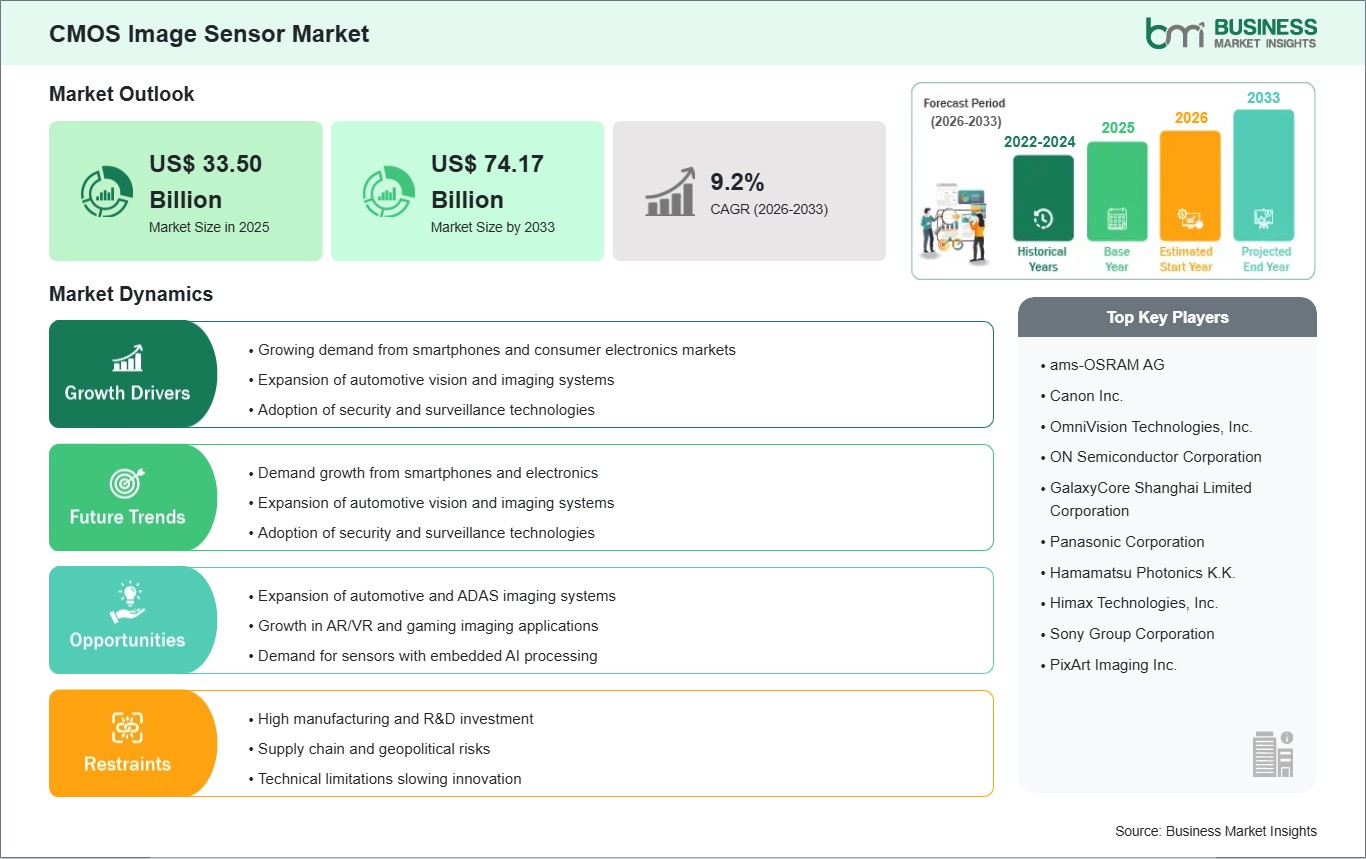
A CMOS (Complementary Metal–Oxide–Semiconductor) image sensor is a semiconductor device that converts light into electrical signals to create digital images, integrating photodetectors and signal processing circuitry on a single chip. Unlike CCD sensors, CMOS sensors enable faster readout, lower power consumption, smaller size, and lower manufacturing costs, making them highly versatile. They are widely used in smartphones, digital cameras, webcams, medical imaging devices, industrial inspection systems, automotive applications such as advanced driver-assistance systems (ADAS), and security and surveillance equipment. The demand for CMOS image sensors is driven by several key factors, including the rapid growth of smartphone adoption, increasing emphasis on high-resolution and multi-camera systems, and the expansion of automotive safety and autonomous driving technologies. Additionally, rising use of IoT devices, smart home systems, and machine vision in industrial automation further accelerates market growth. Continuous technological advancements, such as improved low-light performance and 3D sensing, also play a significant role in sustaining strong market demand.
Segment Analysis
CMOS Image Sensor Market Segmentation
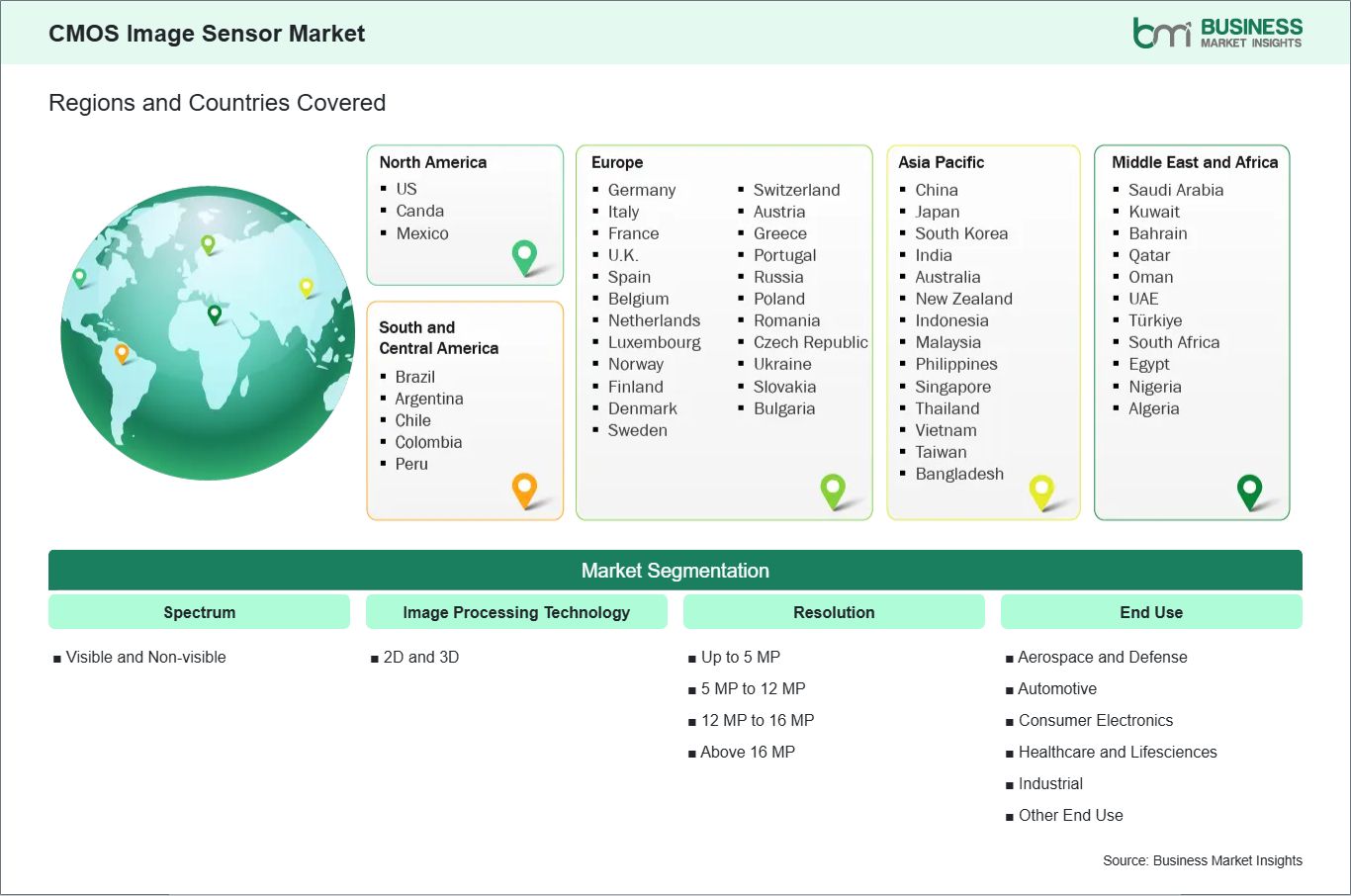
Key segments that contributed to the derivation of the CMOS image sensor market analysis are spectrum, image processing technology, resolution, and end use.
- By spectrum, the market is segmented into visible and non-visible. The visible segment held the largest share of the market in 2025.
- By image processing technology, the market is segmented into 2D and 3D. The 3D segment held the largest share of the market in 2025.
- By resolution, the market is segmented into up to 5 MP, 5 MP to 12 MP, 12 MP to 16 MP, and above 16 MP). The above 16 MP segment held the largest share of the market in 2025.
- By end use, the market is segmented into aerospace and defense, automotive, consumer electronics, healthcare and lifesciences, industrial, and others. The consumer electronics segment held the largest share of the market in 2025.
Market Forces
CMOS Image Sensor Market Drivers and Opportunities
Rising Demand from Smartphones and Consumer Electronics
One major driver positively impacting the CMOS image sensor market is the continued growth in smartphones and consumer electronics. Consumers increasingly expect high-quality photography, video recording, facial recognition, and augmented reality features in their devices. CMOS image sensors enable these capabilities due to their low power consumption, compact size, fast processing speed, and cost efficiency compared to CCD sensors. Smartphone manufacturers integrate multiple cameras per device, further increasing sensor demand. Additionally, growth in tablets, laptops, wearables, and smart home devices expands application areas. This sustained demand from high-volume consumer markets directly accelerates CMOS image sensor production and innovation.
Expansion of Automotive and ADAS Applications
A significant opportunity for CMOS image sensor market growth lies in the rapid adoption of automotive imaging systems, particularly advanced driver-assistance systems (ADAS). Modern vehicles increasingly rely on cameras for functions such as lane departure warning, parking assistance, collision avoidance, and driver monitoring. CMOS image sensors are well-suited for automotive use due to their high dynamic range, reliability, and ability to operate in varying lighting conditions. As electric vehicles and autonomous driving technologies advance, the number of cameras per vehicle continues to rise. This creates long-term demand and opens opportunities for specialized, high-performance CMOS sensor development.
Size and Share Analysis
CMOS Image Sensor Market Size and Share Analysis
By spectrum, the market is segmented into visible and non-visible. The visible segment held the largest share of the market in 2025. Visible CMOS sensors are widely used in smartphones, digital cameras, laptops, and webcams, where most imaging needs are within the visible spectrum. The proliferation of image-centric social media and consumer demand for high-quality photography further drives this dominance.
By image processing technology, the market is segmented in 2D and 3D. The 3D segment held the largest share of the market in 2025. 3D CMOS image sensors can break the performance limitations of traditional 2D sensors by physically separating the pixel array from the logic circuitry. This stacked architecture allows for independent optimization of each layer, resulting in superior performance, reduced form factors, and higher functionality at a competitive, high-volume cost.
By resolution, the market is segmented into 5 MP, 5 MP to 12 MP, 12 MP to 16 MP, and above 16 MP. The above 16 MP segment held the largest share of the market in 2025. High-resolution imaging is crucial for premium smartphone cameras, professional photography gear, and advanced imaging systems where clarity and detail matter.
By end use, the market is segmented aerospace and defense, automotive, consumer electronics, healthcare and lifesciences, industrial, and others. The consumer electronics segment held the largest share of the market in 2025. Smartphones, tablets, laptops, wearable devices, and personal imaging products remain the biggest consumers of CMOS imaging technology due to its integration into mainstream devices and continuous innovation.
Report Coverage
CMOS Image Sensor Market Report Coverage and Deliverables
The "CMOS Image Sensor Market Size and Forecast (2022 - 2033)" report provides a detailed analysis of the market covering below areas:
- CMOS image sensor market size and forecast at global, regional, and country levels for all the key market segments covered under the scope
- CMOS image sensor market trends, as well as market dynamics such as drivers, restraints, and key opportunities
- CMOS image sensor market analysis covering key market trends, global and regional framework, major players, regulations, and recent market developments
- Industry landscape and competition analysis covering market concentration, heat map analysis, prominent players, and recent developments for the air circuit breaker market
- Detailed company profiles, including SWOT analysis
Geographic Insights
CMOS Image Sensor Market Geographic Insights
The geographical scope of the CMOS image sensor market report is divided into five regions: North America, Asia Pacific, Europe, Middle East & Africa, and South & Central America. The CMOS image sensor market in North America is expected to grow significantly during the forecast period.
The Asia Pacific CMOS image sensor market is segmented into China, Japan, South Korea, India, Australia, New Zealand, Indonesia, Malaysia, the Philippines, Singapore, Thailand, Vietnam, Taiwan, Bangladesh, and the Rest of Asia Pacific. The widespread adoption of smartphones, tablets, and wearable devices—especially in China, South Korea, Japan, and India—remains a primary growth factor, as manufacturers continuously integrate advanced camera features to differentiate products. The region’s dominance in electronics manufacturing and semiconductor fabrication also supports cost-effective, large-scale production of CMOS sensors. In addition, rising investments in automotive technologies, including advanced driver-assistance systems (ADAS), electric vehicles, and in-cabin monitoring, are boosting demand for high-performance image sensors. Growth in surveillance systems, smart cities, and industrial automation further accelerates market expansion, particularly across developing economies. Government initiatives supporting semiconductor self-sufficiency, along with the expansion of AI, IoT, and 5G ecosystems, are also encouraging innovation and adoption, making Asia Pacific the fastest-growing and most influential market for CMOS image sensors globally.
Industry Activity
Recent Developments
The CMOS image sensor market is evaluated by gathering qualitative and quantitative data post primary and secondary research, which includes important corporate publications, association data, and databases. A few of the key developments in the CMOS image sensor market are:
- In October 2025, Sony Semiconductor Solutions Corporation (Sony) today announced the upcoming release of the IMX828, the industry’s first1 CMOS image sensor for automotive applications with a built-in MIPI A-PHY interface. There are multiple high-speed transmission interface standards for automotive applications. This product is the first in the industry*1 to include the interface in the image sensor.
- In March 2025, SmartSens Technology (Shanghai) Co., Ltd. announced SC136HGS, a 1.3-MegaPixel (MP) global shutter CMOS image sensor for industrial machine vision applications. Leveraging SmartSens’ advanced technologies including SmartGS™-2 Plus and Lightbox IR, SC136HGS has excellent performance in high sensitivity, high dynamic range, low noise, imaging at high temperatures, etc., which makes it ideal for camera upgrades of industrial machine vision applications such as Automated Guided Vehicle (AGV) and industrial machine vision cameras.
Trust & Transparency
Research Methodology
The market analysis combines proprietary research with secondary data from government agencies, company disclosures, regulatory filings, industry databases and expert interviews. Market estimates are validated through data triangulation, cross-market benchmarking and analyst
review.
View Full Research Methodology
Key Sources Referred:
World Bank - Global Trade IndicatorsWorld Trade Organization (WTO)International Monetary Fund (IMF)International Trade Administration (ITA)Company websiteCompany annual reportsCompany investor presentations