
Immunodiagnostics Market Outlook: Size, Share, Trends, Growth Analysis, Competitive Landscape & Forecast, 2026-2033

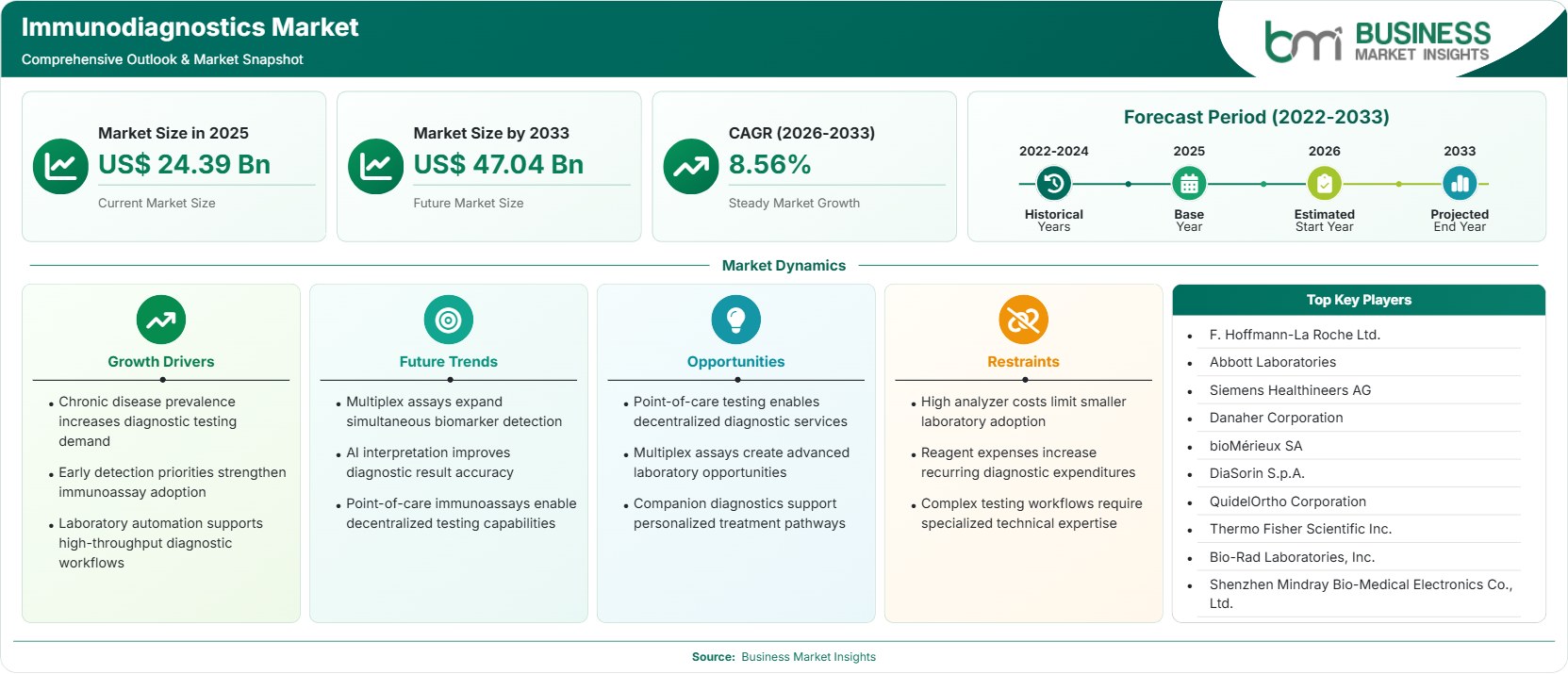
The Immunodiagnostics Market size was valued at US$ 24.39 Billion in 2025 and is projected to reach US$ 47.04 Billion by 2033, growing at a CAGR of 8.56% during 2026–2033, driven by precision diagnostics, chronic disease screening, automation, and demand for decentralized testing.

Report Coverage
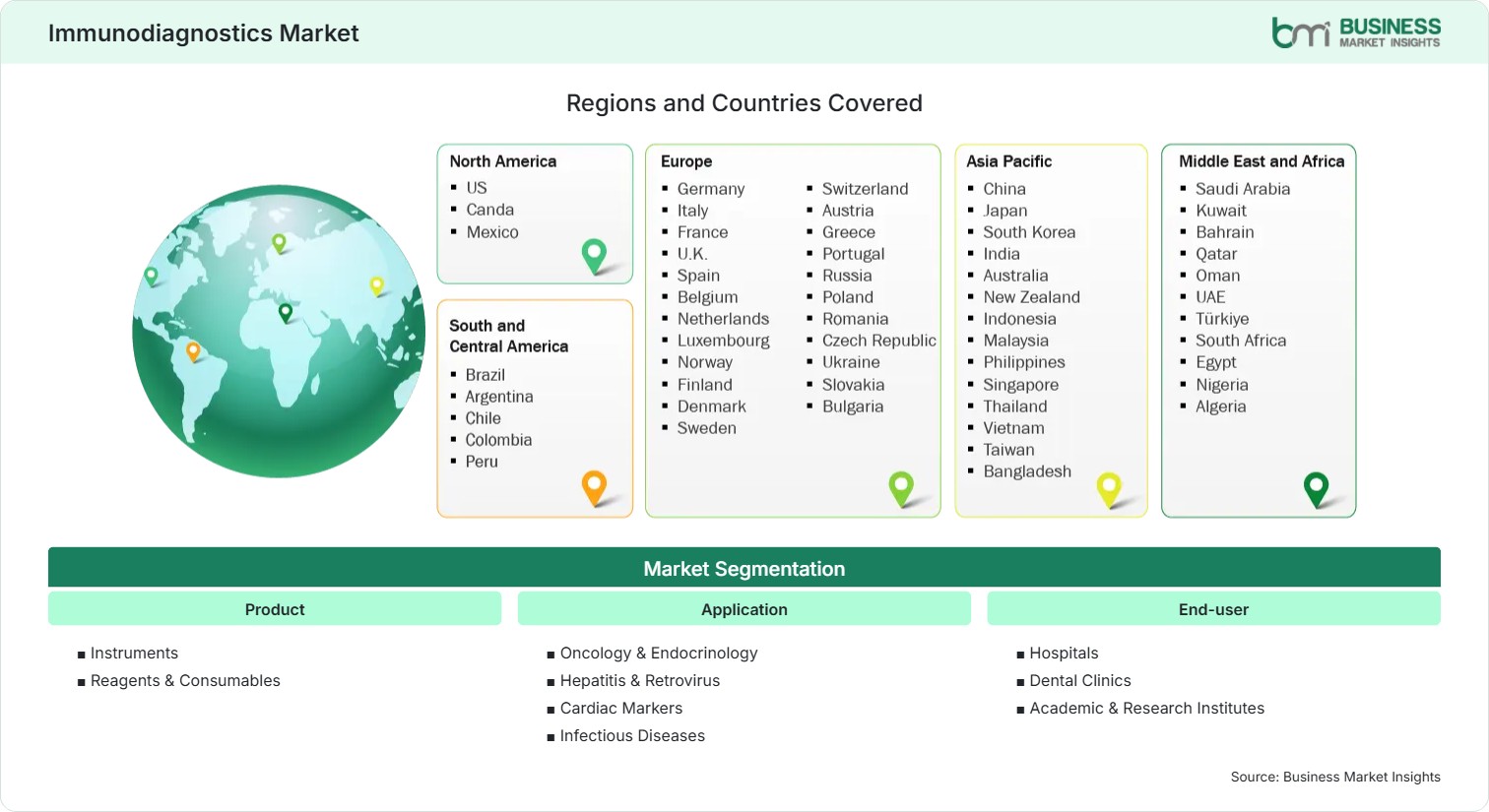
  • Product: Instruments, Reagents & Consumables
  • Application: Oncology & Endocrinology, Hepatitis & Retrovirus, Cardiac Markers, Infectious Diseases
  • End-user: Hospitals, Dental Clinics, Academic & Research Institutes
US$ 24.39 Bn Market size in 2025
US$ 47.04 Bn Market Size by 2033
8.56% CAGR, 2026 - 2033
2026-2033 Forecast Period

AI Overview

Immunodiagnostics Market Summary

  • North America Region: North America holds an estimated 35%–39% share in 2025, growing at a 7.80%–8.60% CAGR during 2026–2033, supported by advanced laboratory infrastructure, oncology testing, reimbursement improvements, and integrated diagnostic automation. The US market benefits from sophisticated immunoassay adoption, decentralized testing investments, and demand for companion diagnostics, with an estimated 7.70%–8.50% CAGR during the forecast period.
  • Fastest Growing Region: Asia Pacific accounts for an estimated 25%–29% share in 2025 and is projected to expand at a 10.00%–11.20% CAGR during 2026–2033, supported by expanding hospital networks, rising healthcare expenditure, local manufacturing, and increased access to infectious disease testing.
  • Leading Segment: Reagents & Consumables represent an estimated 65%–70% Immunodiagnostics Market share in 2025, with a 8.20%–9.00% CAGR during 2026–2033, supported by recurring testing demand, laboratory throughput, assay menu expansion, and increasing use of automated immunoassay systems.
  • High Growth Segment: Infectious Diseases application is estimated to grow at a 9.00%–10.00% CAGR during 2026–2033, supported by multiplex testing, disease surveillance, faster clinical decisions, and expanded diagnostic access across emerging healthcare systems.
  • Key Market Opportunity: Integrated immunoassay platforms, decentralized testing, emerging-market laboratory expansion, and biomarker-based diagnostics create opportunities for recurring consumables revenue, workflow optimization, and differentiated clinical applications.
  • Major Market Players: F. Hoffmann-La Roche Ltd., Abbott Laboratories, Siemens Healthineers AG, Danaher Corporation, bioMérieux SA, DiaSorin S.p.A., QuidelOrtho Corporation, Thermo Fisher Scientific Inc., Bio-Rad Laboratories, Inc., and Shenzhen Mindray Bio-Medical Electronics Co., Ltd.
Strategic Insights

Immunodiagnostics Market: Strategic Insights

Immunodiagnostics Market Strategic Framework
FREE PDF
Request your free sample
Request free sample
Stakeholder View

Key Takeaways

  • The value chain spans antibody and antigen development, assay design, reagent manufacturing, instrument production, distribution, laboratory deployment, and technical service. Recurring consumables and installed-platform relationships influence customer retention and revenue visibility.
  • Oncology, infectious diseases, and cardiac markers provide differentiated application opportunities. Laboratories seek tests that support earlier clinical decisions, workflow efficiency, and expanded testing menus without requiring extensive equipment changes.
  • Chemiluminescence immunoassays, automation, digital connectivity, and biomarker-specific testing are reshaping product development. Research investment increasingly targets analytical performance, faster processing, and clinically actionable results.
  • Asia Pacific offers expansion opportunities through hospital modernization, diagnostic access initiatives, and local manufacturing. Suppliers must adapt pricing, distribution, training, and service models to varied healthcare systems.
  • Diagnostic companies are pursuing portfolio expansion through platform development, specialty testing, and acquisitions. bioMérieux reported acquisitions involving SpinChip, Accellix, and Day Zero Diagnostics as part of its continuing investment in diagnostic capabilities.
  • Laboratory customers increasingly evaluate complete solutions rather than standalone instruments. Reagent availability, equipment uptime, connectivity, validation support, and service responsiveness can influence purchasing decisions alongside analytical performance.
Geographic Outlook

Immunodiagnostics Market Regional Highlights

North America Immunodiagnostics Market

North America held an estimated 35%–39% share in 2025 and is projected to grow at a 7.80%–8.60% CAGR during 2026–2033. The region benefits from established diagnostic laboratories, advanced hospital systems, and strong demand for oncology and endocrine testing. The Immunodiagnostics Market share reflects extensive instrument installations and recurring reagent use. US demand remains central, while Canada and Mexico contribute through healthcare modernization and improved diagnostic access. Platform consolidation, laboratory automation, and specialized biomarker testing support sustained supplier investment across the region.

  • Laboratory automation: Large hospital networks continue investing in integrated analyzers, automated sample handling, and connected workflows to improve throughput and reduce manual processing requirements.
  • Oncology testing: Biomarker-based assays support cancer screening, disease monitoring, and treatment selection, creating demand for specialized immunodiagnostic solutions.
  • Reimbursement environment: Coverage decisions and laboratory payment structures influence adoption, particularly for newer assays requiring clinical and economic evidence.
  • Technology development: Manufacturers are expanding assay portfolios and improving analytical performance to serve specialty testing and high-volume laboratory environments.

US Immunodiagnostics Market

The US accounted for around 29%-33% of the global market and 80%-85% of the North American regional value in 2025. A CAGR of 7.70% - 8.50% is expected from 2026 - 2033 due to the presence of highly sophisticated clinical laboratories, specialized diagnostic centers, and demand for biomarker tests. The US market is inclined towards dependable systems, an extensive assay menu, and workflow validation. Market trends include price pressures, regulation requirements, and diverse reimbursement scenarios.

  • Specialty diagnostics: Demand for oncology, endocrine, cardiac, and neurological biomarkers supports higher-value testing applications across hospitals and reference laboratories.
  • Platform integration: Laboratories increasingly seek systems combining immunoassay analysis, automation, middleware, and quality-control functionality within unified workflows.
  • Clinical validation: New assays require evidence supporting analytical performance, intended use, and regulatory compliance before broad institutional adoption.

Europe Immunodiagnostics Market

The Europe segment is expected to account for 26%-30% of the market in 2025 and is forecast to grow at a 7.50%-8.40% CAGR during 2025-2033. Germany, the UK, France, and Italy are major existing markets, whereas Poland and Spain provide growth opportunities due to investment in health care infrastructure. The regulatory landscape in Europe focuses on product documentation, safety, and performance under the In Vitro Diagnostic Regulation. The market share of the Immunodiagnostics Market depends on the hospital lab network and specialty test requirements.

  • Germany: A large hospital and laboratory ecosystem supports automated testing, reagent demand, and adoption of integrated diagnostic platforms.
  • United Kingdom: Centralized procurement and established clinical laboratory networks influence instrument selection, service requirements, and assay adoption.
  • France and Italy: Public healthcare systems and specialty diagnostics demand support opportunities for reliable, cost-conscious immunoassay solutions.
  • High-growth markets: Poland and selected Eastern European markets may record estimated 8.50%–9.50% CAGRs as laboratory modernization and diagnostic access expand.

Asia Pacific Immunodiagnostics Market

Asia Pacific region held around 25%-29% market share in 2025, and it is expected to register a 10.00%-11.20% CAGR from 2026 to 2033. Countries like China, Japan, India, South Korea, and Australia are among the key regions with varying levels of adoption. China and Japan have already developed capabilities in manufacturing and laboratories, whereas India and Southeast Asia offer opportunities for expansion through hospital development and diagnostic availability. Some of the factors that impact the immunodiagnostics market growth include urbanization, infection testing, the prevalence of chronic diseases, and the development of private laboratories.

  • China: Domestic manufacturing, hospital laboratory investment, and demand for cost-efficient diagnostic platforms support local and international suppliers.
  • India: Expanding diagnostic chains, private hospitals, and chronic disease testing create opportunities for scalable immunoassay systems.
  • Japan and South Korea: Advanced healthcare infrastructure supports specialized testing, automation, and development of higher-performance diagnostic technologies.
  • Southeast Asia: Indonesia, Vietnam, and Thailand offer opportunities through laboratory expansion, infectious disease testing, and improved healthcare access.
  • Growth outlook: India and Indonesia may record estimated 11.00%–12.50% CAGRs as diagnostic infrastructure and test availability improve.

Rest of World Immunodiagnostics Market

South and Central America are estimated to account for 7%–10% of market share in 2025 and are likely to exhibit a CAGR of 8.50%–9.50% through 2033. Brazil and Mexico are driving demand through well-established healthcare marketplaces, while Colombia and Chile offer additional market opportunities. Market access is affected by the procurement budget, cost of imported equipment, and logistics. Immunodiagnostics Market shares differ across countries depending on healthcare spending and the laboratory base.

The Middle East and Africa were anticipated to contribute a share of 5%-8% in 2025 with a forecasted CAGR of 9.00%-10.20%. The Gulf nations are expected to boost demand due to advances in healthcare and dedicated facilities, whereas South Africa and select African regions will offer opportunities in infection diagnosis and hospital diagnostics.

  • Latin America: Brazil and Mexico provide opportunities through laboratory networks, hospital modernization, and demand for accessible immunoassay testing.
  • Middle East: Saudi Arabia and the United Arab Emirates support investment in specialized healthcare infrastructure and advanced diagnostic services.
  • Africa: South Africa and selected markets require reliable infectious disease testing, service support, and cost-sensitive diagnostic solutions.
  • Distribution: Regional distributors and service partnerships remain important for equipment installation, reagent supply, and technical assistance.
  • Growth opportunity: Healthcare investment and diagnostic access programs may support adoption where procurement and reimbursement structures become more favorable.
Global Market Geography
FREE PDF
Request your free sample
Request free sample
Segment Analysis

Immunodiagnostics Market Segmentation

Product

Product Segment is divided into Instruments and Reagents & Consumables segments, with Reagents & Consumables projected to account for 65%- 70% of the Immunodiagnostics Market Share in 2025, with an 8.20%-9.00% CAGR between 2026 and 2033. Test volume, lab utilization, and growth in assay menus underpin segment performance, while instruments enable automation and platform use.

  • Instruments: Automated analyzers and specialized systems support higher throughput, consistent testing, and integration with laboratory information systems, while replacement cycles and new laboratory installations influence equipment demand.
  • Reagents & Consumables: Recurring assay consumption generates repeat revenue through antibodies, calibrators, controls, and testing materials, supported by increased diagnostic volumes and expanded clinical applications.

Application

The Application segment covers Oncology & Endocrinology, Hepatitis & Retrovirus, Cardiac Markers, and Infectious Diseases. Infectious Diseases represents the high-growth application, with an estimated 9.00%–10.00% CAGR during 2026–2033. The Immunodiagnostics Market scope is shaped by clinical testing needs, disease prevalence, laboratory capacity, and the availability of validated assays for routine and specialized use.

  • Oncology & Endocrinology: Biomarker testing supports cancer-related clinical decisions and hormone assessment, with assay development focused on analytical reliability, clinical relevance, and broader testing access.
  • Hepatitis & Retrovirus: Serological testing supports screening, diagnosis, and monitoring, while demand is influenced by public health programs, disease surveillance, and laboratory availability.
  • Cardiac Markers: Troponin and related biomarkers support cardiovascular assessment, creating demand for sensitive assays, rapid turnaround, and integration with emergency and hospital workflows.
  • Infectious Diseases: Serological and antigen-based tests support pathogen detection and disease surveillance, with demand driven by clinical diagnosis, outbreak preparedness, and expanded testing capacity.

End-user

End-users include Hospitals, Dental Clinics, and Academic & Research Institutions. Hospitals account for the majority of demand on the supply side due to their extensive testing needs, existing laboratory systems, and constant patient influx. The adoption of these systems will depend on the difficulty of diagnosing and using the equipment and the requirement for reliable reagent supply.

  • Hospitals: Hospital laboratories use immunodiagnostics for routine screening, specialty testing, emergency care, and disease monitoring, supporting demand for integrated analyzers and dependable consumable supply.
  • Dental Clinics: Dental clinics provide targeted opportunities for relevant diagnostic testing, particularly where point-of-care or specialized assays can be integrated into clinical workflows.
  • Academic & Research Institutes: Research institutions use immunoassay platforms for biomarker studies, assay development, validation, and translational research, supporting demand for flexible analytical solutions.
Market Forces

Immunodiagnostics Market Dynamics

Key Market Drivers

Expansion of Chronic Disease and Specialty Biomarker Testing

Growing demand for oncology, endocrine, cardiovascular, and other specialty diagnostics is driving utilization of immunodiagnostic assays. Management of chronic diseases involves multiple tests, necessitating repeated use of reagents and controls and laboratory work. Immunoassays have well-established techniques for detecting hormones, proteins, antibodies, and disease markers. Clinical laboratories are expanding the test menu to accommodate differentiated approaches and increase access to diagnostics. The drivers of the immunodiagnostics market growth are the frequency of testing, the number of patients, lab capacity, and the use of specific assays. Firms that manufacture high-quality products and have strong capabilities in workflow integration will be able to meet the needs of hospitals and reference laboratories. The demand for clinically valuable biomarkers spurs improvements in diagnostic accuracy and sensitivity.

Laboratory Automation and Chemiluminescence Platform Adoption

Automation is being considered in laboratories to increase throughput, standardize procedures, and handle rising test volumes. Chemiluminescent immunoassays allow for increased sensitivity and automated systems. Integration of instruments may reduce the need for manual operations, increase consistency, and link test procedures with laboratory information systems. The Immunodiagnostics Market trends include interest in modular automation, random-access testing, and broader assay capabilities. Instrument manufacturers compete on throughput, uptime, reagent stability, service, and menu. Hospitals and independent laboratories consider the total cost of instrument operation, including maintenance and consumables.

Expansion of Infectious Disease Screening and Diagnostic Access

Infectious disease testing remains an important application because screening, diagnosis, and surveillance require accessible and reliable laboratory methods. Immunodiagnostic assays support the identification of antibodies, antigens, and disease-related markers across a range of pathogens. The expansion of testing is being done by healthcare professionals in hospitals, diagnostic labs, and public health campaigns. There are different requirements based on the disease prevalence in the area, screening programs, and diagnostic laboratories available in the region. The success of the Immunodiagnostics market will depend on whether there are affordable tests, reliable reagents, and technology suitable for different institutions. Multiplex and rapid tests can be combined with immunoassays, depending on clinical needs.

Key Market Opportunities

Development of Biomarker-Based and Companion Diagnostic Assays

Biomarker-based diagnostics offer opportunities for assay manufacturers to address increasingly targeted clinical workflows. Oncology and neurological testing illustrate the potential for blood-based biomarkers and specialized immunoassays to support clinical assessment. Roche announced the introduction of Elecsys pTau181 in 2025 and emphasized progress in biomarker-based diagnostics, underscoring the company’s continued portfolio development efforts. The Immunodiagnostics Market Forecasts must take into account market needs for the commercialization of these products, including validation, approval, reimbursement, and laboratory implementation. Companies could distinguish themselves by offering accurate assays and having access to appropriate testing populations.

Decentralized and Near-Patient Immunodiagnostic Testing

The use of decentralized testing offers possibilities in situations where central laboratories are constrained. This could happen if the time to get results becomes an important factor, or if the laboratories are far apart. Testing kits could be considered by hospitals, clinics, and health care centers in regions, depending on the time saved and efficiency gained. This would involve testing, quality control, adequate training, connectivity, and proper supply. The suppliers could design a modular system suitable for different types of facilities and testing frequency. Partnership with local distributors in emerging economies could be considered. Growth can be accomplished through integrating testing systems into clinical information systems.

Localization of Manufacturing and Expansion Across Emerging Healthcare Markets

Local production and regional development of the supply chain can facilitate the availability of immunodiagnostic tools. Companies could consider cooperating and investing in manufacturing to avoid logistical problems, meet price constraints, and become more responsive to regional demand. India, China, Southeast Asia, and some Latin American countries offer options for hospital development and the building of a diagnostic network. Localization must be based on proper quality management, regulations, technologies, and raw material supply. Companies can combine local distribution with centralized research and development in order to ensure a good balance between efficiency and flexibility in response to regional requirements.

Market Restraints and Challenges

Regulatory Complexity and Clinical Validation Requirements

Factor: Compliance with the relevant regulatory regimes, analysis, and documentation is mandatory for immunodiagnostic products. Requirements vary depending on the specific geographic market and use to which the product will be put. Impact: The approval process will take time, entail additional product development costs, and require paperwork, which will delay its introduction and pose obstacles for suppliers with limited capital. High-quality management needs to be maintained at a high level, and sufficient evidence should be generated throughout the product's entire life cycle. Regulations can affect changes made to the product, labeling, manufacturing process, and postmarket activities.

Reimbursement Pressure and Laboratory Operating Costs

Factor: There is pressure on laboratories from reimbursement, procurement budgets, reagent spending, maintenance expenses, and staffing needs. The use of immunodiagnostic equipment involves consumables and technical support services, thus affecting the cost of ownership. Impact: Organizations in the health sector can defer equipment purchases, consider tests that yield high-output results, or use other machines due to uncertainty about profitability. The company must offer value in efficiency, effectiveness, and service delivery. This price issue may be more important in developing nations due to high import and logistics costs. Companies offering scalable solutions will meet their customers' requirements.

Company Analysis

Competitive Landscape

The Immunodiagnostics Market analysis indicates a competitive environment shaped by diversified diagnostic companies, specialized assay developers, platform manufacturers, and regional suppliers. Companies compete through automation, assay menus, analytical performance, regulatory capabilities, and laboratory service networks.

Company Name

Overview

Products and Services relevant to this market

F. Hoffmann-La Roche Ltd.

Global healthcare company with a broad diagnostics portfolio and established laboratory customer base.

Elecsys immunoassays, cobas immunoassay systems, laboratory automation, and biomarker testing solutions.

Abbott Laboratories

Diversified healthcare company offering diagnostic technologies for hospitals, laboratories, and clinical settings.

ARCHITECT and Alinity immunoassay systems, reagents, cardiac markers, and infectious disease testing.

Siemens Healthineers AG

Medical technology provider with established laboratory diagnostics and integrated testing platforms.

Atellica IM analyzers, immunoassays, specialty biomarkers, and laboratory workflow solutions.

Danaher Corporation

Diversified science and diagnostics group with businesses serving clinical laboratories and specialized testing markets.

Beckman Coulter immunoassay platforms, diagnostic reagents, automation, and laboratory solutions.

bioMérieux SA

Specialized diagnostics company focused on clinical testing and infectious disease applications.

VIDAS immunoassay systems, reagents, infectious disease testing, and automated diagnostic platforms.

DiaSorin S.p.A.

Diagnostics specialist with expertise in immunodiagnostic and molecular testing technologies.

LIAISON immunoassay systems, specialty reagents, infectious disease assays, and endocrine testing.

QuidelOrtho Corporation

Diagnostic company serving professional healthcare markets through laboratory and point-of-care solutions.

Immunoassays, infectious disease tests, cardiac-related diagnostics, and clinical testing platforms.

Thermo Fisher Scientific Inc.

Life sciences and diagnostic technology supplier with broad laboratory and research capabilities.

Immunoassay reagents, research antibodies, analytical technologies, and laboratory consumables.

Bio-Rad Laboratories, Inc.

Global provider of laboratory products serving clinical diagnostics and research institutions.

Immunohematology and immunodiagnostic reagents, quality-control products, and laboratory systems.

Shenzhen Mindray Bio-Medical Electronics Co., Ltd.

Medical technology manufacturer offering diagnostic equipment and laboratory solutions across international markets.

CL-series chemiluminescence immunoassay systems, reagents, laboratory automation, and integrated diagnostics.

Trust & Transparency

Research Methodology

The market analysis combines proprietary research with secondary data from government agencies, company disclosures, regulatory filings, industry databases and expert interviews. Market estimates are validated through data triangulation, cross-market benchmarking and analyst review.

View Full Research Methodology

Questions Answered

Frequently Asked Questions

What role do research institutions play in immunodiagnostic innovation?

Academic and research institutions contribute to assay development, biomarker discovery, clinical validation, and translational research. Collaboration with manufacturers can support product refinement and the evaluation of emerging diagnostic applications.

How can manufacturers differentiate specialty immunodiagnostic products?

Companies can differentiate through clinically relevant biomarkers, analytical performance, validated intended uses, automation compatibility, evidence generation, and responsive technical service. Differentiation depends on the application and customer requirements.

What considerations affect immunodiagnostic adoption in emerging markets?

Healthcare infrastructure, affordability, regulatory compliance, laboratory workforce availability, distribution, and equipment maintenance influence adoption. Suppliers must align product design and commercial models with regional testing requirements.

How do chemiluminescence immunoassays support laboratory workflows?

Chemiluminescence immunoassays provide sensitive detection and compatibility with automated testing systems. Their commercial value depends on assay reliability, instrument integration, reagent availability, and the testing requirements of individual laboratories.

What factors influence instrument selection in the Immunodiagnostics Market Report?

Laboratories assess throughput, assay availability, analytical performance, automation compatibility, total ownership costs, technical service, and reagent supply. Purchasing priorities differ between hospitals, reference laboratories, research institutions, and smaller diagnostic facilities.

Access the Full Immunodiagnostics Market Report

Get segment-level forecasts, regional estimates, competitive benchmarking, company profiles and downloadable Excel datasets.

Access the full Immunodiagnostics Market Report
350 pages PDF & Excel | 2026-09-28
Similar Research

Related Market Reports