
Bioprocess Validation Market Outlook: Size, Share, Trends, Growth Analysis, Competitive Landscape & Forecast, 2026-2033

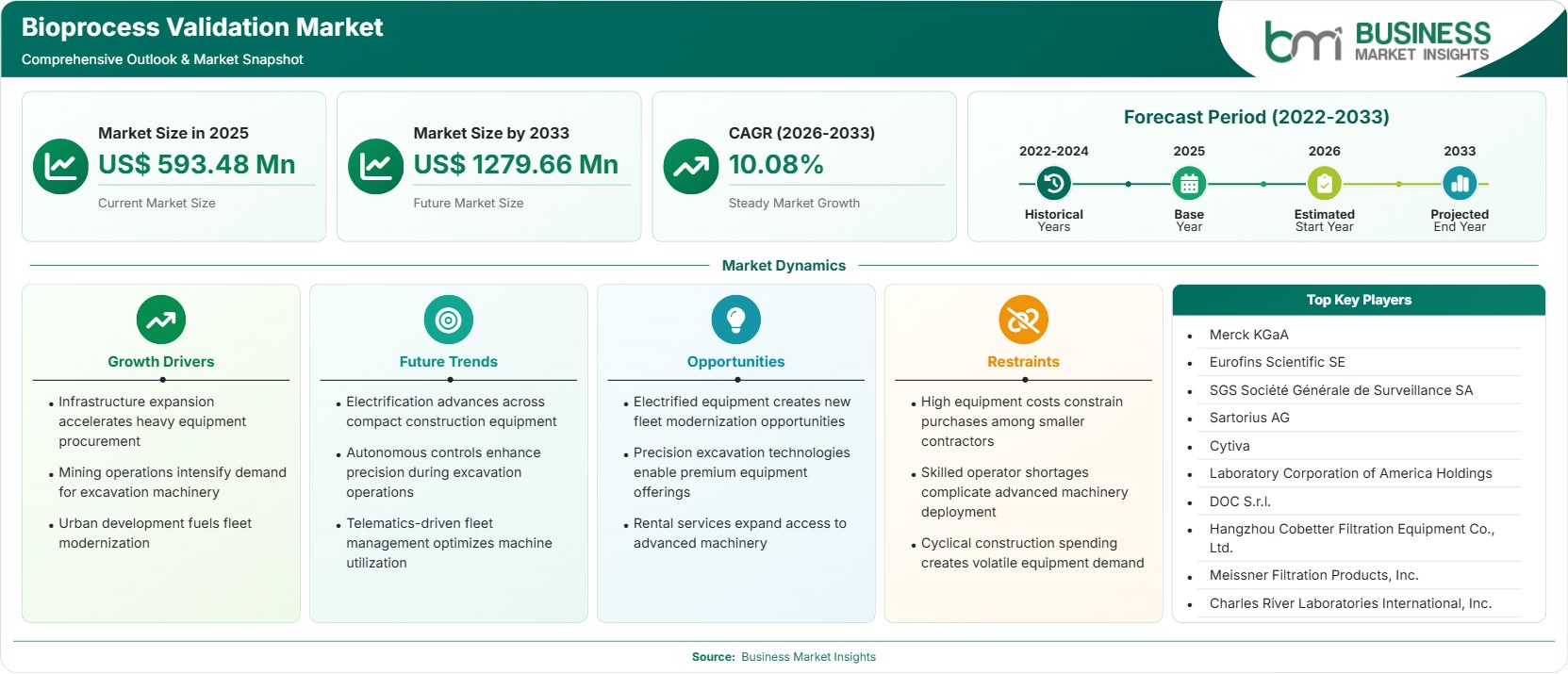
The Bioprocess Validation Market size was valued at US$ 593.48 Million in 2025 and is projected to reach US$ 1279.66 Million by 2033, growing at a CAGR of 10.08% during 2026-2033, supported by biologics manufacturing expansion, stricter quality controls, single-use technologies, and outsourced validation services.

Report Coverage
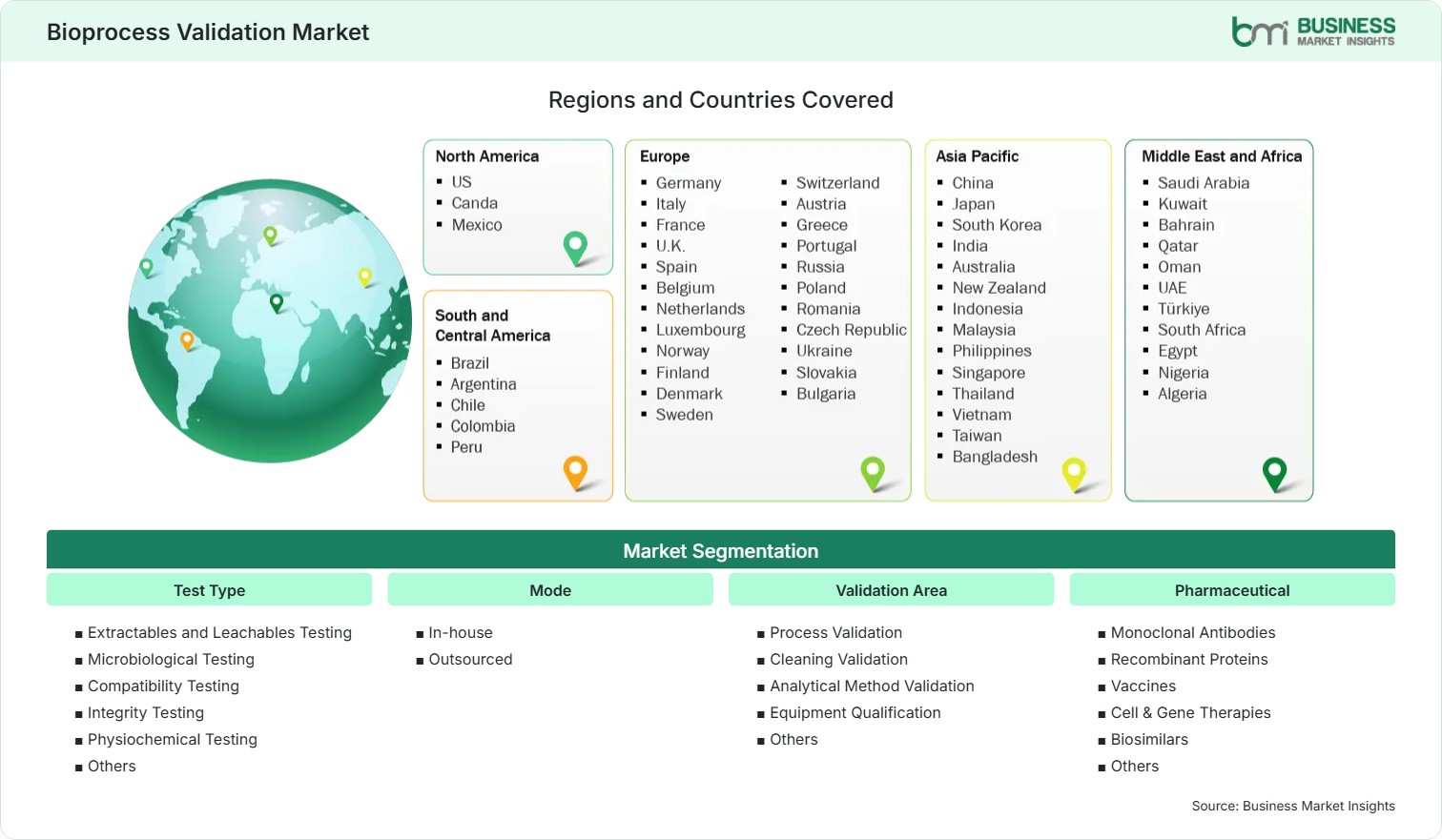
  • Test Type: Extractables and Leachables Testing, Microbiological Testing, Compatibility Testing, Integrity Testing, Physiochemical Testing, Others
  • Mode: In-house, Outsourced
  • Validation Area: Process Validation, Cleaning Validation, Analytical Method Validation, Equipment Qualification, Others
  • Pharmaceutical: Monoclonal Antibodies, Recombinant Proteins, Vaccines, Cell & Gene Therapies, Biosimilars, Others
  • End User: Pharmaceutical & Biotechnology Companies, Others
US$ 593.48 Mn Market size in 2025
US$ 1279.66 Mn Market Size by 2033
10.08% CAGR, 2026 - 2033
2026-2033 Forecast Period

AI Overview

Bioprocess Validation Market Summary

  • North America Region: North America holds a 39%-42% share in 2025, growing at a 9%-10.5% CAGR during 2026-2033, influenced by mature biologics manufacturing, stringent FDA expectations, advanced testing infrastructure, and outsourcing opportunities. The US market benefits from sophisticated biopharmaceutical capacity and established validation laboratories, with a 9%-10% CAGR during 2026-2033.
  • Fastest Growing Region: Asia Pacific represents a 27%-30% share in 2025, with a 11%-12.5% CAGR during 2026-2033, driven by expanding biologics manufacturing, cost-efficient production, biosimilar development, contract manufacturing investments, and increasing regulatory alignment across China, India, South Korea, Singapore, and Japan.
  • Leading Segment: Extractables and Leachables Testing represents an estimated 28%-31% share in 2025, expanding at a 10.5%-12% CAGR during 2026-2033, supported by single-use bioprocessing, material-contact risk assessment, container compatibility requirements, and increasing regulatory scrutiny.
  • High Growth Segment: Cell and Gene Therapies account for an estimated 8%-11% share in 2025, expanding at a 12.5%-14.5% CAGR during 2026-2033, supported by advanced therapy pipelines, viral-vector manufacturing, specialized analytical controls, aseptic processing, and increasingly complex validation requirements.
  • Key Market Opportunity: Outsourced validation offers pharmaceutical developers scalable technical expertise, specialized laboratories, shorter qualification cycles, and flexible capacity as complex biologics and advanced therapies expand across global manufacturing networks.
  • Major Market Players: Merck KGaA, Eurofins Scientific SE, SGS Société Générale de Surveillance SA, Sartorius AG, Cytiva, Laboratory Corporation of America Holdings, DOC S.r.l., Hangzhou Cobetter Filtration Equipment Co., Ltd., Meissner Filtration Products, Inc., and Charles River Laboratories International, Inc.
Strategic Insights

Bioprocess Validation Market: Strategic Insights

Bioprocess Validation Market Strategic Framework
FREE PDF
Request your free sample
Request free sample
Stakeholder View

Key Takeaways

  • The bioprocess equipment manufacturers, the filtration specialists, the analytical laboratories, the contract research organizations, and the pharmaceutical manufacturers are now more connected than ever, and this network enables the development of integrated validation packages relating to the equipment, the materials, the analytical procedures, and the production processes.
  • Testing extractables and leachables, along with integrity and compatibility, offers attractive possibilities, as the use of single-use components and the presence of complex material interfaces increase the need to demonstrate product safety and process suitability.
  • Validation is gradually progressing towards methods that are based on risk, suitable for each phase, and make use of data. The use of automated monitoring, digital batch records, advanced analytical techniques, and standardized platform methods can cut down on the amount of repetitive qualification work and, at the same time, improve traceability.
  • Asia Pacific represents a highly attractive opportunity for expansion since the production of biologics and biosimilars is growing in line with the trend of pharmaceutical outsourcing. Manufacturing and analytical systems are becoming more advanced in China, India, Singapore, South Korea, and Japan.
  • Testing companies and laboratories are expanding their geographic coverage and the range of services they offer. The fact that Eurofins has agreed in 2026 to acquire Element Materials Technology's North American Life Sciences Testing Services business is an example of the ongoing trend of consolidation concerning specialized testing capabilities.
  • Companies that have both the knowledge of validation and an understanding of the specific equipment can distinguish themselves better than those who provide only isolated testing. Increasingly, comprehensive technical documentation and regulatory assistance are affecting the decisions made when purchasing.
Geographic Outlook

Bioprocess Validation Market Regional Highlights

North America Bioprocess Validation Market

North America held a 39%-42% Bioprocess Validation Market share in 2025 and is projected to expand at a 9%-10.5% CAGR during 2026-2033. The region benefits from established biologics production, mature contract testing infrastructure, advanced analytical laboratories, and stringent quality expectations. US manufacturers represent the dominant regional demand base, while Canada contributes through biotechnology development and outsourced testing. Demand is particularly strong for process validation, analytical method validation, integrity testing, and extractables and leachables programs supporting commercial biologics and advanced therapies.

  • The expectations regarding FDA validation lead manufacturers to incorporate it into their lifecycle quality management, which in turn increases the continual need for documented process and analytical controls.
  • The requirements for validation in single-use manufacturing are being extended to include filters, bags, connectors, tubing, and assemblies, especially concerning extractables, leachables, integrity, compatibility, and microbial performance.
  • Pharmaceutical outsourcing is beneficial for specialized laboratories since manufacturers are able to obtain the necessary technical expertise without having to set up their own costly analytical infrastructure and specialist staff.
  • The development of advanced therapies leads to a greater need for highly specific validation methods, which involve viral vectors, cell-based assays, microbiological controls, and complicated analytical procedures.

US Bioprocess Validation Market

The US represented approximately 30%-33% of the global Bioprocess Validation Market in 2025, equivalent to a substantial majority of North American demand, and is projected to expand at a 9%-10% CAGR during 2026-2033. Its position reflects dense biopharmaceutical manufacturing capacity, advanced CDMO infrastructure, regulatory sophistication, and a large pipeline of biologics. Validation demand spans process qualification, analytical procedures, cleaning programs, equipment qualification, microbial testing, and single-use component studies across clinical and commercial manufacturing networks.

  • The guidance on process validation issued by the FDA sets out a framework that is oriented around the product's entire lifecycle in order to show that the process is reproducible and under control, and thus makes detailed validation records essential for ensuring readiness for manufacturing and compliance with regulatory requirements.
  • Increasingly, laboratories in the United States are carrying out validation that is appropriate to each phase, which enables smaller biotechnology companies to make use of specialized facilities without having to set up their own full-scale testing organizations.
  • As the manufacturing of cell and gene therapies expands, there is a growing need for specialized validation strategies covering viral vectors, cell processing, aseptic operations, and the use of highly sensitive analytical methods.

Europe Bioprocess Validation Market

Europe accounted for an estimated 22%-25% Bioprocess Validation Market share in 2025 and is projected to register an 8%-9.5% CAGR during 2026-2033. Germany, Switzerland, France, the UK, and Ireland remain important pharmaceutical and biopharmaceutical manufacturing centers. The region's validation demand is reinforced by strong quality systems, sophisticated CDMO networks, and established testing providers. Germany and Switzerland remain leading markets, while Ireland and selected Central European manufacturing locations offer high-growth opportunities as biologics capacity and outsourced services expand.

  • Increasingly, European manufacturers are requiring validation programmes which support multinational product registrations, leading to a demand for standardized documentation that can be used in various regulatory jurisdictions.
  • Germany is still a vital validation market due to its pharmaceutical manufacturing sector, the sophistication of its laboratory infrastructure, and the fact that it has a high concentration of companies providing bioprocess equipment and services.
  • The biopharmaceutical manufacturing ecosystem in Ireland meets the demand for services relating to process qualification, cleaning, analytical testing, and equipment qualification associated with the large-scale production of biologics.
  • Eurofins has reported that demand for its North American BioPharma Product Testing services remains steady and that it is making continued investments in its global network of laboratories, showing how important geographic scale is in the case of outsourced testing.

Asia Pacific Bioprocess Validation Market

Asia Pacific held approximately 27%-30% of the Bioprocess Validation Market in 2025 and is forecast to grow at an 11%-12.5% CAGR during 2026-2033, making it the fastest-growing major region. China, Japan, India, South Korea, and Singapore are central markets. China and Japan provide established manufacturing capabilities, while India and South Korea offer strong growth through biosimilars, vaccines, CDMOs, and export-oriented pharmaceutical production.

  • China is reinforcing its domestic abilities in the manufacture of biopharmaceuticals and in analytical techniques, which is leading to a greater demand for services relating to process, equipment, microbiological, and analytical validation.
  • India has a large pharmaceutical manufacturing sector, together with growing activity in the area of biologics and biosimilars, which presents opportunities for outsourcing of testing and regulatory assistance.
  • The high-value biomanufacturing ecosystem in Singapore generates a demand for sophisticated validation, analytical development, process controls, and technology-transfer services.
  • The fact that South Korea is investing in the manufacturing and contract development of biologics leads to a need for standardized validation programs able to support regulatory submissions worldwide.

Rest of World Bioprocess Validation Market

Rest of World represented approximately 10%-13% Bioprocess Validation Market share in 2025 and is projected to grow at an 8%-10% CAGR during 2026-2033. South and Central America are developing pharmaceutical manufacturing and biologics capabilities, while Middle Eastern markets are investing in healthcare localization and manufacturing. Brazil and Mexico remain important Latin American markets, whereas Saudi Arabia and the United Arab Emirates offer emerging opportunities for pharmaceutical production and technology transfer.

The growing trend of pharmaceutical localization in emerging markets is leading to a greater demand for validation abilities that can support imported technologies, locally produced products, and international quality standards. By combining local technical support with internationally recognized testing methods, regional laboratories and global service providers can take advantage of the opportunities available to them.

  • Because of the size of its pharmaceutical sector and the growing interest in biotechnology, Brazil has opportunities to provide outsourced validation and analytical services.
  • The manufacturing environment in Mexico offers opportunities for validation providers who support pharmaceutical production, technology transfer, and the quality systems associated with North American supply chains.
  • Saudi Arabia is aiming at localizing the manufacture of pharmaceuticals, which will create longer-term opportunities for equipment qualification, process validation, and laboratory testing.
  • The United Arab Emirates has the potential to become a regional hub for the life sciences as both pharmaceutical investment and the capacity for specialized healthcare manufacturing grow.
Global Market Geography
FREE PDF
Request your free sample
Request free sample
Segment Analysis

Bioprocess Validation Market Segmentation

Test Type

Test Type is a core component of the market because manufacturers require multiple forms of evidence to demonstrate process suitability, material compatibility, sterility, and analytical reliability. The segment held an estimated 2025 share of 42%-46% and is projected to expand at a 10%-11.5% CAGR during 2026-2033. Single-use adoption, complex biologics, and regulatory scrutiny support continued testing demand.

  • Extractables and Leachables Testing: Assesses substances that can migrate from process-contact materials into products, supporting single-use systems, container compatibility, patient safety, and regulatory documentation.
  • Microbiological Testing: Evaluates microbial contamination risks and supports aseptic processing, environmental controls, sterility assurance, and bioburden management throughout biopharmaceutical manufacturing.
  • Compatibility Testing: Determines whether process materials interact adversely with drug substances, formulations, or manufacturing environments, supporting material selection and reliable product quality.
  • Integrity Testing: Confirms the physical integrity of filters, containers, assemblies, and other critical components, reducing contamination and product-loss risks during processing.
  • Physiochemical Testing: Measures relevant chemical and physical characteristics to demonstrate process consistency, material suitability, and analytical control across biopharmaceutical manufacturing operations.

Mode

The Mode segment is divided between internal and external validation capabilities. Outsourcing is gaining strategic importance as specialized studies require expensive laboratories, experienced scientists, and sophisticated analytical instruments. The segment represented an estimated 2025 share of 31%-35% and is projected to expand at a 10%-11.5% CAGR during 2026-2033 as biotechnology companies seek flexible validation capacity.

  • In-house: Internal programs provide direct control over schedules, documentation, technical knowledge, and recurring testing, particularly for large manufacturers with established quality and laboratory organizations.
  • Outsourced: External providers offer specialist laboratories, regulatory expertise, flexible capacity, validated methods, and access to advanced instrumentation without requiring equivalent internal capital investment.

Validation Area

Validation Area encompasses process and facility-related activities required to establish reproducibility and regulatory readiness. The segment accounted for an estimated 2025 share of 35%-39% and is expected to expand at a 9.5%-11% CAGR during 2026-2033. The Bioprocess Validation Market scope increasingly covers integrated validation rather than isolated qualification studies.

  • Process Validation: Demonstrates that manufacturing processes consistently operate within defined parameters and produce outputs meeting established quality attributes and specifications.
  • Cleaning Validation: Establishes that cleaning procedures reliably remove residues, contaminants, and microorganisms to predetermined acceptable levels across manufacturing equipment.
  • Analytical Method Validation: Demonstrates that analytical procedures are suitable for their intended purpose and generate reliable, reproducible results supporting quality decisions.
  • Equipment Qualification: Confirms that equipment is properly designed, installed, operated, and capable of performing according to specified requirements throughout its intended lifecycle.

Pharmaceutical

Pharmaceutical modalities generate different validation requirements because product characteristics, process complexity, manufacturing scale, and analytical control strategies vary considerably. This segment represented an estimated 2025 share of 34%-38% and is projected to grow at a 10.5%-12% CAGR during 2026-2033, with advanced therapies providing additional demand.

  • Monoclonal Antibodies: Require extensive process characterization, analytical testing, microbial controls, and equipment validation across upstream and downstream manufacturing stages.
  • Recombinant Proteins: Depend on controlled cell culture, purification, filtration, and analytical procedures that require robust validation throughout production and release.
  • Vaccines: Require stringent microbiological, analytical, process, and facility controls because contamination and variability can directly affect product safety and consistency.
  • Cell & Gene Therapies: Introduce complex validation needs involving viral vectors, cell processing, aseptic handling, specialized assays, and highly controlled manufacturing environments.
  • Biosimilars: Require strong comparability, analytical characterization, process control, and validation strategies to demonstrate consistency with reference biological products.

End User

End users increasingly balance internal quality oversight with outsourced specialist capabilities. Pharmaceutical and biotechnology companies remain the dominant customer group because validation is embedded throughout clinical-to-commercial manufacturing. The segment represented an estimated 2025 share of 72%-76% and is projected to grow at a 9.5%-11% CAGR during 2026-2033.

  • Pharmaceutical & Biotechnology Companies: Generate the majority of demand because they require validation across manufacturing processes, equipment, analytical methods, cleaning procedures, and material-contact systems.
Market Forces

Bioprocess Validation Market Dynamics

Key Market Drivers

Expansion of Single-Use Bioprocessing Increases Material Validation Requirements

Single-use technologies are changing validation requirements because bags, tubing, filters, connectors, and assemblies introduce multiple product-contact materials into manufacturing workflows. Sartorius states that its validation services cover bags, container closure systems, mixing systems, sterile filters, transfer systems, membrane adsorbers, and virus filters. Its service portfolio also highlights extractables and leachables expertise and risk-based validation. This supports continued demand for material characterization, integrity testing, compatibility assessment, and bacterial retention studies. The Bioprocess Validation Market trends therefore, increasingly reflect the shift from conventional stainless-steel infrastructure toward disposable process platforms. Manufacturers must establish evidence that contact materials do not compromise product quality, while suppliers need documentation capable of supporting multiple manufacturing configurations and regulatory submissions across different jurisdictions.

Growing Biologics Complexity Raises Analytical and Process Control Needs

Biologics increasingly involve complex molecular structures, sensitive manufacturing conditions, and specialized analytical requirements. Monoclonal antibodies, recombinant proteins, vaccines, biosimilars, cell therapies, and gene therapies require different process controls and analytical strategies. Charles River provides method development, qualification, and validation from early development through commercialization, including flow cytometry, qPCR, ddPCR, HPLC, ELISA, cell-based assays, and microbial and viral testing. These capabilities illustrate how validation demand is expanding beyond conventional process qualification. As manufacturing platforms become more specialized, validation providers must demonstrate modality-specific expertise. The resulting Bioprocess Validation Market growth is supported by the need to generate reliable evidence across process development, clinical manufacturing, commercial scale-up, technology transfer, and post-change validation activities while maintaining traceable documentation and regulatory readiness.

Stronger Lifecycle Quality Expectations Support Recurring Validation Demand

Regulatory expectations increasingly position validation as a lifecycle activity rather than a single pre-commercial event. FDA guidance describes process validation as documented evidence that a process can consistently perform effectively and reproducibly within established parameters. ICH Q7 similarly addresses cleaning validation and analytical method validation, emphasizing practical, verifiable limits and suitability under actual conditions of use. These principles support recurring validation after process changes, equipment modifications, technology transfers, and manufacturing expansions. Consequently, service providers can develop longer customer relationships through periodic revalidation, change-control support, method transfer, and lifecycle monitoring. Manufacturers benefit from structured programs that reduce compliance risk while preserving production continuity and audit readiness.

Key Market Opportunities

Outsourcing Creates Scalable Access to Specialized Validation Infrastructure

Outsourcing offers biotechnology companies a way to access specialist laboratories, validated analytical methods, experienced scientists, and regulatory documentation without building equivalent internal infrastructure. This opportunity is particularly relevant for emerging companies moving rapidly from clinical development toward commercial manufacturing. Charles River provides phase-appropriate method development and validation, while SGS offers analytical method development and validation across pharmaceutical and biopharmaceutical workflows. The Bioprocess Validation Market Forecasts indicate attractive potential for service models that combine testing, consulting, documentation, and regulatory support. Providers can differentiate through faster project initiation, standardized study protocols, digital reporting, flexible capacity, and global laboratory networks. Customers can reduce fixed costs while maintaining access to specialized equipment and technical capabilities.

Advanced Therapies Open New Validation Service Applications

Cell and gene therapies create validation requirements that differ from traditional biologics because manufacturing often involves living cells, viral vectors, specialized culture systems, short processing windows, and sensitive analytical assays. Validation opportunities extend across aseptic operations, viral safety, identity, potency, sterility, contamination control, and analytical methods. Labcorp supports advanced modalities, including cell and gene therapies and provides validation capabilities across global laboratories. Service providers can develop dedicated validation packages for emerging therapies, combining analytical testing with process and equipment qualification. This creates an attractive opportunity for providers capable of supporting small-batch manufacturing, rapid method transfer, decentralized production models, and regulatory submissions across multiple markets while maintaining data integrity and reproducibility.

Asia Pacific Expansion Supports Regional Validation Networks

The expansion of manufacturing in the Asia Pacific region offers validation providers the chance to set up local laboratories and technical support teams. Nowadays, pharmaceutical companies are increasingly asking that validation facilities be located near their manufacturing sites to reduce sample transport times, speed up investigations, and facilitate technology transfers. Labcorp has a network in the Asia Pacific area with facilities in China, Japan, Singapore and other markets, and this network provides capabilities in method development, validation, and the analysis of samples. Expansions by specialist testing organizations in this area can also improve the availability of their services in the region. India, China, South Korea and Singapore present especially good opportunities since these countries combine pharmaceutical manufacturing, investment in biologics and export-oriented production. Local validation services can also enable multinational manufacturers to keep their global quality systems consistent while at the same time adjusting their documentation and the way they carry out procedures to meet the requirements of the local operating environment.

Market Restraints and Challenges

High Technical Complexity Increases Validation Costs and Project Timelines

Factor: Validation programs require specialist laboratories, trained personnel, qualified instruments, reference materials, controlled documentation, and carefully designed protocols. Complex biologics and advanced therapies can require multiple analytical platforms and modality-specific assays, increasing study complexity.

Impact: Higher technical requirements can raise project costs and extend validation timelines, particularly for smaller biotechnology companies with limited internal quality resources. Providers must balance customization with standardized methods to maintain efficiency. Sartorius indicates that some validation studies can be completed as quickly as six weeks, while also emphasizing risk-based approaches and specialized extractables and leachables expertise. The challenge creates pressure for service providers to improve laboratory utilization, automation, method standardization, and project management without compromising regulatory expectations or analytical robustness.

Regulatory Variation Complicates Global Validation Programs

Factor: Pharmaceutical manufacturers operating across multiple jurisdictions must manage different regulatory expectations, documentation requirements, pharmacopoeial references, and validation interpretations. A study suitable for one market may require additional evidence for another market or manufacturing location.

Impact: Regulatory variation can increase documentation workloads, create additional testing requirements, and complicate technology transfers. Merck's BioReliance Validation Services specifically describes developing validation strategies according to the country where manufacturing occurs and the markets where products will be marketed. This illustrates the operational challenge faced by multinational manufacturers. Service providers can mitigate the issue through globally harmonized protocols, regulatory consulting, standardized reports, and region-specific technical expertise, but maintaining these capabilities requires continuous investment in regulatory knowledge.

Company Analysis

Competitive Landscape

Competitive Bioprocess Validation Market analysis indicates a fragmented but increasingly integrated service ecosystem. Suppliers differentiate through laboratory scale, geographic reach, equipment expertise, analytical breadth, regulatory knowledge, and the ability to combine validation with broader biopharmaceutical testing.

Company Name

Overview

Products and Services Relevant to This Market

Merck KGaA

Global life sciences company providing BioReliance validation capabilities and specialized laboratory support for biopharmaceutical manufacturing.

Filter and single-use validation, bacterial retention, integrity testing, extractables and leachables, compatibility testing, and validation consultancy.

Eurofins Scientific SE

Global testing organization with broad BioPharma Services capabilities and expanding laboratory infrastructure across major pharmaceutical markets.

Biopharmaceutical product testing, analytical services, microbiology, method development, validation, bioanalysis, and specialized laboratory services.

SGS Société Générale de Surveillance SA

Global inspection, testing, and certification provider with extensive pharmaceutical and biopharmaceutical analytical capabilities.

Method validation, microbiology, analytical CMC, facility validation, environmental monitoring, product testing, and biopharmaceutical quality services.

Sartorius AG

Biopharmaceutical technology provider with dedicated validation services supporting single-use and conventional manufacturing systems.

Process-component validation, sterile-filter validation, extractables and leachables, bacterial challenge testing, and single-use system validation.

Cytiva

Bioprocess technology supplier supporting pharmaceutical manufacturers through equipment, filtration, process, and validation-related capabilities.

Bioprocess validation support, filtration solutions, single-use technologies, process systems, and related technical services.

Laboratory Corporation of America Holdings

Global laboratory and drug development organization supporting pharmaceutical and biotechnology customers across development and CMC activities.

Analytical method validation, technical transfer, cross-validation, revalidation, QC testing, and biopharmaceutical analytical services.

DOC S.r.l.

Specialist Italian provider participating in pharmaceutical and biopharmaceutical testing and validation activities.

Validation-related testing, analytical support, pharmaceutical quality services, and specialized laboratory capabilities.

Hangzhou Cobetter Filtration Equipment Co., Ltd.

China-based filtration technology company serving biopharmaceutical and industrial filtration applications.

Filtration systems, single-use components, process filtration, integrity-related solutions, and bioprocess validation support.

Meissner Filtration Products, Inc.

US-based filtration technology provider focused on critical filtration and single-use solutions for biopharmaceutical manufacturing.

Sterilizing-grade filtration, single-use systems, filtration components, integrity-related services, and bioprocess support.

Charles River Laboratories International, Inc.

Global laboratory services provider offering analytical development and validation across complex biologic modalities.

Method development, qualification, GMP validation, qPCR, ddPCR, flow cytometry, HPLC, ELISA, microbial and viral testing.

Trust & Transparency

Research Methodology

The market analysis combines proprietary research with secondary data from government agencies, company disclosures, regulatory filings, industry databases and expert interviews. Market estimates are validated through data triangulation, cross-market benchmarking and analyst review.

View Full Research Methodology

Questions Answered

Frequently Asked Questions

How can companies use the Bioprocess Validation Market Report for strategic planning?

The Bioprocess Validation Market Report can support supplier evaluation, regional expansion planning, outsourcing decisions, competitive benchmarking, technology prioritization, and investment assessment. Decision-makers can also use segmentation insights to compare testing types, validation areas, pharmaceutical modalities, and end-user requirements.

What capabilities should buyers evaluate when selecting a validation provider?

Buyers should evaluate technical expertise, regulatory knowledge, laboratory accreditation, modality experience, analytical breadth, geographic coverage, documentation quality, turnaround time, data integrity controls, and experience with technology transfer. Providers that understand both process equipment and analytical requirements can reduce coordination complexity across validation programs.

How does ICH influence validation programs?

ICH guidance provides internationally recognized principles for pharmaceutical quality and analytical procedures. ICH Q7 addresses cleaning validation and analytical method validation, while newer analytical procedure frameworks support science- and risk-based development. These principles encourage manufacturers to document suitability, reproducibility, and control.

Why are biotechnology companies increasingly outsourcing validation?

Outsourcing provides access to specialized laboratories, experienced scientists, validated methods, analytical instruments, and regulatory expertise without requiring equivalent internal infrastructure. It can be particularly valuable for smaller biotechnology companies that need flexible capacity during clinical development, technology transfer, scale-up, and commercial manufacturing.

What validation activities are most important for single-use bioprocessing?

Single-use manufacturing places particular emphasis on extractables and leachables, filter integrity, bacterial retention, material compatibility, container closure, and process-component validation. The exact testing package depends on product characteristics, process conditions, material composition, and regulatory requirements. Sartorius and Merck both maintain specialized capabilities addressing these validation needs.

Access the Full Bioprocess Validation Market Report

Get segment-level forecasts, regional estimates, competitive benchmarking, company profiles and downloadable Excel datasets.

Access the full Bioprocess Validation Market Report
350 pages PDF & Excel | 2026-09-15
Similar Research

Related Market Reports