
Hydrocolloids Market Outlook: Size, Share, Trends, Growth Analysis, Competitive Landscape & Forecast, 2026-2033

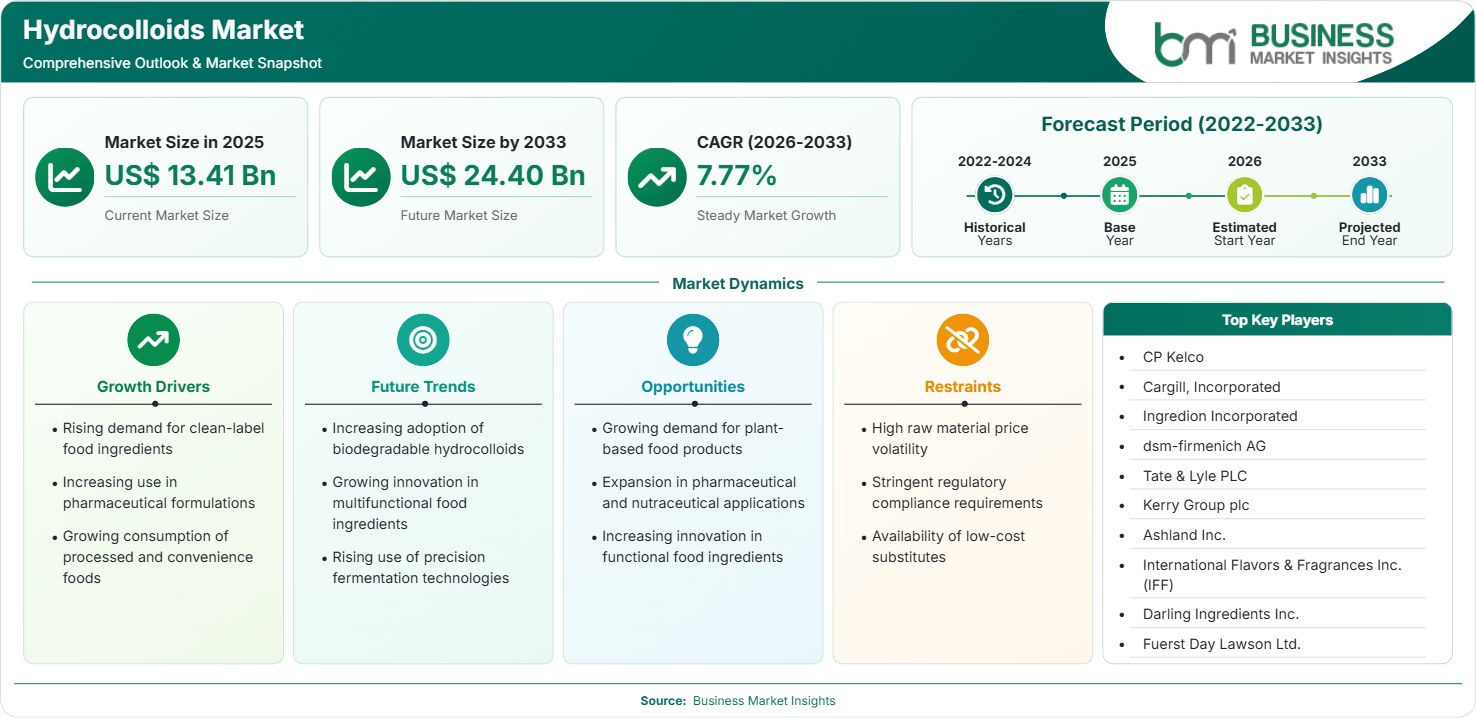
The Hydrocolloids Market size was valued at US$ 13.41 Billion in 2025 and is projected to reach US$ 24.40 Billion by 2033, growing at a CAGR of 7.77% during 2026–2033. Rising demand for clean-label ingredients, expanding pharmaceutical applications, and increasing consumption of processed foods continue to support market expansion, while innovation in plant-based formulations and functional food ingredients creates significant long-term growth opportunities.

Report Coverage
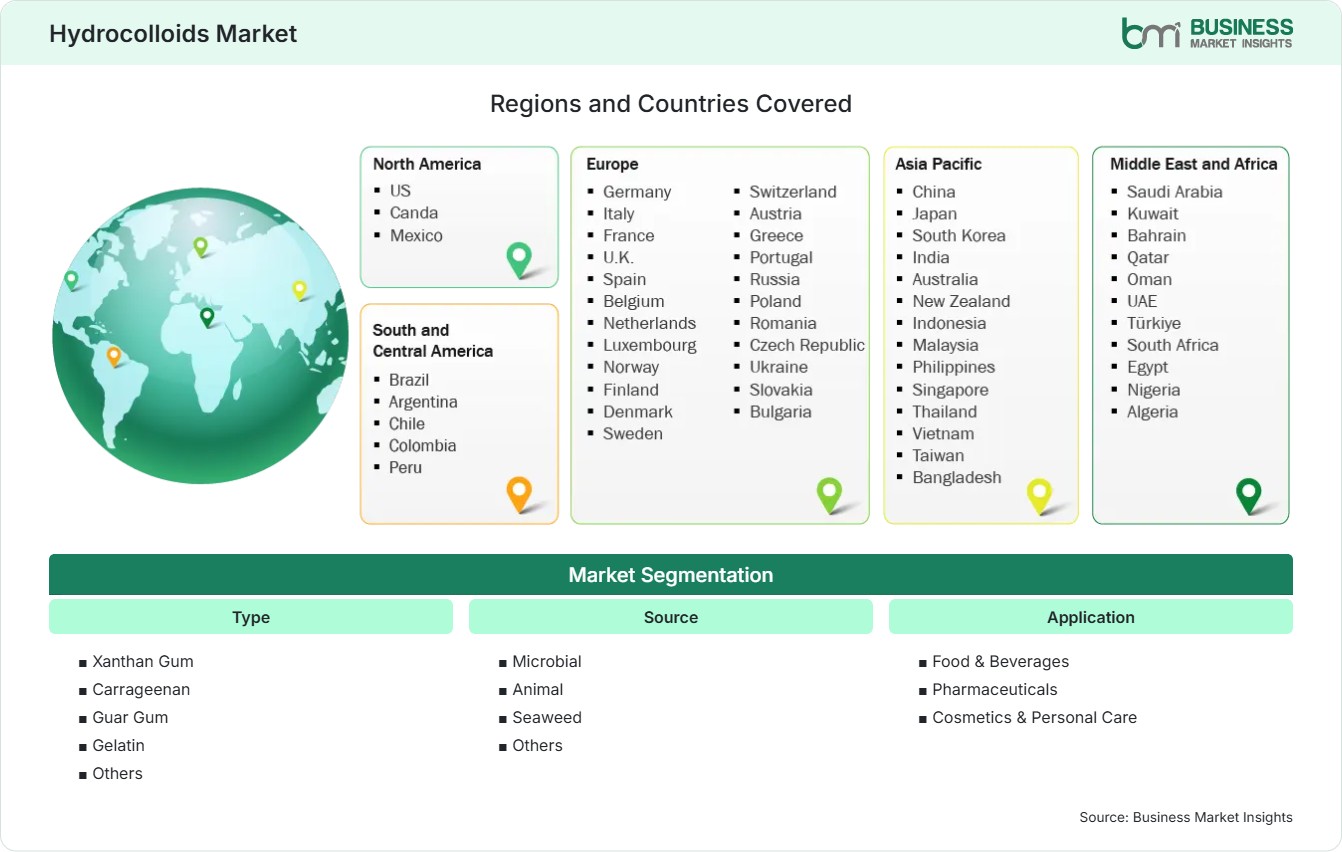
  • Type: Xanthan Gum, Carrageenan, Guar Gum, Gelatin, Others
  • Source: Microbial, Animal, Seaweed, Others
  • Application: Food & Beverages, Pharmaceuticals, Cosmetics & Personal Care
US$ 13.41 Bn Market size in 2025
US$ 24.40 Bn Market Size by 2033
7.77% CAGR, 2026 - 2033
2026-2033 Forecast Period

01 AI Overview

Hydrocolloids Market Summary

  • North America Region: North America holds 33%–35% share in 2025 and is projected to grow at a 6.8%–7.3% CAGR during 2026–2033. Strong demand for clean-label formulations, advanced food processing capabilities, and expanding pharmaceutical manufacturing continue driving investment across ingredient innovation and specialty hydrocolloid production. The United States remains the largest regional contributor, expanding at a CAGR of 6.9%–7.5% through increasing adoption in processed foods, nutraceuticals, and pharmaceutical excipients.
  • Fastest Growing Region: Asia Pacific accounts for 29%–31% share in 2025 while advancing at a 8.8%–9.4% CAGR during 2026–2033. Rising urbanization, expanding processed food consumption, improving healthcare infrastructure, and growing investment in food ingredient manufacturing continue strengthening regional demand.
  • Leading Segment: Food & Beverages accounts for 51%–54% share in 2025 and is expected to register a 7.9%–8.4% CAGR during 2026–2033. Increasing utilization as stabilizers, thickeners, emulsifiers, and texture modifiers supports sustained adoption across bakery, dairy, beverages, confectionery, and ready-to-eat food products.
  • High Growth Segment: Seaweed source contributes 24%–27% share in 2025 while expanding at a 8.7%–9.2% CAGR through 2033. Growing preference for naturally derived ingredients, expanding carrageenan production, and increasing demand for plant-based food formulations continue supporting rapid adoption.
  • Key Market Opportunity: Expanding development of plant-based proteins, clean-label processed foods, pharmaceutical excipients, nutraceutical supplements, and innovative texture-enhancing ingredients creates long-term opportunities for hydrocolloid manufacturers across global consumer industries.
  • Major Market Players: CP Kelco, Cargill, Incorporated, Ingredion Incorporated, dsm-firmenich AG, Tate & Lyle PLC, Kerry Group plc, Ashland Inc., International Flavors & Fragrances Inc. (IFF), Darling Ingredients Inc., Fuerst Day Lawson Ltd.
02 Strategic Insights

Hydrocolloids Market: Strategic Insights

Hydrocolloids Market Strategic Framework
FREE PDF
Request your free sample
Request free sample
03 Stakeholder View

Key Takeaways

  • The market ecosystem increasingly integrates agricultural producers, fermentation technology providers, seaweed processors, specialty ingredient manufacturers, food processors, pharmaceutical companies, and distribution partners to ensure consistent product quality and supply chain resilience.
  • Food and beverage manufacturers represent the strongest commercial opportunity as consumer preference shifts toward clean-label, reduced-fat, plant-based, and texture-enhanced products requiring advanced hydrocolloid functionality.
  • Innovation is increasingly centered on multifunctional hydrocolloid blends, precision fermentation technologies, sustainable extraction methods, and ingredient optimization that simultaneously improve texture, stability, and nutritional value.
  • Asia Pacific presents the most attractive long-term investment destination because of expanding food manufacturing capacity, rising processed food consumption, supportive industrial policies, and increasing healthcare expenditure across emerging economies.
  • Strategic acquisitions, product portfolio expansion, and collaborative research initiatives continue reshaping competitive dynamics as ingredient suppliers strengthen capabilities in specialty food ingredients, pharmaceutical excipients, and functional nutrition.
  • Sustainability initiatives encouraging renewable raw materials, reduced environmental impact, and circular production processes are becoming important competitive differentiators for manufacturers serving multinational food and healthcare companies.
04 Geographic Outlook

Hydrocolloids Market Regional Highlights

North America Hydrocolloids Market

North America accounts for 33%–35% Hydrocolloids Market share in 2025 and is projected to expand at a 6.8%–7.3% CAGR during 2026–2033. The region benefits from advanced food processing infrastructure, established pharmaceutical manufacturing, strong consumer demand for premium food products, and continuous ingredient innovation. Investments in natural stabilizers, clean-label formulations, and biotechnology-based ingredient development continue supporting regional leadership.

  • Food manufacturers increasingly replace synthetic additives with naturally derived hydrocolloids to satisfy consumer demand for transparent ingredient labels and minimally processed products.
  • Pharmaceutical companies continue incorporating hydrocolloids into controlled drug delivery systems, tablet formulations, wound care products, and encapsulation technologies requiring reliable rheological performance.
  • Strong research collaborations between ingredient suppliers and food manufacturers accelerate commercialization of multifunctional hydrocolloid blends for premium product applications.
  • Increasing demand for plant-based dairy alternatives and meat substitutes supports sustained utilization of hydrocolloids for texture enhancement, moisture retention, and product stability.
  • Regulatory emphasis on food safety, product traceability, and ingredient quality continues encouraging investment in advanced production technologies.

US Hydrocolloids Market

The United States represents the largest national market with 25%–27% global share in 2025 while expanding at a 6.9%–7.5% CAGR through 2033. Strong innovation in functional foods, dietary supplements, pharmaceutical formulations, and clean-label processed foods continues supporting steady demand. Manufacturers increasingly adopt advanced hydrocolloid technologies to improve product consistency, stability, and consumer appeal.

  • Growth in functional beverages and protein-enriched foods increases demand for hydrocolloids capable of enhancing viscosity, suspension stability, and sensory characteristics.
  • Pharmaceutical innovation supports broader application of gelatin, xanthan gum, and microbial hydrocolloids in controlled-release drug delivery systems.
  • Consumer preference for organic, natural, and minimally processed food products encourages wider adoption of clean-label stabilizing ingredients.
  • Expanding investment in food biotechnology and ingredient research strengthens domestic manufacturing capabilities and product innovation.

Europe Hydrocolloids Market

Europe represents 26%–28% share in 2025 while growing at a 7.2%–7.8% CAGR through 2033. Stringent food quality regulations, mature processed food industries, and increasing consumer preference for sustainable ingredients continue supporting market expansion. Germany remains the leading regional market, while Poland records the fastest growth with a projected 8.4%–8.9% CAGR through the forecast period.

  • European food manufacturers continue investing in natural hydrocolloids to comply with evolving clean-label and sustainability objectives.
  • Pharmaceutical producers increasingly utilize specialty hydrocolloids for tablet binding, controlled-release formulations, and biomedical applications.
  • Rising demand for vegan and vegetarian food products accelerates adoption of seaweed-derived hydrocolloids across multiple food categories.
  • Strong regulatory oversight encourages innovation focused on ingredient purity, traceability, and sustainable sourcing practices.
  • Continued investment in functional nutrition strengthens demand for premium hydrocolloid ingredients throughout the region.

Asia Pacific Hydrocolloids Market

Asia Pacific accounts for 29%–31% share in 2025 while recording the highest growth at a 8.8%–9.4% CAGR during 2026–2033. Rising disposable incomes, rapid urbanization, expanding food processing industries, and increasing healthcare investments continue driving regional consumption. China leads overall demand, while India records the fastest growth with a projected 9.5%–10.1% CAGR through 2033.

  • Rapid expansion of packaged foods and convenience meals significantly increases utilization of hydrocolloids for texture enhancement and shelf-life improvement.
  • Local pharmaceutical manufacturing growth creates additional demand for excipients, encapsulation materials, and controlled-release formulation ingredients.
  • Growing investment in seaweed cultivation supports regional supply of carrageenan and other marine-derived hydrocolloids.
  • Increasing consumer awareness regarding functional nutrition encourages adoption of premium ingredient formulations.
  • Government support for food processing and biotechnology industries strengthens long-term manufacturing capacity.

Rest of World Hydrocolloids Market

The Rest of World region contributes 10%–12% share in 2025 while expanding at a 7.8%–8.3% CAGR through 2033. South & Central America benefit from increasing processed food production, whereas Middle East & Africa experience growing demand driven by food security initiatives, healthcare expansion, and modernization of food manufacturing industries.

Growing investments in agricultural processing, ingredient imports, and pharmaceutical manufacturing continue strengthening regional consumption while encouraging greater adoption of natural food stabilizers across commercial applications.

  • Brazil remains the leading South & Central American market, while Mexico records the strongest regional expansion with a projected 8.5%–9.0% CAGR.
  • The United Arab Emirates leads Middle Eastern demand through advanced food manufacturing investments, while Saudi Arabia expands at a 8.6%–9.1% CAGR supported by food diversification initiatives.
  • Expanding dairy processing and beverage manufacturing continue increasing utilization of stabilizers and texture-modifying ingredients.
  • Rising healthcare infrastructure investment supports growing consumption of pharmaceutical-grade hydrocolloids.
  • International ingredient manufacturers continue strengthening regional distribution partnerships to improve supply chain efficiency and market penetration.
Global Market Geography
FREE PDF
Request your free sample
Request free sample
05 Segment Analysis

Hydrocolloids Market Segmentation

Type

The Type segment is the key landscape of products in the industry, which are chosen based on viscosity, gelling capacity, emulsion properties, stability, and compatibility within the formulation. The Xanthan Gum remains in the leadership because of its high thickening capacity, stability in a wide range of temperatures and pH values, and wide use in food and pharmaceutical industries. The main segment accounted for approximately 30%–33% market share in 2025 and is projected to expand at a 7.9%–8.4% CAGR during 2026–2033. The Hydrocolloids Market scope continues broadening as manufacturers develop customized hydrocolloid blends that improve functionality while meeting clean-label and sustainability requirements.

  • Xanthan Gum: Xanthan gum remains widely adopted owing to excellent viscosity control, freeze-thaw stability, and compatibility with numerous food, beverage, pharmaceutical, and industrial formulations requiring consistent texture and suspension properties.
  • Carrageenan: Carrageenan continues gaining traction in dairy products, plant-based beverages, processed meat, and confectionery applications because of its superior gelling, stabilizing, and water-binding characteristics derived from seaweed sources.
  • Guar Gum: Guar gum is extensively utilized for thickening, moisture retention, and emulsification across bakery products, sauces, dairy applications, pharmaceuticals, and personal care formulations due to its cost-effective functional performance.
  • Gelatin: Gelatin maintains strong demand in confectionery, capsules, desserts, dairy products, and biomedical applications where superior gel formation, film-forming capability, and protein functionality remain essential performance attributes.

Source

The trend toward source-based hydrocolloids market segmentation is a result of the growing industry focus on sustainable sourcing and diversified supply of raw materials. Microbial hydrocolloids form the biggest segment due to controlled fermentation technology and consistent quality of products produced. The segment accounted for approximately 34%–37% market share in 2025 while advancing at a 7.8%–8.3% CAGR during the forecast period. Growing consumer preference for naturally derived ingredients and technological improvements in fermentation continue supporting long-term expansion across multiple end-use industries.

  • Microbial: Fermentation-derived hydrocolloids continue experiencing increasing demand because of consistent quality, scalable production, high purity, and broad functionality across food processing, pharmaceuticals, and industrial applications.
  • Animal: Animal-derived hydrocolloids maintain importance in pharmaceutical capsules, confectionery products, desserts, and biomedical applications where superior gel strength and protein functionality remain key formulation requirements.
  • Seaweed: Seaweed-derived hydrocolloids continue benefiting from increasing demand for plant-based ingredients, sustainable sourcing practices, and expanding utilization in dairy alternatives, beverages, processed foods, and nutritional products.

Application

Application-based demand continues to be dominated by food processing industries, where hydrocolloids enhance texture, stability, mouthfeel, moisture retention, and shelf life across diverse product categories. Food & Beverages accounted for approximately 51%–54% market share in 2025 and is projected to register a 7.9%–8.4% CAGR during 2026–2033. The Hydrocolloids Market share within food manufacturing continues increasing as clean-label product development, plant-based innovation, and functional ingredient adoption reshape global formulation strategies.

  • Food & Beverages: Food manufacturers increasingly incorporate hydrocolloids into bakery, dairy, confectionery, beverages, sauces, frozen foods, and plant-based alternatives to improve texture, stability, processing efficiency, and overall product quality.
  • Pharmaceuticals: Pharmaceutical companies utilize hydrocolloids as binders, controlled-release agents, encapsulation materials, suspension stabilizers, and wound-care ingredients, supporting consistent formulation performance and improved therapeutic delivery.
  • Cosmetics & Personal Care: Cosmetic manufacturers employ hydrocolloids to improve viscosity, emulsification, moisture retention, product stability, and sensory performance across skincare, haircare, oral care, and personal hygiene formulations.
06 Market Forces

Hydrocolloids Market Dynamics

Key Market Drivers

Rising demand for clean-label food ingredients

Consumer interest in easily identifiable natural ingredients has altered formulating approaches in the worldwide food industry. According to the International Food Information Council (IFIC), ingredient identification and label clarity continue to be major factors affecting purchases of packaged foods. Hydrocolloids Market growth is increasingly supported by manufacturers replacing synthetic stabilizers with naturally sourced hydrocolloids that deliver comparable functionality while aligning with clean-label expectations. Manufacturers are now also reformulating bakery, dairy, confectionary, and beverages to increase shelf-life, enhance texture, and increase water retention properties without compromising the simplicity of ingredients, thus making sustained efforts in hydrocolloid research essential.

Increasing use in pharmaceutical formulations

Hydrocolloids are becoming more popular in the pharmaceutical industry owing to the unique binding, controlled release, encapsulation, and stabilization characteristics they possess. Gelatin, xanthan gum, carrageenan, and microbial hydrocolloids are now finding extensive use in pharmaceutical applications like tablets, capsules, dressings for wounds, and other drug delivery platforms that require constant rheology. The rise in health care costs, increase in the manufacture of biological drugs, and higher demands for sophisticated oral dose formulations are further boosting usage. Pharmaceutical producers are now investing in multifunctional excipients that help achieve better stability, bioavailability, and efficiency.

Growing consumption of processed and convenience foods

Fast-paced urbanization, changes in dietary trends, and increased disposable income are factors that continue to increase the consumption of processed food in the world today. The Food and Agriculture Organization (FAO) indicates that the urban population continues growing, thus causing the demand for processed foods. Hydrocolloids Market trends increasingly reflect manufacturers' need for ingredients that enhance viscosity, emulsification, freeze-thaw stability, and moisture retention. These functional benefits improve product quality across bakery, dairy, frozen foods, sauces, confectionery, and plant-based alternatives while supporting large-scale food manufacturing efficiency.

Key Market Opportunities

Growing demand for plant-based food products

The fast-growing number of different types of plant-based foods offers great possibilities to the hydrocolloid industry. Alternative dairy, meat, dessert, and drinks need sophisticated texture modification and stabilization in order to resemble regular products. The use of seaweed- and microbe-based hydrocolloids is more popular due to the fact that they are natural and suitable for vegan products. Hydrocolloids Market Forecasts indicate sustained investment in innovative ingredient systems that improve mouthfeel, water retention, and product stability while enabling manufacturers to satisfy consumer expectations for clean-label, plant-based nutrition.

Expansion in pharmaceutical and nutraceutical applications

The rising need for preventive health care, dietary supplements, and specialty drugs provides many lucrative business opportunities in the market. More applications are being found for hydrocolloids in products like nutraceutical gummies, functional capsules, oral suspensions, and controlled release dosage forms that need better performance and stability. Rising populations of older people, increased healthcare expenditures, and increased consumption of dietary supplements make it a necessity for pharmaceutical companies to use hydrocolloids that have multiple functions. Those businesses that can provide quality pharmaceutical grade products will definitely benefit from this trend.

Increasing innovation in functional food ingredients

Manufacturers of food products are continuously exploring research and development of food products that are healthier, protein-rich, low in sugar content, and enriched with fiber content but at the same time do not affect the taste or texture. Hydrocolloid utilization helps the formulation of flexible products through the help of improved viscosity, suspension, emulsions, and sensory attributes of food products. Advances in fermentation technologies, accurate mixing of components, and eco-friendly extraction methodologies increase the functionality of the products while reducing ecological footprint. Companies that concentrate on developing custom hydrocolloid formulations for high-value functional foods can gain competitive edge as the global demand for nutrition-based products grows rapidly.

Market Restraints and Challenges

High raw material price volatility

Factor: limiting industry expansion is fluctuating prices of agricultural and marine raw materials, including guar, seaweed, and animal-derived inputs. Impact: Supply disruptions caused by climate variability, changing agricultural output, geopolitical developments, and logistics constraints increase production costs and reduce pricing stability for manufacturers. Smaller ingredient producers face greater pressure in maintaining margins, while downstream food and pharmaceutical companies experience procurement uncertainty. Long-term supply agreements, diversified sourcing strategies, and investments in alternative production technologies are becoming increasingly important to mitigate these risks.

Stringent regulatory compliance requirements

Factor: Constraining market growth is the complex regulatory environment governing food additives, pharmaceutical excipients, labeling requirements, and ingredient safety across multiple jurisdictions. Impact: Compliance with standards established by authorities such as the U.S. FDA, European Food Safety Authority (EFSA), and Codex Alimentarius requires continuous investment in quality assurance, product testing, traceability, and documentation. Regulatory variations between countries can delay product commercialization, increase certification costs, and complicate global market expansion, particularly for companies introducing novel hydrocolloid formulations.

07 Company Analysis

Competitive Landscape

The competitive environment is characterized by continuous investment in product innovation, sustainable sourcing, biotechnology, and application-specific ingredient development. Hydrocolloids Market analysis indicates that leading manufacturers are strengthening their positions through capacity expansions, strategic acquisitions, research collaborations, and customized hydrocolloid solutions for food, pharmaceutical, and personal care applications. Companies are also emphasizing clean-label ingredients, fermentation technologies, and sustainable raw material sourcing to address evolving customer preferences and regulatory expectations.

Company Name

Overview

Products and Services Relevant to this Market

CP Kelco

Global specialty ingredient manufacturer recognized for hydrocolloid innovation serving food, beverage, pharmaceutical, and industrial customers worldwide.

Pectin, xanthan gum, carrageenan, gellan gum, citrus fiber, formulation support, and specialty hydrocolloid solutions.

Cargill, Incorporated

Multinational food ingredient company providing extensive ingredient portfolios supported by global sourcing and application expertise.

Texturizers, pectin, starches, carrageenan, stabilizer systems, emulsifiers, and customized food ingredient solutions.

Ingredion Incorporated

Global ingredient solutions provider specializing in texture, nutrition, and clean-label formulation technologies for diverse industries.

Starches, hydrocolloids, texturizers, clean-label ingredients, formulation services, and food system solutions.

dsm-firmenich AG

Science-based nutrition and ingredient company delivering sustainable solutions across food, health, and personal care markets.

Functional ingredients, nutritional solutions, texturizing systems, formulation expertise, and specialty ingredient technologies.

Tate & Lyle PLC

Global supplier of food ingredient solutions emphasizing healthier formulations and ingredient functionality for manufacturers worldwide.

Stabilizers, texture systems, specialty fibers, hydrocolloid blends, and formulation optimization services.

Kerry Group plc

International taste and nutrition company providing integrated ingredient technologies for global food and beverage manufacturers.

Texture systems, hydrocolloid blends, clean-label ingredients, beverage stabilization, and application development services.

Ashland Inc.

Specialty materials company supplying functional ingredients for pharmaceutical, food, and personal care industries globally.

Cellulose gums, pharmaceutical excipients, rheology modifiers, stabilizers, and formulation technologies.

International Flavors & Fragrances Inc. (IFF)

Global ingredient innovator offering advanced food formulation technologies following integration of nutrition and biosciences capabilities.

Hydrocolloids, cultures, texturizers, stabilizer systems, food ingredients, and biotechnology-based formulation solutions.

Darling Ingredients Inc.

Sustainable ingredient producer utilizing natural raw materials for food, feed, pharmaceutical, and industrial applications.

Gelatin, collagen ingredients, specialty proteins, pharmaceutical materials, and value-added ingredient solutions.

Fuerst Day Lawson Ltd.

International supplier specializing in functional food ingredients, stabilizers, and customized ingredient systems for manufacturers.

Hydrocolloid blends, stabilizers, emulsifiers, texture solutions, formulation support, and specialty ingredient distribution.


10 Trust & Transparency

Research Methodology

The market analysis combines proprietary research with secondary data from government agencies, company disclosures, regulatory filings, industry databases and expert interviews. Market estimates are validated through data triangulation, cross-market benchmarking and analyst review.

View Full Research Methodology

11 Questions Answered

Frequently Asked Questions

How does the Hydrocolloids Market Report support business decision-making?

The report provides comprehensive insights into market size, competitive landscape, regional performance, segmentation, technology developments, growth opportunities, regulatory trends, and strategic investment prospects, enabling informed business planning and expansion decisions.

Which source category is expected to witness strong future demand?

Seaweed-derived hydrocolloids are expected to experience particularly strong demand because they align with clean-label, plant-based, and sustainable ingredient trends while providing excellent gelling, thickening, and stabilizing performance across multiple food applications.

Why is Asia Pacific the fastest-growing regional market?

Asia Pacific benefits from rapid urbanization, expanding processed food industries, increasing healthcare investments, growing disposable incomes, and rising consumer demand for premium packaged foods. Government support for food processing and biotechnology further accelerates regional growth.

Which application segment dominates the Hydrocolloids Market?

Food & Beverages remains the leading application because hydrocolloids provide thickening, stabilization, emulsification, moisture retention, and texture enhancement across bakery, dairy, confectionery, beverages, sauces, frozen foods, and plant-based product formulations.

What is driving the growth of the Hydrocolloids Market?

Growth is primarily supported by rising demand for clean-label food ingredients, increasing consumption of processed foods, broader pharmaceutical applications, and expanding use of hydrocolloids in plant-based food formulations. Continuous innovation in multifunctional ingredients also strengthens long-term market prospects.

Access the Full Hydrocolloids Market Report

Get segment-level forecasts, regional estimates, competitive benchmarking, company profiles and downloadable Excel datasets.

Access the full Hydrocolloids Market Report
350 pages PDF & Excel | 2026-08-04