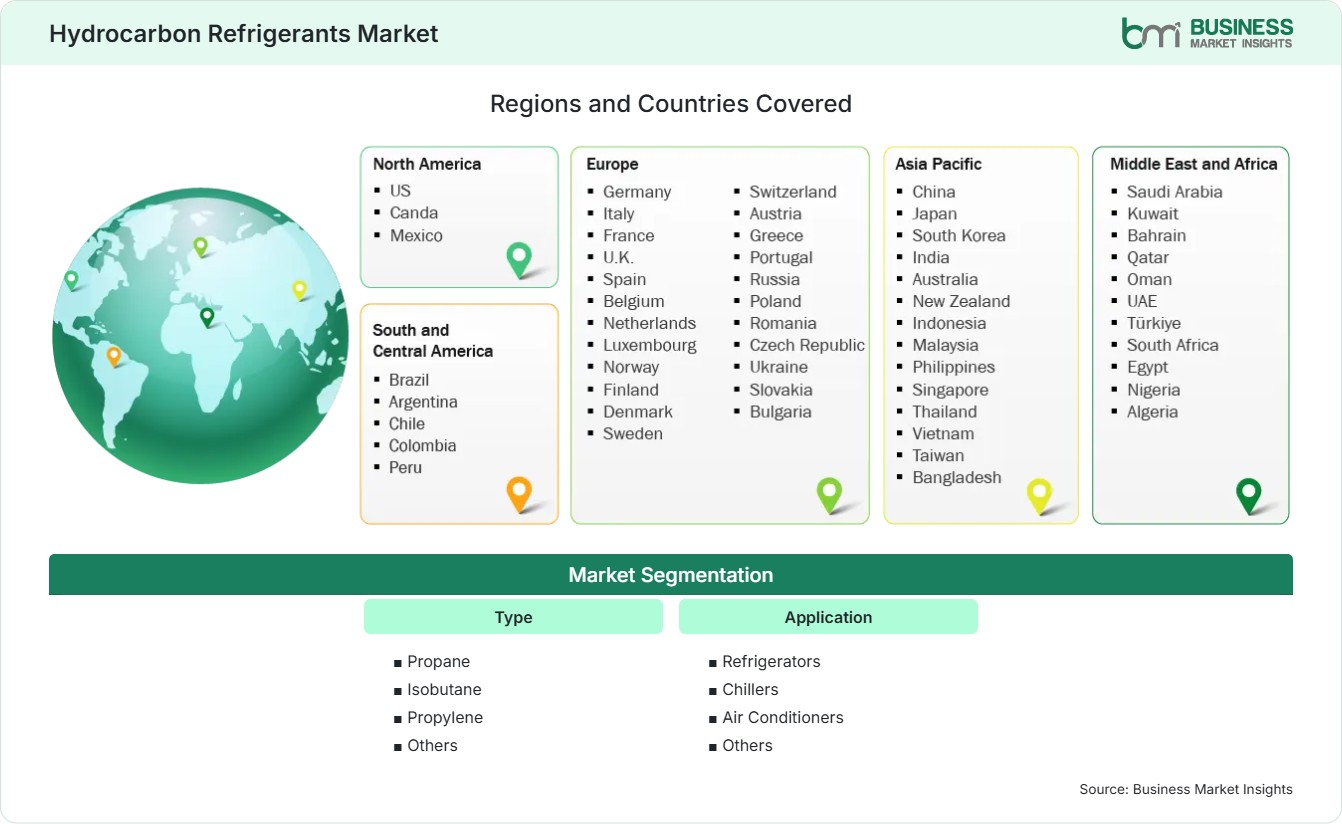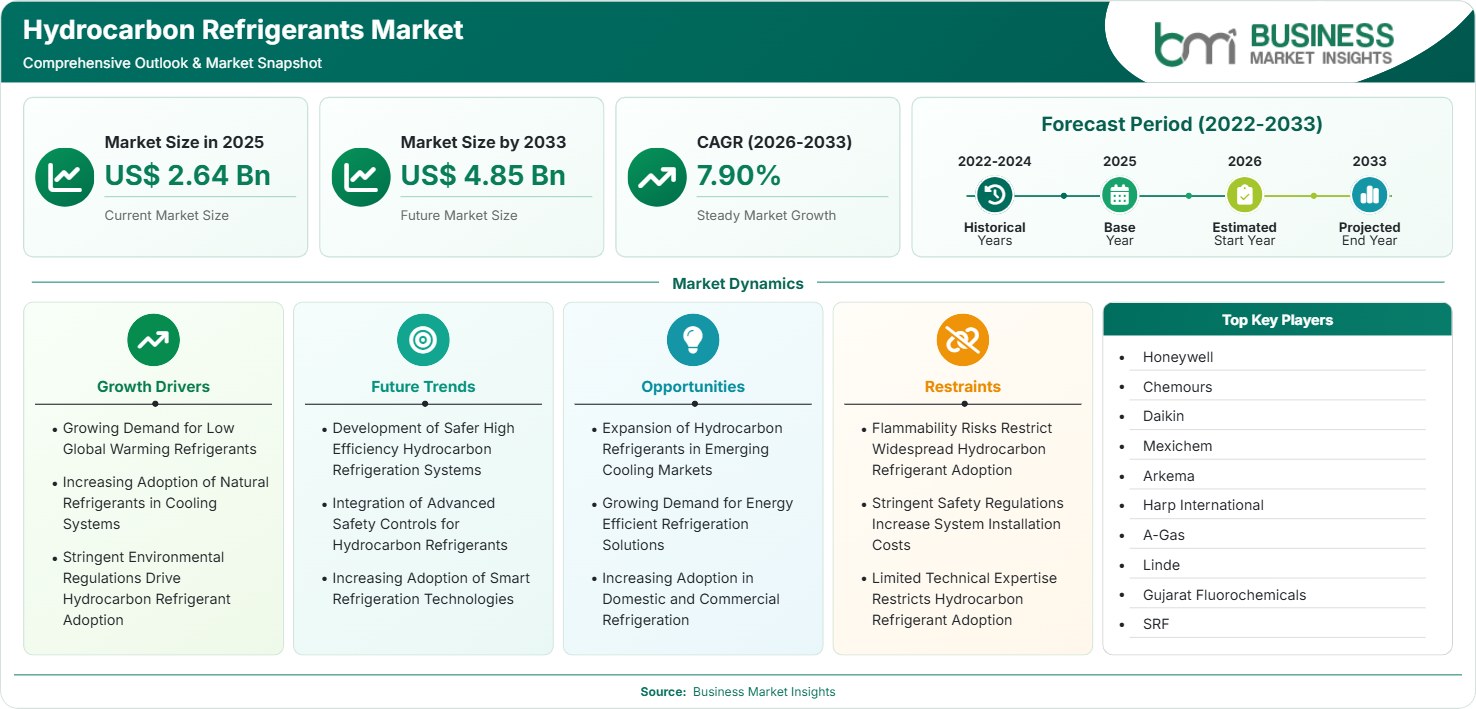
Hydrocarbon Refrigerants Market Regional Highlights
North America Hydrocarbon Refrigerants Market
North America held an estimated 27%–31% share in 2025, with the Hydrocarbon Refrigerants Market share supported by established refrigeration infrastructure, environmental regulations, energy-efficiency initiatives, and growing demand for lower-impact cooling technologies. The region is projected to grow at a 7.2%–7.6% CAGR through 2033.
- Companies producing refrigeration equipment are considering natural refrigerants in their strategic planning and transition to meet environmental demands without sacrificing energy efficiency and reliability.
- The trend of evaluating refrigeration technologies based on their environmental impact is becoming more popular among commercial supermarket and food distribution operations.
- Changes in regulations affect replacement cycles as organizations adapt to future bans on higher-impact refrigerants and purchase equipment that meets current environmental guidelines.
- Safety becomes the key concern as organizations invest in leak detection, proper charging, ventilation, and overall safety in systems using flammable refrigerants.
US Hydrocarbon Refrigerants Market
The U.S. represented an estimated 24%–28% share in 2025 and is projected to grow at a 7.3%–7.7% CAGR through 2033. Demand in the US Hydrocarbon Refrigerants Market
is supported by regulatory transition, commercial refrigeration replacement, energy-efficiency priorities, and increasing attention to low-global-warming alternatives. Adoption remains application-specific because flammability considerations influence equipment design, installation practices, technician training, and compliance requirements.
- Retail refrigeration operators are increasingly evaluating lower-impact refrigerant options as equipment replacement decisions become closely linked to environmental compliance and long-term operating efficiency.
- Domestic refrigeration applications provide opportunities for isobutane-based systems where manufacturers can manage refrigerant charge and incorporate appropriate safety engineering into compact equipment designs.
- Commercial applications require greater attention to installation standards and technician expertise because larger refrigerant charges can increase safety considerations during equipment operation and maintenance.
- Equipment suppliers are investing in product redesign and technical support to help customers transition toward refrigerants that meet environmental requirements without compromising cooling performance.
Europe Hydrocarbon Refrigerants Market
Europe held an estimated 22%–26% share in 2025 and is projected to grow at a 7.6%–8.0% CAGR through 2033. Germany, France, Italy, and the UK represent leading Hydrocarbon Refrigerants Markets supported by established refrigeration infrastructure and environmental regulation. Germany is projected to grow at a 7.8%–8.2% CAGR, while Italy and France offer opportunities through commercial refrigeration modernization and energy-efficiency initiatives.
- Germany remains a key market because environmental policies, advanced refrigeration infrastructure, and technical expertise support adoption of natural refrigerant technologies across selected applications.
- France provides opportunities as commercial and industrial users modernize cooling equipment and seek solutions that reduce environmental impact while maintaining reliable operating performance.
- Italy benefits from strong food retail and refrigeration equipment demand, creating opportunities for efficient systems using natural refrigerants in suitable applications.
- The UK Hydrocarbon Refrigerants Market is supported by refrigeration replacement programs, energy-efficiency priorities, and growing attention to technologies that can reduce greenhouse gas emissions.
Asia Pacific Hydrocarbon Refrigerants Market
Asia Pacific represented an estimated 35%–39% share in 2025 and is projected to grow at a 9.1%–9.5% CAGR through 2033. China, Japan, India, and South Korea lead regional opportunities, with India projected to grow at a 9.5%–9.9% CAGR. Rising cooling demand, appliance manufacturing, urbanization, cold-chain expansion, and energy-efficiency priorities are strengthening adoption opportunities.
- China represents a major opportunity because of its extensive appliance manufacturing base and expanding domestic and commercial refrigeration requirements across urban and industrial markets.
- India offers strong growth potential as rising household incomes, food retail development, cold-chain expansion, and increasing cooling demand support investment in efficient refrigeration technologies.
- Japan's mature appliance market creates opportunities for compact systems using low-impact refrigerants where manufacturers can combine energy efficiency with appropriate safety controls.
- South Korea provides opportunities through advanced appliance manufacturing and technology development, particularly where manufacturers seek efficient cooling solutions aligned with environmental objectives.
Rest of World Hydrocarbon Refrigerants Market
South and Central America accounted for an estimated 8%–10% share in 2025 and are projected to grow at a 7.0%–7.4% CAGR through 2033. Brazil and Mexico lead regional opportunities. The Middle East and Africa represented an estimated 7%–9% share and are projected to grow at a 7.2%–7.6% CAGR, supported by rising cooling demand and commercial infrastructure expansion.
- Brazil provides opportunities through food retail, cold-chain development, and residential appliance demand, although affordability and technical expertise remain important adoption considerations.
- Mexico benefits from expanding commercial refrigeration requirements and increasing attention to energy efficiency, creating opportunities for equipment suppliers offering lower-impact refrigerant technologies.
- Saudi Arabia offers potential as high cooling demand and commercial infrastructure development encourage interest in efficient refrigeration and air-conditioning technologies with reduced environmental impact.
- The UAE provides opportunities through hospitality, retail, logistics, and commercial construction, where energy-efficient cooling systems can help address operating costs and sustainability objectives.