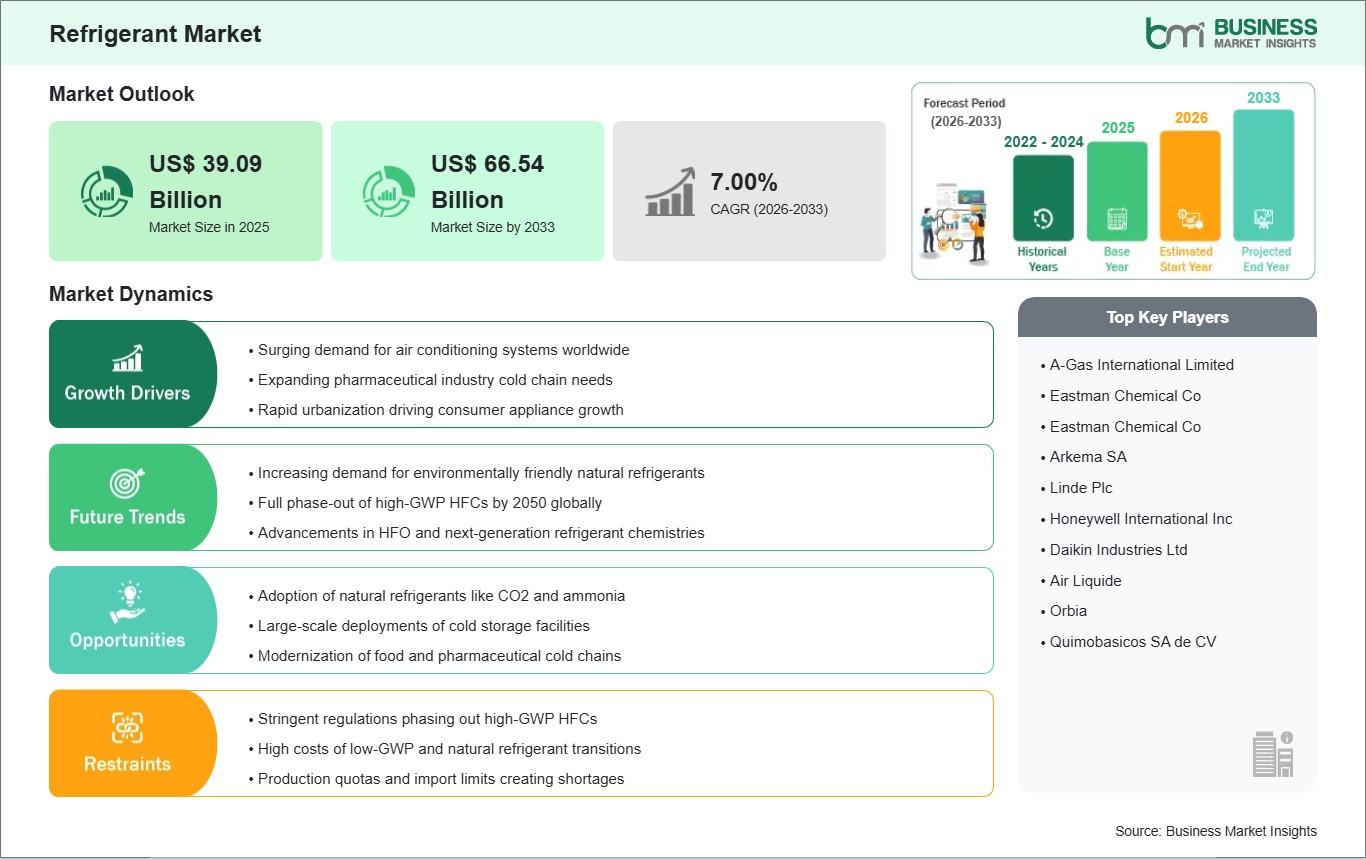
The refrigerant market size is expected to reach US$ 66,538.17 million by 2033 from US$ 39,094.94 million in 2025. The market is estimated to record a CAGR of 7.0% from 2026 to 2033.
Modern cooling systems depend greatly on the refrigerants, which allow the effective transfer of heat in air conditioning, refrigeration, and heat pump systems used in residential, commercial, industrial, and automotive applications. They play a crucial role in the preservation of food, indoor comfort, medical, and industrial processes. The market is supported by the growth of the cold chain system, increased disposable income that drives up demand to purchase HVAC systems, and the high rate of urbanization in the emerging economies. The shift to natural substitutes like ammonia, CO2, and hydrocarbons, as well as technological developments in low-GWP (Global Warming Potential) refrigerants, is also influencing market trends.
Nevertheless, the refrigerant business is confronted with various issues, such as strict environmental policies as stipulated in the Kigali Amendment, high prices of the next-generation refrigerants, and the phase-out of HFCs. Cases of supply chain disruptions and changes in the prices of raw materials also influence the market. Although such limitations exist, there are growth prospects due to the growing demand for energy-saving systems, growing cold storage facilities, and the establishment of green building projects. The further development of sustainable cooling technologies and the reuse of reclaimed refrigerants is likely to speed up the process of moving the world market to climate-friendly solutions.

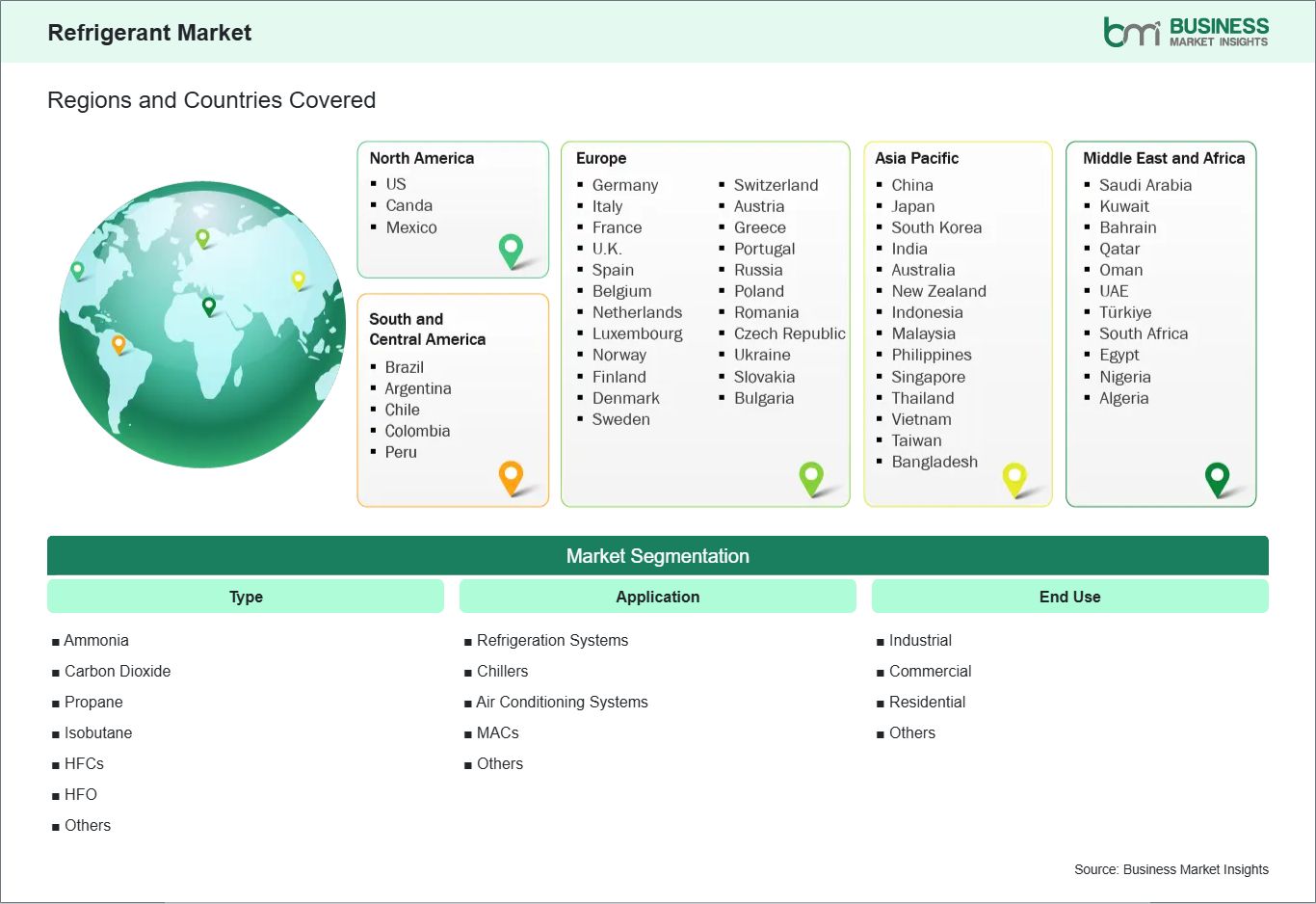
Key segments that contributed to the derivation of the refrigerant market analysis are type, application, and end use.
Due to the growing cold chain infrastructure, the demand for refrigerants is growing tremendously, with an increasing number of industries relying on sophisticated temperature-controlled logistics. Cold chains play a critical role in maintaining the quality and safety of perishable products like food, drinks, and drugs. With the increased world trade of such products, the demand for efficient refrigeration facilities in storage units, transportation facilities, as well as retail outlets has increased. All parts of this network require good cooling to ensure that the temperatures remain constant, and this increases the use of refrigerants in compressors and cooling systems.
The healthcare and pharmaceutical industries, especially, are committing lots of money into specialized cold storage to store vaccines, biologics, and temperature-sensitive medicines. This has led to the high demand for high-performance refrigerants that can regulate and maintain temperatures accurately and firmly. Likewise, the rise in food processing industries and the progress in the consumption of frozen and ready-to-eat food are driving the development of large-scale refrigerated warehouses and distribution centers.
Besides, the developing economies are extending their cold chain facilities to minimize food losses, enhance export, and domestic supply chains. Extensive construction of infrastructure means that refrigeration and HVAC systems must be installed in large quantities, and these systems use modern refrigerants. The current move towards efficient and eco-friendly refrigerants can also be linked to the idea of sustainability in the development of a cold chain, whereby the increase in the scale of logistics infrastructure is directly connected to the increase in the use of refrigerants in the international market.
The market of refrigerants opens a major opportunity with the development of low-GWP and natural refrigerants, as it allows adhering to the strict international environmental standards such as the Kigali Amendment, which eliminates high-GWP HFCs. These substitutes, such as hydrofluoroolefins (HFOs), carbon dioxide, ammonia, and hydrocarbons, bring down greenhouse gas emissions and still keep cooling performance, and this gives manufacturers an opportunity to provide next-generation systems in HVAC, refrigeration, and vehicle industries.
This change is leading to a push in blend formulations and equipment retrofits as industries are shifting off HFC legacy into drop-in solutions that create minimal disturbance. Natural refrigerants are also strong in commercial refrigeration and cold chains, where their non-toxic, non-flammable profiles in CO2 cascade systems favor food safety and energy conservation, and attract investments by supermarkets and logistics companies, which need sustainability credentials.
Substitutes such as R-1234yf and R-454B have low GWP and are suitable for automotive and residential air conditioning, which contributes to the demand for specialized production and recycling facilities. Compressors and heat exchangers are redesigned by equipment manufacturers to perform best, leading to a surge in new installations in the new markets with growing cooling demand.
In general, this shift makes refrigerant manufacturers the collaborators of the decarbonization process, enabling them to offer their innovative chemistries at a premium and enter the heat pump market with the trend of electrification. It turns regulatory requirements into sources of technological leadership and market differentiation.

| Report Attribute | Details |
|---|---|
| Market size in 2025 | US$ 39.09 Billion |
| Market Size by 2033 | US$ 66.54 Billion |
| Global CAGR (2026 - 2033) | 7.00% |
| Historical Data | 2022 - 2024 |
| Forecast period | 2026-2033 |
| Segments Covered | By Type
|
|
Regions and Countries Covered
| |
| North America | US, Canada, Mexico |
| Europe | Belgium, Austria, Finland, Denmark, Greece, Poland, Romania, Russia, Ukraine, Czech Republic, Slovakia, Bulgaria, Italy, Luxembourg, Germany, Switzerland, France, Netherlands, Norway, Portugal, Spain, Sweden, United Kingdom |
| Asia-Pacific | Australia, China, India, Japan, South Korea, Indonesia, Malaysia, Philippines, Singapore, Thailand, Vietnam, Bangladesh, New Zealand, Taiwan |
| South and Central America | Brazil, Argentina, Peru, Chile, Colombia |
| Middle East and Africa | Bahrain, Kuwait, Oman, Qatar, Saudi Arabia, United Arab Emirates, Turkiye, South Africa, Egypt, Algeria, Nigeria |
| Market leaders and key company profiles |
|
The Refrigerant Market Size and Forecast (2022-2033) report provides a detailed analysis of the market covering below areas:
The geographical scope of the refrigerant market report is divided into five regions: North America, Asia Pacific, Europe, Middle East & Africa, and South & Central America. The refrigerant market in Asia Pacific is expected to grow significantly during the forecast period.
The Asia-Pacific refrigerant market is segmented into China, Japan, South Korea, India, Australia, New Zealand, Indonesia, Malaysia, the Philippines, Singapore, Thailand, Vietnam, Taiwan, Bangladesh, and the Rest of Asia. The highest percentage of the refrigerant market is served in the Asia Pacific region as a result of the high pace of urbanization and industrialization, especially in China and India, which leads to the huge demand for air conditioning, refrigeration, and cold chain systems. The growing manufacturing industry in the region, such as the HVAC and automobile industry, coupled with the increasing number of middle classes and warmer weather, is driving the high use of cooling appliances in homes, offices, and industries.
The consumption of refrigerants is further enhanced by government infrastructure development, economic growth, and investment in consumer appliances, with China being the best consumer of refrigerants in the world due to low production costs and export-oriented plants. Southeast Asian countries such as Thailand and Indonesia are entering through increasing construction, retail, and food storage demands, and policies that are consistent with global phase-outs would encourage low-GWP substitutes without limiting growth. This vibrant ecosystem is a stronghold of the dominance of the region in other markets.

The refrigerant market is evaluated by gathering qualitative and quantitative data post primary and secondary research, which includes important corporate publications, association data, and databases. A few of the key developments in the refrigerant market are:
The Refrigerant Market is valued at US$ 39.09 Billion in 2025, it is projected to reach US$ 66.54 Billion by 2033.
As per our report Refrigerant Market, the market size is valued at US$ 39.09 Billion in 2025, projecting it to reach US$ 66.54 Billion by 2033. This translates to a CAGR of approximately 7.00% during the forecast period.
The Refrigerant Market report typically cover these key segments-
The historic period, base year, and forecast period can vary slightly depending on the specific market research report. However, for the Refrigerant Market report:
The Refrigerant Market is populated by several key players, each contributing to its growth and innovation. Some of the major players include:
The Refrigerant Market report is valuable for diverse stakeholders, including:
Essentially, anyone involved in or considering involvement in the Refrigerant Market value chain can benefit from the information contained in a comprehensive market report.
Please tell us your area of interest
(Market Segments/ Regions and Countries/ Companies)