
Hybrid Video Surveillance Market Outlook: Size, Share, Trends, Growth Analysis, Competitive Landscape & Forecast, 2026-2033

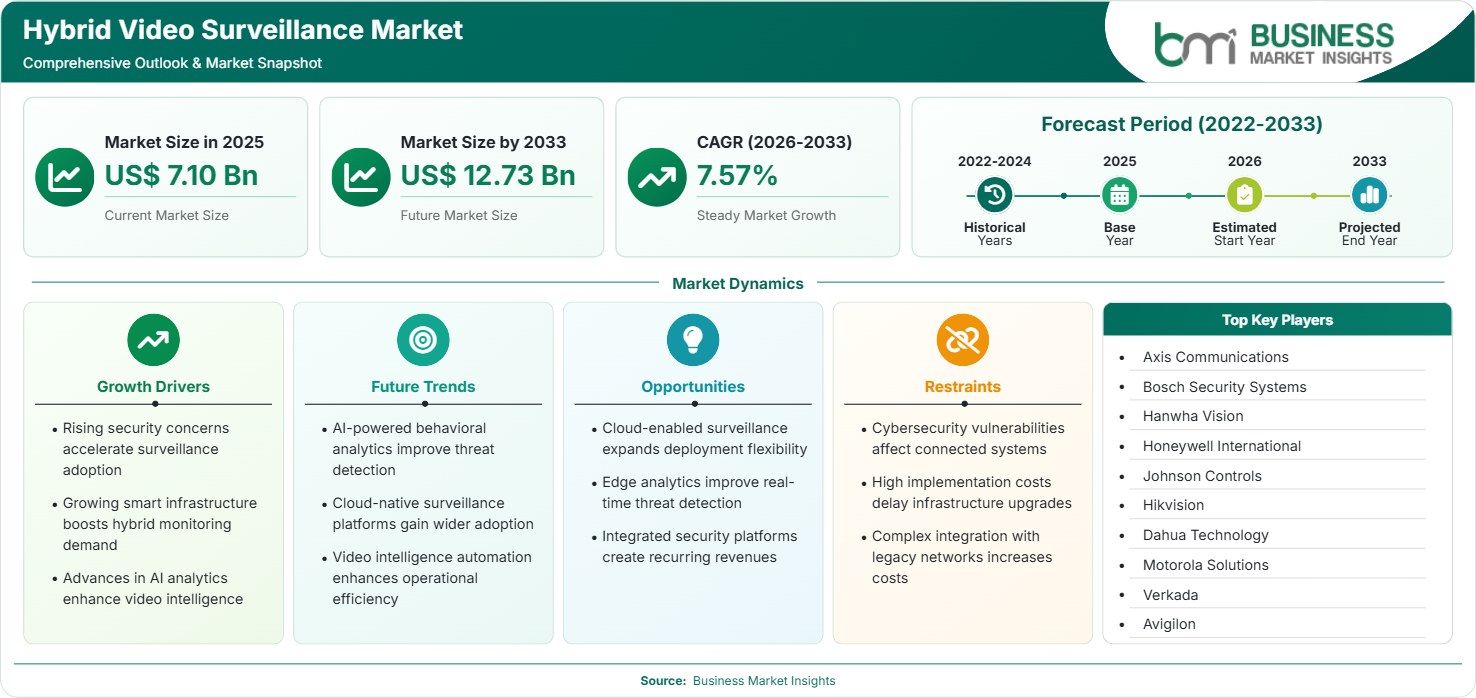
The Hybrid Video Surveillance Market size was valued at US$ 7.10 billion in 2025 and is projected to reach US$ 12.73 billion by 2033, growing at a CAGR of 7.57% during 2026–2033. Rising security modernization, increasing adoption of AI-enabled surveillance, and expanding smart infrastructure projects continue creating long-term opportunities for hybrid video monitoring solutions across commercial, industrial, and public sector environments.

Report Coverage
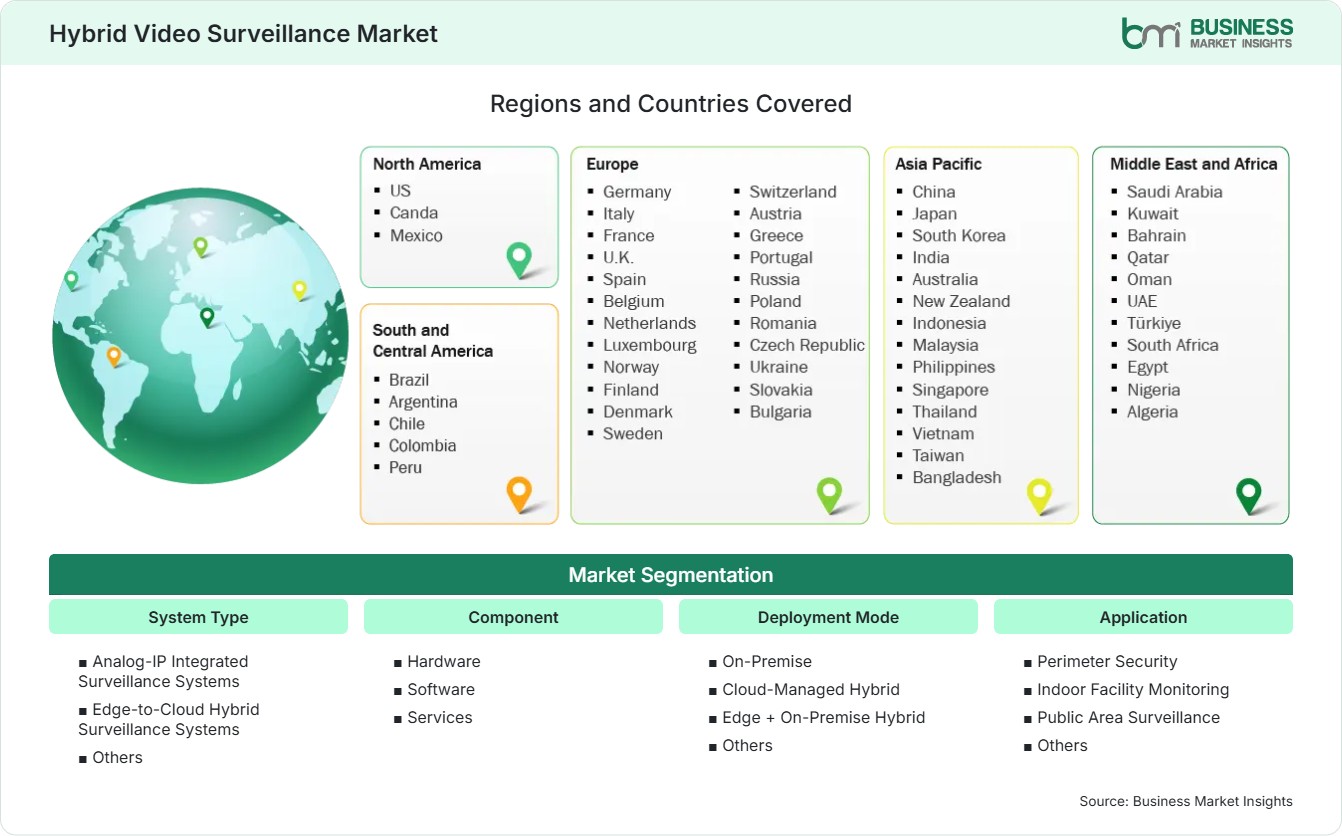
  • System Type: Analog-IP Integrated Surveillance Systems, Edge-to-Cloud Hybrid Surveillance Systems, Others
  • Component: Hardware, Software, Services
  • Deployment Mode: On-Premise, Cloud-Managed Hybrid, Edge + On-Premise Hybrid, Others
  • Application: Perimeter Security, Indoor Facility Monitoring, Public Area Surveillance, Others
  • End User: Commercial Enterprises, Industrial & Logistics, Government & Civic Institutions, Others
US$ 7.10 Bn Market size in 2025
US$ 12.73 Bn Market Size by 2033
7.57% CAGR, 2026 - 2033
2026-2033 Forecast Period

AI Overview

Hybrid Video Surveillance Market Summary

  • North America Region: North America held 34%–37% market share in 2025 and is projected to register a CAGR of 7.1%–7.6% during 2026–2033. Investments in critical infrastructure protection, AI-powered security analytics, and cloud-enabled surveillance platforms continue driving demand. The U.S. represents the largest regional market with a CAGR of 7.2%–7.7%, supported by enterprise digital transformation and increasing adoption of intelligent security systems.
  • Fastest Growing Region: Asia Pacific accounted for 29%–32% market share in 2025 and is expected to expand at a CAGR of 8.3%–8.8%, supported by smart city initiatives, industrial automation, expanding transportation infrastructure, and rising investments in intelligent public surveillance.
  • Leading Segment: Hardware represented 44%–47% market share in 2025 and is projected to grow at a CAGR of 7.5%–8.0%, driven by continuous deployment of IP cameras, storage devices, sensors, and intelligent networking equipment.
  • High Growth Segment: Cloud-Managed Hybrid deployment accounted for 25%–28% market share in 2025 and is anticipated to record a CAGR of 8.6%–9.1%, supported by scalable infrastructure, remote accessibility, and reduced operational complexity.
  • Key Market Opportunity: Growing adoption of cloud-native surveillance, AI-driven analytics, and integrated security ecosystems continues creating new revenue opportunities for solution providers serving enterprise and public infrastructure projects.
  • Major Market Players: Axis Communications AB, Bosch Security Systems B.V., Hanwha Vision Co., Ltd., Honeywell International Inc., Johnson Controls International plc, Hangzhou Hikvision Digital Technology Co., Ltd., Zhejiang Dahua Technology Co., Ltd., Motorola Solutions, Inc., Verkada Inc., and Avigilon Corporation.
Strategic Insights

Hybrid Video Surveillance Market: Strategic Insights

Hybrid Video Surveillance Market Strategic Framework
FREE PDF
Request your free sample
Request free sample
Stakeholder View

Key Takeaways

  • Hybrid surveillance platforms enable organizations to modernize existing security infrastructure while preserving previous hardware investments, reducing migration costs and operational disruption.
  • Cloud-managed deployments present the strongest long-term opportunity by supporting centralized monitoring, simplified maintenance, and scalable security management across multiple facilities.
  • Artificial intelligence, video analytics, and edge computing continue redefining surveillance performance through automated event detection, behavioral analysis, and faster security response.
  • Asia Pacific offers the most attractive investment landscape as governments accelerate smart city deployments, industrial expansion, and public infrastructure modernization.
  • Strategic collaborations between surveillance hardware manufacturers, cloud platform providers, and cybersecurity specialists continue strengthening integrated security ecosystems.
  • Product differentiation increasingly depends on AI capabilities, cybersecurity resilience, cloud interoperability, and lifecycle service offerings rather than camera hardware alone.
Geographic Outlook

Hybrid Video Surveillance Market Regional Highlights

North America Hybrid Video Surveillance Market

North America accounts for **34%–37% Hybrid Video Surveillance Market Share in 2025 and is projected to register a CAGR of 7.1%–7.6% during 2026–2033. Demand is supported by enterprise digitalization, critical infrastructure protection, and increasing investments in AI-enabled surveillance systems. Commercial facilities, transportation networks, healthcare institutions, and logistics operators continue upgrading legacy surveillance infrastructure through hybrid deployments that combine IP and analog technologies.

  • Commercial enterprises increasingly deploy hybrid surveillance systems integrating AI analytics with existing analog camera infrastructure to improve monitoring efficiency while minimizing replacement costs.
  • Investments in transportation security, data centers, healthcare facilities, and logistics hubs continue driving adoption of scalable hybrid surveillance architectures.
  • Cybersecurity improvements and cloud-based video management platforms enhance operational resilience for enterprise surveillance deployments.
  • System integrators increasingly offer lifecycle services including predictive maintenance, cloud migration, and remote monitoring capabilities.

US Hybrid Video Surveillance Market

The United States contributes 80%–83% of North American revenue and is projected to expand at a CAGR of 7.2%–7.7% throughout the forecast period. Enterprise security modernization, smart infrastructure investment, and AI-enabled video analytics continue supporting sustained demand for hybrid surveillance solutions.

  • Critical infrastructure operators increasingly deploy intelligent surveillance platforms to improve security resilience and regulatory compliance.
  • Growing adoption of cloud-managed video management software strengthens enterprise monitoring capabilities.
  • Educational institutions and healthcare facilities continue replacing conventional surveillance with integrated hybrid solutions.
  • AI-enabled analytics improve operational efficiency by automating threat detection and incident investigation.

Europe Hybrid Video Surveillance Market

Europe represents 24%–27% hybrid video surveillance market share in 2025 and is expected to record a CAGR of 7.0%–7.5% through 2026–2033. Strong regulatory compliance, smart infrastructure investment, and modernization of public security systems continue supporting market expansion. Germany remains the leading regional market, while Poland demonstrates the fastest growth due to industrial digitalization and infrastructure development.

  • Smart transportation projects continue increasing demand for intelligent surveillance systems across major European economies.
  • Compliance with data protection regulations encourages deployment of secure hybrid surveillance platforms.
  • Industrial automation and warehouse expansion strengthen demand for integrated video monitoring solutions.
  • Cloud-based surveillance management platforms improve operational flexibility across multi-site organizations.

Asia Pacific Hybrid Video Surveillance Market

Asia Pacific accounts for 29%–32% hybrid video surveillance market share in 2025 and is projected to register the fastest 8.3%–8.8% CAGR through 2026–2033. Rapid urbanization, smart city programs, industrial expansion, and government investments in public safety continue driving regional demand. China remains the largest regional market, while India records the highest growth owing to expanding infrastructure and digital security investments.

  • Smart city initiatives continue expanding deployment of intelligent public surveillance networks.
  • Manufacturing facilities increasingly integrate AI-enabled hybrid monitoring into industrial security operations.
  • Transportation infrastructure modernization accelerates surveillance technology investments.
  • Growing commercial construction supports demand for scalable cloud-enabled surveillance systems.

Rest of World Hybrid Video Surveillance Market

The Rest of World region accounts for 8%–11% market share in 2025 and is projected to grow at a CAGR of 7.4%–7.9% during 2026–2033. Infrastructure modernization, urban security initiatives, and industrial expansion continue supporting surveillance investments across Latin America, the Middle East, and Africa. Governments and enterprises increasingly adopt hybrid monitoring platforms to strengthen public safety and operational security.

  • Brazil leads regional demand through expanding commercial security and transportation infrastructure investments.
  • GCC countries continue investing in smart city surveillance and critical infrastructure protection.
  • Mining, energy, and industrial sectors increasingly deploy hybrid surveillance for asset monitoring.
  • Cloud-enabled surveillance platforms improve operational efficiency across geographically dispersed facilities.
Global Market Geography
FREE PDF
Request your free sample
Request free sample
Segment Analysis

Hybrid Video Surveillance Market Segmentation

System Type

System type remains the foundation of market development as organizations modernize legacy surveillance infrastructure while preserving existing investments. The segment accounted for 41%–44% market share in 2025 and is projected to expand at a CAGR of 7.8%–8.3% during 2026–2033. Growing demand for scalable monitoring platforms, AI-enabled analytics, and centralized security management continues expanding the Hybrid Video Surveillance Market scope across commercial, industrial, and government applications.

  • Analog-IP Integrated Surveillance Systems: Continue witnessing widespread adoption because they allow organizations to connect existing analog cameras with modern IP infrastructure, reducing capital expenditure while improving monitoring capabilities and extending equipment lifecycle.
  • Edge-to-Cloud Hybrid Surveillance Systems: Gain strong momentum by combining edge-based video processing with cloud storage and centralized analytics, enabling faster threat detection, improved scalability, and simplified multi-site surveillance management.

Component

The component segment is driven by continuous investments in intelligent surveillance infrastructure, software innovation, and lifecycle support services. It represented 44%–47% market share in 2025 and is anticipated to register a CAGR of 7.5%–8.0% through 2026–2033. Current Hybrid Video Surveillance Market trends highlight increasing adoption of AI-enabled cameras, cloud-based video management software, and managed services that improve operational efficiency and security performance.

  • Hardware: Remains the largest sub-segment owing to continuous deployment of IP cameras, video encoders, network video recorders, storage devices, sensors, and communication equipment supporting hybrid surveillance environments.
  • Software: Experiences steady growth as organizations deploy video management systems, AI-powered analytics, facial recognition, object detection, cybersecurity tools, and centralized monitoring platforms for intelligent surveillance operations.
  • Services: Continue expanding through increasing demand for consulting, installation, maintenance, managed security, system integration, remote monitoring, and lifecycle support across enterprise and public infrastructure projects.

Deployment Mode

Deployment strategies continue evolving as organizations balance data security, operational flexibility, and infrastructure costs. This segment accounted for 25%–28% market share in 2025 and is projected to record a CAGR of 8.6%–9.1% during 2026–2033. Enterprises increasingly adopt hybrid deployment architectures that combine cloud scalability with on-premise control to improve resilience and regulatory compliance.

  • On-Premise: Continues serving organizations requiring complete control over surveillance data, local storage, and strict regulatory compliance across government, defense, banking, and critical infrastructure facilities.
  • Cloud-Managed Hybrid: Registers the fastest adoption because it enables centralized monitoring, remote accessibility, simplified software updates, and lower infrastructure management costs across geographically distributed facilities.
  • Edge + On-Premise Hybrid: Supports real-time analytics by processing video at the network edge while maintaining local storage, reducing latency and improving response times for mission-critical surveillance environments.

Application

Application diversity continues expanding as intelligent surveillance becomes an essential component of modern security strategies across public and private sectors. The segment benefits from rising investments in AI-enabled monitoring, critical infrastructure protection, and automated threat detection technologies.

  • Perimeter Security: Widely deployed across industrial facilities, airports, utilities, military installations, and logistics centers to detect unauthorized access and improve asset protection.
  • Indoor Facility Monitoring: Supports continuous monitoring of offices, educational institutions, healthcare facilities, retail stores, and manufacturing sites while improving operational safety and security management.
  • Public Area Surveillance: Continues expanding across transportation hubs, city centers, stadiums, parks, and public infrastructure where authorities require intelligent monitoring and rapid incident response capabilities.

End User

Growing digital transformation across industries continues accelerating adoption of hybrid surveillance technologies among diverse end-user groups. Organizations increasingly prioritize integrated security ecosystems capable of supporting centralized monitoring, predictive analytics, and scalable infrastructure expansion.

  • Commercial Enterprises: Continue leading adoption as corporate offices, retail chains, hospitality facilities, educational institutions, and healthcare providers strengthen physical security and operational monitoring capabilities.
  • Industrial & Logistics: Experience rising deployment across manufacturing plants, warehouses, distribution centers, ports, and supply chain facilities where continuous monitoring improves asset protection and operational efficiency.
  • Government & Civic Institutions: Increase investments in intelligent surveillance for transportation infrastructure, municipal facilities, public safety operations, law enforcement, and critical infrastructure protection programs.
Market Forces

Hybrid Video Surveillance Market Dynamics

Key Market Drivers

Rising security concerns accelerate surveillance adoption

Companies operating in commerce, industry, transport, and government sectors are increasingly beefing up their physical security efforts due to the rising complexity of security risks in terms of intrusion, theft, vandalism, and critical infrastructure attacks. The deployment of hybrid surveillance systems represents a pragmatic solution that involves upgrading current analog systems with IP-based technology for wider coverage without fully replacing the system. These developments continue driving Hybrid Video Surveillance Market Growth by encouraging enterprises to deploy intelligent monitoring platforms capable of improving operational awareness and security response.

Growing smart infrastructure boosts hybrid monitoring demand

Smart cities, intelligent transportation systems, connected public infrastructure, and digitally managed commercial facilities are increasing the need for surveillance platforms capable of supporting multiple technologies within a unified ecosystem. Hybrid systems allow for centralized monitoring from different locations while at the same time being able to integrate with existing technologies. There is an ongoing trend of governments and businesses focusing on scalable solutions for monitoring purposes, which make operations more efficient and easy to maintain while allowing for technological upgrades.

Advances in AI analytics enhance video intelligence

Artificial intelligence continues transforming surveillance operations by enabling automated object recognition, facial matching, behavioral analysis, intrusion detection, and real-time event classification. In modern hybrid systems, there has been an increasing integration of AI-based analytics not only in edge but also in cloud computing. This results in lower human intervention in monitoring processes, faster response, and enhanced enterprise security. Intelligent video analysis has been advancing continuously, allowing organizations to achieve more value from the cameras installed on their premises.

Key Market Opportunities

Cloud-enabled surveillance expands deployment flexibility

Cloud-based hybrid surveillance is more favored in enterprises today because it facilitates easy implementation and centralization management and allows remote access. The cloud-based model minimizes infrastructure complexities and provides quick software updates and scalable storage, as well as easy integrations with security applications in enterprises. Hybrid Video Surveillance Market Forecasts indicate that continued migration toward cloud-managed security environments will create substantial opportunities for technology providers delivering flexible, subscription-based surveillance solutions with enhanced cybersecurity and lifecycle management capabilities.

Edge analytics improve real-time threat detection

Edge computing enables surveillance systems to process video closer to the source, reducing latency and improving response speed for mission-critical security operations. Organizations are now turning to edge analytics to provide security at the periphery, for industry analysis, transit centers, and other public safety applications that require instant decisions. The constant improvements in processing capability, AI acceleration, and intelligent video analysis are driving commercial adoption while reducing bandwidth demands and centralization.

Integrated security platforms create recurring revenues

Demand for unified security ecosystems continues increasing as enterprises seek integrated management of surveillance, access control, intrusion detection, visitor management, and operational intelligence through a single platform. Technology suppliers are also making an effort to increase software subscriptions, managed services, cybersecurity solutions, and cloud monitoring that produce additional revenue from software sales other than hardware. Building long-lasting relationships through service integration is expected to help technology companies be more competitive in the market.

Market Restraints and Challenges

Cybersecurity vulnerabilities affect connected systems

As surveillance systems become increasingly connected through cloud platforms, remote access, and enterprise networks, cybersecurity risks continue growing. Factor: Vulnerabilities associated with network-connected cameras, software platforms, and cloud infrastructure may expose surveillance systems to unauthorized access, ransomware attacks, or data breaches. Impact: Organizations often increase investment in cybersecurity measures, encryption, network segmentation, and compliance programs, extending deployment timelines and raising overall implementation costs for large-scale hybrid surveillance projects.

High implementation costs delay infrastructure upgrades

Although hybrid architectures reduce replacement expenses compared with complete system modernization, deployment still requires investment in networking equipment, storage infrastructure, software licenses, AI analytics, and professional integration services. Factor: Budget limitations and capital expenditure constraints may discourage organizations from upgrading aging surveillance infrastructure. Impact: Delayed purchasing decisions and phased implementation strategies can slow technology adoption, particularly among small and medium-sized enterprises managing multiple facilities with limited investment resources.

Company Analysis

Competitive Landscape

Competition in the market is centered on AI-enabled analytics, cloud-native video management platforms, cybersecurity, and integrated physical security solutions. Hybrid Video Surveillance Market Analysis shows that leading vendors are investing in intelligent edge devices, cloud services, and strategic partnerships to strengthen recurring revenue streams while supporting enterprise, industrial, and public sector security modernization initiatives.

Company Name

Overview

Products and Services Relevant to this Market

Axis Communications AB

Global provider of network video solutions specializing in intelligent surveillance technologies for commercial and public infrastructure.

Network cameras, video encoders, video management software, analytics, access control, and hybrid surveillance solutions.

Bosch Security Systems B.V.

Develops integrated security technologies with strong expertise in AI-powered video surveillance and enterprise security management.

IP cameras, hybrid recording systems, video analytics, intrusion detection, and centralized security platforms.

Hanwha Vision Co., Ltd.

Leading surveillance manufacturer delivering advanced imaging technologies and AI-enabled monitoring solutions worldwide.

Surveillance cameras, network video recorders, AI analytics, cloud surveillance, and hybrid monitoring systems.

Honeywell International Inc.

Provides enterprise-grade building security and integrated surveillance solutions across multiple industries.

Video management systems, intelligent cameras, access control, hybrid surveillance platforms, and managed security services.

Johnson Controls International plc

Offers integrated building technologies combining surveillance, automation, and facility security management.

Video surveillance systems, access control, cloud security software, analytics, and integrated building management solutions.

Hangzhou Hikvision Digital Technology Co., Ltd.

Global manufacturer of intelligent video surveillance products serving commercial, industrial, and government customers.

AI cameras, hybrid DVRs, NVRs, video management software, cloud surveillance, and intelligent analytics.

Zhejiang Dahua Technology Co., Ltd.

Develops AI-driven surveillance equipment and smart security solutions for diverse end-user industries.

Network cameras, hybrid recorders, intelligent video analytics, cloud security, and edge surveillance technologies.

Motorola Solutions, Inc.

Provides mission-critical communication and video security technologies for enterprise and public safety applications.

Video security platforms, AI analytics, cloud video management, access control, and command center software.

Verkada Inc.

Cloud-based security technology company focused on simplified enterprise surveillance and building security.

Cloud-managed cameras, environmental sensors, access control, workplace security software, and remote monitoring services.

Avigilon Corporation

Specializes in AI-powered surveillance solutions designed for critical infrastructure and enterprise security environments.

Video analytics, network cameras, access control systems, AI monitoring software, and hybrid surveillance platforms.

Trust & Transparency

Research Methodology

The market analysis combines proprietary research with secondary data from government agencies, company disclosures, regulatory filings, industry databases and expert interviews. Market estimates are validated through data triangulation, cross-market benchmarking and analyst review.

View Full Research Methodology

Questions Answered

Frequently Asked Questions

What does the Hybrid Video Surveillance Market Report include?

The Market Report provides detailed insights into market segmentation, regional outlook, competitive landscape, technology developments, investment opportunities, key growth drivers, challenges, and future business prospects.

How is artificial intelligence improving hybrid surveillance systems?

AI enables automated object detection, facial recognition, anomaly identification, behavioral analytics, and real-time threat detection, reducing manual monitoring while improving response speed and operational efficiency.

Which industries are major users of hybrid video surveillance systems?

Commercial enterprises, industrial facilities, logistics operators, transportation networks, government agencies, educational institutions, healthcare organizations, and smart city projects represent the primary end users of hybrid surveillance technologies.

Which deployment mode is expected to grow the fastest?

Cloud-managed hybrid deployment is projected to record the fastest growth because it offers centralized management, remote accessibility, simplified maintenance, scalability, and lower operational complexity than conventional surveillance architectures.

What is driving demand in the Hybrid Video Surveillance Market?

Increasing security requirements, modernization of legacy surveillance infrastructure, adoption of AI-powered analytics, cloud-based monitoring, and smart infrastructure projects are the primary factors supporting market expansion across commercial and public sectors.

Access the Full Hybrid Video Surveillance Market Report

Get segment-level forecasts, regional estimates, competitive benchmarking, company profiles and downloadable Excel datasets.

Access the full Hybrid Video Surveillance Market Report
350 pages PDF & Excel | 2026-08-21
Similar Research

Related Market Reports