
HVAC Drive Market Outlook: Size, Share, Trends, Growth Analysis, Competitive Landscape & Forecast, 2026-2033

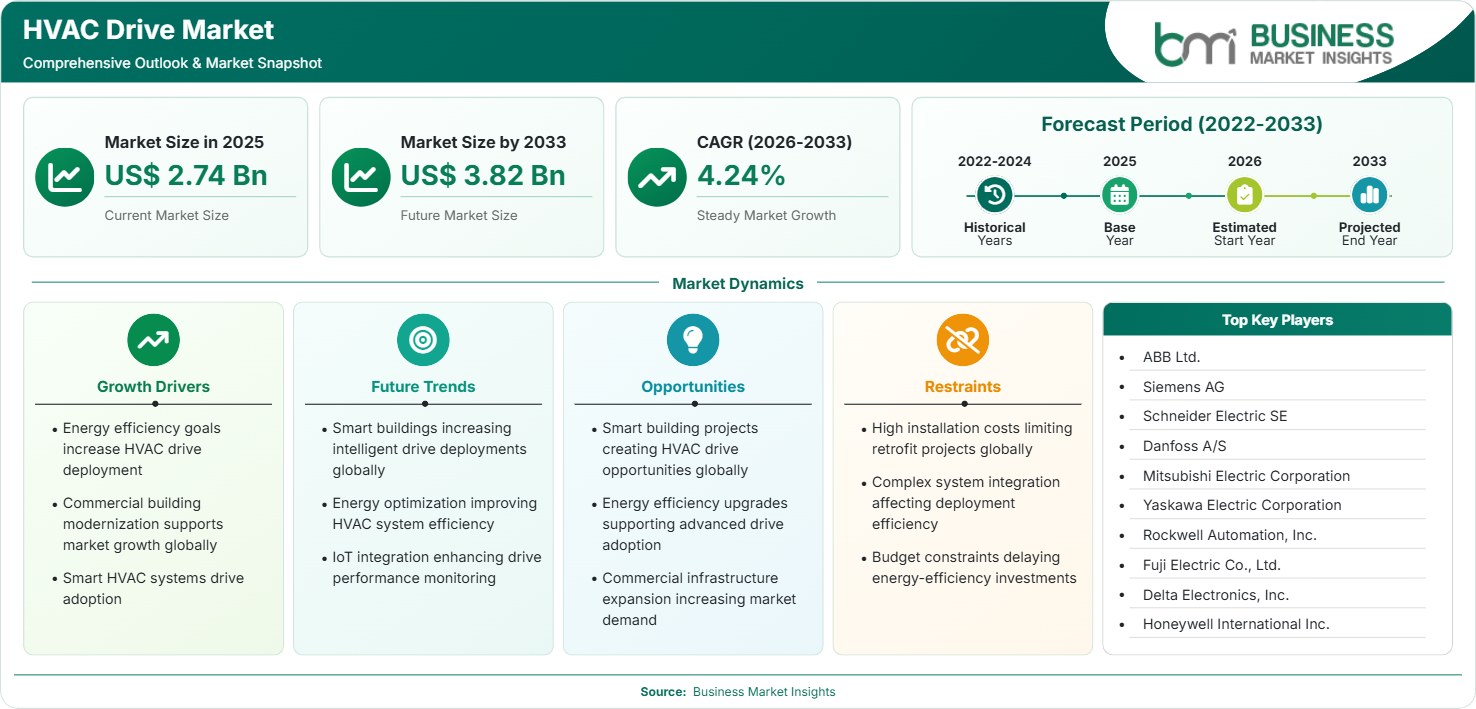
The HVAC Drive Market size was valued at US$ 2.74 Billion in 2025 and is projected to reach US$ 3.82 Billion by 2033, growing at a CAGR of 4.24% during 2026–2033, driven by building electrification, efficiency mandates, smart controls, data-center cooling, retrofit demand, and automation.

Report Coverage
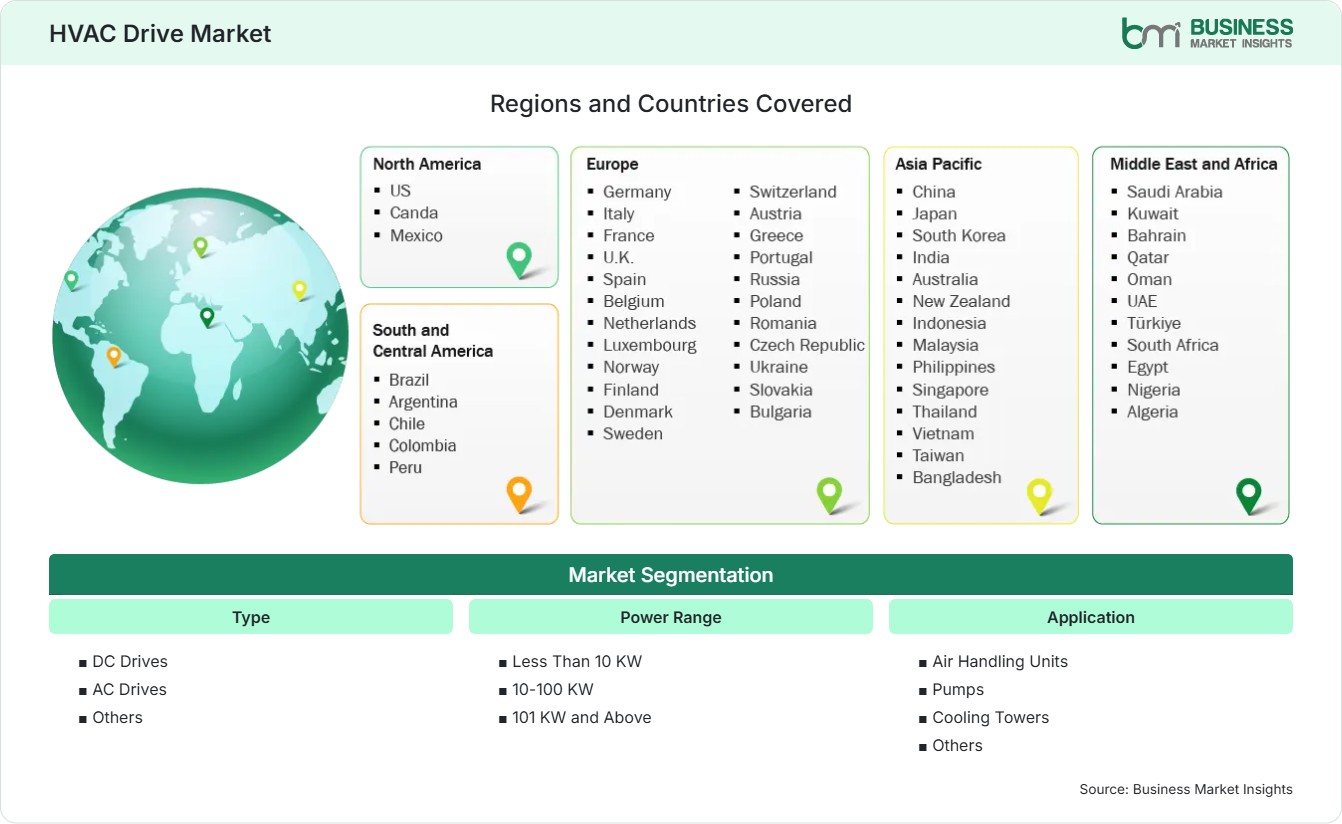
  • Type: DC Drives, AC Drives, Others
  • Power Range: Less Than 10 KW, 10-100 KW, 101 KW and Above
  • Application: Air Handling Units, Pumps, Cooling Towers, Others
US$ 2.74 Bn Market size in 2025
US$ 3.82 Bn Market Size by 2033
4.24% CAGR, 2026 - 2033
2026-2033 Forecast Period

AI Overview

HVAC Drive Market Summary

  • North America Region: North America holds a market share of 27%–30% in 2025, growing with a CAGR of 3.8%–4.2%, influenced by commercial retrofits, data centers, efficiency regulations, replacement cycles, and intelligent building automation investments.
  • Fastest Growing Region: Asia Pacific holds HVAC Drive Market share of 34%–38% in 2025, growing with a CAGR of 5.1%–5.6%, supported by urbanization, industrial expansion, cooling demand, infrastructure construction, data centers, and efficiency-focused modernization.
  • Leading Segment: AC Drives hold market share of 72%–76% in 2025, growing with a CAGR of 4.3%–4.7%, supported by broad motor compatibility, variable-speed control, pump and fan applications, energy optimization, and established building automation integration.
  • High Growth Segment: 101 and Above KW holds market share of 13%–16% in 2025, growing with a CAGR of 5.2%–5.8%, driven by district cooling, large commercial facilities, industrial campuses, hospitals, airports, and hyperscale data centers.
  • Key Market Opportunity: Replacement of fixed-speed motors with connected variable-speed systems creates an attractive opportunity, particularly where fan and pump loads operate below full capacity for extended operating periods.
  • Major Market Players: ABB Ltd., Siemens AG, Schneider Electric SE, Danfoss A/S, Mitsubishi Electric Corporation, Yaskawa Electric Corporation, Rockwell Automation, Inc., Fuji Electric Co., Ltd., Delta Electronics, Inc., and Honeywell International Inc.
Strategic Insights

HVAC Drive Market: Strategic Insights

HVAC Drive Market Strategic Framework
FREE PDF
Request your free sample
Request free sample
Stakeholder View

Key Takeaways

  • The value chain spans semiconductor suppliers, power-electronics manufacturers, motor producers, drive vendors, OEMs, panel builders, system integrators, contractors, facility operators, and service providers. Competitive differentiation increasingly depends on application software, commissioning support, interoperability, and lifecycle services rather than hardware alone.
  • Large air handling units, cooling towers, chilled-water pumps, and central plant equipment provide substantial opportunities for higher-capacity drives because these applications combine long operating hours with variable-load conditions. Retrofit projects can also create demand without requiring a complete HVAC system replacement.
  • Drive platforms are incorporating edge diagnostics, condition monitoring, cybersecurity controls, wireless commissioning, harmonic-management technologies, and compatibility with efficient motor architectures. Danfoss introduced enhanced FC 102 capabilities in 2025 for AHU and rooftop-unit applications, including operational monitoring and connectivity features.
  • Asia Pacific offers an investment environment shaped by rapid urban development, cooling demand, manufacturing expansion, and digital infrastructure. India and Southeast Asia provide particularly relevant opportunities where new buildings can integrate variable-speed control at the design stage instead of retrofitting legacy systems.
  • Capital allocation is increasingly directed toward energy-management platforms, connected automation, power electronics, and specialized building technologies. Strategic positioning, therefore, extends beyond drive hardware into software, services, controls, and integrated energy optimization.
  • Product selection is increasingly influenced by total installed cost, harmonics, enclosure requirements, cybersecurity, commissioning time, and service availability. Vendors able to combine these requirements into standardized packages can reduce engineering complexity for OEMs and contractors.
Geographic Outlook

HVAC Drive Market Regional Highlights

North America HVAC Drive Market

North America represented 27%–30% HVAC Drive Market share in 2025 and is projected to grow at 3.8%–4.2% during 2026–2033. Demand centers on commercial modernization, healthcare facilities, data centers, institutional buildings, and energy-saving retrofits. Variable-speed control is increasingly specified where operating schedules create substantial part-load conditions. The region also benefits from established building-management infrastructure and replacement demand from installed drive bases.

  • Increasingly, commercial retrofit schemes involve replacing fixed-speed fan and pump controls, which in turn leads to a greater demand for application-specific drives, integrated bypass packages, and simplified commissioning.
  • The expansion of the data center includes higher-capacity cooling applications such as redundant pump and fan systems, which need reliable operation, monitoring, harmonic management, and quick serviceability.
  • In the case of healthcare and institutional buildings, reliable ventilation, pressure control, and air quality management are prioritized, which in turn leads to a demand for drives that have strong communication and fault-handling capabilities.
  • It is important for OEMs to adopt this approach since air handlers, rooftop units, pumps, and cooling equipment that are manufactured as complete packages are now incorporating drives during the manufacturing process.

US HVAC Drive Market

The US represented 70%–74% of North American HVAC Drive Market demand in 2025 and is projected to grow at 3.9%–4.3% during 2026–2033. Commercial construction, data-center development, healthcare modernization, and replacement of aging mechanical equipment support adoption. The market favors products with BACnet compatibility, cybersecurity features, harmonic mitigation, bypass configurations, and broad motor compatibility.

  • The building of data centers leads to a greater need for redundant cooling equipment, especially regarding the use of variable-speed pumps and fans, which are needed for thermal control and to ensure continuous operation.
  • The creation of demand for modernization projects is due to the fact that older motors, controls, and drives require more frequent maintenance and make it difficult to carry out digital monitoring.
  • The OEM and contractor channels are still influential since the choice of drive is often included in the specifications for packaged HVAC equipment and in the mechanical-electrical project designs.

Europe HVAC Drive Market

Europe accounted for 24%–27% HVAC Drive Market share in 2025 and is forecast to expand at 3.6%–4.0% during 2026–2033. Energy-efficiency requirements, building renovation, electrification, and industrial decarbonization support variable-speed control. Germany and the United Kingdom remain important established markets, while Spain and Italy offer renovation-driven opportunities.

  • Germany has a large number of existing buildings together with the ability in the field of industrial engineering, which enables it to meet the demand for replacements, modernizations, and drive systems that have been tailored for specific applications in both commercial and industrial facilities.
  • The United Kingdom sees increased demand for variable-speed ventilation, pumping, and cooling equipment as a result of its building-efficiency programs and commercial refurbishment.
  • Spain and Italy offer possibilities in the areas of hospitality, the renovation of commercial properties, healthcare infrastructure, and the need for cooling caused by the climate.
  • Poland and Turkey are being supported by investments in construction, industry, and the modernization of their mechanical infrastructure, which results in a relatively higher growth potential.

Asia Pacific HVAC Drive Market

Asia Pacific accounted for 34%–38% HVAC Drive Market share in 2025 and is projected to grow at 5.1%–5.6% through 2033. China remains the largest regional demand center, while India and Southeast Asia provide faster expansion opportunities. Urbanization, commercial construction, manufacturing, cooling demand, and digital infrastructure are increasing the installed base of motor-driven HVAC equipment.

  • The reason why China has the largest installed potential is that its large-scale commercial, industrial, and infrastructure building activities require huge amounts of fan, pump, and cooling equipment.
  • With commercial building construction, industrial expansion, increased investment in healthcare, and the development of data centers, India's demand for cooling is rising, leading to widespread acceptance of variable-speed HVAC controls.
  • The demand for efficient fan and pump control is growing in Southeast Asian markets due to urbanization, manufacturing investment, the construction of hospitality facilities, and the need for tropical cooling.
  • Japan and South Korea have well-developed automation systems that meet the high demand for highly integrated drives, efficient motors, monitoring facilities, and accurate HVAC control.

Rest of World HVAC Drive Market

South and Central America represented an important emerging demand pool, supported by commercial development, industrial facilities, food processing, healthcare construction, and cooling requirements. Brazil remains the leading HVAC Drive Market, while Mexico provides strong opportunities through industrial and commercial investment.

  • Brazil is leading the way in terms of demand due to its use in industrial and commercial sectors, whereas Mexico is benefiting as a result of investment in manufacturing and the expansion of its infrastructure.
  • Saudi Arabia and the United Arab Emirates need high-performance cooling equipment, including large-capacity drives for chilled-water pumps, cooling towers, and air-handling systems.
  • Egypt has infrastructure-related opportunities in the areas of commercial buildings, healthcare, hospitality, and industrial facilities, even though the economics of the projects are still affected by the cost of imported equipment.
  • South Africa has both a well-established industrial demand and is undergoing commercial modernization, and its emphasis on energy efficiency leads to the installation of variable-speed systems where the operational savings are sufficient to justify the investment.
Global Market Geography
FREE PDF
Request your free sample
Request free sample
Segment Analysis

HVAC Drive Market Segmentation

Type

AC Drives represented the leading type with a 2025 HVAC Drive Market share of 72%–76% and a 2026–2034 CAGR of 4.3%–4.7%, reflecting broad adoption in variable-load fans and pumps. DC Drives remain specialized, while Others address application-specific architectures and emerging control configurations.

  • DC Drives: DC drives serve specialized legacy and controlled-motor applications where existing infrastructure supports direct-current motor operation, but new HVAC installations increasingly favor AC architectures for availability, efficiency, and simpler maintenance.
  • AC Drives: AC drives dominate because induction and high-efficiency AC motors support pumps, fans, compressors, and air-handling equipment while enabling precise speed control, energy optimization, and straightforward building-management integration.
  • Others: Other configurations address specialized equipment and evolving motor-control requirements, with adoption influenced by application engineering, motor technology changes, system integration requirements, and specific performance characteristics.

Power Range

The power-range structure reflects the diversity of HVAC equipment, from small packaged units to central plants and large cooling infrastructure. Less than 10 KW serves distributed equipment, while higher ranges support centralized mechanical systems. Large-drive demand has greater upside as data centers, district cooling, hospitals, and industrial campuses expand.

  • Less Than 10 KW: Small drives support compact fans, pumps, rooftop equipment, and distributed HVAC units, benefiting from OEM integration, standardized designs, compact dimensions, and growing demand for efficient variable-speed operation.
  • 10-100 KW: Mid-range drives address mainstream air handlers, pumps, cooling equipment, and commercial mechanical systems, with adoption supported by retrofit activity, broad equipment compatibility, and building automation requirements.
  • 101 and Above KW: Large drives serve central plants, cooling towers, major pumps, and mission-critical facilities, benefiting from data centers, district cooling, industrial campuses, and infrastructure projects requiring scalable motor control.

Application

Application demand is concentrated in equipment where motor speed can be continuously adjusted according to airflow, pressure, temperature, or cooling requirements. Air Handling Units remain a major use case, while pumps and cooling towers provide substantial opportunities because operating loads frequently vary throughout the day.

  • Air Handling Units: AHUs use drives to regulate fan speed according to airflow and pressure requirements, supporting comfort, indoor-air quality, energy optimization, filter monitoring, and integration with building-management systems.
  • Pumps: HVAC pumps benefit from variable-speed control because chilled-water and hot-water demand changes throughout operating cycles, allowing pressure and flow to be adjusted without continuous full-speed operation.
  • Cooling Towers: Cooling-tower fans use drives to modulate heat rejection according to thermal conditions, improving efficiency during partial loads while supporting precise condenser-water temperature management.
Market Forces

HVAC Drive Market Dynamics

Key Market Drivers

Energy Efficiency Requirements Accelerate Variable-Speed Adoption

The driving force behind energy efficiency is the fluctuating conditions of temperature and airflow under which HVAC motors run most of the time. Variable speed helps in adjusting fan and pump speeds according to real demands rather than operating at maximum speed all the time. The IEA found that the proportion of buildings in total global electricity demand growth was almost 45% in 2025; this increase in ACs and heat pumps made a significant contribution towards electricity consumption. HVAC Drive Market growth therefore benefits from efficiency-oriented building design, retrofit programs, energy-management strategies, and lifecycle-cost evaluation.

Building Automation and Connected Controls Expand Drive Functionality

The contemporary buildings now need some kind of mechanical equipment that can be used to transfer operating data to a control system. This results in the development of drives, which become more sophisticated as they can transmit alarms, temperatures, pressures, energy data, runtime, and maintenance status. BACnet and other protocols enable their connection with building management systems. HVAC Drive Market trends are therefore moving toward software-enabled products that combine motor control, diagnostics, connectivity, and application-specific logic.

Data-Center Cooling Increases Demand for Reliable High-Power Drives

The growth of data centers is driving demand for HVAC drives, since cooling systems operate continuously and must maintain very tight thermal conditions. Large chilled-water pumps, cooling-tower fans, air handlers, and other mechanical systems now require motor designs that are both redundant and controllable. As a result, the specifications for drives place a strong emphasis on availability, fault management, harmonic performance, cybersecurity, and the ability for remote monitoring. ABB has targeted its ACH580 HVACR drives and the associated solutions towards use in data-center cooling applications, offering ultra-low-harmonic and redundant setups. This type of application is suitable for more valuable installations since drive performance can influence both energy usage and the resilience of the cooling system.

Key Market Opportunities

Smart Retrofit Programs Create Recurring Replacement Demand

There is a significant chance of obtaining benefits by substituting the existing fixed-speed motors, the outmoded drives, and the separate controllers currently used in commercial buildings. Retrofitting projects could focus on individual air handlers, pumps, cooling towers, or mechanical rooms without the need for the entire building to be reconstructed. This reduces the complexity of the project and enables the energy savings to be assessed in relation to the specific operating conditions of each piece of equipment. Businesses can gain extra value by offering commissioning, carrying out condition monitoring, providing service agreements, and planning replacements. Moreover, connected drives enable the gradual digitization of older mechanical systems rather than attempting to do so through large-scale, building-wide automation initiatives.

High-Power Cooling Infrastructure Supports Premium Product Positioning

Large commercial complexes, district cooling networks, industrial estates, hospitals, airports, and data centers offer high-power drive suppliers the chance to stand out by focusing on power quality, redundancy, thermal management, and lifecycle support. Since these kinds of projects usually include a number of large pumps and fans that operate under varying loads, there is a need for coordinated control rather than for the individual regulation of motors. In cases where the electrical infrastructure is sensitive to power-quality disturbances or where compatibility with backup generation is important, ultra-low-harmonic solutions can be appealing. It is also possible for suppliers to combine drives with bypass systems, disconnects, cabinets, commissioning services, and monitoring software.

Emerging Markets Enable Greenfield Integration of Connected Drives

Greenfield construction in the Asia Pacific, the Middle East, and selected Latin American markets offers an opportunity to integrate connected drives from the initial mechanical design. New buildings can specify compatible motors, sensors, controllers, communications, and drives as one coordinated architecture, avoiding retrofit limitations. Developers increasingly consider operational expenditure alongside construction cost, particularly where cooling loads remain substantial throughout the year. HVAC Drive Market Forecasts are particularly relevant to investors evaluating infrastructure-linked equipment demand because greenfield projects create larger system opportunities than individual component replacement.

Market Restraints and Challenges

High Initial Cost Can Delay Retrofit Decisions

The fact is that variable-speed drives involve an initial outlay for the equipment, its installation, engineering, commissioning, and, in some cases, electrical upgrades, which results in a greater first cost compared to keeping the existing fixed-speed systems. As a result, building owners who are tight on budget might delay modernization even if the savings over the lifecycle are favorable. This issue is especially pertinent for smaller commercial properties where operating hours are limited or energy savings are hard to measure. Moreover, projects may have to incur extra costs if the old motors, control panels, sensors, or wiring need to be replaced to ensure reliable integration.

Power Quality, Integration Complexity and Skills Constraints

The connection of drives to larger automation networks can lead to the presence of harmonics, raise electromagnetic compatibility requirements, increase the complexity of commissioning, and introduce cybersecurity issues. As a result, projects might need extra filters, additional engineering expertise, further network configuration, or specialized commissioning resources, which in turn lengthen installation time and increase overall project complexity. Harmonic requirements become especially significant in large facilities that have sensitive electrical systems, backup generators, and a high concentration of electronic loads. Integration can also prove difficult when older building management systems use proprietary protocols or lack standard interfaces.

Company Analysis

Competitive Landscape

The competitive environment combines global electrical-equipment manufacturers, automation specialists, drive technology providers, and HVAC-focused solution suppliers. HVAC Drive Market analysis indicates that competition increasingly centers on efficiency, interoperability, power quality, application software, cybersecurity, service reach, and integration with building-management systems.

Company Name

Overview

Products and Services relevant to this market

ABB Ltd.

Global electrification and automation supplier with an established HVACR drive portfolio and extensive application-engineering capabilities.

ACH580 HVACR drives, ultra-low-harmonic solutions, bypass configurations, HVAC motors, commissioning tools, and lifecycle services.

Siemens AG

Diversified technology company with strong automation, electrification, building technology, and variable-frequency drive capabilities.

SINAMICS G120X and related infrastructure converters for HVAC pumps, fans, compressors, automation integration, and engineering support.

Schneider Electric SE

Energy-management and automation specialist serving commercial buildings, infrastructure, OEMs, and mission-critical facilities.

Altivar HVAC drives, building-management integration, motor control, cybersecurity-ready solutions, energy-management platforms, and services.

Danfoss A/S

HVAC-focused engineering company with extensive variable-speed drive expertise across commercial and industrial applications.

VLT HVAC Drive FC 102, smart AHU functions, condition monitoring, BMS connectivity, harmonic solutions, and lifecycle support.

Mitsubishi Electric Corporation

Japanese technology manufacturer with broad automation, factory, building, and motor-control capabilities.

Variable-frequency drives, HVAC control solutions, motor-control systems, automation integration, and energy-management technologies.

Yaskawa Electric Corporation

Drive and motion-control specialist with dedicated HVAC products for commercial and infrastructure applications.

HV600 HVAC drives, HV305 microdrives, harmonic solutions, bypass packages, communications, and application software.

Rockwell Automation, Inc.

Industrial automation provider supplying drive and control technologies through OEM and system-integrator channels.

PowerFlex variable-frequency drives, motor control, automation integration, monitoring, and engineered HVAC control solutions.

Fuji Electric Co., Ltd.

Power electronics and automation manufacturer with established inverter and energy-management capabilities.

FRENIC series drives, HVAC fan and pump control, power-quality solutions, motors, automation integration, and engineering services.

Delta Electronics, Inc.

Power and automation technology company with strong exposure to energy-efficient motor-control and building applications.

AC motor drives, HVAC automation, building-management integration, energy monitoring, controllers, and system solutions.

Honeywell International Inc.

Building technology provider combining controls, automation, energy management, and facility optimization capabilities.

Variable-speed control solutions, building automation, HVAC controls, energy-management systems, monitoring, and integrated building services.

Trust & Transparency

Research Methodology

The market analysis combines proprietary research with secondary data from government agencies, company disclosures, regulatory filings, industry databases and expert interviews. Market estimates are validated through data triangulation, cross-market benchmarking and analyst review.

View Full Research Methodology

Questions Answered

Frequently Asked Questions

How does drive integration affect HVAC maintenance?

The HVAC Drive Market Report highlights that Integrated diagnostics can provide information about operating conditions, alarms, filter status, equipment performance, and emerging faults. This can support condition-based maintenance and help facility teams identify problems before failures cause prolonged downtime or disrupt critical cooling and ventilation services.

What role does cybersecurity play in connected HVAC Drive Market?

Connected drives can exchange operational information with building-management and automation networks, creating additional cybersecurity considerations. Modern products increasingly incorporate access controls, secure communications, software safeguards, and cybersecurity-oriented development processes to reduce risks associated with network-connected equipment.

Why are harmonic-management features becoming more important?

Large buildings increasingly contain sensitive electronic loads, backup generators, automation equipment, and multiple power-electronic devices. Harmonic-management features help control electrical distortion and can support compliance with project-specific power-quality requirements while reducing potential interference with connected equipment.

How do HVAC drives improve pump and fan efficiency?

HVAC drives regulate motor speed according to actual airflow, pressure, temperature, or water-flow requirements. This reduces unnecessary operation at full speed and can lower electrical consumption during part-load conditions while improving control stability and equipment coordination.

What factors determine the appropriate HVAC drive power rating?

Drive sizing depends on motor power, voltage, load characteristics, starting requirements, operating environment, overload requirements, and application-specific duty cycles. Engineers should also consider ambient temperature, enclosure rating, harmonic requirements, motor efficiency, and future capacity requirements before final selection.

Access the Full HVAC Drive Market Report

Get segment-level forecasts, regional estimates, competitive benchmarking, company profiles and downloadable Excel datasets.

Access the full HVAC Drive Market Report
350 pages PDF & Excel | 2026-11-03
Similar Research

Related Market Reports