Market Summary
Executive Summary and Global Market Analysis
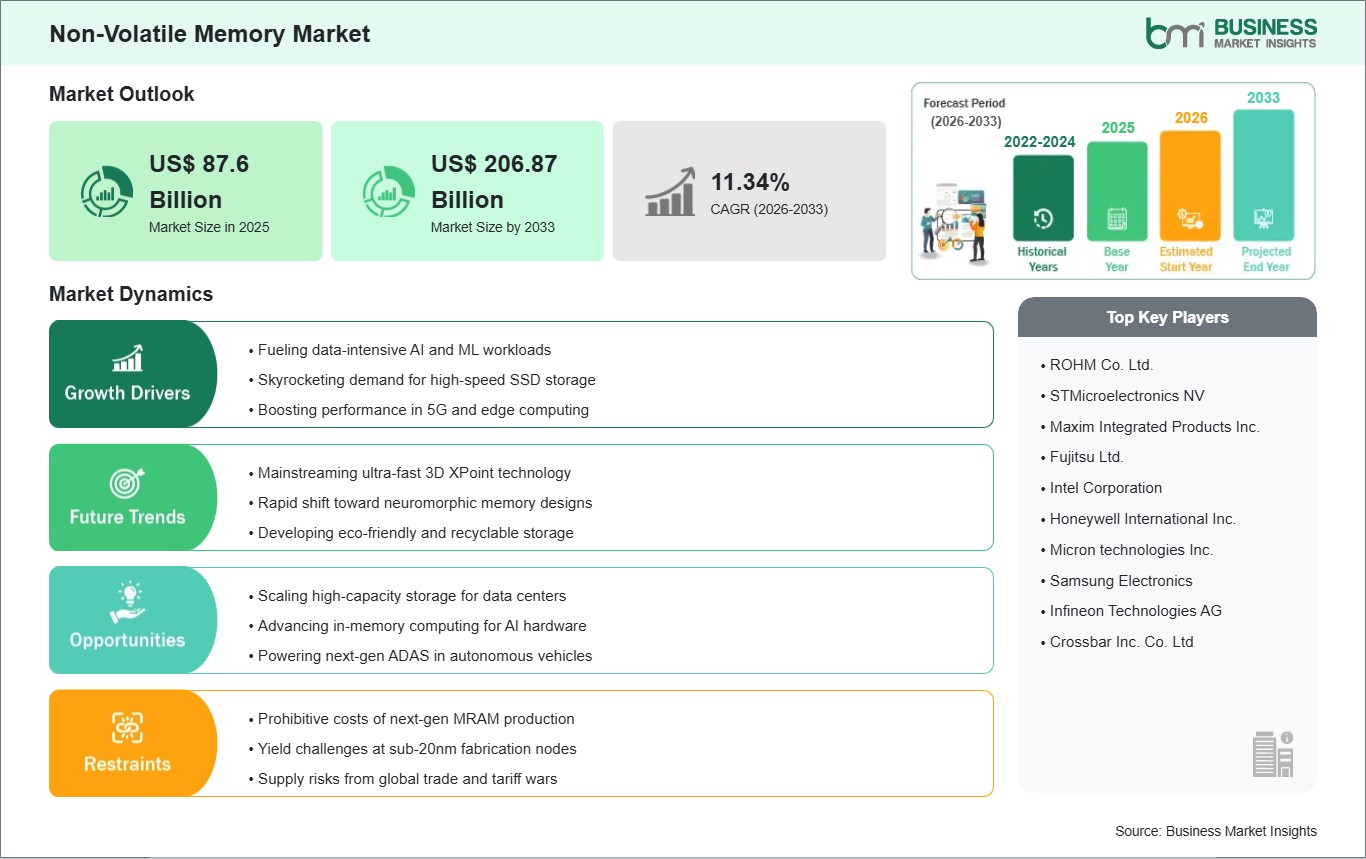
Non-Volatile Memory (NVM) plays a pivotal role in all digital systems, providing essential storage that retains data even when the power supply is cut off. They are essential for core segments: consumer electronics (smartphones, wearables), enterprise storage, automotive systems, and IoT devices. NVM offers advantages including high data retention, fast read/write speeds, lower power consumption compared to traditional memory, and increased durability. The market is being fueled by the explosive growth in data-intensive applications such as Artificial Intelligence (AI) and Machine Learning (ML), the proliferation of smart and connected devices (IoT), and the increasing demand for high-performance enterprise storage solutions, especially in data centers. Additionally, the development of next-generation NVM technologies (MRAM, ReRAM, PCM) is redefining speed and endurance capabilities.
However, several challenges can restrain market growth: the high manufacturing complexity and elevated costs associated with emerging NVM technologies limit widespread adoption in price-sensitive markets. Low write endurance rates in some traditional NVM types and compatibility issues with existing legacy system architectures also present technical integration hurdles. Furthermore, the industry is sensitive to global semiconductor supply chain disruptions, which can impact production volumes and pricing. Despite these challenges, the market holds immense opportunities as a result of the shift toward storage-class memory (SCM) to bridge the performance gap between DRAM and NAND, the critical need for robust memory in autonomous vehicles and ADAS, and the increasing integration of embedded NVM (eNVM) into microcontrollers for low-power edge computing.
Segment Analysis
Non-Volatile Memory Market Segmentation
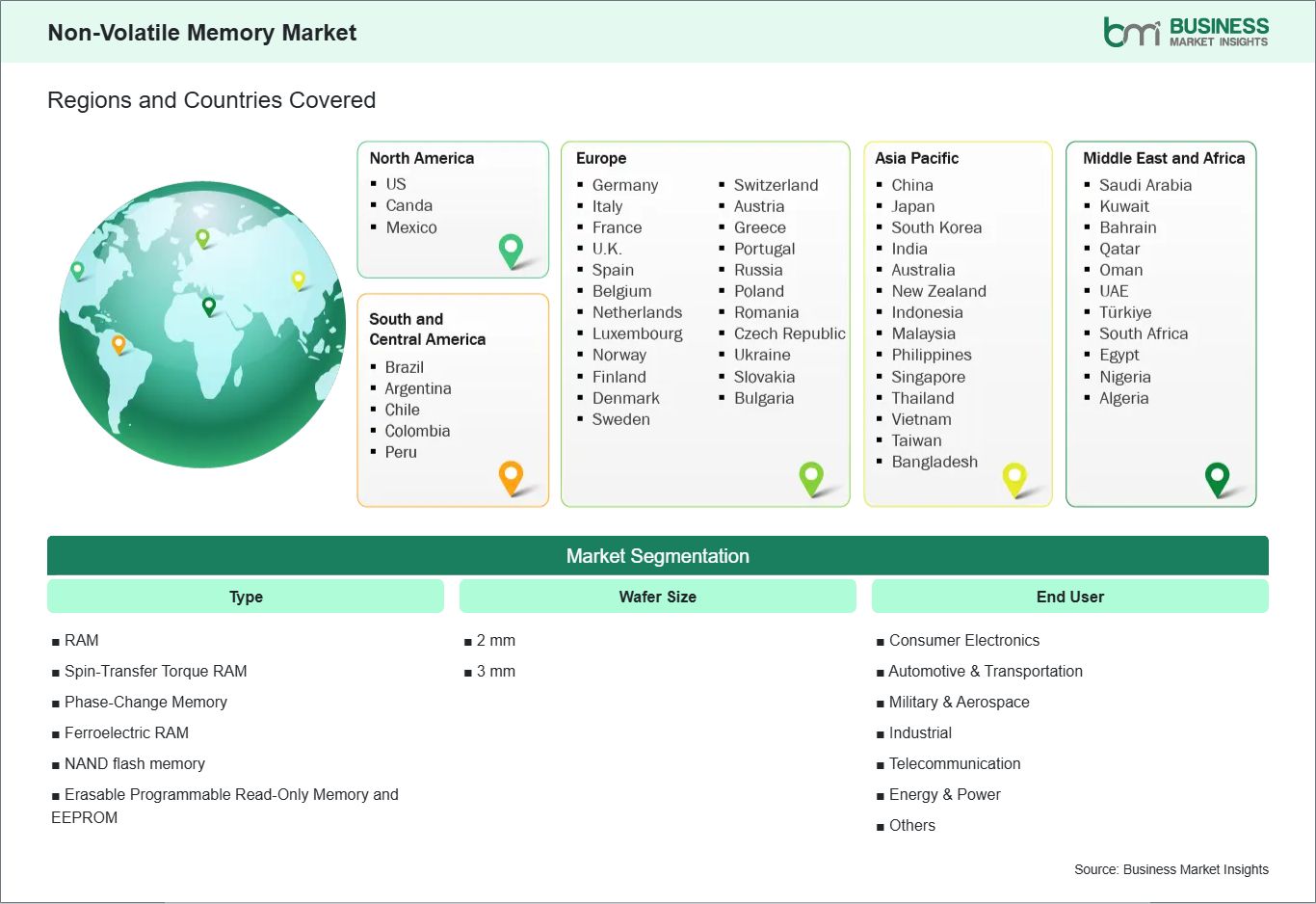
Key segments that contributed to the derivation of the Non-Volatile Memory market analysis are type, wafer size, and end user.
- By Type, the market is segmented into RAM (Reram), Spin-Transfer Torque RAM, Phase-Change Memory (PCM), Ferroelectric RAM (FRAM), NAND Flash Memory, Erasable Programmable Read-Only Memory (EPROM), and EEPROM.
- By Wafer Size, the market is bifurcated into 200 mm and 300 mm.
- By End User, the market is segmented into Consumer Electronics, Automotive & Transportation, Military & Aerospace, Industrial, Telecommunication, Energy & Power, and Others.
Market Forces
Non-Volatile Memory Market Drivers and Opportunities
Acceleration of AI and Edge Data Expansion
The primary force driving the Non-Volatile Memory (NVM) market is the exponential growth of digital data generated by Artificial Intelligence (AI) applications, Big Data analytics, and the deployment of edge computing devices. These technologies require high-speed, high-density, and persistent data storage. AI models and machine learning algorithms demand massive amounts of NVM for both training and inference data sets, requiring fast, low-latency access. At the same time, the shift towards edge computing, where data is processed closer to its source (e.g., in industrial IoT gateways, autonomous vehicles, and smart cities), is creating intense demand for NVM that can operate reliably in harsh, space-constrained environments while retaining data without power. This continuous need to store, manage, and quickly retrieve ever-increasing data volumes is the critical factor fueling demand across all NVM technologies, from NAND Flash to emerging memory types.
Transition to Next-Generation Storage
In the enterprise and data center space, the demand for faster data access is pushing the market toward advanced memory technologies such as 3D NAND Flash and Solid-State Drives (SSDs), utilizing faster interfaces such as NVMe. Crucially, emerging memory technologies (such as MRAM, ReRAM, and PCM) present a high-value opportunity to bridge the performance gap between traditional DRAM and NAND storage, offering ultra-low latency and high endurance for specialized applications. Furthermore, the automotive sector's move to Electric Vehicles (EVs) and autonomous driving also requires high-reliability NVM for driver-assistance systems, infotainment, and vehicle-to-everything (V2X) communication. These safety and operational systems need automotive-grade NVM that can withstand extreme temperatures and ensure data integrity over the vehicle's lifespan.
Size and Share Analysis
Non-Volatile Memory Market Size and Share Analysis
The Non-Volatile Memory market demonstrates steady growth, with size and share analysis revealing evolving trends and competitive positioning among key players. The report further examines subsegments categorized within type, wafer size, and end user, offering insights into their contribution to overall market performance.
For instance, the NAND flash memory segment represents a substantial portion of the market, primarily serving the Consumer Electronics sector. This technology is integral to smartphones, tablets, and solid-state drives (SSDs), where high-capacity storage and cost-effectiveness are paramount. To improve manufacturing efficiency and lower the cost per bit, producers are increasingly transitioning these chips to 300 mm production lines, which offer significantly higher yields per wafer compared to smaller diameters.
Report Coverage
Non-Volatile Memory Market Report Coverage and Deliverables
The "Non-Volatile Memory Market Size and Forecast (2022 - 2033)" report provides a detailed analysis of the market covering below areas:
- Non-Volatile Memory market size and forecast at global, regional, and country levels for all the key market segments covered under the scope
- Non-Volatile Memory market trends, as well as market dynamics such as drivers, restraints, and key opportunities
- Non-Volatile Memory market analysis covering key market trends, global and regional framework, major players, regulations, and recent market developments
- Industry landscape and competition analysis covering market concentration, heat map analysis, prominent players, and recent developments for the Non-Volatile Memory market
- Detailed company profiles, including SWOT analysis
Geographic Insights
Non-Volatile Memory Market Geographic Insights
The geographical scope of the Non-Volatile Memory market report is divided into five regions: North America, Asia Pacific, Europe, Middle East & Africa, and South & Central America.
The Asia-Pacific Non-Volatile Memory Market is segmented into China, Japan, South Korea, India, Australia, New Zealand, Indonesia, Malaysia, the Philippines, Singapore, Thailand, Vietnam, Taiwan, Bangladesh, and the Rest of Asia. The market is primarily driven by the region's role as the global epicenter for semiconductor manufacturing and consumer electronics production.
Growth is further bolstered by the rapid expansion of 5G infrastructure and hyperscale data centers, which require high-endurance, low-latency storage solutions. The rising adoption of NVM in the automotive sector for ADAS and infotainment systems, alongside heavy investments in AI and IoT, solidify Asia-Pacific as the critical global driver for non-volatile memory innovation.
Industry Activity
Recent Developments
The Non-Volatile Memory market is evaluated by gathering qualitative and quantitative data post primary and secondary research, which includes important corporate publications, association data, and databases. A few of the key developments in the Non-Volatile Memory market are:
- In September 2025, Deca Technologies and SST Join Forces to Advance Chiplet-Based Non-Volatile Memory Solutions. The partnership leverages Deca’s M-Series™ fan-out technology and its proprietary Adaptive Patterning® capabilities in combination with SST’s highly regarded SuperFlash® embedded flash memory technology.
- In November 2025, Frontgrade Technologies Expands MRAM Family: High-Speed, Non-Volatile Memory with Near Infinite Endurance for Mission-Critical Systems. Frontgrade Technologies, a leading provider of high-reliability electronic solutions for space and national security missions, today announced the expansion of its Magnetoresistive Random Access Memory (MRAM) product line.
- In August 2024, FMS: The Future of Memory and Storage — Micron Technology, Inc. (Nasdaq: MU), announced it is the first to develop PCIe® Gen6 data center SSD technology for ecosystem enablement as part of a portfolio of memory and storage products to support the broad demand for AI.
Trust & Transparency
Research Methodology
The market analysis combines proprietary research with secondary data from government agencies, company disclosures, regulatory filings, industry databases and expert interviews. Market estimates are validated through data triangulation, cross-market benchmarking and analyst
review.
View Full Research Methodology
Key Sources Referred:
World Bank - Global Trade IndicatorsWorld Trade Organization (WTO)International Monetary Fund (IMF)International Trade Administration (ITA)Company WebsitesCompany Annual ReportsCompany Investor Presentations