
Hot Rolled Coil Steel Market Outlook: Size, Share, Trends, Growth Analysis, Competitive Landscape & Forecast, 2026-2033

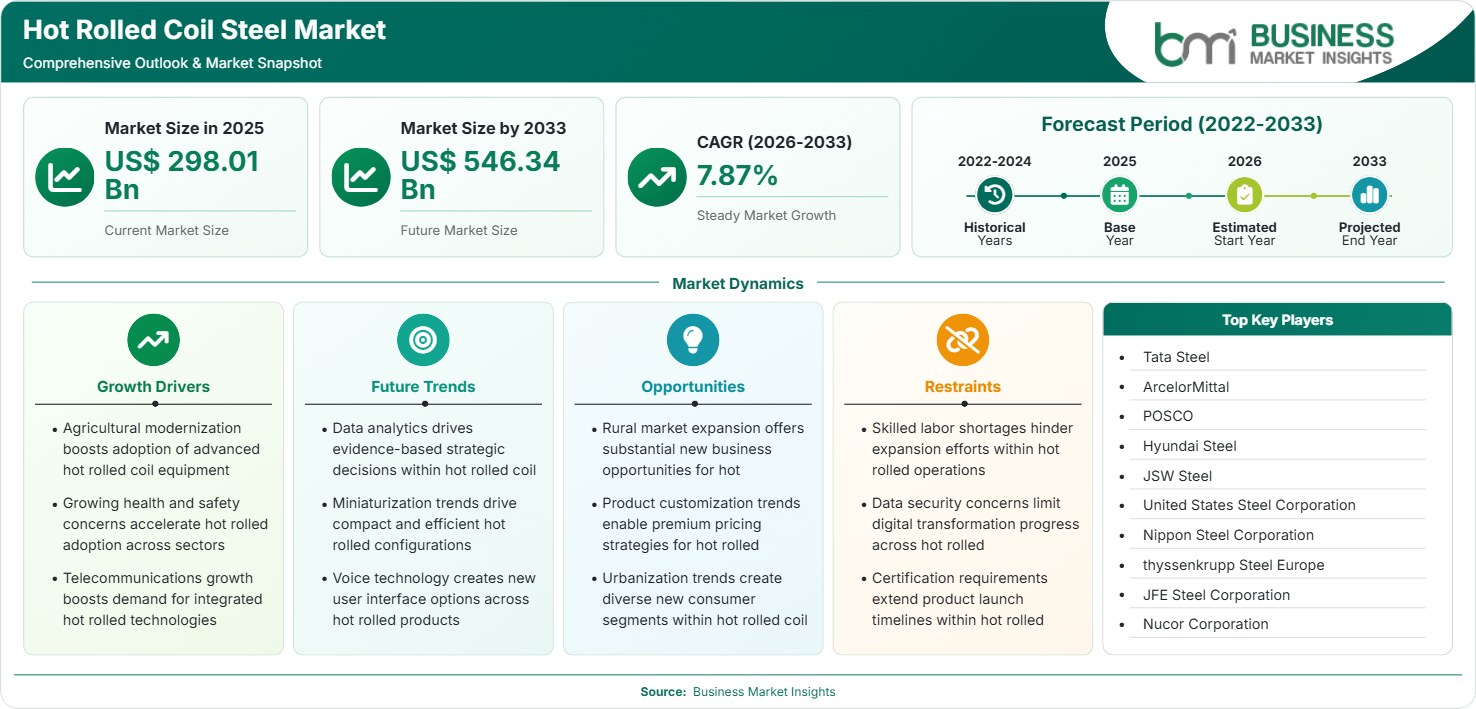
The Hot Rolled Coil Steel Market size was valued at US$ 298.01 Billion in 2025 and is projected to reach US$ 546.34 Billion by 2033, growing at a CAGR of 7.87% during 2026–2033. Growth is driven by infrastructure development, automotive production recovery, renewable energy investments, industrial expansion, modernization of manufacturing facilities, and increasing demand for structurally efficient steel products.

Report Coverage
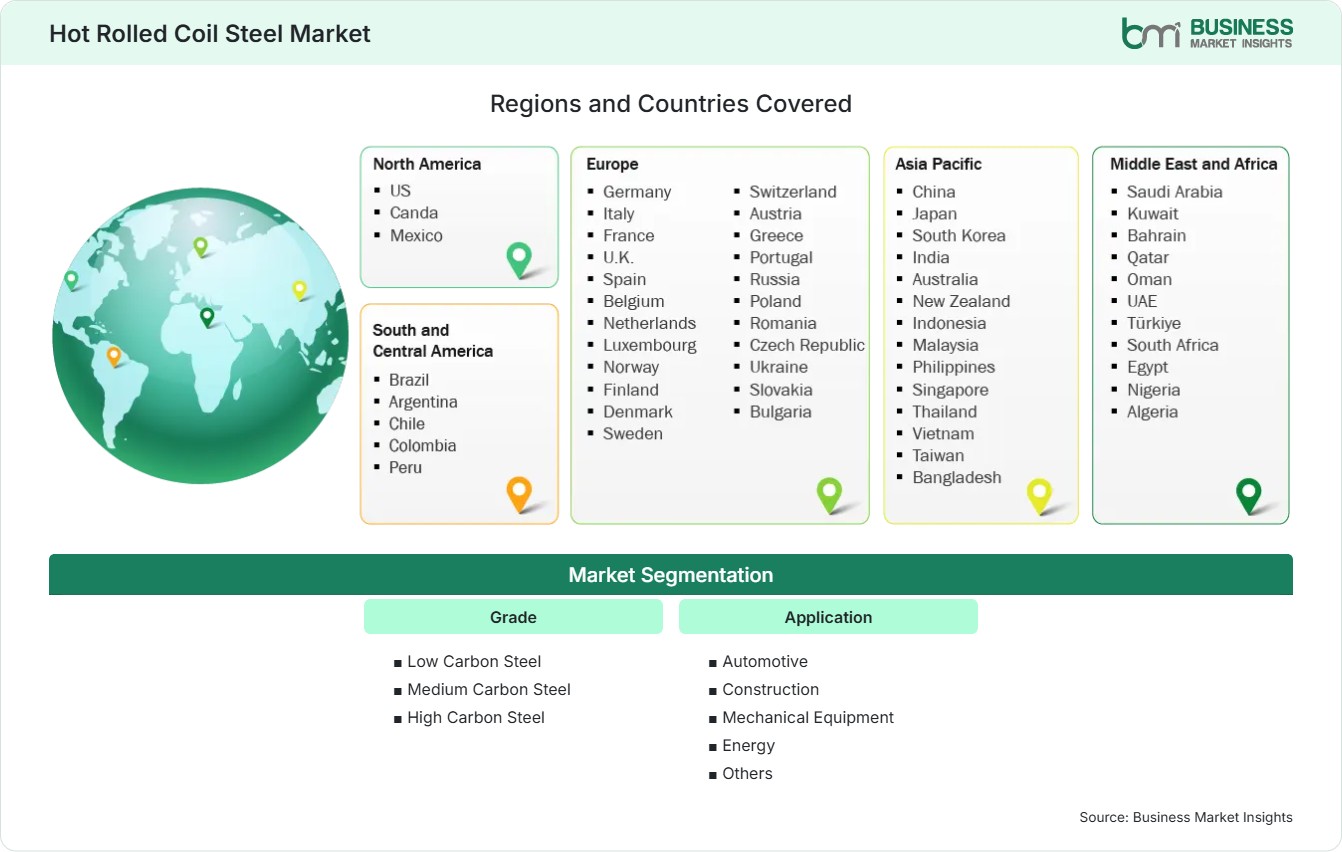
  • Grade: Low Carbon Steel, Medium Carbon Steel, High Carbon Steel
  • Application: Automotive, Construction, Mechanical Equipment, Energy, Others
US$ 298.01 Bn Market size in 2025
US$ 546.34 Bn Market Size by 2033
7.87% CAGR, 2026 - 2033
2026-2033 Forecast Period

AI Overview

Hot Rolled Coil Steel Market Summary

  • North America Region: North America holds a market share of 18%–21% in 2025 and is expected to grow at a CAGR of 6.8%–7.3% during 2026–2033. Demand is supported by infrastructure spending, industrial reshoring, energy projects, construction modernization, domestic steel investments, manufacturing output expansion, and transportation sector upgrades. The U.S. accounts for 80%–84% of regional demand and is forecast to expand at a CAGR of 6.9%–7.4%.
  • Fastest Growing Region: Asia Pacific holds a 56%–60% share in 2025 and is projected to grow at a CAGR of 8.6%–9.2%. Urbanization, industrial development, automotive manufacturing, shipbuilding, renewable energy installations, and large-scale infrastructure programs continue supporting consumption.
  • Leading Segment: Low Carbon Steel accounts for a 49%–53% share in 2025 and is expected to grow at a CAGR of 7.5%–8.0%. Strong demand from construction, automotive parts, machinery fabrication, and structural applications sustains dominance.
  • High Growth Segment: Automotive represents 26%–30% share in 2025 and is forecast to grow at a CAGR of 8.8%–9.4%. Vehicle production expansion, electric vehicle manufacturing, safety requirements, and lightweight steel innovations support growth.
  • Key Market Opportunity: Adoption of low-emission steelmaking technologies and green steel procurement commitments presents opportunities for producers to improve competitiveness, secure premium contracts, and align with sustainability goals.
  • Major Market Players: ArcelorMittal S.A., Nippon Steel Corporation, POSCO Holdings Inc., China Baowu Steel Group Corporation Limited, JFE Holdings, Inc., United States Steel Corporation, Nucor Corporation, Tata Steel Limited, JSW Steel Limited, and Hyundai Steel Company.
Strategic Insights

Hot Rolled Coil Steel Market: Strategic Insights

Hot Rolled Coil Steel Market Strategic Framework
FREE PDF
Request your free sample
Request free sample
Stakeholder View

Key Takeaways

  • Integrated steelmakers with captive raw material access maintain stronger margin stability during commodity price fluctuations.
  • Automotive applications offer substantial growth opportunities because of expanding electric vehicle manufacturing and increasing demand for advanced steel grades.
  • Innovation is centered on hydrogen-based steelmaking, electric arc furnace modernization, and carbon-reduction technologies.
  • Asia Pacific remains the primary investment destination due to manufacturing scale, infrastructure spending, and industrial growth.
  • Mergers, acquisitions, and strategic alliances increasingly focus on green steel production and downstream value-added processing.
  • Renewable energy infrastructure projects are becoming major consumers of hot rolled coil products used in towers, frames, and support structures.
Geographic Outlook

Hot Rolled Coil Steel Market Regional Highlights

North America Hot Rolled Coil Steel Market

The North American region will account for 18% to 21% of global demand in 2025 and is expected to grow at a CAGR of 6.8% to 7.3% through 2033. It is backed by vigorous industrial reshoring efforts, government infrastructure spending, and investments in the energy sector, all of which boost demand. Hot Rolled Coil Steel Market shares are influenced by rising manufacturing activity and improved production technologies. Demand remains concentrated across automotive, construction, heavy machinery, and energy infrastructure projects requiring reliable structural steel products.

  • Infrastructure modernization programs continue supporting demand for bridges, highways, industrial facilities, and transportation assets.
  • Manufacturing reshoring initiatives strengthen domestic steel procurement across machinery, equipment, and fabricated metal industries.
  • Renewable energy projects increase consumption of structural steel components and associated fabrication products.
  • Producers continue investing in electric arc furnace technologies to improve competitiveness and sustainability.
  • Construction renovation activity supports stable demand for flat steel products.

US Hot Rolled Coil Steel Market

The United States accounts for 80%–84% of regional consumption and is forecast to grow at a CAGR of 6.9%–7.4%. Strong automotive production, infrastructure expenditures, industrial investments, and manufacturing activity support market expansion.

  • Automotive assembly expansion continues supporting flat steel consumption.
  • Federal infrastructure programs increase demand across transportation networks.
  • Energy investments strengthen heavy-gauge steel requirements.
  • Industrial modernization projects stimulate sustained procurement activity.

Europe Hot Rolled Coil Steel Market

Europe holds a 15-18% market share in 2025 and is forecast to exhibit a CAGR of 6.5-7.0% through 2033. Germany is the dominant force within the region in terms of demand, while Eastern Europe displays a higher growth trajectory. Decarbonization initiatives and advanced manufacturing strategies remain influential factors shaping steel procurement and production investments.

  • Germany remains the largest regional consumer due to automotive and machinery production.
  • Poland experiences stronger growth from industrial expansion and infrastructure projects.
  • Green steel investments accelerate adoption of low-emission manufacturing technologies.
  • Renewable energy installations support structural steel requirements.
  • Modernized production facilities enhance efficiency and product quality.

Asia Pacific Hot Rolled Coil Steel Market

Asia Pacific represents 56%–60% of demand in 2025 and is expected to record a CAGR of 8.6%–9.2% through 2033. China remains the dominant producer and consumer, while India exhibits the strongest expansion due to infrastructure and industrial development. Market growth remains closely linked to manufacturing expansion across the region.

  • China leads consumption through construction, shipbuilding, and manufacturing sectors.
  • India benefits from transportation, housing, and industrial corridor development.
  • ASEAN economies continue increasing steel-intensive infrastructure investments.
  • Export-oriented manufacturing creates significant demand for flat steel products.
  • Renewable energy capacity additions strengthen material consumption.

Rest of World Hot Rolled Coil Steel Market

The Rest of the World accounts for 8% to 11% of the share and will continue to grow at a CAGR of 7.8% to 8.4%. Diversification efforts in the Middle East and industrialization and infrastructure development in Latin America continue to drive steel consumption.

  • Saudi Arabia and UAE drive consumption through large-scale development projects.
  • Brazil remains the leading Latin American steel-consuming market.
  • Energy infrastructure spending supports long-term procurement growth.
  • Industrialization initiatives expand domestic manufacturing activity.
  • Mining and processing investments strengthen steel requirements.
Global Market Geography
FREE PDF
Request your free sample
Request free sample
Segment Analysis

Hot Rolled Coil Steel Market Segmentation

Grade

The grade segment accounts for 47%–51% of market activity and is projected to grow at a CAGR of 7.5%–8.2%. The Market scope continues expanding due to increasing utilization across fabrication, construction, transportation, and machinery manufacturing industries requiring versatile and cost-effective steel grades.

  • Low Carbon Steel: Preferred for excellent weldability, formability, structural versatility, and extensive use in construction and automotive components.
  • Medium Carbon Steel: Utilized in machinery, industrial equipment, and engineering applications requiring enhanced strength and durability.
  • High Carbon Steel: Supports demanding industrial applications where hardness, wear resistance, and mechanical performance remain critical.

Application

This segment represents 42%–46% market share and is anticipated to expand at 7.9%–8.5% through the forecast period. Hot Rolled Coil Steel Market trends indicate rising adoption across transportation, industrial machinery, and infrastructure development.

  • Automotive: Vehicle bodies, chassis structures, wheels, and safety components continue driving consumption.
  • Construction: Demand is generated by structural frameworks, bridges, industrial buildings, and civil infrastructure projects.
  • Mechanical Equipment: Manufacturing equipment, industrial machinery, and heavy engineering systems remain key end users.
  • Energy: Applications include pipelines, wind-energy structures, transmission systems, and industrial energy projects.
Market Forces

Hot Rolled Coil Steel Market Dynamics

Key Market Drivers

Rising Global Infrastructure Investments

Global governments have increased their spending on transport infrastructure, industrial zones, utilities, and urban development. Hot-rolled coils serve as vital raw materials for bridge construction, railways, commercial buildings, and industrial sites. The major pipeline projects in the Asia Pacific, North America, and the Middle East region guarantee steady demand for such commodities. Long-term public investment commitments support volume growth for steel producers supplying major construction and engineering contractors.

Growth in Automotive Manufacturing

Flat steel remains a key demand segment for the automobile industry. The growth in vehicle manufacturing, the sale of electric automobiles, and localized manufacturing continue to foster this demand. High-strength steel is gaining traction due to its ability to meet performance and safety requirements while maintaining production efficiency. These trends continue to support stable procurement by automotive manufacturers and suppliers. Additionally, increasing investments in lightweight vehicle design, stricter fuel efficiency standards, and advancements in electric vehicle platforms are driving the adoption of specialized steel grades. Enhanced durability, crash resistance, recyclability, and cost-effectiveness make advanced flat steel products a preferred material choice, supporting sustained demand across passenger and commercial vehicle segments worldwide.

Expansion of Renewable Energy Projects

Wind farms, solar arrays, power transmission equipment, and energy storage units need considerable amounts of structural steel. Growth is increasingly associated with global investments in the energy transition, especially in regions with rapid renewable development and supportive policy frameworks. Expanding grid modernization projects, offshore wind installations, utility-scale solar parks, and battery storage facilities are further increasing steel consumption. Demand is also supported by investments in hydrogen infrastructure, transmission networks, and renewable manufacturing facilities. As countries pursue energy security and decarbonization objectives, long-term procurement of high-quality steel products is expected to remain strong across the renewable energy value chain.

Key Market Opportunities

Development of Green Steel Production

Steel companies that invest in production processes involving hydrogen, renewable energy, and carbon capture will benefit from improved competitiveness in the future. The Hot Rolled Coil Steel Market forecasts include rising demand for green steel among builders, manufacturers, and industrial consumers. Increasing environmental regulations, net-zero commitments, and sustainability targets across major economies are encouraging the adoption of low-carbon steel production technologies. Companies that successfully reduce emissions and demonstrate strong environmental performance can strengthen brand value, access premium markets, attract investors, secure long-term contracts, and enhance resilience against future regulatory changes.

Digital Manufacturing and Smart Mills

Automation, predictive maintenance, artificial intelligence, and process optimization provide possibilities for increased productivity and cost efficiency. Companies adopting smart manufacturing practices can increase the consistency of quality and flexibility of operations. The integration of advanced analytics, industrial Internet of Things (IIoT) solutions, digital twins, robotics, and real-time monitoring systems enables better decision-making, reduced downtime, improved resource utilization, enhanced supply chain visibility, lower operational risks, greater energy efficiency, and stronger competitiveness in rapidly evolving global markets.

Growth Across Emerging Economies

The rapid industrialization, urbanization, and infrastructure development in India, Southeast Asia, the Middle East, and Africa present ample business opportunities. The growing production capacity and government initiatives for industrial development help sustain increased steel consumption. Rising investments in transportation networks, energy projects, residential housing, commercial construction, manufacturing facilities, and smart city developments are further driving demand, strengthening market growth and long-term industry prospects.

Market Restraints and Challenges

Raw Material Price Volatility and Profitability Pressure

Factor: Steel manufacturers remain highly dependent on key raw materials such as iron ore, coking coal, scrap metal, and energy, all of which are subject to significant price volatility driven by global supply-demand dynamics, geopolitical developments, transportation costs, and energy market disruptions. Impact: The unpredictability of raw material costs creates substantial pressure on production economics and profit margins across the steel industry. Producers often face challenges in aligning procurement strategies with rapidly changing market conditions, making cost forecasting and inventory planning more complex. Since steel prices cannot always be adjusted immediately to reflect higher input costs, manufacturers frequently absorb a portion of the increase, resulting in margin compression. Prolonged periods of volatility can also reduce financial flexibility, limit capital allocation for growth initiatives, and increase overall business risk.

Environmental Compliance Requirements and Capital Expenditure Burden

Factor: Governments and regulatory bodies are implementing stricter emissions standards and carbon-reduction targets, requiring steel manufacturers to adopt cleaner production technologies, improve energy efficiency, and invest in low-carbon manufacturing processes. Impact: Compliance with evolving environmental regulations is driving significant capital expenditure and operational costs throughout the industry. Steel producers, particularly those operating traditional blast furnace facilities, must allocate substantial resources toward equipment upgrades, emissions-control systems, and sustainability initiatives. These investments can extend modernization timelines and place additional pressure on profitability, especially for smaller producers with limited financial capacity. At the same time, rising compliance obligations intensify competitive challenges as companies balance regulatory requirements with the need to maintain cost-efficient operations.

Company Analysis

Competitive Landscape

Hot Rolled Coil Steel Market analysis highlights competition among integrated steelmakers investing in capacity expansion, decarbonization initiatives, advanced grades, and operational efficiency improvements.

Company Name

Overview

Products and Services Relevant to this Market

ArcelorMittal S.A.

Global steel producer with extensive international operations and diversified product portfolio.

Hot rolled coils, advanced steels, automotive grades, construction products.

Nippon Steel Corporation

Leading Japanese steelmaker with strong technology capabilities.

High-performance hot rolled steel, automotive steels, industrial materials.

POSCO Holdings Inc.

Major global steel producer focused on technology and sustainability.

Hot rolled coils, energy-sector steel, automotive materials.

China Baowu Steel Group Corporation Limited

World's largest steel manufacturing group by output.

Flat steel products, hot rolled coils, industrial steel solutions.

JFE Holdings, Inc.

Integrated producer serving automotive and industrial sectors.

Hot rolled steel, construction steel, specialty steel grades.

United States Steel Corporation

North American steel manufacturer with integrated operations.

Hot rolled coils, industrial steel, tubular products.

Nucor Corporation

Major steel producer with strong electric arc furnace capabilities.

Flat-rolled steel, structural steel, value-added products.

Tata Steel Limited

Global steel producer serving diverse end-use industries.

Hot rolled coils, automotive steel, infrastructure products.

JSW Steel Limited

Integrated Indian steel producer with expanding capacity.

Hot rolled coils, plates, automotive and construction grades.

Hyundai Steel Company

South Korean steelmaker with strong automotive focus.

Automotive-grade hot rolled steel, industrial steel products.

Trust & Transparency

Research Methodology

The market analysis combines proprietary research with secondary data from government agencies, company disclosures, regulatory filings, industry databases and expert interviews. Market estimates are validated through data triangulation, cross-market benchmarking and analyst review.

View Full Research Methodology

Questions Answered

Frequently Asked Questions

What does a Hot Rolled Coil Steel Market Report typically include?

A Market Report typically evaluates market size, supply-demand dynamics, regional performance, segment trends, competitive positioning, pricing influences, technology developments, and strategic growth opportunities.

Which application segment shows the highest growth potential?

Automotive applications show strong potential because of rising vehicle production, electric mobility investments, and demand for advanced high-strength steel products.

How does decarbonization affect the industry?

Steelmakers increasingly invest in low-emission technologies, renewable energy integration, and green steel production methods to comply with environmental regulations and meet customer sustainability requirements.

Why is low carbon steel the leading grade segment?

Low carbon steel offers superior weldability, formability, affordability, and processing flexibility, making it suitable for construction, automotive, machinery, and general engineering applications.

Which region dominates the Market?

Asia Pacific dominates due to its large manufacturing base, infrastructure development programs, construction activity, shipbuilding sector, and extensive steel production capacity across China, India, Japan, and Southeast Asia.

Access the Full Hot Rolled Coil Steel Market Report

Get segment-level forecasts, regional estimates, competitive benchmarking, company profiles and downloadable Excel datasets.

Access the full Hot Rolled Coil Steel Market Report
350 pages PDF & Excel | 2026-08-21
Similar Research

Related Market Reports