
Stainless Steel Sheet Market Outlook: Size, Share, Trends, Growth Analysis, Competitive Landscape & Forecast, 2026-2033

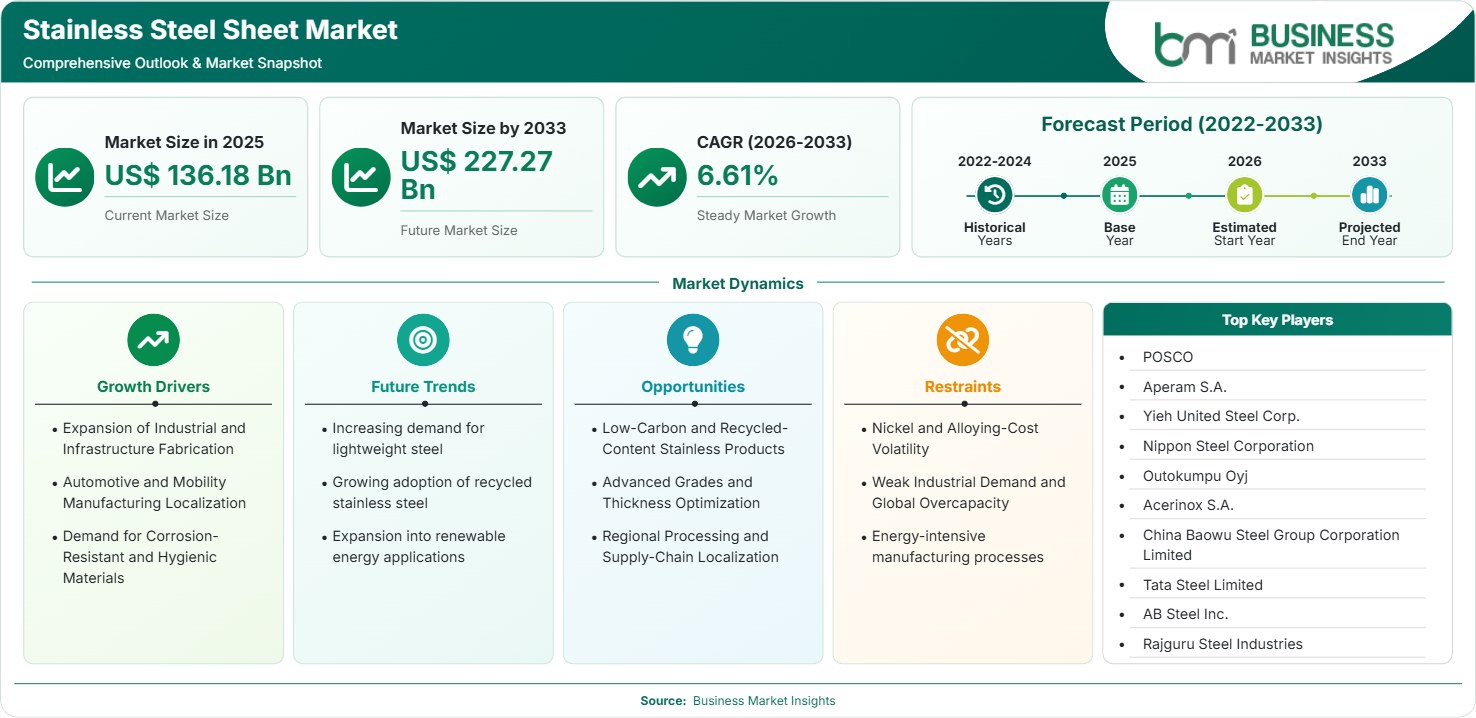
The Stainless Steel Sheet Market size was valued at US$ 136.18 Billion in 2025 and is projected to reach US$ 227.27 Billion by 2033, growing at a CAGR of 6.61% during 2026–2033, supported by construction demand, industrial modernization, automotive lightweighting, corrosion resistance, recycling, and premium-grade applications.

Report Coverage
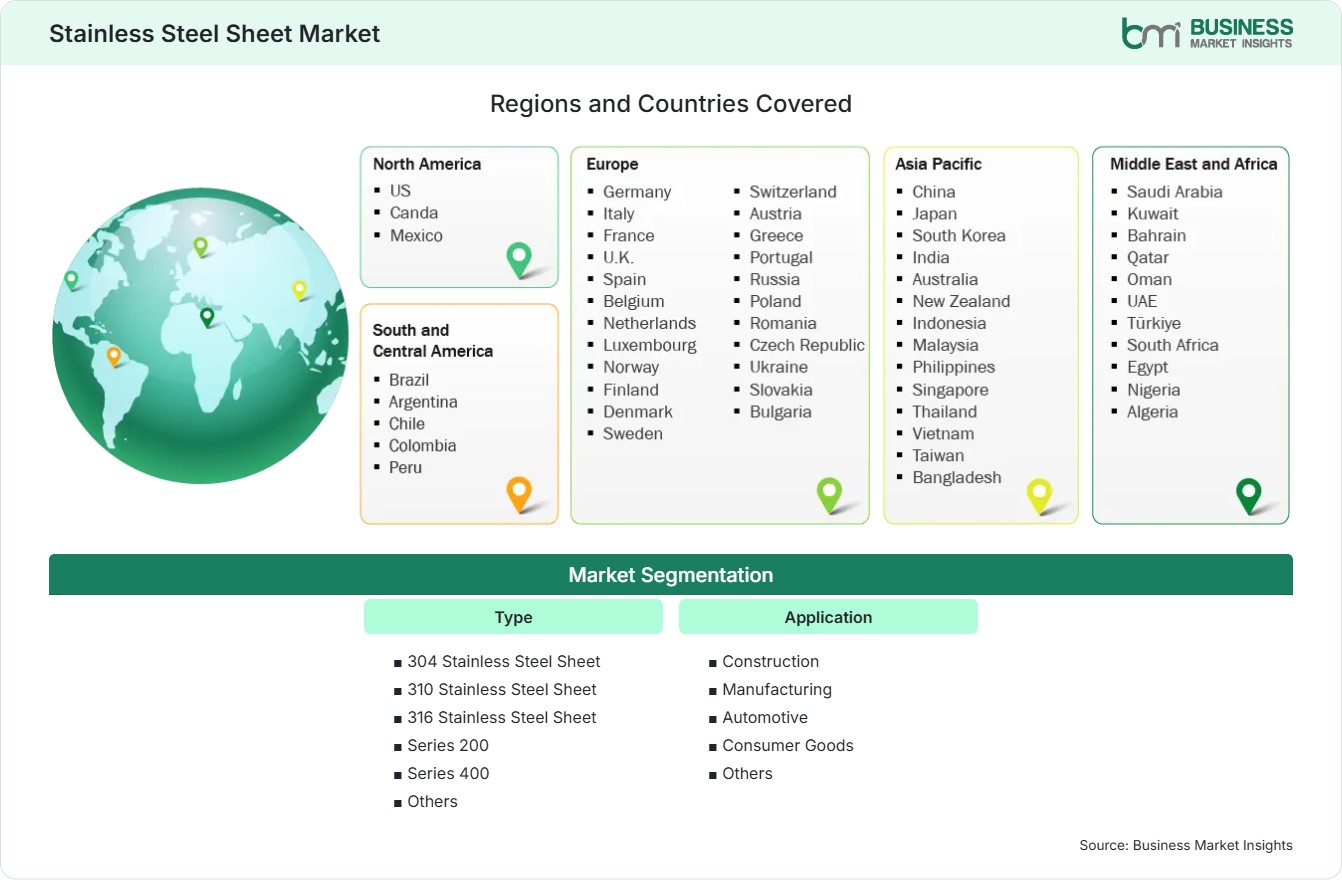
  • Type: 304 Stainless Steel Sheet, 310 Stainless Steel Sheet, 316 Stainless Steel Sheet, Series 200, Series 400, Others
  • Application: Construction, Manufacturing, Automotive, Consumer Goods, Others
US$ 136.18 Bn Market size in 2025
US$ 227.27 Bn Market Size by 2033
6.61% CAGR, 2026 - 2033
2026-2033 Forecast Period

AI Overview

Stainless Steel Sheet Market Summary

  • North America Region: North America holds a market share of 8%–10% in 2025, growing with a CAGR of 6.8%–7.4%, influenced by reshoring, automotive investment, infrastructure renewal, food processing expansion, and demand for durable corrosion-resistant fabricated products. The U.S. market benefits from industrial reshoring, infrastructure modernization, automotive investment, and domestic sheet production, with a modeled 7.0%–7.6% CAGR through 2033.
  • Fastest Growing Region: Asia Pacific holds a market share of 69%–74% in 2025, growing with a CAGR of 6.8%–7.4%, driven by manufacturing capacity, urban infrastructure, automotive production, appliance demand, construction activity, and expanding stainless processing ecosystems.
  • Leading Segment: 304 Stainless Steel Sheet holds a 45%–49% share in 2025, with a CAGR of 6.4%–7.0%, supported by balanced corrosion resistance, fabrication flexibility, broad availability, food equipment adoption, architectural applications, and extensive industrial processing requirements.
  • High Growth Segment: Manufacturing holds a 31%–35% share in 2025, advancing at a CAGR of 7.0%–7.7%, supported by machinery modernization, process equipment replacement, industrial automation, fabricated components, energy equipment, and corrosion-resistant production environments.
  • Key Market Opportunity: Decarbonized production, recycled-content procurement, advanced grades, precision finishing, and localized processing create opportunities for suppliers to capture premium applications while strengthening customer retention and margins.
  • Major Market Players: POSCO, Aperam S.A., Yieh United Steel Corp., Nippon Steel Corporation, Outokumpu Oyj, Acerinox S.A., China Baowu Steel Group Corporation Limited, Tata Steel Limited, AB Steel Inc., and Rajguru Steel Industries.
Strategic Insights

Stainless Steel Sheet Market: Strategic Insights

Stainless Steel Sheet Market Strategic Framework
FREE PDF
Request your free sample
Request free sample
Stakeholder View

Key Takeaways

  • The value chain is evolving as being based on integrated producers, service centers, distributors, fabricators, and specific application processors. Melting, rolling, finishing, and logistics control is still critical because the use of nickel and chromium can rapidly change the economics of the sheet.
  • The strongest opportunities are in manufacturing, automotive, energy equipment, food processing, and infrastructure applications, where corrosion resistance reduces maintenance costs and extends asset operating life.
  • Grade engineering is becoming a competitive tool. Producers are creating low-alloy grades, duplex alloys, lighter gauges, better-finishing grades, and recycled-content grades to meet the needs of cost reduction and sustainability.
  • India and South East Asia offer exciting prospects of investment due to the need for stainless processing resulting from the growth of manufacturing localization, construction, appliance manufacture, and automobile capacity.
  • There is a move towards consolidation towards high-value portfolio as opposed to mere capacity build-up, for example, with Acerinox's merger with Haynes International and Aperam's takeover of Magnetec.
  • Procurement has increasingly become regional. Tariffs, CBAM, safeguards, cost of freight, and carbon considerations make it strategically important to finish stainless locally.
Geographic Outlook

Stainless Steel Sheet Market Regional Highlights

North America Stainless Steel Sheet Market

North America represents 8%–10% share in 2025 and is modeled to expand at a 6.8%–7.4% CAGR from 2026–2033. The region benefits from reshoring initiatives, infrastructure renewal, food equipment demand, automotive manufacturing, and industrial machinery production. These applications continue to create demand for stainless steel sheets because of their durability, corrosion resistance, and suitability for demanding operating conditions.

  • The automotive industry is creating a greater need for corrosion-resistant materials, exhaust systems, structural materials, and precision-finished sheets through automotive localization.
  • Infrastructure renewal is driving demand for architectural panels, transit equipment, water infrastructure, commercial kitchens, and industrial structures that require durable surfaces with low maintenance.
  • Sheet material is needed in food processing and pharmaceuticals, where clean, corrosion-resistant surfaces are integral to operating conditions.
  • Sheet steel is becoming more important in Mexico due to the localization of manufacturing in North America.

US Stainless Steel Sheet Market

The U.S. accounts for 75%–80% of North America's 2025 market and is modeled at a 7.0%–7.6% CAGR during 2026–2033. U.S. stainless steel sheet market demand is supported by reshoring efforts, infrastructure development, automotive investment, and replacement demand from industrial facilities and equipment. Domestic producers are also benefiting from efforts to strengthen local supply chains and reduce dependence on overseas sourcing. 

  • Reshoring has increased demand for locally available sheets due to shorter supply chains, improved inventory management, tariff clarity, and reliable material delivery.
  • Automotive and Aerospace suppliers need materials with uniform thickness and surface quality for fabricated components, assemblies, heat-transfer systems, and special equipment.
  • The growth in industrial construction and food processing investments creates a constant demand as stainless surfaces can lower maintenance intervals.

Europe Stainless Steel Sheet Market

Europe represents 11%–14% share in 2025 and is modeled to grow at a 4.2%–5.1% CAGR through 2033. Germany remains the leading industrial market, while Poland and Spain provide stronger downstream growth opportunities, modeled around 5.0%–5.8%. Regional Stainless Steel Sheet market growth is constrained by soft industrial activity but supported by CBAM, import safeguards, recycling, energy transition, and demand for lower-carbon materials.

  • EU trade-defense instruments may be leading consumers to reconsider their supply, inventories, and long-term agreements, which could increase efficiency for local producers.
  • The manufacturers of automobiles and machinery continue focusing on precision sheet metal due to low industrial activity, with corrosion resistance and fabrication characteristics being critical in specifications.
  • Germany is the major consumer via machinery, automobiles, chemical processes, and industrial equipment, and Poland is helped by its manufacturing base and appliances.
  • Spain integrates stainless steel production with industrial consumption, and France and Italy offer opportunities in food equipment, construction, and engineered applications.

Asia Pacific Stainless Steel Sheet Market

Asia Pacific commands 69%–74% share in 2025 and is modeled to expand at a 6.8%–7.4% CAGR through 2033. China remains the dominant stainless steel production base in the region, supported by its large manufacturing sector, established processing capacity, and strong domestic demand. India, Indonesia, Vietnam, and Thailand are emerging as attractive downstream markets as industrial activity, construction, automotive production, and local fabrication expand in Stainless Steel Sheet Market.

  • China continues to be an integral part of regional supplies, with its stainless steel production expected to grow by 40.9 million tonnes in 2025, up 3.6%.
  • India continues to build strength through its development of infrastructure, automobiles, appliances, railways, construction, and industrialization, adding another demand for stainless steel grades of superior standards.
  • Indonesia and Southeast Asia benefit from the stainless steel supply chain linked to nickel, processing, and manufacturing operations in their domestic and international markets.
  • Japan and South Korea continue to hold significance through the supply of advanced grades, automobiles, precision processing, and industrial-grade sheets.

Rest of World Stainless Steel Sheet Market

Rest of World represents 5%–8% share in 2025 and is modeled at a 5.5%–6.4% CAGR during 2026–2033. South and Central America benefit from construction, food processing, energy infrastructure, and automotive-related manufacturing. The Middle East and Africa are supported by water infrastructure, food equipment, energy projects, and urban development, although import dependence can increase exposure to freight and currency volatility in Stainless Steel Sheet market.

  • Brazil has the most robust manufacturing presence in the region, whereas Mexico's supply chains also affect stainless steel demand in Central America through industrial and automotive linkages.
  • Construction, desalination, food processing, and energy infrastructures in the Middle East need corrosion-resistant material that can withstand tough thermal, chemical, and humid conditions.
  • Saudi Arabia and the UAE have potential for project-based demand owing to increasing diversity of industry and infrastructure projects.
  • South Africa is an important African country due to industrial processing, mining machinery, food applications, and infrastructure that need durable fabricated sheet.
Global Market Geography
FREE PDF
Request your free sample
Request free sample
Segment Analysis

Stainless Steel Sheet Market Segmentation

Type

The Type segment is led by 304 Stainless Steel Sheet market share, representing 45%–49% share in 2025 and modeled at a 6.4%–7.0% CAGR from 2026–2033. Broad corrosion resistance, fabrication ease, availability, and application versatility sustain its leadership, while 316 and heat-resistant grades capture specialized industrial demand.

  • 304 Stainless Steel Sheet: Broadly used in food equipment, architecture, appliances, processing machinery, and general fabrication because balanced corrosion resistance and formability support diverse operating requirements.
  • 310 Stainless Steel Sheet: Serves high-temperature applications including furnaces, heat-treatment equipment, burners, and thermal processing systems where oxidation resistance and elevated-temperature strength justify premium material selection.
  • 316 Stainless Steel Sheet: Favored for marine, chemical, pharmaceutical, and demanding processing environments because molybdenum-enhanced corrosion resistance improves performance against chlorides and aggressive operating conditions.
  • Series 200: Provides a cost-sensitive alternative for selected architectural, appliance, kitchenware, and fabricated applications where moderate corrosion performance can satisfy service requirements.
  • Series 400: Supports automotive, industrial, appliance, cutlery, and heat-resistant applications where magnetic properties, hardness, wear resistance, or thermal performance influence material selection.

Application

The Application segment is led by Manufacturing, representing 31%–35% share in 2025 and modeled at a 7.0%–7.7% CAGR from 2026–2033. Industrial automation, machinery replacement, process equipment, energy systems, and localized production are strengthening demand for corrosion-resistant sheet. Stainless Steel Sheet market scope increasingly extends into precision-fabricated components and specialized equipment.

  • Construction: Used for cladding, roofing, façades, railings, structural components, kitchens, elevators, and infrastructure where durability and architectural appearance reduce long-term maintenance requirements.
  • Manufacturing: Supports machinery, process equipment, tanks, conveyors, industrial components, and fabricated assemblies where corrosion resistance and dimensional consistency improve operational reliability.
  • Automotive: Applied in exhaust systems, trim, structural components, thermal systems, and specialized vehicle parts where strength, corrosion resistance, formability, and weight control influence engineering decisions.
  • Consumer Goods: Used in appliances, kitchen equipment, sinks, cookware, household products, and premium surfaces because cleanability, durability, aesthetics, and corrosion resistance influence purchasing decisions.
Market Forces

Stainless Steel Sheet Market Dynamics

Key Market Drivers

Expansion of Industrial and Infrastructure Fabrication

Industrial modernization is driving stainless steel sheet market demand across machinery, process equipment, food processing, water infrastructure, energy systems, and commercial construction. The use of stainless steel has become more common among manufacturers in circumstances where its corrosion resistance and durability would result in longer-lasting equipment and decrease the need for replacements. There is also increased demand due to infrastructure upgrades by governments and corporations improving their facilities, pipelines, processing plants, and other buildings. The growing number of manufacturing and fabrication operations, especially in areas developing industrial capabilities, also helps drive demand for stainless steel.

Automotive and Mobility Manufacturing Localization

The automotive sector continues to fuel demand for stainless steel sheets, which are used for exhaust, heat-related, and structural components, vehicle trim, and electric vehicles. The automotive industry has started to localize its manufacturing processes and source components from regions, reducing the risk of supply chain disruptions. This has opened opportunities for local stainless steel processors and suppliers who can deliver consistently high-quality products reliably. Increased focus on reducing vehicle weight and improving efficiency has also generated greater demand for thinner, stronger stainless steel sheets.

Demand for Corrosion-Resistant and Hygienic Materials

Food processing, pharmaceuticals, chemicals, water treatment, and clean manufacturing require materials that tolerate moisture, cleaning chemicals, temperature changes, and repeated sanitation. Stainless sheet provides a combination of corrosion resistance, cleanability, strength, and surface quality that is difficult to replicate economically across many applications. Demand is shifting toward grade optimization rather than simple volume expansion, with customers selecting 304, 316, heat-resistant, ferritic, and specialized grades according to operating conditions. The Stainless Steel Sheet market trends therefore include more application engineering, surface-finishing specialization, and lower material consumption through optimized thickness. These changes allow producers to compete through technical value rather than commodity pricing alone.

Key Market Opportunities

Low-Carbon and Recycled-Content Stainless Products

Decarbonization is creating new opportunities for stainless steel sheet market growth producers to differentiate products through recycled content, efficient melting processes, renewable energy use, scrap optimization, and better carbon tracking. Customers are increasingly considering environmental performance when selecting materials, particularly in markets with stricter sustainability requirements. This is encouraging producers to improve energy efficiency, increase scrap use, and provide clearer information on the environmental impact of their products. Low-carbon stainless steel sheets can help manufacturers meet sustainability goals while maintaining the strength, corrosion resistance, and durability expected from stainless steel. Producers with efficient production systems, reliable scrap networks, and transparent environmental data are likely to gain an advantage in sustainability-focused applications.

Advanced Grades and Thickness Optimization

Development of advanced stainless steel grades is creating opportunities for producers to offer better performance at lower overall material costs. Customers are increasingly looking for grades that provide the required corrosion resistance, strength, and service life without using more expensive alloying elements than necessary. Thinner and stronger sheets can also reduce material consumption and component weight while maintaining performance. This is encouraging suppliers to work more closely with customers on grade selection, thickness, surface finish, and fabrication requirements. Producers that combine metallurgical development with application-specific engineering can differentiate their products, improve margins, and build stronger relationships with customers across demanding end-use industries.

Regional Processing and Supply-Chain Localization

There are several reasons why regional processing and localizing the supply chain can provide value to stainless steel sheet manufacturers and processors. There is an opportunity to provide faster access to material and become less reliant on distant transportation networks by offering local slitting, cut-to-length services, surface treatment, and stocking capabilities. Reshoring of manufacturing to North America and changing dynamics of international trade in Europe are making it even more important for companies to rely on regional supply sources. This can provide a competitive advantage to regional suppliers by enabling them to deliver faster, offer custom-size options, and maintain consistent inventory and logistics security.

Market Restraints and Challenges

Nickel and Alloying-Cost Volatility

Factor: Fluctuations in nickel, chromium, molybdenum, energy, and scrap prices can increase stainless steel sheet production costs and create pricing uncertainty. Impact: Higher alloy prices will push manufacturers to raise their surcharges, making stainless steel sheets more expensive for their clients. They may defer their orders, reduce stockpiling, or switch to lower-alloy steels to manage costs. Such an impact will be greater for higher alloyed grades like 316. Proper procurement of the required raw materials and scrap steel will mitigate the problem.

Weak Industrial Demand and Global Overcapacity

Factor: Uneven industrial activity and excess stainless steel production capacity can increase competition, particularly for standardized grades and commodity sheet products. Impact: Weak demand can reduce mill utilization, put pressure on selling prices, delay customer restocking, and encourage distributors to keep inventories low. Excess capacity can further narrow producer margins as mills compete for available orders. These conditions may be more challenging for suppliers that depend heavily on standard products and price-based competition. Producers with specialized grades, efficient manufacturing operations, strong service networks, and established regional customers can better manage these pressures and reduce exposure to commodity pricing.

Company Analysis

Competitive Landscape

The Stainless Steel Sheet Market analysis indicates competition is shifting from volume alone toward integrated production, specialty grades, processing quality, sustainability credentials, regional availability, and customer-specific engineering.

Company Name

Overview

Products and Services relevant to this market

POSCO

South Korean steel producer with extensive flat-steel capabilities and global downstream operations serving industrial customers.

Stainless flat products, sheets, automotive materials, processing, surface treatment, and application-specific steel solutions.

Aperam S.A.

Luxembourg-based stainless and specialty steel producer with integrated European and Brazilian operations.

Stainless coils and sheets, specialty grades, electrical steels, recycling, finishing, and advanced alloy solutions.

Yieh United Steel Corp.

Taiwan-based stainless producer serving international industrial, construction, appliance, and fabrication customers.

Stainless sheets, coils, plates, precision products, multiple grades, finishes, and customized processing services.

Nippon Steel Corporation

Japanese steelmaker emphasizing advanced materials, product engineering, and integrated production optimization.

Stainless sheets, plates, high-performance grades, automotive materials, infrastructure products, and technical support.

Outokumpu Oyj

Finnish stainlesssteel specialist focused on sustainable production and high-performance stainless applications.

Stainless sheets, coils, precision products, specialty grades, recycled-content solutions, and technical services.

Acerinox S.A.

Spanish stainless producer with European, North American, and specialty materials capabilities.

Stainless sheets and coils, high-performance alloys, precision products, finishing, and engineered material solutions.

China Baowu Steel Group Corporation Limited

Major Chinese steel group with extensive production and downstream capabilities across multiple steel categories.

Stainless flat products, sheets, coils, specialty steels, processing, and industrial supply solutions.

Tata Steel Limited

Indian steel producer with broad downstream capabilities serving infrastructure and manufacturing applications.

Stainless products, flat steel, processed materials, industrial solutions, and customer-specific steel services.

AB Steel Inc.

U.S.-based stainlesssteel supplier serving industrial buyers requiring sheet and related flat products.

Stainless sheet, plate, coils, processing, cutting, distribution, and customized material supply.

Rajguru Steel Industries

Indian stainlesssteel supplier and processor serving domestic and international fabrication requirements.

Stainless sheets, plates, coils, grades, finishes, cutting, processing, and distribution support.

Trust & Transparency

Research Methodology

The market analysis combines proprietary research with secondary data from government agencies, company disclosures, regulatory filings, industry databases and expert interviews. Market estimates are validated through data triangulation, cross-market benchmarking and analyst review.

View Full Research Methodology

Questions Answered

Frequently Asked Questions

How could trade policies influence future stainless sheet sourcing in Stainless Steel Sheet Market report?

Trade safeguards, tariffs, import quotas, carbon regulations, and local-content policies can shift purchasing toward regional producers and processors. The effect is likely to be strongest where domestic capacity exists and customers require predictable supply. Companies with local finishing networks and diversified sourcing can respond more effectively to sudden policy changes.

What makes regional stainless processing strategically important?

Regional processing reduces lead times and allows producers or service centers to supply cut-to-length dimensions, slit widths, surface finishes, and application-specific specifications. It also reduces exposure to freight volatility and improves responsiveness when customers operate with lean inventories or require rapid production changes.

Why are manufacturers investing in thinner stainless sheet?

Thinner sheet can reduce material consumption, component weight, transportation requirements, and fabrication costs when strength and corrosion performance are maintained. Advanced metallurgy, precision rolling, improved forming practices, and application engineering make thinner gauges more practical for automotive, industrial, appliance, and engineered applications.

How are sustainability requirements changing stainless steel procurement in Stainless Steel Sheet Market forecasts?

Procurement is increasingly incorporating recycled content, production emissions, energy sources, traceability, and carbon-related documentation. European regulations are particularly influential because CBAM and trade-defense measures can affect sourcing economics. Producers able to document environmental performance and provide consistent material traceability can gain an advantage in sustainability-sensitive infrastructure, automotive, construction, and industrial projects.

What factors determine stainless steel sheet grade selection?

Grade selection depends on corrosion exposure, temperature, strength, fabrication requirements, surface finish, magnetic properties, and lifecycle economics. 304 is suitable for many general environments, while 316 is preferred for chloride-rich conditions and demanding chemical or marine applications. Heat-resistant grades such as 310 are selected when elevated-temperature performance becomes the dominant engineering requirement.

Access the Full Stainless Steel Sheet Market Report

Get segment-level forecasts, regional estimates, competitive benchmarking, company profiles and downloadable Excel datasets.

Access the full Stainless Steel Sheet Market Report
350 pages PDF & Excel | 2026-09-03