
Herbicide Market Outlook: Size, Share, Trends, Growth Analysis, Competitive Landscape & Forecast, 2026-2033

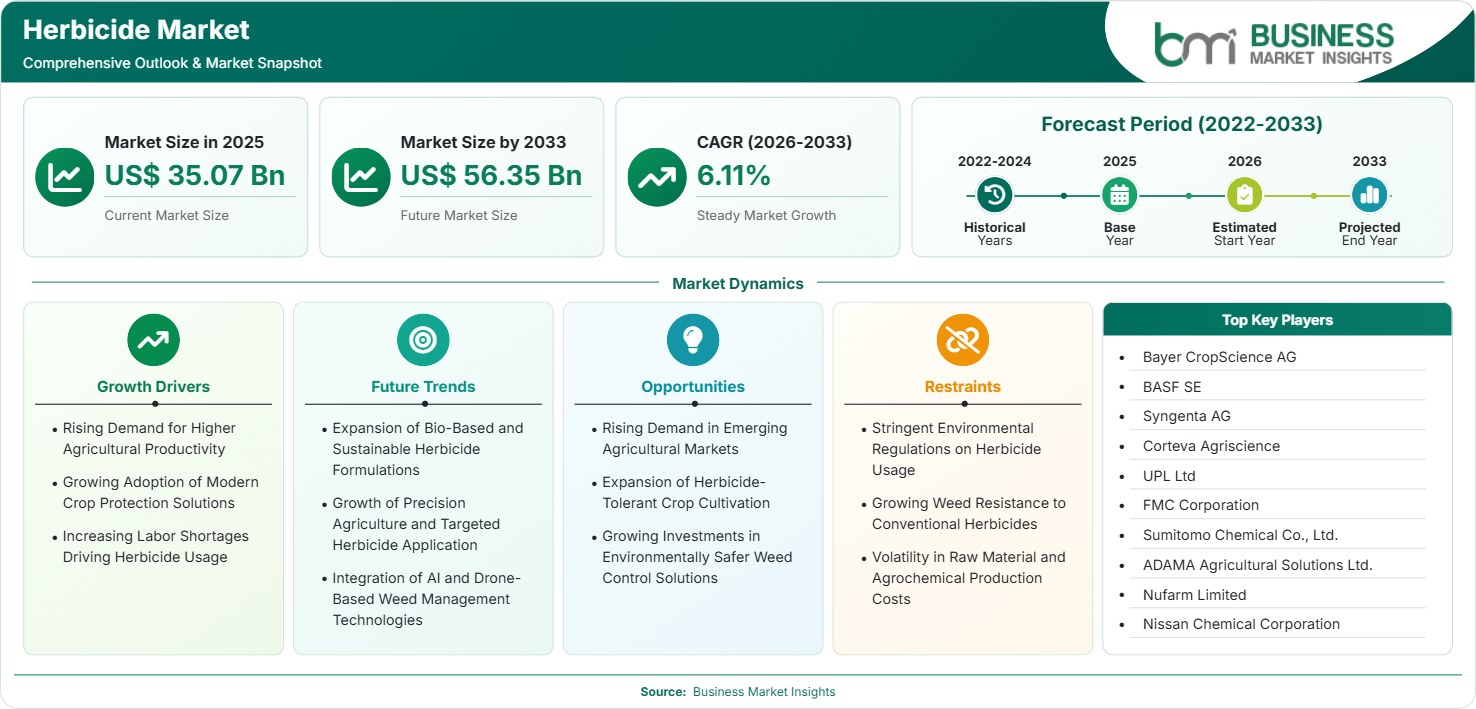
The Herbicide Market size was valued at US$ 35.07 Billion in 2025 and is projected to reach US$ 56.35 Billion by 2033, growing at a CAGR of 6.11% during 2026–2033. Rising demand for crop protection solutions, increasing pressure to improve agricultural productivity, growing adoption of precision farming practices, and expanding commercial cultivation activities are supporting market growth globally.

Report Coverage
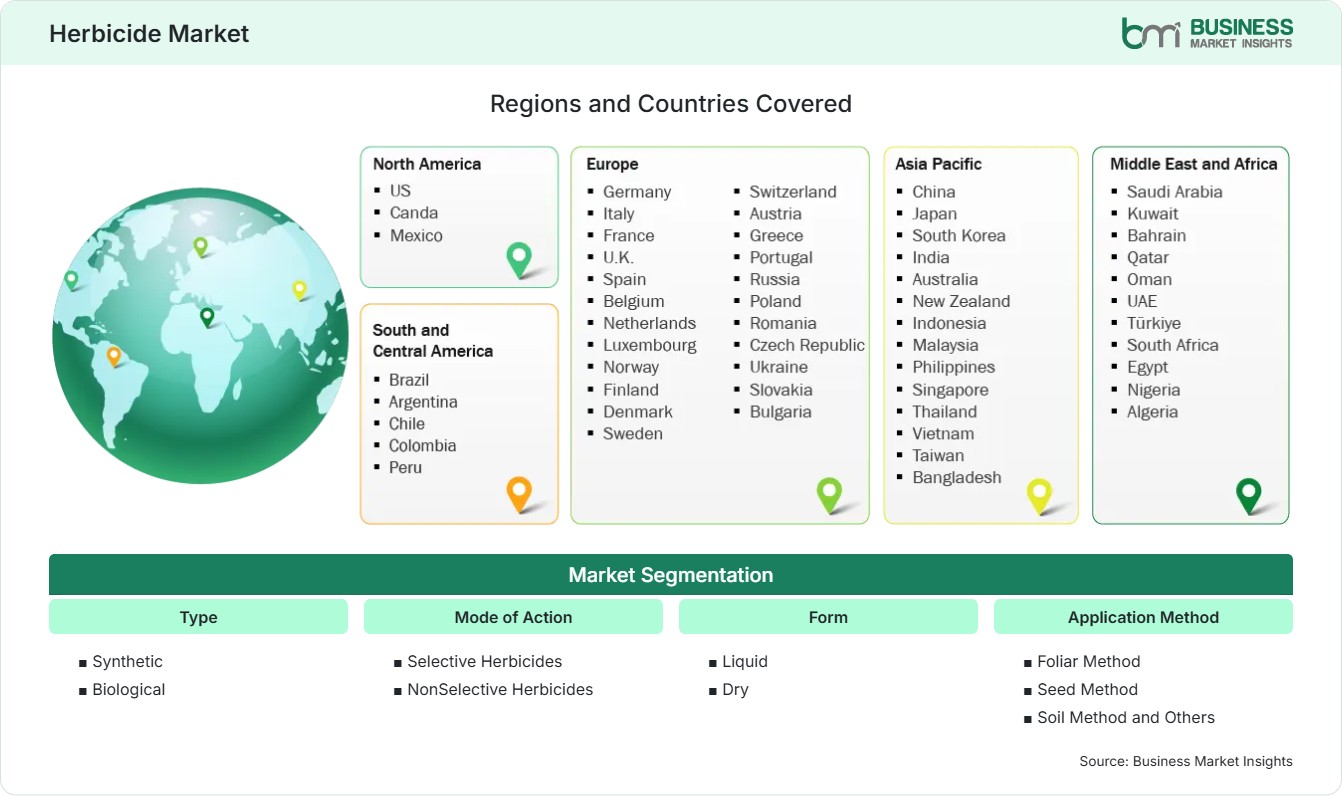
  • Type: Synthetic, Biological
  • Mode of Action: Selective Herbicides, NonSelective Herbicides
  • Form: Liquid, Dry
  • Application Method: Foliar Method, Seed Method, Soil Method and Others
  • Crop Type: Cereals & Grains, Oilseeds & Pulses, Fruits & Vegetables and Others
US$ 35.07 Bn Market size in 2025
US$ 56.35 Bn Market Size by 2033
6.11% CAGR, 2026 - 2033
2026-2033 Forecast Period

AI Overview

Herbicide Market Summary

  • North America Region: North America holds a market herbicide market of 36%–39% in 2025, growing with a CAGR of 5.8%–6.5% during 2026–2033. Large-scale commercial farming operations, widespread adoption of crop protection products, and advanced agricultural technologies continue supporting regional leadership. The U.S. market is expected to register a CAGR of 6.0%–6.7%.
  • Fastest Growing Region: Asia Pacific accounts for 29%–32% share in 2025 and is projected to grow at a CAGR of 6.7%–7.4% through 2033. Rising food demand, increasing agricultural modernization, and growing awareness regarding weed management continue driving regional growth.
  • Leading Segment: Synthetic Herbicides represent 78%–81% share in 2025 and are expected to grow at a CAGR of 5.9%–6.6% through 2033. Broad-spectrum weed control effectiveness, cost efficiency, and widespread adoption continue supporting segment dominance.
  • High Growth Segment: Cereals & Grains account for 42%–45% share in 2025 and are forecast to grow at a CAGR of 6.5%–7.2% during 2026–2033. Increasing global grain production requirements and large cultivation areas continue accelerating segment growth.
  • Key Market Opportunity: Expansion of biological herbicides, precision agriculture technologies, sustainable crop protection programs, and integrated weed management practices is creating substantial growth opportunities.
  • Major Market Players: Bayer CropScience AG, BASF SE, Syngenta AG, Corteva Agriscience, UPL Ltd, FMC Corporation, Sumitomo Chemical Co., Ltd., ADAMA Agricultural Solutions Ltd., Nufarm Limited, and Nissan Chemical Corporation.
Strategic Insights

Herbicide Market: Strategic Insights

Herbicide Market Strategic Framework
FREE PDF
Request your free sample
Request free sample
Stakeholder View

Key Takeaways

  • Herbicides remain essential components of modern crop protection and weed management programs.
  • Synthetic herbicides continue dominating the market due to proven effectiveness and broad application scope.
  • Cereals and grains represent the leading crop segment due to extensive global cultivation acreage.
  • Precision agriculture technologies are improving herbicide application efficiency and effectiveness.
  • Biological herbicides are gaining attention as sustainable agricultural practices expand.
  • North America remains the leading herbicide market due to large-scale commercial farming operations.
  • Asia Pacific is projected to witness the fastest growth owing to agricultural modernization and increasing food demand.
  • Integrated weed management solutions are expected to create significant future opportunities.
Geographic Outlook

Herbicide Market Regional Highlights

North America Herbicide Market

North America accounts for 36%–39% Herbicide Market share in 2025 and is projected to grow at a CAGR of 5.8%–6.5% through 2033. The region benefits from extensive commercial farming operations, advanced crop protection practices, increasing precision agriculture adoption, and strong demand for high-yield agricultural production systems. Continued investment in agricultural technology continues supporting regional market leadership.

  • Large-scale crop producers increasingly utilize advanced herbicide programs to improve weed control efficiency and maximize yield potential.
  • Precision agriculture technologies are improving herbicide application accuracy and resource utilization.
  • Farmers continue adopting integrated weed management practices to address resistant weed species and maintain productivity.
  • Rising investments in digital farming technologies continue enhancing crop protection decision-making capabilities.
  • Agricultural producers increasingly focus on reducing labor requirements through effective chemical weed control solutions.
  • Continued innovation in crop protection products supports long-term market expansion.

US Herbicide Market

The United States contributes approximately 88%–92% of North American revenue and is expected to register a CAGR of 6.0%–6.7% through 2033. The country remains the largest market due to extensive cultivation of corn, soybeans, wheat, and other major crops requiring effective weed management solutions.

  • Commercial farming operations continue investing in advanced crop protection technologies.
  • Adoption of precision spraying technologies is improving herbicide deployment efficiency.
  • Growing focus on yield optimization continues supporting demand for weed management solutions.
  • Technological advancements in agricultural equipment are enhancing product effectiveness and application precision.
  • Expansion of integrated crop management strategies continues supporting market development.

Europe Herbicide Market

Europe represents 22%–25% of global revenue in 2025 and is anticipated to expand at a CAGR of 6.1%–6.8% through 2033. Strong agricultural production systems, increasing focus on sustainable farming practices, and rising demand for crop productivity improvements continue supporting regional growth. Germany remains the leading market while Poland demonstrates stronger growth momentum.

  • Germany continues leading regional demand through advanced agricultural practices and extensive crop cultivation activities.
  • Poland is among the fastest-growing markets and is estimated to register a CAGR of 7.0%–7.7% during the forecast period, supported by agricultural modernization initiatives.
  • Farmers are increasingly adopting precision farming technologies to improve weed management efficiency.
  • Sustainable agriculture programs are encouraging adoption of environmentally responsible crop protection products.
  • Demand for enhanced agricultural productivity continues supporting market expansion.
  • Ongoing innovation in biological weed control solutions is creating new growth opportunities.

Asia Pacific Herbicide Market

Asia Pacific accounts for 29%–32% of global revenue in 2025 and is expected to achieve the fastest CAGR of 6.7%–7.4% through 2033. Rising food demand, agricultural modernization, increasing farm mechanization, and expanding crop cultivation continue supporting strong regional growth.

  • China remains the largest regional market due to extensive agricultural production and increasing use of crop protection products.
  • India is projected to achieve approximately 7.6%–8.3% CAGR, supported by rising agricultural productivity initiatives, improving farmer awareness, and expanding commercial farming activities.
  • Governments continue introducing programs aimed at improving crop yields and agricultural efficiency.
  • Growing mechanization is increasing adoption of modern crop protection solutions.
  • Rising population levels continue supporting demand for higher agricultural output.
  • Investments in farming technology continue strengthening long-term market opportunities.

Rest of World Herbicide Market

Rest of World accounts for 8%–11% of global revenue in 2025 and is projected to expand at a CAGR of 5.4%–6.1% through 2033. Increasing agricultural development, growing food production requirements, and rising adoption of modern farming practices are supporting market growth across Latin America, the Middle East, and Africa.

  • Brazil continues generating demand through extensive soybean, corn, and sugarcane cultivation activities.
  • The UAE is witnessing growing investment in agricultural productivity enhancement technologies.
  • Saudi Arabia is expected to achieve approximately 6.3%–7.0% CAGR through 2033, supported by agricultural modernization programs and food security initiatives.
  • Crop protection product adoption continues increasing across commercial farming operations.
  • Agricultural technology investments are improving farm productivity and resource efficiency.
  • Expansion of modern cultivation practices continues creating long-term market opportunities.
Global Market Geography
FREE PDF
Request your free sample
Request free sample
Segment Analysis

Herbicide Market Segmentation

Type

The type segment represents the major categories of herbicides utilized across agricultural production systems to manage weeds and improve crop productivity. This segment accounts for approximately 78%–81% share in 2025 and is projected to grow at a CAGR of 5.9%–6.6% through 2033. The expanding Herbicide Market Scope is supported by rising demand for crop yield enhancement, increasing adoption of commercial farming practices, and growing need for efficient weed management solutions.

  • Synthetic: Synthetic herbicides dominate the market due to their broad-spectrum weed control capabilities, cost efficiency, ease of application, and widespread adoption across large-scale farming operations. Continued product innovation supports strong demand.
  • Biological: Biological herbicides are gaining traction due to increasing focus on sustainable agriculture, environmental protection, and integrated weed management practices. Growing regulatory support for bio-based crop protection solutions continues driving adoption.

Mode of Action

The mode of action segment highlights the primary approaches through which herbicides control weed growth in agricultural environments. This segment accounts for approximately 62%–65% share in 2025 and is expected to register a CAGR of 6.2%–6.9% through 2033. Current Herbicide Market Trends indicate increasing demand for targeted weed control solutions, resistance management strategies, and advanced formulation technologies.

  • Selective Herbicides: Selective herbicides lead the market by targeting specific weed species while minimizing damage to desirable crops. Their effectiveness across cereals, oilseeds, and specialty crops continues supporting widespread use.
  • Non-Selective Herbicides: Non-selective herbicides are extensively utilized for land preparation, industrial vegetation management, and broad-spectrum weed control applications where complete vegetation removal is required.

Form

The form segment reflects the primary product formulations utilized to improve handling, storage, transportation, and field application efficiency. This segment accounts for approximately 66%–69% share in 2025 and is projected to grow at a CAGR of 6.0%–6.7% through 2033.

  • Liquid: Liquid herbicides dominate due to ease of mixing, uniform application, compatibility with spraying systems, and widespread adoption in commercial agriculture.
  • Dry: Dry formulations continue to be utilized for specific crop protection programs, offering advantages in storage stability, transportation efficiency, and extended shelf life.

Application Method

The application method segment highlights the major techniques used for herbicide deployment across agricultural systems. This segment accounts for approximately 47%–50% share in 2025 and is forecast to grow at a CAGR of 6.3%–7.0% through 2033.

  • Foliar Method: Foliar application remains the leading method due to rapid weed control effectiveness, ease of spraying, and compatibility with precision agriculture technologies.
  • Seed Method: Seed treatment applications are increasingly utilized to provide early-stage weed management and improve crop establishment.
  • Soil Method: Soil-applied herbicides continue supporting pre-emergence weed control strategies and long-term field management programs.
  • Others: Other methods include chemigation, spot spraying, precision drone applications, and integrated application technologies designed to optimize herbicide performance.

Crop Type

The crop type segment reflects the major agricultural crops utilizing herbicides to improve yield, quality, and production efficiency. This segment accounts for approximately 42%–45% share in 2025 and is projected to grow at a CAGR of 6.5%–7.2% through 2033.

  • Cereals & Grains: Cereals and grains remain the leading crop segment due to extensive cultivation acreage, increasing food demand, and significant dependence on weed management programs for productivity improvement.
  • Oilseeds & Pulses: Oilseed and pulse growers increasingly utilize herbicides to maximize yields and improve cultivation efficiency across commercial farming operations.
  • Fruits & Vegetables: Fruit and vegetable production continues adopting advanced weed management solutions to improve quality, crop protection, and labor efficiency.
  • Others: Other crop categories include plantation crops, forage crops, turf management, and specialty agricultural products.
Market Forces

Herbicide Market Dynamics

Key Market Drivers

Rising Demand for Higher Agricultural Productivity

The increasing need to boost farm productivity is considered one of the key motivating factors contributing to the use of herbicides across the globe. With an increasing population and a shrinking amount of arable land, there are growing concerns about food security, motivating farmers to maximize crop efficiency by properly managing weeds. Weeds interfere with the crops by competing for water, nutrients, and sunlight; thus, the need for proper control of weeds becomes necessary for sustaining the levels of production.

Growing Adoption of Modern Crop Protection Solutions

Farmers are increasingly adopting advanced crop protection technologies to improve agricultural performance, minimize yield losses, and strengthen farm profitability. Modern herbicide formulations offer enhanced effectiveness, improved compatibility with precision agriculture systems, and better management of challenging weed species. Growing awareness regarding integrated crop management practices is further supporting adoption. In addition, ongoing innovation by crop protection manufacturers continues expanding the availability of high-performance herbicide products suited for diverse agricultural environments.

Increasing Labor Shortages Driving Herbicide Usage

Agricultural labor shortages across many regions are encouraging producers to adopt chemical weed control solutions that reduce reliance on manual labor. Herbicides provide an efficient alternative to labor-intensive weed removal practices while supporting timely field management activities. Large-scale commercial farms particularly benefit from mechanized herbicide application systems that improve operational efficiency and reduce overall production costs. As labor availability challenges persist, herbicide usage is expected to continue increasing across both developed and developing agricultural markets.

Key Market Opportunities

Rising Demand in Emerging Agricultural Markets

Emerging economies are creating significant opportunities for herbicide manufacturers due to expanding agricultural activities, increasing mechanization, and rising focus on productivity enhancement. Governments and agricultural institutions are investing in modern farming techniques to improve food production and rural economic development. Growing awareness regarding crop protection technologies is supporting broader adoption of herbicides across these markets. This trend continues creating favorable opportunities for both established and emerging industry participants.

Expansion of Herbicide-Tolerant Crop Cultivation

The increasing cultivation of herbicide-tolerant crop varieties is contributing to demand for advanced weed management solutions. These crops enable farmers to implement more effective weed control programs while improving crop productivity and operational efficiency. Growing adoption of modern agricultural biotechnology across key farming regions continues creating opportunities for herbicide manufacturers. The trend also supports development of specialized formulations designed to complement evolving crop production systems.

Growing Investments in Environmentally Safer Weed Control Solutions

Agricultural stakeholders are increasingly investing in sustainable weed management technologies that balance productivity objectives with environmental considerations. The development of biological herbicides, reduced-residue formulations, precision application tools, and integrated weed management programs is gaining momentum globally. Companies are expanding research and development activities to create safer and more environmentally responsible solutions that comply with evolving regulatory requirements. Long-term Herbicide Market Forecast projections remain positive as sustainable agricultural practices continue expanding worldwide.

Market Restraints and Challenges

Stringent Environmental Regulations on Herbicide Usage

Factor: Governments and regulatory authorities continue implementing stricter regulations governing herbicide registration, application practices, environmental impact, and residue management. Increasing focus on ecosystem protection and sustainable agriculture is strengthening regulatory oversight.

Impact: Regulatory compliance requirements can increase development costs, delay product approvals, and limit the availability of certain active ingredients. Manufacturers may face additional investments in research, testing, and compliance management activities.

Growing Weed Resistance to Conventional Herbicides

Factor: Continuous and repeated use of certain herbicide chemistries has contributed to the emergence of resistant weed populations across numerous agricultural regions. Resistance development can reduce treatment effectiveness and complicate weed management efforts.

Impact: Weed resistance can increase production costs, reduce crop productivity, and create demand for more complex weed management programs. Farmers and manufacturers may need to adopt diversified strategies, including new herbicide technologies and integrated weed control approaches, to maintain effectiveness.

Company Analysis

Competitive Landscape

The Herbicide Market Analysis is characterized by intense competition among global agrochemical manufacturers, crop protection technology providers, and agricultural biotechnology companies. Market participants are focusing on advanced herbicide formulations, biological weed control solutions, resistance management technologies, precision application systems, and sustainable crop protection products to strengthen their market positions. Rising demand for agricultural productivity, increasing adoption of modern farming practices, and expanding cultivation of herbicide-tolerant crops continue driving innovation across the market. Companies are investing in new active ingredient development, biological product portfolios, digital agriculture integration, and environmentally responsible weed management solutions to address evolving agricultural challenges.

Company Name

Overview

Products and Services relevant to this market

Bayer CropScience AG

Agricultural science company specializing in crop protection and seed technologies.

Herbicides, weed management solutions, crop protection products, digital farming tools, and agricultural technologies.

BASF SE

Chemical company providing agricultural and crop protection solutions globally.

Herbicides, crop management products, agricultural chemicals, and integrated weed control solutions.

Syngenta AG

Agricultural technology company serving growers across global markets.

Herbicide products, crop protection technologies, biological solutions, and weed control programs.

Corteva Agriscience

Agricultural innovation company focused on crop protection and seed solutions.

Herbicides, crop enhancement products, weed management technologies, and precision agriculture solutions.

UPL Ltd

Global agricultural solutions provider serving diverse crop production systems.

Herbicides, crop protection chemicals, biological products, and integrated farming solutions.

FMC Corporation

Agricultural sciences company focused on crop protection innovation.

Herbicides, selective weed control solutions, agricultural chemicals, and crop productivity technologies.

Sumitomo Chemical Co., Ltd.

Chemical and agricultural technology company operating internationally.

Herbicides, crop protection products, agricultural formulations, and weed management technologies.

ADAMA Agricultural Solutions Ltd.

Crop protection company serving commercial agricultural markets worldwide.

Herbicides, agricultural chemicals, resistance management solutions, and crop protection programs.

Nufarm Limited

Agricultural solutions company specializing in crop protection products.

Herbicides, weed control technologies, crop enhancement products, and agricultural management solutions.

Nissan Chemical Corporation

Chemical manufacturer serving agriculture and specialty markets.

Herbicides, crop protection solutions, agricultural chemicals, and advanced weed management products.

Trust & Transparency

Research Methodology

The market analysis combines proprietary research with secondary data from government agencies, company disclosures, regulatory filings, industry databases and expert interviews. Market estimates are validated through data triangulation, cross-market benchmarking and analyst review.

View Full Research Methodology

Questions Answered

Frequently Asked Questions

How are biological herbicides influencing the herbicide market?

Biological herbicides are supporting sustainable agriculture initiatives by providing environmentally friendly weed control alternatives, helping growers reduce dependency on conventional chemical products while supporting integrated weed management programs.

What does this Herbicide Market Report cover?

The market report covers type analysis, mode of action assessment, form evaluation, application method analysis, crop type assessment, regional trends, competitive landscape analysis, market drivers, opportunities, restraints, challenges, and future growth prospects through 2033.

Why are Cereals & Grains the leading crop type segment?

Cereals and grains lead the market because they account for a substantial portion of global cultivated acreage and require effective weed management to maintain crop yields and production efficiency.

Which type segment dominates the market?

Synthetic Herbicides dominate the market due to their broad-spectrum weed control effectiveness, affordability, large-scale availability, and extensive use across major agricultural crops.

What is driving growth in the Herbicide market?

Rising demand for higher agricultural productivity, growing adoption of modern crop protection solutions, increasing labor shortages driving herbicide usage, and expanding commercial farming activities are major factors driving market growth.

Access the Full Herbicide Market Report

Get segment-level forecasts, regional estimates, competitive benchmarking, company profiles and downloadable Excel datasets.

Access the full Herbicide Market Report
350 pages PDF & Excel | 2026-08-21
Similar Research

Related Market Reports