Market Summary
Executive Summary and Global Market Analysis
Heat shields are thermal management components designed to regulate heat transfer within automotive systems and protect adjacent assemblies from excessive temperatures. These structures are integrated into engine compartments, exhaust systems, battery packs, and electronic modules to maintain operational stability and improve component durability. Material engineering advancements have expanded their functionality across both conventional and electrified vehicle architectures.
Vehicle manufacturers are prioritizing thermal insulation technologies to support stricter emission standards and improve energy efficiency. Heat concentration around compact engine layouts and high-density battery systems has accelerated the integration of lightweight shielding materials. Expanding electrification trends are also reshaping product configurations, particularly for battery and power-electronics protection applications requiring controlled thermal dissipation.
The market demonstrates diversified demand patterns across component categories and propulsion platforms. Engine compartment applications maintain broad utilization due to the continuous production of internal combustion vehicles, while battery and power-electronics systems are gaining stronger commercial relevance. OEM procurement channels account for substantial integration volumes because thermal shielding requirements are increasingly incorporated during vehicle platform development stages.
Material innovation remains a defining industry characteristic, with manufacturers focusing on multilayer insulation structures, lightweight metallic composites, and non-metallic thermal barriers. Product engineering is evolving toward compact, corrosion-resistant, and acoustically optimized solutions compatible with hybrid and battery-electric vehicle designs. Integration capabilities are becoming equally important as automakers seek modular thermal management systems adaptable across vehicle categories.
Competitive conditions within the industry are shaped by manufacturing precision, material performance, and long-term supply alignment with automotive producers. Market participants continue refining production efficiency while expanding application-specific product portfolios. Technological differentiation increasingly depends on thermal endurance, weight optimization, and compatibility with evolving vehicle propulsion systems, creating a dynamic environment for product development and strategic positioning.
Segment Analysis
Heat Shield Market Segmentation
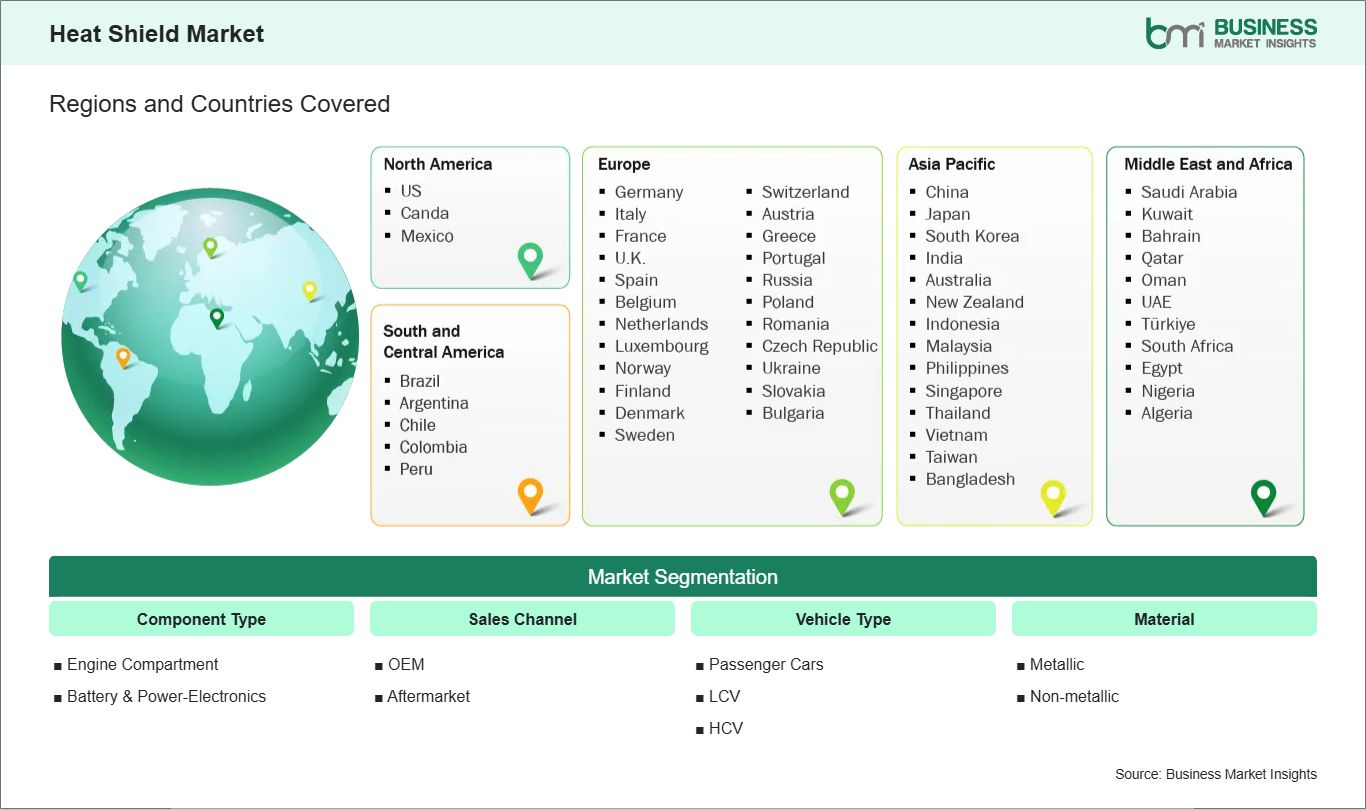
The Heat Shield market is segmented based on component type, sales channel, vehicle type, material, and vehicle propulsion.
By Component Type
- Engine Compartment: Sustains widespread installation across combustion-oriented vehicle assemblies.
- Battery & Power-Electronics: Gains traction through electrified vehicle thermal protection requirements.
By Sales Channel
- OEM: Dominates procurement through factory-level integration during vehicle manufacturing.
- Aftermarket: Benefits from replacement demand associated with aging vehicle fleets.
By Vehicle Type
- Passenger Cars – Accounts for substantial usage across mass-production automotive platforms.
- LCV – Utilization expands with commercial transportation fleet modernization activities.
- HCV – Requires durable thermal barriers for high-load operational environments.
By Material
- Metallic – Preferred for structural strength and elevated heat resistance performance.
- Non-metallic – Supports lightweight insulation requirements in modern vehicle platforms.
By Vehicle Propulsion
- ICE – Retains extensive deployment due to continuing conventional vehicle production.
- BEV – Encourages specialized shielding around batteries and electronic power systems.
Market Forces
Heat Shield Market Drivers and Opportunities
Rising Integration of Thermal Management Systems in Modern Vehicles
Automotive platforms are incorporating advanced thermal protection systems to manage elevated operating temperatures within compact vehicle architectures. Increased electronic content, turbocharged engines, and densely packaged assemblies create conditions requiring efficient heat isolation solutions. Manufacturers are adopting engineered shielding materials to maintain system reliability, reduce thermal degradation, and support long-term operational efficiency across vehicle categories.
Thermal management requirements are becoming increasingly relevant as vehicle performance expectations continue evolving across passenger and commercial transportation segments. Heat shields contribute to emission control efficiency, passenger comfort, and component longevity under demanding operating conditions. Their integration also aligns with automotive lightweighting strategies, encouraging the deployment of compact insulation systems capable of balancing structural durability with thermal resistance.
Expansion of Electrified Vehicle Platforms and Advanced Materials
The transition toward electrified mobility is creating opportunities for specialized heat shielding technologies compatible with battery-intensive vehicle architectures. Manufacturers are developing multilayer insulation systems and lightweight non-metallic materials to address temperature sensitivity within battery packs and electronic control systems. These innovations improve thermal containment while supporting compact packaging requirements across electric mobility platforms.
Future opportunities are linked to scalable thermal management solutions adaptable across hybrid and battery-electric vehicle production lines. Advanced material engineering is expected to encourage broader integration within high-voltage systems, charging infrastructure interfaces, and electronic propulsion assemblies. Product customization capabilities and improved thermal efficiency may further strengthen supplier positioning as vehicle manufacturers prioritize safety-oriented thermal control technologies.
Size and Share Analysis
Heat Shield Market Size and Share Analysis
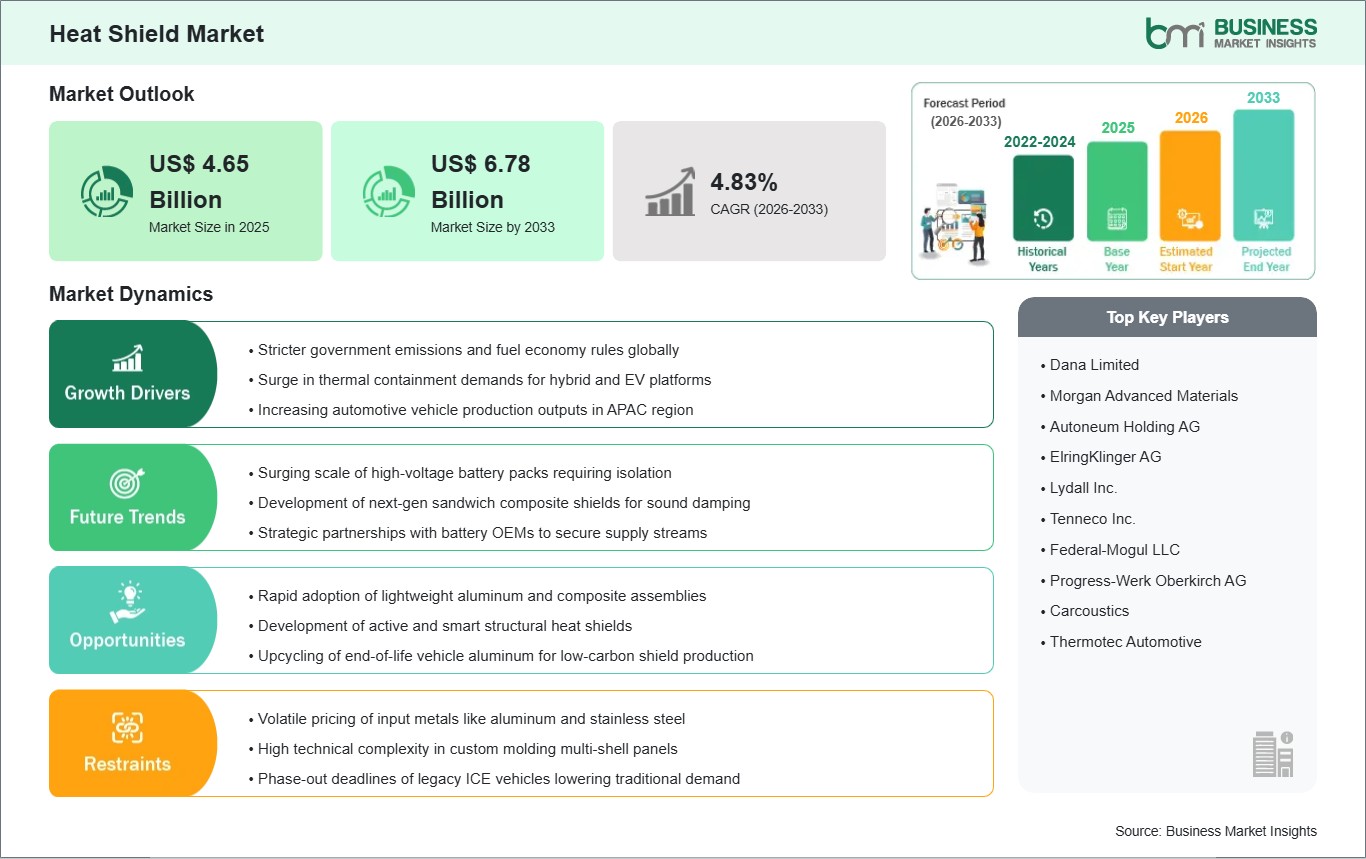
The Heat Shield Market is projected to grow from US$ 4.65 Billion in 2025 to US$ 6.78 Billion by 2033 , registering a CAGR of 4.83% from 2026 to 2033.
The market expansion reflects sustained thermal management requirements across conventional and electrified vehicle production environments. Product development activities centered on lightweight insulation materials and advanced thermal resistance technologies continue influencing industry progression.
OEM sales channels maintain substantial market presence because vehicle manufacturers increasingly integrate thermal shielding systems during early-stage platform engineering. Metallic materials preserve broad utilization due to structural durability and elevated heat tolerance characteristics. Passenger vehicle applications also contribute significantly through continuous automotive production and platform diversification activities.
Engine compartment applications account for notable utilization owing to persistent deployment within internal combustion vehicle assemblies. Simultaneously, battery and power-electronics applications are establishing stronger relevance with the expansion of electrified mobility systems. Thermal management requirements surrounding electronic propulsion systems continue to encourage broader implementation of advanced shielding configurations across emerging vehicle architectures.
Report Coverage
Heat Shield Market Report Coverage and Deliverables
The "Heat Shield Market Size and Forecast (2022–2033)" report provides a detailed analysis of the market covering below areas:
- Market size and forecast at global, regional, and country levels for all market segments covered under the scope
- Market trends, as well as drivers, restraints, and opportunities
- Market analysis covering key trends, global and regional framework, major players, regulations, and recent developments
- Industry landscape and competition analysis covering market concentration, heat map analysis, prominent players, and recent developments for the market
- Detailed company profiles, including SWOT analysis
Geographic Insights
Heat Shield Market Geographic Insights
The Heat Shield market shows diverse regional adoption patterns influenced by vehicle manufacturing concentration, propulsion technology transitions, regulatory frameworks, and material engineering capabilities. Automotive producers across multiple regions are integrating advanced thermal protection systems to improve operational efficiency and support evolving vehicle safety requirements. Product demand patterns also differ according to electrification strategies, industrial supply networks, and vehicle production specialization.
North America demonstrates steady utilization of heat shield technologies due to strong automotive manufacturing infrastructure and continuous development of performance-oriented vehicle platforms. Thermal insulation integration remains closely associated with emission compliance requirements and component protection standards. Electrified mobility investments and expanding electronic vehicle architectures are also reinforcing the relevance of advanced thermal shielding systems across regional production facilities.
Asia Pacific maintains a substantial industry presence supported by extensive automotive manufacturing activities and accelerating electric vehicle deployment. Regional suppliers continue expanding production capabilities to address rising integration requirements across passenger and commercial transportation segments. Material innovation and localized component manufacturing strategies contribute to broader adoption of lightweight thermal protection technologies throughout major automotive economies.
Europe emphasizes advanced thermal management solutions aligned with vehicle efficiency initiatives and electrification objectives. Demand for compact, lightweight, and high-performance insulation systems remains closely connected with stringent automotive engineering standards. Emerging markets across the Middle East, Africa, and South and Central America are gradually increasing deployment through expanding vehicle ownership, infrastructure development, and modernization of automotive assembly operations.
Industry Activity
Recent Developments
The Heat Shield market is evaluated by gathering qualitative and quantitative data post primary and secondary research, which includes important corporate publications, association data, and databases. A few of the key developments in the Heat Shield market are:
- In September 2025, Teconnex India, a subsidiary of the UK-based Teconnex Group and a global leader in engineered clamping solutions, announced the commencement of its new Heatshield Manufacturing Line at its state-of-the-art facility in Chakan, Pune. The new line marks a significant milestone in Teconnex India’s growth journey, enabling the company to diversify its product portfolio and cater to the growing demand for heatshield solutions in the Indian and international automotive, industrial, and off-highway sectors.
- In November 2025, Redwire and Los Alamos National Laboratory, with assistance from the National Aeronautics and Space Administration (NASA) Ames Research Center, successfully completed the demonstration of a new deployable aeroshell. Deployable heat shields are crucial for protecting spacecraft from the extreme heat encountered at high speeds.
Trust & Transparency
Research Methodology
The market analysis combines proprietary research with secondary data from government agencies, company disclosures, regulatory filings, industry databases and expert interviews. Market estimates are validated through data triangulation, cross-market benchmarking and analyst
review.
View Full Research Methodology
Key Sources Referred:
Automotive industry thermal management reports Government transportation and vehicle production databases Peer-reviewed journals on thermal insulation materials Automotive component manufacturer annual filings International mobility and electrification studies Technical publications on battery thermal management systems