
Halides Market Outlook: Size, Share, Trends, Growth Analysis, Competitive Landscape & Forecast, 2026-2033

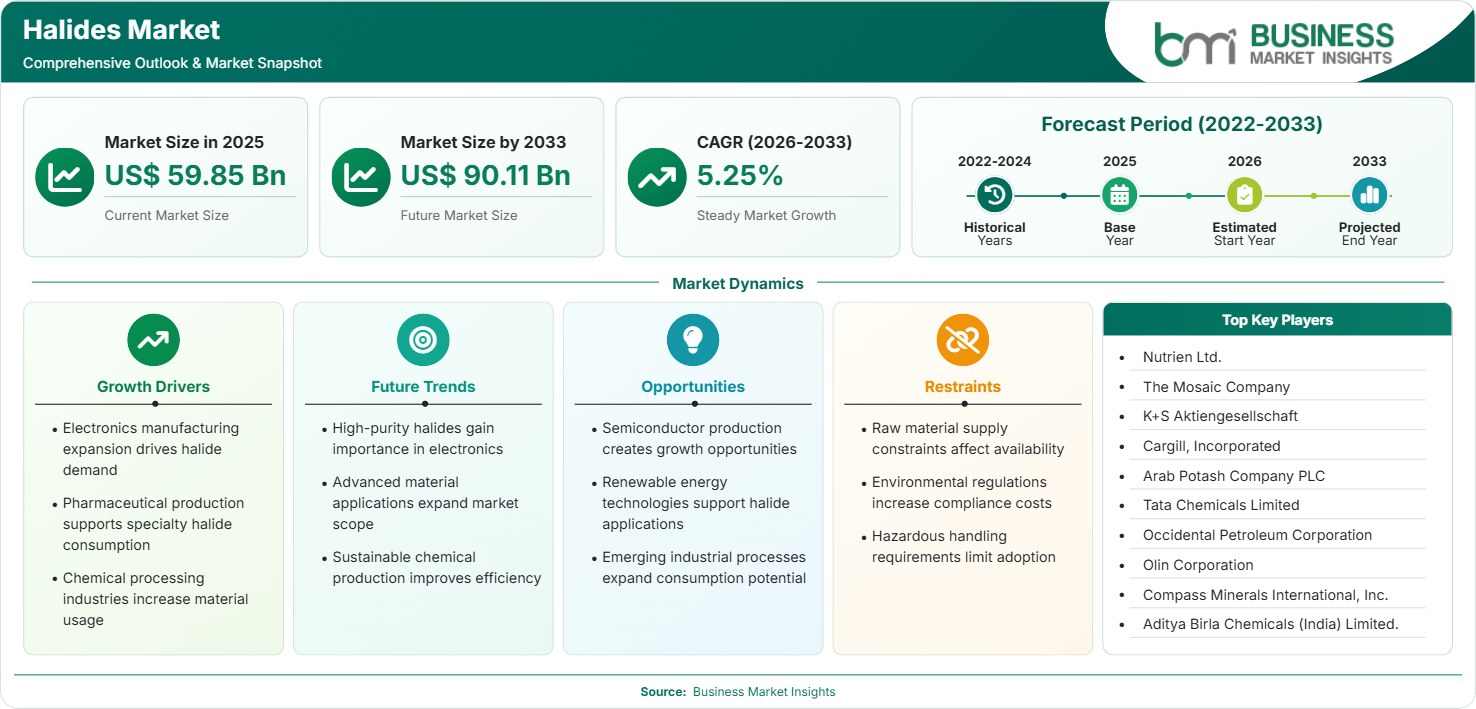
The Halides Market size was valued at US$ 59.85 Billion in 2025 and is projected to reach US$ 90.11 Billion by 2033, growing at a CAGR of 5.25% during 2026–2033. Rising fertilizer consumption, chlor-alkali production expansion, water treatment investments, steelmaking demand, and infrastructure development are supporting industry expansion, while specialty applications and emerging economies create attractive opportunities.

Report Coverage
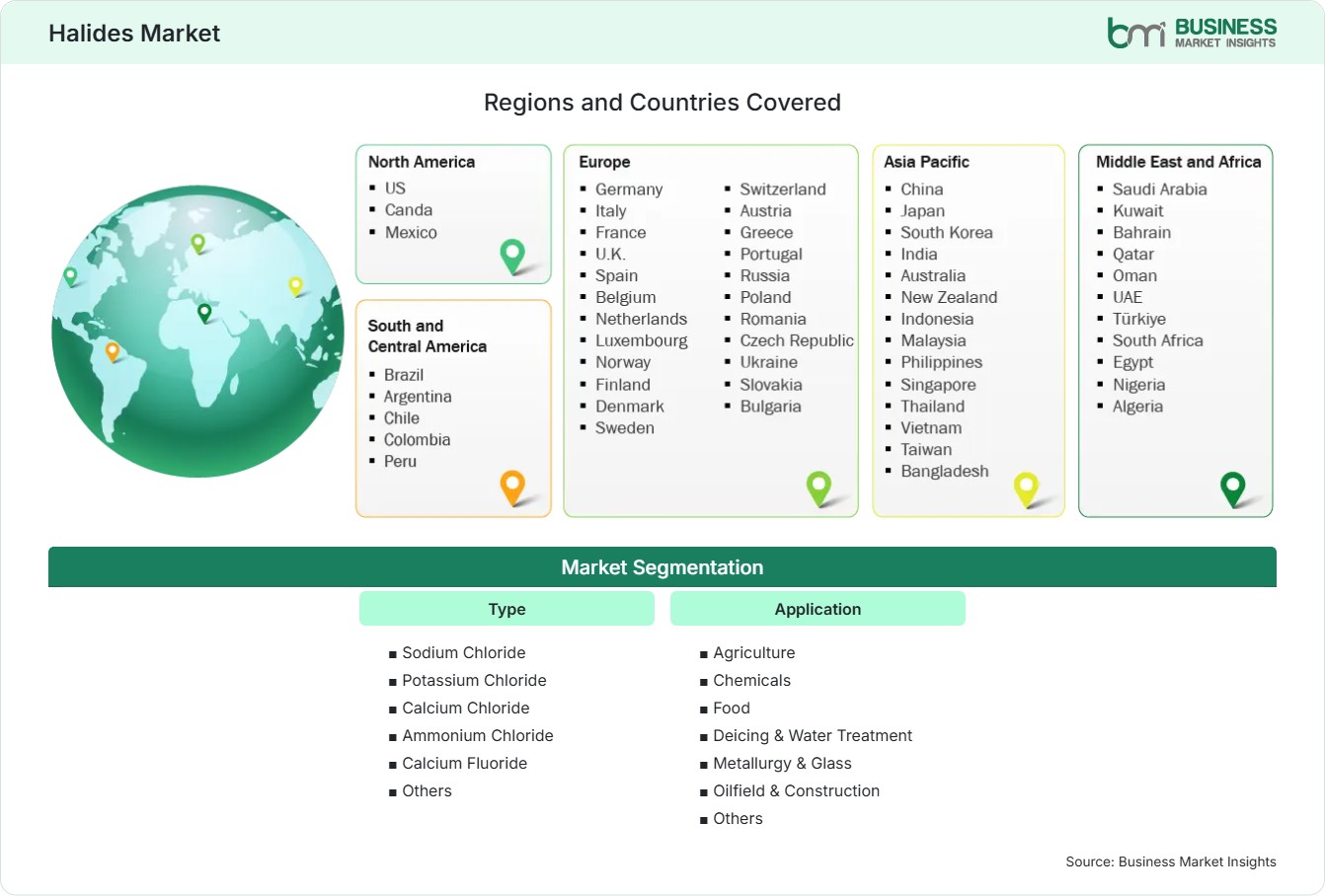
  • Type: Sodium Chloride , Potassium Chloride , Calcium Chloride , Ammonium Chloride , Calcium Fluoride , Others
  • Application: Agriculture, Chemicals, Food, Deicing & Water Treatment, Metallurgy & Glass, Oilfield & Construction, Others
US$ 59.85 Bn Market size in 2025
US$ 90.11 Bn Market Size by 2033
5.25% CAGR, 2026 - 2033
2026-2033 Forecast Period

AI Overview

Halides Market Summary

  • North America Region: North America holds a market share of 27%–30% in 2025, growing at a CAGR of 4.4%–4.8% during 2026–2033. Key drivers include chlor-alkali integration, winter deicing demand, industrial water treatment expansion, energy infrastructure investment, fertilizer optimization programs, production efficiency upgrades, supply security initiatives, recycling adoption, environmental compliance, and specialty chemical development opportunities.
    US market benefits from industrial salt consumption, water treatment modernization, and a CAGR of 4.5%–4.9%.
  • Fastest Growing Region: Asia Pacific holds a market share of 39%–42% in 2025 and advances at a CAGR of 6.1%–6.5% during 2026–2033. Growth is driven by fertilizer demand, urban construction, metallurgical capacity additions, chemical manufacturing expansion, water infrastructure projects, industrialization, food processing investment, and export-oriented production growth.
  • Leading Segment: Sodium Chloride (NaCl) accounts for 34%–38% share in 2025 and grows at 4.8%–5.2% CAGR. Demand is supported by chlor-alkali feedstock requirements, food processing usage, deicing applications, water treatment adoption, industrial processing, reliable availability, established logistics networks, and broad end-use penetration globally.
  • High Growth Segment: Agriculture represents 24%–28% share in 2025 and expands at 6.0%–6.4% CAGR. Rising crop productivity requirements, fertilizer consumption, soil nutrient management programs, food security initiatives, precision farming adoption, and expanding agricultural output support accelerating consumption across developing economies.
  • Key Market Opportunity: Expansion of advanced water treatment infrastructure, battery-material supply chains, fluorochemical production, and agricultural productivity programs creates new revenue streams, supporting higher-value product portfolios and regional manufacturing investments.
  • Major Market Players: Nutrien Ltd., The Mosaic Company, K+S Aktiengesellschaft, Cargill, Incorporated, Arab Potash Company PLC, Tata Chemicals Limited, Occidental Petroleum Corporation, Olin Corporation, Compass Minerals International, Inc., Aditya Birla Chemicals (India) Limited.
Strategic Insights

Halides Market: Strategic Insights

Halides Market Strategic Framework
FREE PDF
Request your free sample
Request free sample
Stakeholder View

Key Takeaways

  • Integrated mining, refining, logistics, and downstream chemical operations are increasingly defining competitive advantage and improving cost stability across global supply chains.
  • Agricultural applications offer the strongest volume upside as fertilizer demand remains tied to food security and crop yield improvement initiatives.
  • Innovation is shifting toward high-purity grades, advanced fluorochemical feedstocks, energy-efficient processing systems, and digital production monitoring.
  • Asia Pacific presents the strongest investment case due to industrial expansion, infrastructure spending, and rising chemical manufacturing output.
  • Strategic acquisitions and capacity expansions are focused on strengthening potash, industrial salt, and specialty halide portfolios across regional markets.
  • Sustainability-linked investments in water treatment chemicals and circular resource utilization are creating differentiated growth pathways for producers.
Geographic Outlook

Halides Market Regional Highlights

North America Halides Market

North America represents 27%–30% of global demand in 2025 and is projected to expand at a 4.4%–4.8% CAGR through 2033. Regional consumption is supported by chlor-alkali manufacturing, road deicing requirements, municipal water treatment investment, and oilfield activity. The region maintains strong logistics infrastructure and mature industrial end-user networks. The Halides Market share remains substantial because integrated chemical producers and mineral extraction companies continue investing in operational efficiency, sustainability programs, and supply security while maintaining broad downstream market access.

  • Deicing demand remains a major consumption pillar, particularly across northern states and Canada.
  • Water-treatment infrastructure modernization supports stable industrial salt and chloride demand.
  • Energy and petrochemical projects increase utilization of specialty halide formulations.
  • Automation technologies improve mining productivity and cost competitiveness.
  • Environmental compliance investments strengthen demand for treatment-related applications.

US Halides Market

The United States accounts for 76%–80% of North American Halides Market demand and is expected to grow at 4.5%–4.9% CAGR. Domestic production benefits from abundant mineral resources, advanced chlor-alkali infrastructure, and large-scale industrial demand. Water quality regulations, food processing activity, and infrastructure spending continue supporting consumption. Producers emphasize reliable domestic supply chains and value-added products serving chemical, agricultural, and energy sectors. Strong industrial diversification reduces exposure to individual end-market fluctuations and supports consistent demand patterns across applications.

  • Chlor-alkali production remains a major sodium chloride consumption driver.
  • Municipal investment in drinking-water treatment supports long-term chloride demand.
  • Oilfield applications contribute steady specialty-product requirements.
  • Food manufacturing expansion increases utilization of high-purity grades.

Europe Halides Market

Europe contributes 22%–25% of global revenue in 2025 and is projected to expand at 4.3%–4.7% CAGR through 2033. The market is shaped by industrial sustainability initiatives, advanced chemical manufacturing, and metallurgical applications. Germany remains the leading market, while Poland and Eastern European countries exhibit comparatively stronger growth. Producers are prioritizing energy efficiency and emissions reduction. Regulatory scrutiny encourages higher-value products and process optimization, strengthening competitiveness across industrial, agricultural, and specialty chemical applications.

  • Germany leads regional consumption with strong chemical manufacturing output.
  • Poland displays faster expansion, approaching 5.2%–5.6% CAGR.
  • Circular-economy initiatives encourage recovery and resource efficiency.
  • Metallurgy and specialty glass applications support stable demand.
  • Water-treatment investments enhance consumption across municipalities.

Asia Pacific Halides Market

Asia Pacific accounts for 39%–42% of global Halides Market demand in 2025 and records the fastest growth at 6.1%–6.5% CAGR. China remains the largest producer and consumer, supported by chemical manufacturing and metallurgy. India represents the fastest-growing major national market with industrial expansion and agricultural modernization contributing to demand. Regional infrastructure investment, fertilizer consumption, and food processing growth sustain momentum. The region continues attracting manufacturing investments because of competitive production economics and expanding domestic markets.

  • China leads regional consumption due to large industrial and chemical sectors.
  • India records rapid expansion, with CAGR estimated at 6.8%–7.2%.
  • Agricultural productivity programs boost potash-related consumption.
  • Water infrastructure projects increase treatment-chemical usage.
  • Industrialization sustains demand across construction and manufacturing.

Rest of World Halides Market

Rest of World maintains 8%–11% Halides Market share in 2025 and expands at 5.0%–5.4% CAGR. South and Central America benefit from agricultural exports and fertilizer demand, while Middle East and Africa leverage mining resources and industrial diversification initiatives. Brazil leads regional consumption in Latin America, whereas Saudi Arabia demonstrates strong industrial growth potential. Investments in desalination, infrastructure development, and resource processing strengthen end-use demand. Expanding industrial capabilities increasingly support local production and downstream value creation.

  • Brazil benefits from strong agricultural export activity and fertilizer consumption.
  • Saudi Arabia gains momentum through industrial diversification initiatives.
  • Desalination projects support chloride-product utilization.
  • Mining investments strengthen regional raw-material supply chains.
  • Infrastructure programs create additional construction-related demand.
Global Market Geography
FREE PDF
Request your free sample
Request free sample
Segment Analysis

Halides Market Segmentation

Type

Type segment accounts for the core value chain of the market. Sodium chloride remains dominant with 34%–38% share in 2025 and grows at 4.8%–5.2% CAGR. Product adoption depends on industrial processing requirements, agricultural demand, and chemical feedstock utilization. The Halides Market scope continues to broaden as higher-purity grades and specialty formulations gain traction in industrial applications.

  • Sodium Chloride (NaCl): Dominant feedstock for chlor-alkali production, food processing, water treatment, and deicing applications, supported by abundance, pricing competitiveness, and extensive industrial consumption.
  • Potassium Chloride (KCl): Demand is strongly linked to fertilizer manufacturing and agricultural productivity programs aimed at increasing crop yields and nutrient efficiency.
  • Calcium Chloride (CaCl₂): Widely utilized across deicing, dust control, construction, and drilling applications where moisture absorption and temperature resistance are valuable.
  • Ammonium Chloride (NH₄Cl): Consumption is supported by fertilizers, dry-cell batteries, metal processing, and specialty industrial formulations requiring consistent chemical properties.
  • Calcium Fluoride (CaF₂): Critical for steelmaking, hydrofluoric acid production, glass manufacturing, and advanced fluorochemical value chains serving industrial markets.

Application

Application demand is led by agriculture, representing 24%–28% share in 2025 while recording 6.0%–6.4% CAGR through the forecast period. Expanding fertilizer consumption, food-security priorities, and crop-yield optimization initiatives continue driving adoption. The Halides Market trends indicate increasing penetration across water treatment and advanced industrial processing applications, supporting diversified revenue generation.

  • Agriculture: Fertilizer applications remain central to demand growth as farmers seek improved productivity and nutrient management efficiency.
  • Chemicals: Chlor-alkali production and downstream chemical manufacturing create substantial volume requirements across industrial value chains.
  • Food: Preservation, processing, and quality-control requirements sustain demand for high-purity halide grades.
  • Deicing & Water Treatment: Infrastructure modernization and environmental management programs support consumption across municipal and industrial facilities.
  • Metallurgy & Glass: Steel refining, glass production, and specialized manufacturing processes continue requiring fluoride and chloride compounds.
  • Oilfield & Construction: Drilling fluids, dust suppression, concrete acceleration, and infrastructure development support stable market demand.
Market Forces

Halides Market Dynamics

Key Market Drivers

Expansion of Global Fertilizer Consumption

Rising food demand and crop-yield optimization are increasing fertilizer consumption worldwide. The significance of potassium chloride is not diminished by any means in the fertilizer industry, especially in the Asia Pacific region and Latin America. International agencies like the FAO have emphasized time and again that efficiency in production is key for food security, hence, sustaining the requirement for nutrients. The initiatives in agricultural modernization have been emphasizing efficient use of fertilizers and hence, enhancing the demand for it. Thereby, this ensures visibility in demand, facilitates investment in the supply chain, and drives industry growth.

Growth in Water Treatment and Municipal Infrastructure

Water scarcity concerns and stricter quality standards are accelerating water-treatment investments globally. Chlorine-containing compounds continue to be important in treatment processes in municipalities and industries. Governments have been extending wastewater, water purification and water supply treatment systems in order to cater to urbanization demands. Industries too have been increasing their investments in treatment facilities in order to conform to environmental regulations. Extended water treatment infrastructure programs ensure stable use irrespective of economic cycles. The market demand is especially strong in developing countries due to the population and infrastructure growth therein.

Industrial and Metallurgical Production Growth

Steelmaking, specialty glass manufacturing, and fluorochemical production depend on multiple halide compounds. Growth of industries in Asia Pacific as well as certain Middle Eastern countries is sustaining the consumption of the product. Calcium fluoride is a very important ingredient for the production of hydrofluoric acid and for metallurgy processes. Greater investments in the manufacturing process as well as in electronics and infrastructural construction are contributing to higher demands for processed products.

Key Market Opportunities

Advanced Water Infrastructure Investment

The next growth stage will be influenced by massive construction of water infrastructure in emerging as well as developed countries. Construction and operation of municipal facilities, recycling plants for industries, as well as desalination plants, will involve massive consumption of chemicals for water treatment. There is now an increased emphasis on water security among investors, offering chances to firms that have assured supply capacities. Halides Market Forecasts indicate that treatment-related applications could become a major value contributor as sustainability initiatives expand. Companies capable of supplying specialized formulations and technical services are positioned to capture attractive margins and recurring demand.

Expansion of Fluorochemical Value Chains

Demand for fluorochemical intermediates used in electronics, refrigerants, specialty materials, and industrial processing continues increasing. The manufacturers of calcium fluoride can take advantage of downstream integration to produce hydrofluoric acid and specialty fluorides. Diversification and technological investments will help in the consumption of high-quality fluoride. Collaborations between mining companies and chemical companies are expected to yield better value. Newer technologies need improved material qualities, which offer excellent growth prospects for fluoride products.

Emerging Market Capacity Development

Manufacturing expansion in India, Southeast Asia, the Middle East, and Latin America is creating opportunities for regional capacity development. Domestic processing industries are being encouraged by the government more to enhance supply security and minimize reliance on imports. Companies that engage in localized production will be able to enjoy benefits in terms of cost savings and increased responsiveness to customers. Investments in industry parks, improved infrastructure, and agricultural development help to build a solid foundation for demand.

Market Restraints and Challenges

Energy Cost Volatility and Production Economics

Factor: Halide processing, mining, refining, and chlor-alkali operations require significant energy inputs. Impact: Changes in electricity and fuel prices can squeeze profit margins and make firms less competitive, especially in regions where the production costs are already relatively higher. The uncertainty associated with costs based on energy affects strategic decision-making concerning pricing and investment decisions. Firms can find it difficult to remain profitable with price ceilings on customer contracts. Consequently, firms make investments in efficiency, use of renewable energy, and optimization in order to minimize risks. These require capital investment, which can be a barrier for smaller firms.

Regulatory and Environmental Compliance Pressures

Factor: Environmental standards governing extraction, processing, waste management, and water usage continue becoming more stringent. Impact: Compliance cost increases operation complexities and prolongs development time for projects. Investments will be made in the development of monitoring systems, control of emissions, water treatment facilities, and reporting systems. Delayed permitting could have an impact on expansion plans and return on investment. Even though sustainable objectives have long term benefits, compliance obligations could be detrimental to the bottom line especially when there are substantial investments required in terms of infrastructure.

Company Analysis

Competitive Landscape

The Halides Market analysis indicates competition is centered on resource access, integrated processing capabilities, distribution networks, and downstream application expertise.

Company Name

Overview

Products and Services relevant to this market

Nutrien Ltd.

Global fertilizer and agricultural input leader with extensive potash production assets.

Potassium chloride products, crop nutrient solutions, distribution services.

The Mosaic Company

Major producer serving agricultural and industrial customers globally.

Potash products, nutrient materials, industrial mineral solutions.

K+S Aktiengesellschaft

European mining and specialty minerals company with diversified operations.

Potash, industrial salts, deicing and water-treatment products.

Cargill, Incorporated

Large multinational active in food, agriculture, and industrial ingredients.

Salt products, food-grade halides, industrial solutions.

Arab Potash Company PLC

Leading regional potash producer serving international fertilizer markets.

Potassium chloride and related mineral products.

Tata Chemicals Limited

Diversified chemical manufacturer with broad industrial presence.

Industrial salts, specialty chemicals, treatment products.

Occidental Petroleum Corporation

Integrated energy and chemical company operating chlor-alkali assets.

Chlorine, caustic soda, chlor-alkali derivatives.

Olin Corporation

Major chlor-alkali and chemical producer with global operations.

Chlorine, caustic soda, related halide-based chemicals.

Compass Minerals International, Inc.

Mineral-focused company supplying agriculture and infrastructure markets.

Deicing salt, specialty minerals, plant nutrition products.

Aditya Birla Chemicals (India) Limited

Large chlor-alkali producer serving industrial customers internationally.

Chlor-alkali products, hydrochloric acid, specialty chemicals.

Trust & Transparency

Research Methodology

The market analysis combines proprietary research with secondary data from government agencies, company disclosures, regulatory filings, industry databases and expert interviews. Market estimates are validated through data triangulation, cross-market benchmarking and analyst review.

View Full Research Methodology

Questions Answered

Frequently Asked Questions

What does the Halides Market Report emphasize for investors?

The report highlights regional expansion opportunities, agricultural demand fundamentals, fluorochemical value chains, water infrastructure growth, and strategic capacity investments.

How do environmental regulations influence demand?

Regulations increase investment in water treatment, pollution control, and cleaner industrial processes, supporting demand while also raising compliance requirements for producers.

What role does calcium fluoride play in industry?

Calcium fluoride is essential for hydrofluoric acid production, steelmaking, specialty glass manufacturing, and multiple fluorochemical applications serving advanced industrial sectors.

Why is Asia Pacific the fastest-growing regional market?

Industrialization, fertilizer consumption, infrastructure development, chemical manufacturing expansion, and rising water-treatment investments collectively support the region's leadership position.

Which application generates the highest growth potential in the market?

Agriculture offers the strongest long-term upside due to fertilizer demand, food-security initiatives, and crop-yield improvement programs across emerging economies.

Access the Full Halides Market Report

Get segment-level forecasts, regional estimates, competitive benchmarking, company profiles and downloadable Excel datasets.

Access the full Halides Market Report
350 pages PDF & Excel | 2026-08-28
Similar Research

Related Market Reports