Hafnium Market Regional Highlights
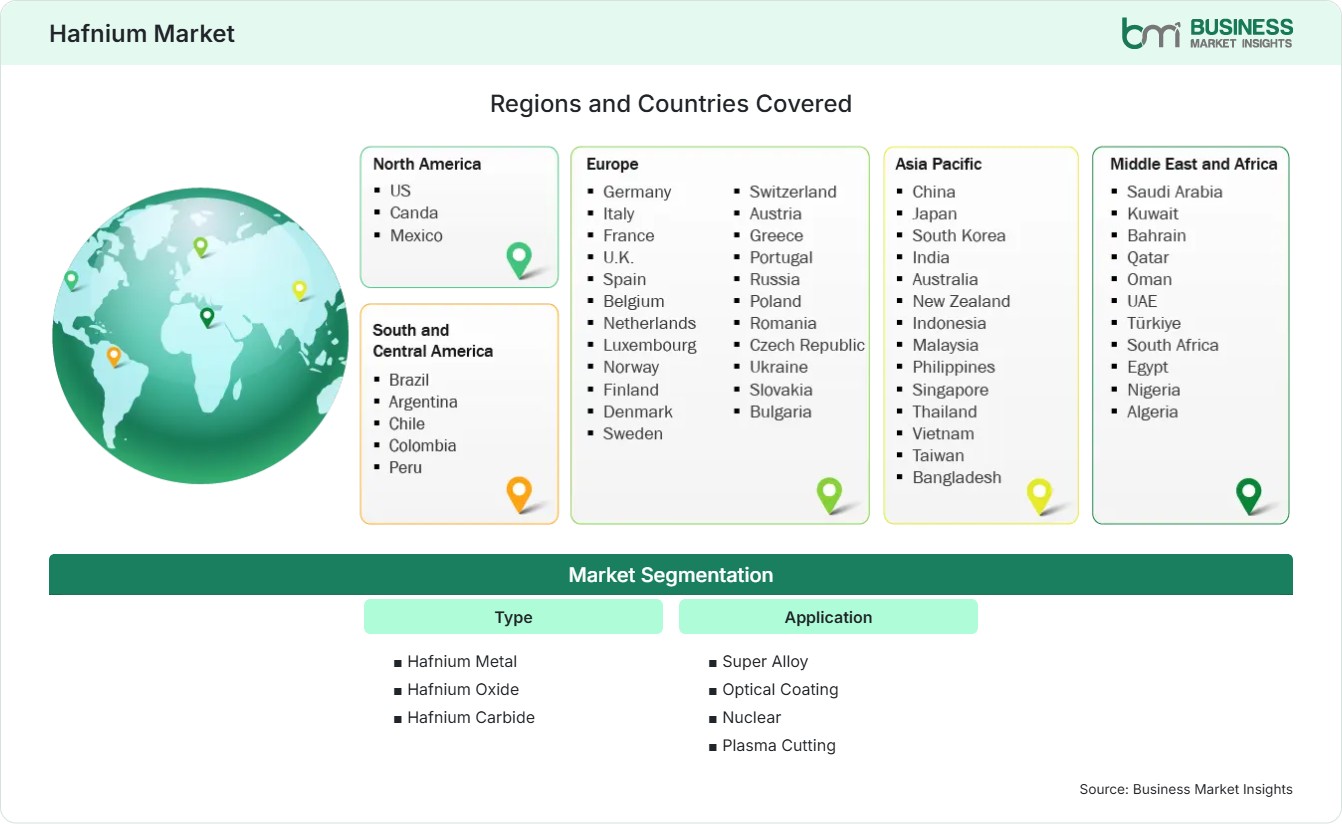
North America Hafnium Market
North America accounts for approximately 34%–37% of global demand in 2025 and is expected to register a CAGR of 8.1%–8.7% through 2033. The region benefits from a strong aerospace manufacturing base, extensive nuclear infrastructure, and advanced semiconductor investments. The Hafnium Market share remains supported by domestic critical-mineral policies and increasing attention to supply-chain resilience.
- Aerospace turbine manufacturers continue increasing utilization of high-temperature alloys capable of operating under extreme thermal conditions, supporting sustained demand for specialty metal inputs throughout regional supply chains.
- U.S. government initiatives focused on critical minerals and domestic manufacturing are encouraging investment in refining capabilities and strategic sourcing partnerships across advanced-material sectors.
- Nuclear reactor refurbishment projects and emerging small modular reactor programs are strengthening procurement activity among fuel-system and reactor-component suppliers.
- Semiconductor fabrication investments supported by industrial policy initiatives are creating additional demand for advanced dielectric materials used in next-generation electronic devices.
- Collaboration between universities, national laboratories, and industrial participants continues accelerating research into high-performance materials and advanced processing technologies.
US Hafnium Market
The United States represents approximately 78%–82% of North American consumption and is projected to expand at a CAGR of 8.3%–8.9% through 2033. Demand is concentrated within aerospace propulsion systems, nuclear energy technologies, defense applications, and semiconductor manufacturing. Domestic industrial capabilities, combined with significant R&D investments, position the country as a leading consumer and technology innovator within the regional ecosystem.
- Advanced aircraft engine production continues requiring materials capable of maintaining structural stability at elevated operating temperatures, supporting long-term procurement activity.
- Investments in domestic semiconductor fabrication facilities are increasing requirements for high-purity materials used in sophisticated chip manufacturing processes.
- Energy-security objectives are supporting modernization projects across nuclear infrastructure and encouraging deployment of advanced reactor technologies.
- Defense modernization programs continue generating specialized material requirements for aerospace, propulsion, and strategic technology applications.
Europe Hafnium Market
Europe holds approximately 24%–27% of global Hafnium Market demand in 2025 and is expected to record a CAGR of 7.8%–8.4% through 2033. The region benefits from strong aerospace manufacturing capabilities, established nuclear technology expertise, and growing interest in strategic raw materials. France remains the leading national market, while Eastern European countries demonstrate comparatively higher expansion potential near 8.5%–9.1% due to energy-security investments and industrial modernization initiatives supporting advanced materials consumption.
- France maintains leadership through nuclear fuel-cycle expertise, advanced engineering capabilities, and a strong concentration of nuclear technology companies.
- Germany supports demand through industrial manufacturing, specialty materials development, and increasing investment in technology-driven production systems.
- Energy diversification initiatives are encouraging selected countries to evaluate advanced nuclear technologies and associated supply-chain requirements.
- Aerospace production programs across Western Europe continue generating demand for heat-resistant alloy components and specialized engineered materials.
- Strategic autonomy initiatives are promoting investments in critical-material sourcing and domestic processing capabilities.
Asia Pacific Hafnium Market
Asia Pacific accounts for approximately 27%–30% of global Hafnium Market demand in 2025 and is forecast to achieve a CAGR of 9.8%–10.5% through 2033, making it the fastest-growing region. China remains the largest regional market, while India and Southeast Asia demonstrate the strongest expansion rates. Semiconductor manufacturing growth, industrial alloy production, and nuclear energy investments are supporting adoption. Regional governments continue promoting advanced-material industries, enhancing refining capacity, and strengthening strategic supply-chain capabilities across key manufacturing economies.
- China benefits from extensive processing infrastructure, electronics manufacturing leadership, and growing investment in strategic-material supply chains.
- South Korea and Japan support demand through advanced semiconductor production and technology-intensive manufacturing sectors.
- India is emerging as a high-growth destination due to expanding industrial capabilities, energy investments, and advanced manufacturing initiatives.
- Southeast Asian economies are attracting electronics and materials-processing investments as companies diversify production networks.
- Public and private sector investments continue improving refining technologies and advanced-material production capabilities.
Rest of World Hafnium Market
Rest of World represents approximately 10%–13% of global Hafnium Market demand in 2025 and is projected to expand at a CAGR of 8.5%–9.2% through 2033. South & Central America benefit from mining-sector development and growing industrial activity. The Middle East and Africa are increasingly exploring opportunities linked to energy diversification, strategic minerals, and advanced manufacturing initiatives. Countries including the UAE and Saudi Arabia are strengthening industrial capabilities, while selected African markets are evaluating resource-processing opportunities.
- Resource-development initiatives are improving awareness of critical-mineral opportunities across several emerging economies and supporting long-term investment interest.
- Industrial diversification programs in Gulf countries are encouraging advanced-material production and technology-oriented manufacturing activities.
- Strategic infrastructure investments are creating supportive conditions for future refining and processing developments.
- Regional governments increasingly recognize the importance of securing participation in global critical-material value chains.
- Partnerships with international technology providers are supporting capability development and knowledge transfer initiatives.