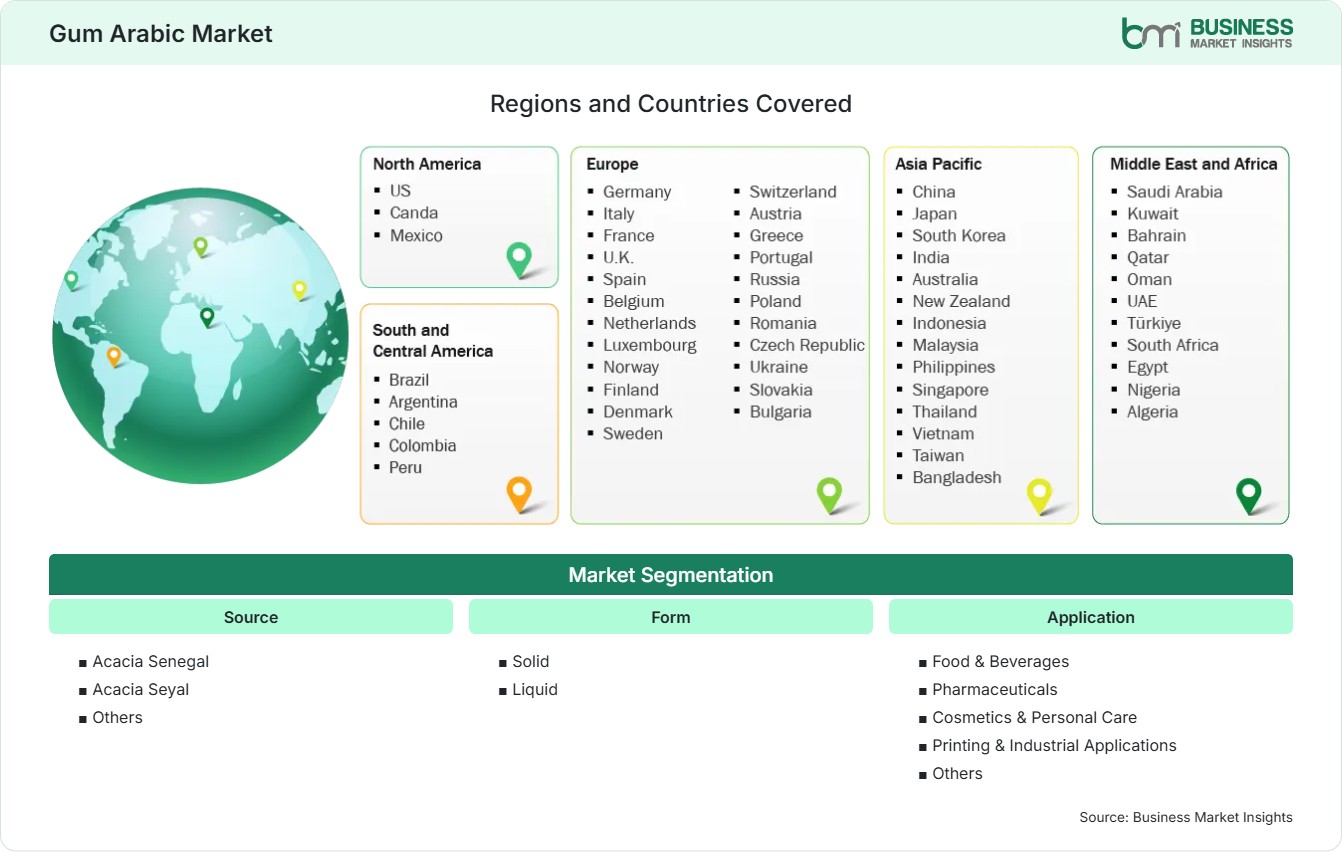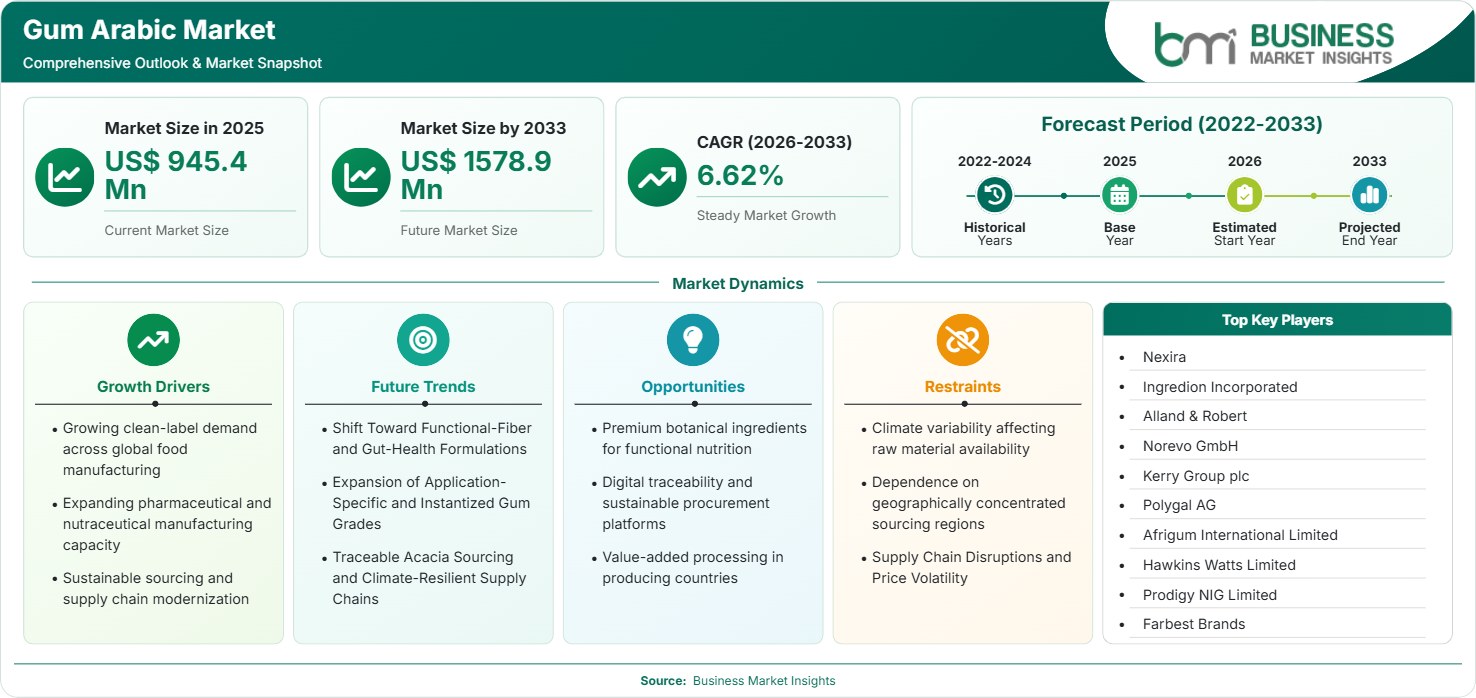
Gum Arabic Market Regional Highlights
North America Gum Arabic Market
North America accounted for 34%–37% of the global market share in 2025 and is projected to register a CAGR of 5.8%–6.4% during 2026–2033. Strong consumer preference for clean-label ingredients, expanding nutraceutical production, and increasing use of natural hydrocolloids in beverages continue supporting regional demand. Major ingredient manufacturers are investing in supply chain diversification, quality certification, and traceability programs to ensure stable sourcing from African producing countries. The Gum Arabic Market share remains supported by premium food innovation and stringent regulatory compliance for natural additives.
- Food and beverage manufacturers are replacing synthetic stabilizers with natural alternatives to meet demand for clean-label, premium products.
- Pharmaceutical companies are increasing demand for pharmaceutical-grade materials for tablet binding, encapsulation, and controlled-release formulations.
- Digital supply chain monitoring and sustainability certification are becoming key priorities for transparency, risk reduction, and compliance.
- Investment in functional beverages and plant-based nutrition is creating opportunities for improved emulsification, stability, and shelf life.
- Supplier–food technology collaborations are accelerating customized hydrocolloid solutions with better processing efficiency and product consistency.
US Gum Arabic Market
The United States represented approximately 72%–75% of North American demand in 2025 and is expected to expand at a CAGR of 5.9%–6.5% through 2033. Growth is supported by increasing clean-label product launches, expanding dietary supplement manufacturing, and continuous investment in premium food processing technologies in Gum Arabic Market.
- Premium beverage producers are adopting natural stabilizers for functional drinks and nutritional products to improve texture, emulsification, and label transparency.
- Pharmaceutical companies are expanding oral solid dosage production, driving demand for natural excipients with reliable binding and formulation stability.
- Major distributors are building long-term partnerships with African exporters to strengthen sourcing, reduce disruptions, and ensure steady supply.
- Ongoing R&D supports improved formulations for confectionery, supplements, and specialty foods requiring high-quality functional ingredients.
Europe Gum Arabic Market
Europe held approximately 27%–30% share of the global market in 2025 and is forecast to grow at a CAGR of 6.1%–6.8% through 2033. Strong demand for organic foods, sustainable sourcing initiatives, and stringent food ingredient regulations continue supporting Gum Arabic Market expansion. France remains the leading regional market due to its advanced ingredient processing industry, while Germany demonstrates the fastest growth with increasing pharmaceutical manufacturing and functional food innovation supported by expanding investments in natural ingredient technologies.
- European manufacturers prioritize sustainable sourcing, strengthening African supplier partnerships, traceability, quality, and environmental compliance.
- Functional confectionery, premium dairy, and clean-label bakery products are driving demand for natural food ingredients.
- Germany is expanding rapidly due to growth in pharmaceuticals, nutraceuticals, and advanced ingredient processing.
- France remains a leader through strong processing expertise, exports, and specialty food ingredient innovation.
- EU transparency and sustainability regulations are boosting demand for premium natural hydrocolloids.
Asia Pacific Gum Arabic Market
Asia Pacific represented 23%–26% of global demand in 2025 and is projected to record the fastest regional expansion with a CAGR of 7.5%–8.3% during 2026–2033. Rapid urbanization, expanding processed food production, growing pharmaceutical manufacturing, and increasing disposable incomes are stimulating consumption. China leads regional demand owing to its large food processing industry, while India records the highest growth rate supported by expanding nutraceutical manufacturing, healthcare investment, and rising demand for natural functional ingredients in.
- Food manufacturers continue expanding premium confectionery, dairy beverages, and nutritional products requiring natural stabilizers, emulsifiers, and viscosity modifiers that enhance product quality and consumer acceptance.
- India's pharmaceutical and nutraceutical sectors are rapidly increasing utilization of naturally derived excipients as domestic manufacturing capacity expands alongside government support for healthcare and pharmaceutical production.
- China remains the largest regional consumer because of its extensive processed food industry, large-scale beverage manufacturing, and continuous investment in advanced ingredient technologies.
- International ingredient companies are establishing regional partnerships and expanding distribution networks to strengthen customer support, improve logistics efficiency, and respond to rising industrial demand.
- The Gum Arabic Market growth outlook remains favorable as multinational food manufacturers increase localization strategies, diversify sourcing, and develop innovative formulations tailored to evolving regional consumer preferences.
Rest of World Gum Arabic Market
Rest of World accounted for 11%–14% of global demand in 2025 and is expected to register a CAGR of 6.6%–7.3% through 2033 in Gum Arabic Market. South & Central America continue experiencing increasing demand from processed food manufacturers seeking natural stabilizers and clean-label ingredients for premium consumer products.
Meanwhile, the Middle East & Africa remain strategically important because major raw material production originates from African countries. Nigeria leads regional processing activities, while Kenya demonstrates stronger downstream value addition through export-oriented ingredient processing, supporting international supply chains and long-term industry sustainability.
- African producers are investing in sustainable harvesting, farmer training, and processing infrastructure to improve quality and export competitiveness.
- South and Central American manufacturers are adopting natural hydrocolloids in beverages, confectionery, and premium foods amid changing consumer preferences.
- Nigeria remains a key processing and export hub, supported by stronger partnerships, logistics, and agricultural investment.
- Kenya is emerging as a higher-value processing center through investment in ingredient manufacturing, certification, and sustainable sourcing.
- Climate-resilience and agroforestry programs are improving raw material availability, producer incomes, and supply chain stability.