
Grain Fumigation Market Outlook: Size, Share, Trends, Growth Analysis, Competitive Landscape & Forecast, 2026–2033

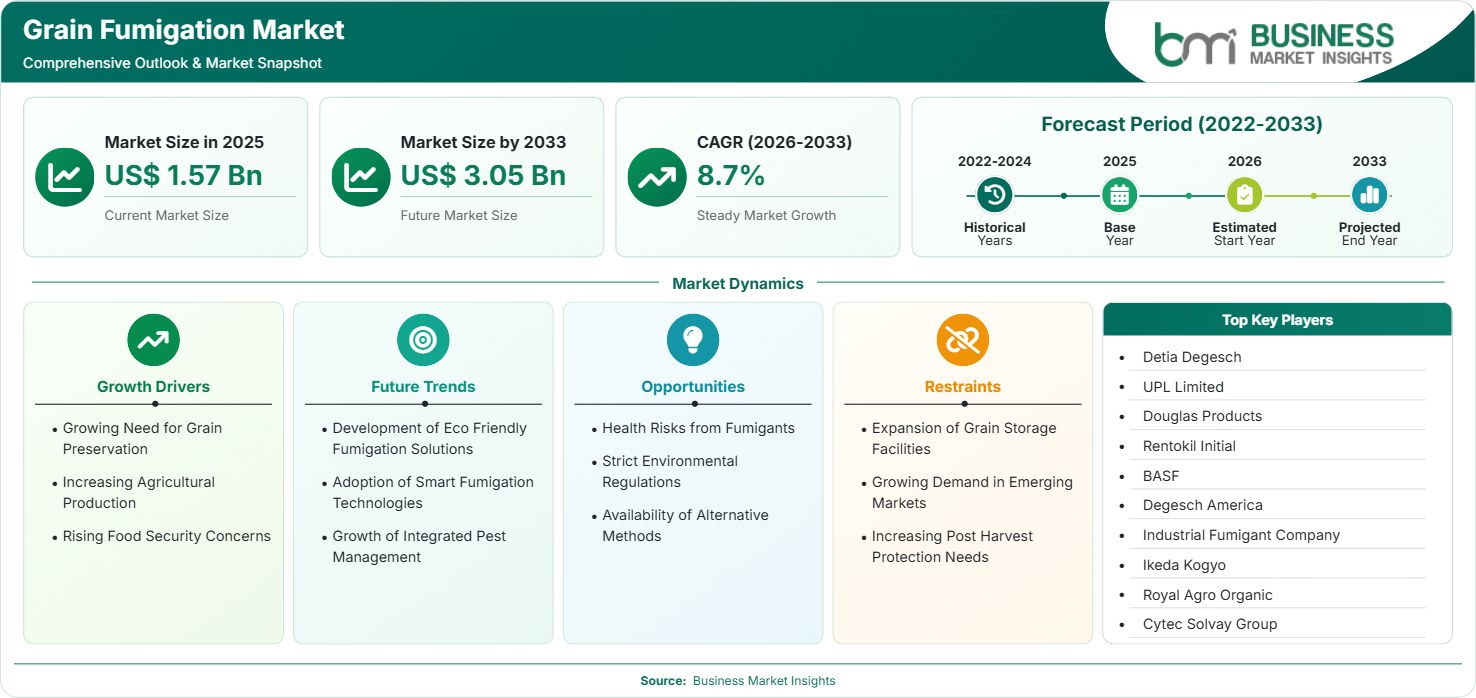
The Grain Fumigation Market size was valued at US$ 1.57 billion in 2025 and is projected to reach US$ 3.05 billion by 2033, growing at a CAGR of 8.7% during 2026–2033, driven by increasing grain preservation requirements, rising agricultural output, food security initiatives, expanding storage infrastructure, and growing demand for effective post-harvest pest management solutions.

Report Coverage
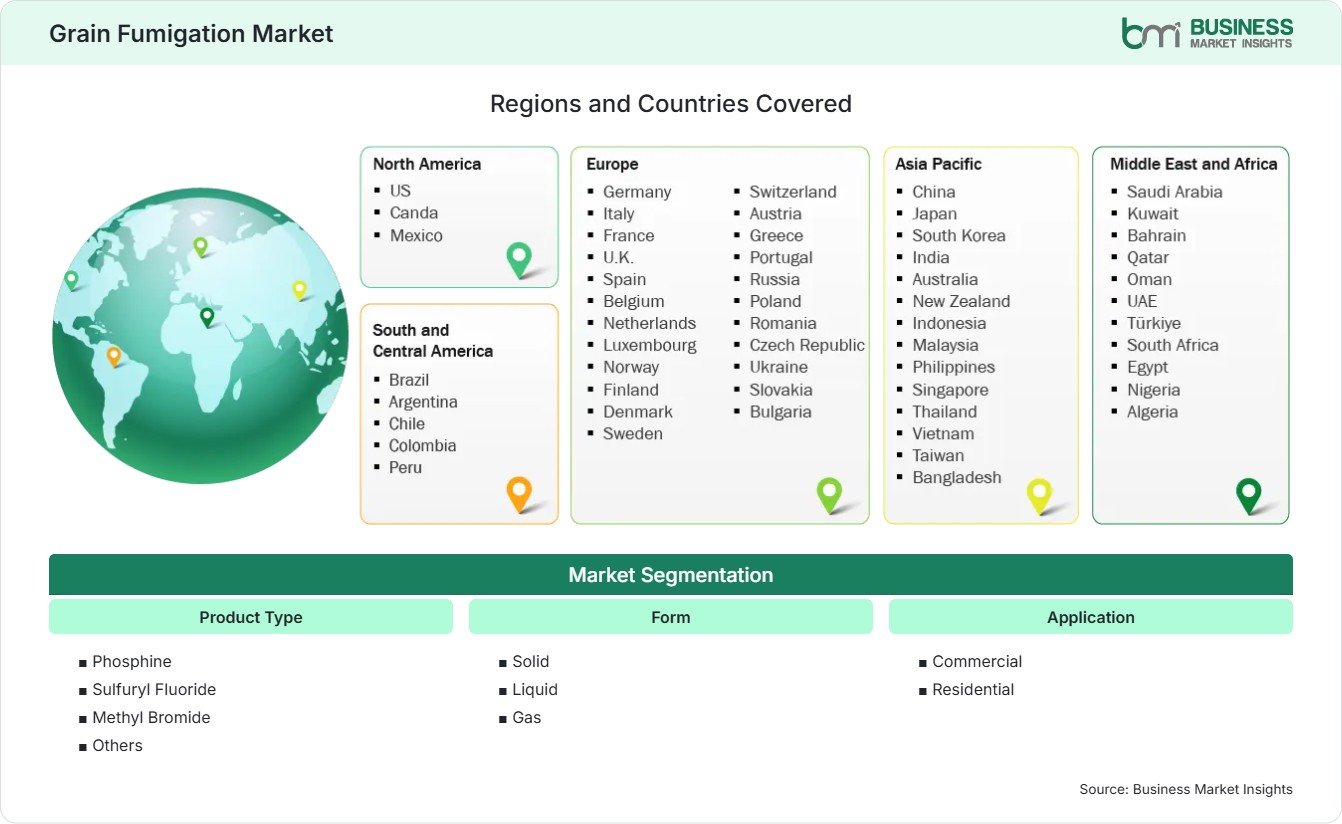
  • Product Type: Phosphine, Sulfuryl Fluoride, Methyl Bromide, Others
  • Form: Solid, Liquid, Gas
  • Application: Commercial, Residential
US$ 1.57 Bn Market size in 2025
US$ 3.05 Bn Market Size by 2033
8.7% CAGR, 2026 - 2033
2026-2033 Forecast Period

01 AI Overview

Grain Fumigation Market Summary

  • North America Region: North America holds a market share of 27%–30% in 2025, growing with a CAGR of 7%–9% influenced by advanced grain storage systems, agricultural exports, pest control requirements, and regulatory-compliant fumigation practices. The US market shows strong adoption through large-scale grain handling facilities and commercial agriculture operations, expanding at a CAGR of 7%–8% during 2026–2033.
  • Fastest Growing Region: Asia Pacific maintains a market share of 35%–38% in 2025, expanding with a CAGR of 9%–11% supported by increasing grain production, storage expansion, food security programs, and rising adoption of post-harvest protection technologies.
  • Leading Segment: Phosphine represents a market share of 55%–58% in 2025, growing with a CAGR of 8%–10% due to widespread use in stored grain protection, cost-effectiveness, proven pest control performance, and compatibility with large storage facilities.
  • High Growth Segment: Gas-form fumigants account for a market share of 20%–23% in 2025, developing with a CAGR of 10%–12% driven by rapid penetration capability, efficient treatment coverage, commercial storage adoption, and improved application technologies.
  • Key Market Opportunity: Expansion of grain storage infrastructure, increasing agricultural trade, emerging market demand, and improved post-harvest protection practices create opportunities for fumigation providers developing safer and more efficient pest management solutions.
  • Major Market Players: Detia Degesch, UPL Limited, Douglas Products, Rentokil Initial, BASF, Degesch America, Industrial Fumigant Company, Ikeda Kogyo, Royal Agro Organic, and Cytec Solvay Group.
02 Strategic Insights

Grain Fumigation Market: Strategic Insights

Grain Fumigation Market Strategic Framework
FREE PDF
Request your free sample
Request free sample
03 Stakeholder View

Key Takeaways

  • The grain protection ecosystem is shifting toward integrated pest management approaches combining fumigation products, monitoring technologies, storage solutions, and professional application services.
  • Commercial grain storage operators and agricultural exporters represent major growth opportunities as demand increases for reliable preservation methods that maintain quality throughout supply chains.
  • Innovation is focusing on safer fumigant formulations, improved application equipment, monitoring systems, and environmentally responsible pest control approaches.
  • Asia Pacific provides strong investment potential due to expanding agricultural production, increasing storage infrastructure development, and rising food security priorities.
  • Strategic partnerships between chemical manufacturers, agricultural service providers, and storage operators are increasing to improve fumigation efficiency and regulatory compliance.
  • Emerging markets are becoming important growth centers as governments invest in reducing post-harvest losses and strengthening agricultural supply chains.
04 Geographic Outlook

Grain Fumigation Market Regional Highlights

North America Grain Fumigation Market

The North America region held a market share of 27%–30% in 2025 and is expected to grow at a CAGR of 7%–9% from 2026 to 2033. North America has a well-developed agricultural infrastructure, along with extensive grain storage and export services. The market share in the Grain Fumigation Market is driven by reliable fumigation service providers and regulated application practices.

  • The United States drives regional demand through extensive grain storage and agricultural export activities.
  • Commercial grain facilities increasingly adopt professional fumigation services for pest management.
  • Regulatory compliance is encouraging safer application methods and monitoring technologies.
  • Canada supports demand through grain production and storage infrastructure development.

US Grain Fumigation Market

The US represented a market share of 23%–26% in 2025 and is expected to grow at a CAGR of 7%–8% during 2026–2033. The country maintains a strong position due to large grain production volumes, export operations, and advanced storage infrastructure. The Grain Fumigation Market growth is supported by demand for efficient pest control solutions.

  • Grain elevators and storage facilities are major users of fumigation products.
  • Agricultural exporters require effective protection methods to maintain grain quality.
  • Integrated pest management adoption is increasing across commercial operations.
  • Professional fumigation services support compliance with safety standards.

Europe Grain Fumigation Market

Europe has a 20%-23% market share in 2025 and is estimated to register a CAGR of 7%-9% from 2026-2033. This region is well-known for its efficient storage techniques, use of agricultural technology, and stringent quality standards. Key countries in the region, such as Germany, France, United Kingdom, and Italy contribute significantly, while regulations influence the adoption of sustainable fumigation practices.

  • Germany supports demand through advanced agricultural storage and processing infrastructure.
  • France utilizes fumigation solutions across grain production and export operations.
  • The United Kingdom focuses on quality preservation within food supply chains.
  • European regulations encourage development of safer pest control alternatives.
  • Agricultural companies invest in improved storage management practices.

Asia Pacific Grain Fumigation Market

Asia Pacific generated a market share of 35%–38% in 2025 and is expected to register a CAGR of 9%–11% during 2026–2033. The region represents the largest and fastest-growing market due to high grain production, expanding storage facilities, and increasing food security initiatives. China, India, and Southeast Asian countries are major contributors.

  • China adopts fumigation solutions to support large grain storage networks.
  • India increases demand through agricultural production growth and food preservation programs.
  • Southeast Asian countries invest in post-harvest protection technologies.
  • Rising food demand encourages improved grain handling practices.
  • Storage modernization programs support fumigation technology adoption.

Rest of World Grain Fumigation Market

South America, the Middle East, and Africa accounted for a combined market share of 9%–12% in 2025. Growth is supported by agricultural expansion, grain trade development, storage improvements, and food security initiatives. Brazil, Argentina, South Africa, and Middle Eastern countries represent developing markets where improved grain protection solutions are gaining adoption.

  • Brazil utilizes fumigation solutions across large-scale grain production and export operations.
  • Argentina supports market growth through expanding agricultural storage requirements.
  • Middle Eastern countries invest in grain preservation due to food import dependence.
  • South Africa adopts pest control solutions for agricultural supply chains.
  • Emerging regions offer opportunities through improving storage infrastructure and agricultural modernization.
Global Market Geography
FREE PDF
Request your free sample
Request free sample
05 Segment Analysis

Grain Fumigation Market Segmentation

Product Type

Product Type Segmentation helps to know the adoption process of fumigation solutions in terms of efficiency, applicability, and regulations. Phosphine is the widely used solution as it has been used extensively in protecting stored grains, whereas sulfuryl fluoride and methyl bromide have niche applications. The Grain Fumigation Market is driven by factors such as high demand for pest control, low grain loss, and good storage practices. The segment is projected to hold a leading share of 2025 revenue with steady growth through 2034, supported by agricultural expansion and post-harvest protection requirements.

  • Phosphine: Phosphine is widely used for stored grain protection due to effective pest control, cost efficiency, and compatibility with large-scale storage facilities and agricultural applications.
  • Sulfuryl Fluoride: Sulfuryl fluoride provides rapid fumigation performance and is adopted in specialized grain storage applications requiring effective insect control and operational flexibility.
  • Methyl Bromide: Methyl bromide is utilized in limited applications due to regulatory restrictions, with demand focused on specific pest control requirements and controlled fumigation environments.

Form

Form segmentation reflects differences in application efficiency, handling requirements, and treatment effectiveness across grain storage environments. Solid fumigants remain widely adopted because of their convenience and controlled release characteristics, while liquid and gas forms support specialized fumigation operations. The Grain Fumigation Market scope is expanding as storage operators seek solutions offering improved penetration, operational safety, and effective pest elimination. Increasing investment in grain warehouses, silos, and commercial storage facilities is supporting demand across different fumigant formats.

  • Solid: Solid fumigants are extensively used in grain storage due to controlled gas release, easier handling, and suitability for large-scale pest management operations.
  • Liquid: Liquid fumigants support targeted applications requiring precise dosage control and are used across specialized agricultural and commercial fumigation processes.
  • Gas: Gas fumigants provide rapid distribution and effective treatment coverage, supporting large storage facilities where complete pest elimination is required.

Application

Application segmentation highlights the usage of fumigation solutions across commercial and residential environments. Commercial applications represent the major demand area due to large-scale grain storage, processing facilities, and agricultural supply chains. Residential applications remain smaller but contribute through household grain protection requirements. The Grain Fumigation Market trends indicate increasing adoption of professional fumigation services and advanced pest management approaches to maintain grain quality and reduce post-harvest losses.

  • Commercial: Commercial applications dominate due to extensive use in warehouses, grain elevators, processing facilities, and agricultural storage operations requiring reliable pest protection.
  • Residential: Residential applications support localized grain preservation needs through smaller-scale fumigation solutions and improved awareness of stored grain pest management.
06 Market Forces

Grain Fumigation Market Dynamics

Key Market Drivers

Growing Need for Grain Preservation

With increasing demands for grain preservation, there is a trend in favor of fumigation solutions as both grain producers and grain store owners work to minimize their losses due to damage from insects and other pests. Deterioration of stored grains results in lower food quality and availability, and reduced profitability in agriculture. The Grain Fumigation Market growth is driven by investments in the construction of warehouses, silos, and controlled storage facilities. The Food and Agriculture Organization claims that minimization of post-harvest loss is a key priority towards increasing food availability worldwide. Fumigation systems allow pest management and increase grain storage time.

Increasing Agricultural Production

The increase in food production is leading to the need for protection products for grains, as farmers and storage facilities are handling large amounts of harvested grains. The increase in cereal production, global grain transport, and farming operations is resulting in a greater need for pest protection during storage and transport. The Grain Fumigation market trends show an increase in the use of grain fumigation in areas where there is increased agricultural production and storage facilities. Grain producers need methods that can help them protect their grains from pests. The need to protect wheat, rice, maize, and other grains during storage is driving investment in grain fumigation.

Rising Food Security Concerns

There is an increase in demand for grain preservation technologies due to food security concerns, as governments and organizations focus on maintaining it. Issues such as population growth, climatic changes, and supply chain problems are leading to a lot of consideration being placed on how to prevent post-harvest losses. Fumigation plays a crucial role in food security, as it helps ensure that stored food is not damaged by insects and retains its quality. There are efforts by agricultural organizations to enhance the storage processes to help sustain food security.

Key Market Opportunities

Expansion of Grain Storage Facilities

Building more grain storage facilities creates major business opportunities for companies that specialize in fumigation, as nations are developing storage facilities, silos, and other agricultural infrastructure. The increase in grain production necessitates proper storage facilities that can preserve the quality of the produce for a long time. There is an increase in the demand for fumigation companies as new storage facilities are being developed in developing nations. There is a possibility that governments will implement policies geared towards food security and agricultural development that promote the construction of more storage facilities.

Growing Demand in Emerging Markets

Opportunities have been generated by increased agricultural production, increased grain consumption, and improved storage capacity. The Asia-Pacific region, Latin American countries, and African countries are investing in modern agriculture to improve food-chain logistics. Increased awareness about post-harvest protection will make people adopt professional fumigation services. Firms that can expand their networks and offer value-for-money services can capitalize on demand from developing countries. Agricultural producers and storage service providers are looking for innovative technology that not only improves quality but also reduces loss.

Increasing Post Harvest Protection Needs

The growing need for post-harvest protection is offering new opportunities to the agricultural players who strive to find ways to reduce grain losses post-harvesting. Improved means of protecting grains from pests are becoming increasingly necessary owing to the growing need for food and the need for efficiency in the supply chain. Fumigation technology helps maintain grain quality during storage and transport by preventing insect infestation. Innovations in the formulation of safer chemicals, application techniques, and integrated pest management offer promising competitive advantages for companies that develop them.

Market Restraints and Challenges

Health Risks from Fumigants

Factor: Fumigants contain active chemicals that require careful handling, controlled application, and trained personnel to prevent exposure risks. Impact: Issues relating to health and safety can affect implementation, compliance, and costs for grain storers. Inappropriate use practices can pose a risk to personnel and the environment around them, which calls for adherence to strict health and safety guidelines and monitoring processes. This calls for companies to incur expenses to train and protect their employees and to develop better application methods. These issues become more complicated for smaller companies. The industry is making efforts to develop safer formulas and methods of application.

Strict Environmental Regulations

Factor: Environmental regulations governing chemical fumigants are becoming increasingly stringent due to concerns regarding emissions, chemical exposure, and ecological impact. Impact: Regulatory restrictions can limit the availability of certain fumigants, increase approval requirements, and influence product development strategies. Companies must comply with evolving environmental standards across regions, which requires additional investment in research and regulatory processes. Restrictions on specific chemicals can encourage adoption of alternative solutions but may also increase operational challenges for users. Manufacturers are developing environmentally responsible fumigation technologies to address regulatory expectations while maintaining effectiveness. Compliance requirements remain a key consideration influencing product innovation and market strategies.

07 Company Analysis

Competitive Landscape

The Grain Fumigation Market analysis highlights competitive activities among global chemical manufacturers, agricultural service providers, and pest management companies focused on improving grain protection solutions. Key participants are investing in safer fumigation technologies, expanded distribution networks, and integrated pest management services to address rising demand from commercial storage operators. Product innovation, regulatory compliance, and geographic expansion are influencing competitive strategies across the grain preservation ecosystem.

Company Name

Overview

Products and Services relevant to this market

Detia Degesch

Global fumigation specialist providing grain protection and pest management solutions.

Phosphine fumigants, grain protection products, application technologies, and fumigation services.

UPL Limited

Agricultural solutions company offering crop protection and post-harvest management products.

Fumigants, pest control solutions, agricultural chemicals, and grain preservation technologies.

Douglas Products

Provider of stored product protection and fumigation solutions for agriculture.

Grain fumigation products, pest management solutions, and storage protection technologies.

Rentokil Initial

Global pest control company providing commercial protection services.

Fumigation services, pest management programs, grain storage protection, and monitoring solutions.

BASF

Chemical company developing agricultural and industrial solutions globally.

Pest control products, fumigation-related solutions, agricultural protection technologies, and chemical innovations.

Degesch America

Fumigation company specializing in stored commodity protection solutions.

Phosphine fumigants, grain treatment products, application systems, and technical support.

Industrial Fumigant Company

Provider of commercial fumigation services for agricultural commodities.

Grain fumigation services, pest control programs, storage treatment, and commodity protection.

Ikeda Kogyo

Japanese company involved in chemical and agricultural product solutions.

Agricultural chemicals, fumigation products, pest control technologies, and related services.

Royal Agro Organic

Agricultural company providing crop protection and organic-based solutions.

Agricultural inputs, pest management products, and grain protection solutions.

Cytec Solvay Group

Specialty chemicals company serving multiple industrial applications.

Chemical solutions, specialty products, and technologies supporting agricultural applications.

08 Industry Activity

Recent Developments

June 2026

Detia Degesch Group strengthened its grain fumigation and stored-product protection portfolio through the acquisition of the eFUME business from Draslovka. The acquisition is expected to expand the company’s fumigation solutions and strengthen its position in stored-product protection.

May 2026

Solvay & Pantys expanded their partnership through a new three-year collaboration focused on scaling verified social impact initiatives in health and inclusion. The collaboration is expected to support the development of initiatives that promote social well-being and inclusive practices.

December 2024

Rentokil Initial (S&A Service- und Anwendungstechnik GmbH) expanded its grain protection and stored-product pest management capabilities through its Getreidesilo (grain silo) operation in Hamburg-Harburg, Germany. The expansion is expected to strengthen its capabilities in protecting stored agricultural commodities from pest-related losses.

March 2024

BASF Agricultural Solutions began construction of a new fermentation plant at its Ludwigshafen site, Germany, focused on producing biological crop protection products and biotechnological solutions. The facility is expected to support the development and production of sustainable biological crop protection solutions.

10 Trust & Transparency

Research Methodology

The market analysis combines proprietary research with secondary data from government agencies, company disclosures, regulatory filings, industry databases and expert interviews. Market estimates are validated through data triangulation, cross-market benchmarking and analyst review.

View Full Research Methodology

11 Questions Answered

Frequently Asked Questions

What does the Grain Fumigation Market Report analyze?

The report analyzes market size, segmentation, regional trends, competitive landscape, growth drivers, opportunities, restraints, and technological developments influencing global grain preservation practices.

What challenges affect fumigation solution adoption?

Health risks associated with chemical exposure, regulatory restrictions, safety requirements, and environmental concerns influence adoption. Companies are focusing on safer formulations, improved application methods, and compliance-focused solutions.

How are emerging markets influencing grain fumigation demand?

Emerging markets are increasing adoption through agricultural modernization, storage infrastructure development, rising grain production, and government initiatives focused on reducing post-harvest losses and improving food security.

Which fumigant type dominates the grain protection industry?

Phosphine remains the most widely adopted fumigant type due to its effectiveness, cost efficiency, and suitability for large-scale grain storage applications. It is extensively used across warehouses, silos, and agricultural storage facilities, supporting the grain fumigation market forecast.

What factors are driving the market growth?

Growing grain production, increasing food security concerns, expanding storage infrastructure, and rising demand for effective post-harvest protection solutions are major factors supporting market expansion. Commercial storage operators are adopting fumigation technologies to reduce losses and maintain grain quality.

Access the Full Grain Fumigation Market Report

Get segment-level forecasts, regional estimates, competitive benchmarking, company profiles and downloadable Excel datasets.

Access the full Grain Fumigation Market Report
350 pages PDF & Excel | 2026-07-31