
Geotextiles Market Outlook: Size, Share, Trends, Growth Analysis, Competitive Landscape & Forecast, 2026-2033

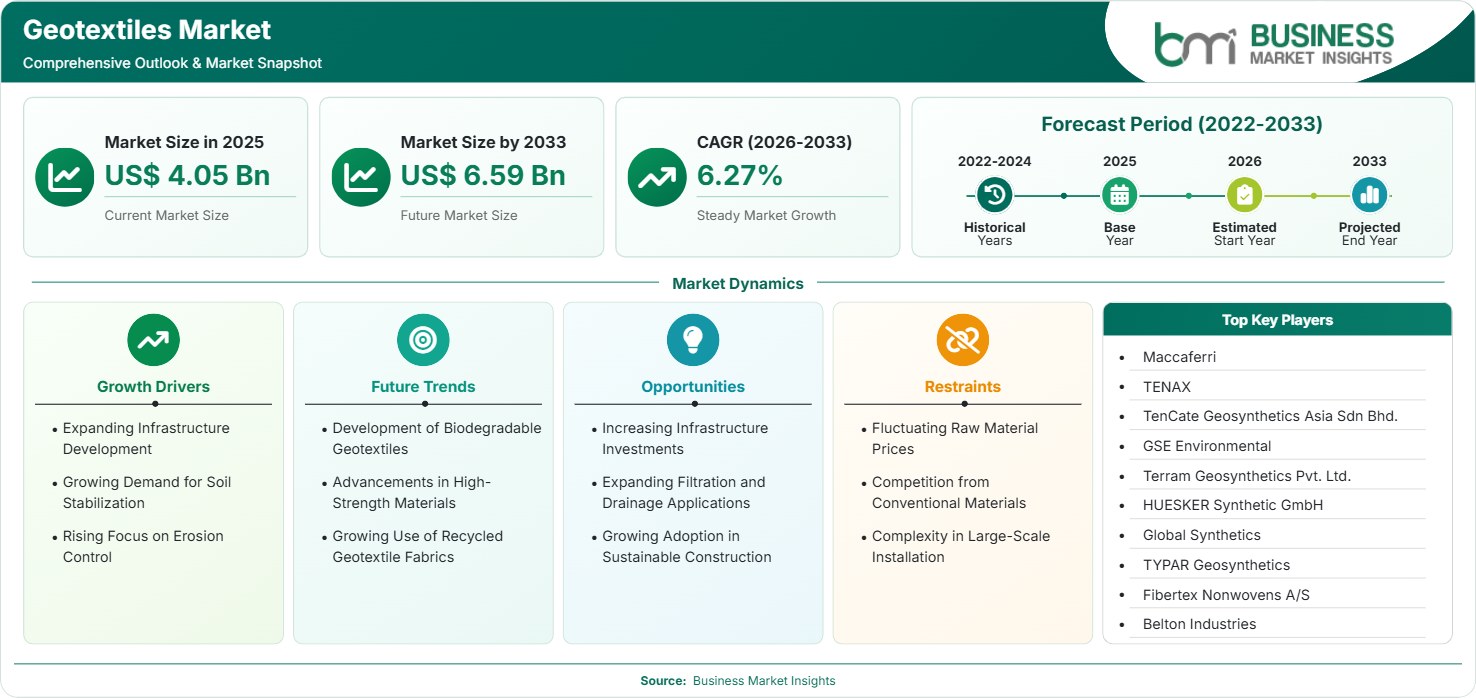
The Geotextiles Market size was valued at US$ 4.05 Billion in 2025 and is projected to reach US$ 6.59 Billion by 2033, growing at a CAGR of 6.27% during 2026–2033, supported by infrastructure development, soil stabilization, erosion control, drainage upgrades, and sustainable construction requirements.

Report Coverage
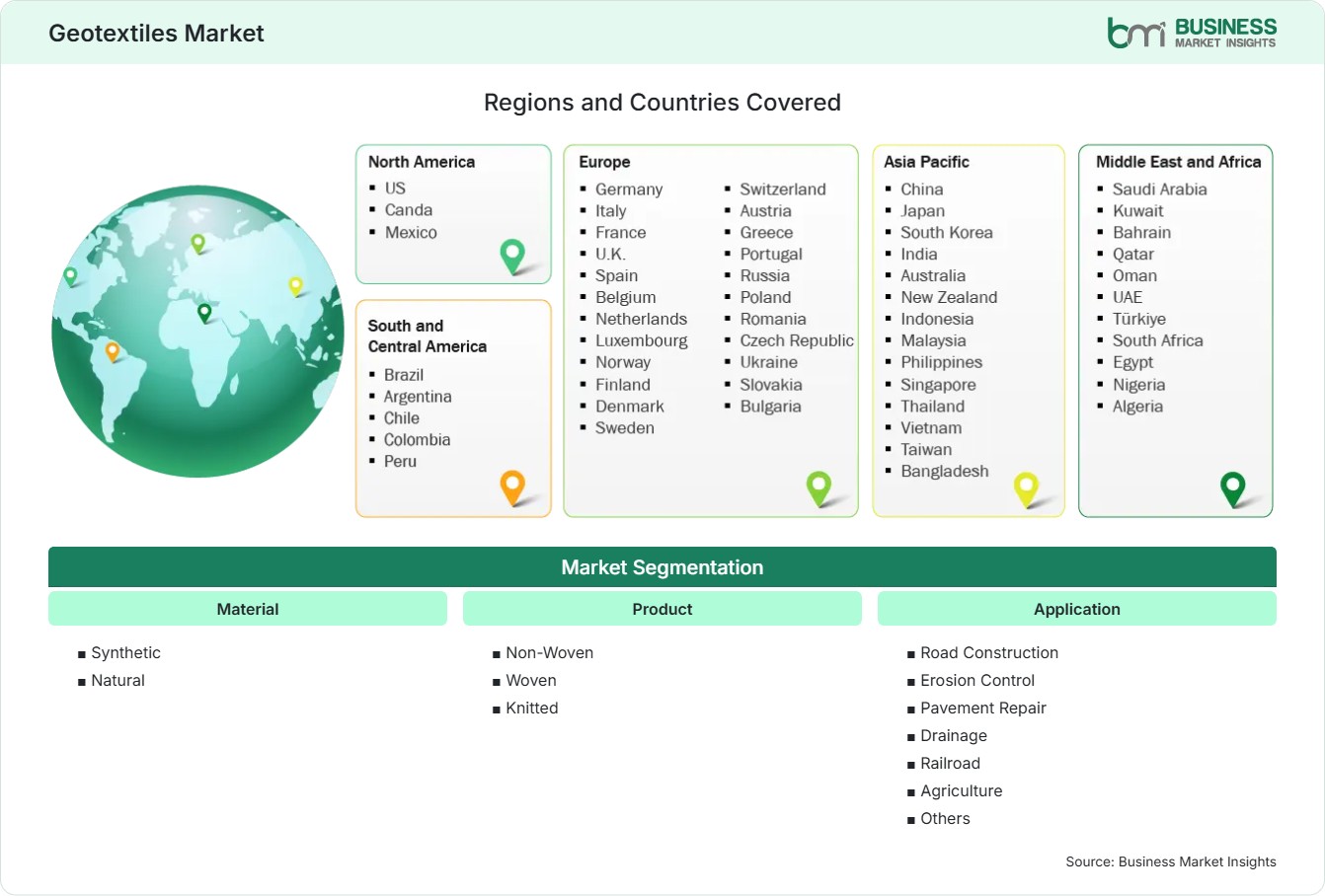
  • Material: Synthetic, Natural
  • Product: Non-Woven, Woven, Knitted
  • Application: Road Construction, Erosion Control, Pavement Repair, Drainage, Railroad, Agriculture, Others
US$ 4.05 Bn Market size in 2025
US$ 6.59 Bn Market Size by 2033
6.27% CAGR, 2026 - 2033
2026-2033 Forecast Period

AI Overview

Geotextiles Market Summary

  • North America Region: North America holds a 27%–30% share in 2025, growing at a CAGR of 5.8%–6.6% during 2026–2033, driven by highway rehabilitation, drainage modernization, erosion management, landfill engineering, and demand for durable infrastructure materials. The U.S. remains dominant, with approximately 5.9%–6.7% CAGR, supported by transportation rehabilitation, environmental engineering, and resilient infrastructure investment.
  • Fastest Growing Region: Asia Pacific holds a 34%–37% share in 2025 and is projected to expand at a CAGR of 6.8%–7.6% during 2026–2033, supported by highway construction, railway expansion, urbanization, flood management, agricultural modernization, and rising geosynthetic adoption.
  • Leading Segment: Synthetic materials hold a 96%–98% share in 2025, expanding at a CAGR of 6.1%–6.6% during 2026–2033, supported by polypropylene and polyester performance, chemical resistance, durability, scalable manufacturing, and extensive infrastructure applications.
  • High Growth Segment: Erosion Control is estimated to represent a 16%–19% share in 2025, with a CAGR of 7.0%–8.0% during 2026–2033, driven by slope stabilization, watershed protection, climate resilience, and infrastructure exposed to heavy rainfall.
  • Key Market Opportunity: Sustainable geotextiles, recycled polymers, biodegradable natural-fiber products, advanced drainage composites, and integrated erosion-control systems can expand adoption across climate-resilient infrastructure projects.
  • Major Market Players: Maccaferri; TENAX S.p.A.; TenCate Geosynthetics Asia Sdn Bhd.; GSE Environmental; Terram Geosynthetics Pvt. Ltd.; HUESKER Synthetic GmbH; Global Synthetics Pty Ltd; TYPAR Geosynthetics; Fibertex Nonwovens A/S; Belton Industries.
Strategic Insights

Geotextiles Market: Strategic Insights

Geotextiles Market Strategic Framework
FREE PDF
Request your free sample
Request free sample
Stakeholder View

Key Takeaways

  • The value chain is becoming more technically integrated, linking polymer suppliers, textile manufacturers, geosynthetic designers, engineering consultants, contractors, and infrastructure owners around performance-based specifications.
  • Road construction remains the largest application opportunity because geotextiles separate weak subgrades from aggregate layers, improve load distribution, and support longer pavement service life.
  • Material innovation is moving beyond conventional polypropylene and polyester toward recycled polymers, bio-based fibers, biodegradable temporary fabrics, and composite structures combining multiple geotechnical functions.
  • Asia Pacific provides the strongest investment case because transportation construction, urban development, rail expansion, water management, and erosion-control requirements are developing simultaneously.
  • Strategic activity is increasingly focused on portfolio expansion and technology acquisition, illustrated by HUESKER’s 2025 acquisition of Sineco International to strengthen drainage and dewatering capabilities.
  • Sustainability is becoming a product-development criterion, creating opportunities for suppliers that can demonstrate lifecycle benefits, reduced aggregate requirements, recycled content, and lower installation impacts.
Geographic Outlook

Geotextiles Market Regional Highlights

North America Geotextiles Market

North America accounts for a 27%–30% share in 2025 and is projected to grow at a CAGR of 5.8%–6.6% through 2033. Demand is supported by highway rehabilitation, railway maintenance, drainage projects, landfill engineering, and erosion-control requirements. The U.S. represents the dominant national market because of its extensive transportation network and recurring infrastructure rehabilitation needs. Canada contributes through mining, transportation, environmental engineering, and northern infrastructure. Product selection increasingly emphasizes long-term performance, installation efficiency, and project-specific engineering specifications.

  • U.S. infrastructure rehabilitation supports recurring demand for separation, reinforcement, filtration, and pavement-related geotextile solutions across highways and municipal transportation projects.
  • Canada provides opportunities in mining, roads, drainage, erosion control, and infrastructure projects exposed to demanding climatic conditions and difficult terrain.
  • Environmental applications increasingly require engineered filtration and drainage layers for landfills, contaminated sites, water-management facilities, and shoreline protection.
  • Specification-based procurement favors manufacturers with technical design support, testing capabilities, installation guidance, and established contractor relationships.

US Geotextiles Market

The U.S. represents approximately 73%–77% of North American demand in 2025 and is forecast to expand at a CAGR of 5.9%–6.7% through 2033. Highway rehabilitation, stormwater management, landfill development, mining, and erosion protection support consistent consumption. State and local infrastructure programs create demand for products capable of separating aggregate from weak soils while limiting rutting and maintaining drainage. Geotextiles are increasingly evaluated according to lifecycle performance rather than initial material cost.

  • Road and pavement projects remain major demand centers because geotextiles can improve subgrade performance and reduce intermixing between soil and aggregate.
  • Environmental engineering creates opportunities in drainage, containment, landfill closure, sediment control, and contaminated-site remediation.
  • Manufacturers increasingly differentiate through engineering assistance, product certification, performance testing, and customized fabric specifications.

Europe Geotextiles Market

Europe holds a 23%–26% share in 2025 and is projected to register a CAGR of 5.7%–6.5% during 2026–2033. Germany, France, the U.K., Italy, and Spain represent important markets, supported by transportation maintenance, flood management, sustainable construction, and environmental engineering. Germany remains a leading technical market, while Italy and Spain offer strong opportunities in erosion control and water management. European sustainability requirements are encouraging interest in recycled and biodegradable geosynthetic solutions.

  • Germany benefits from sophisticated engineering standards, infrastructure modernization, industrial construction, and established geosynthetics expertise.
  • France provides demand across roads, railways, water infrastructure, erosion control, and environmental applications.
  • Italy and Spain offer opportunities in slope stabilization, coastal protection, drainage, agriculture, and climate-resilience projects.
  • Sustainability initiatives are encouraging recycled and bio-based products, including temporary biodegradable geotextiles for suitable applications.

Asia Pacific Geotextiles Market

Asia Pacific represents a 34%–37% Geotextiles Market share in 2025 and is projected to expand at a CAGR of 6.8%–7.6% through 2033, making it the fastest-growing regional market. China, India, Japan, South Korea, and Southeast Asian economies are important demand centers. Rapid infrastructure construction, highway expansion, rail investment, flood management, urbanization, and industrial development support consumption. India is particularly attractive because road, railway, drainage, and erosion-control projects increasingly incorporate geosynthetic engineering solutions.

  • China remains a major demand center because transportation infrastructure, urban construction, water management, and environmental projects require large volumes of engineered geosynthetics.
  • India offers strong opportunities across highways, rural roads, railways, drainage, erosion control, and infrastructure rehabilitation.
  • Japan and South Korea emphasize high-performance materials for transportation infrastructure, environmental protection, and technically demanding construction applications.
  • Southeast Asia provides growth opportunities through urbanization, flood-control projects, coastal infrastructure, agriculture, and expanding road networks.

Rest of World Geotextiles Market

Rest of World represents approximately 11%–15% of global demand in 2025 and is forecast to expand at a CAGR of 5.9%–6.8% through 2033. South and Central America are adopting geotextiles for roads, erosion control, drainage, agriculture, mining, and water infrastructure. Brazil and Mexico are leading opportunities due to infrastructure requirements and large construction ecosystems. In the Middle East and Africa, Saudi Arabia, the UAE, South Africa, and selected emerging markets offer opportunities in transportation, water management, and land development.

  • Brazil provides demand from highways, railways, mining, agriculture, drainage, and erosion-management projects across diverse climatic conditions.
  • Mexico benefits from industrial infrastructure, transportation investment, manufacturing development, and environmental engineering requirements.
  • Saudi Arabia and the UAE offer opportunities linked to large-scale construction, landscaping, drainage, and desert-environment infrastructure.
  • South Africa supports demand through mining, roads, water infrastructure, erosion management, and land rehabilitation projects.
Global Market Geography
FREE PDF
Request your free sample
Request free sample
Segment Analysis

Geotextiles Market Segmentation

Material

Synthetic materials represent a 96%–98% share in 2025 and are projected to grow at a 6.1%–6.6% CAGR through 2033, supported by superior durability, predictable performance, chemical resistance, and scalable manufacturing. Natural materials remain relevant for temporary erosion-control applications and sustainability-oriented projects requiring biodegradable solutions.

  • Synthetic: Polypropylene, polyester, and polyethylene provide strength, durability, chemical resistance, and controlled permeability for transportation, drainage, reinforcement, and environmental engineering applications.
  • Polypropylene: Offers low density, chemical resistance, and cost efficiency, making it widely suited to nonwoven filtration, separation, drainage, and erosion-control products.
  • Polyester: Provides high tensile strength and dimensional stability, supporting reinforcement, stabilization, and demanding infrastructure applications requiring durable mechanical performance.
  • Polyethylene: Provides moisture resistance and durability, supporting specialized civil engineering, environmental protection, and composite geosynthetic applications.
  • Natural: Bio-based materials provide biodegradable alternatives for temporary applications, particularly where vegetation establishment, erosion control, and lower environmental persistence are priorities.
  • Jute: Jute fabrics support temporary erosion protection and vegetation establishment, particularly in landscaping, slopes, agricultural areas, and environmentally sensitive projects.
  • Coir: Coir products offer natural resistance and biodegradability for erosion control, slope protection, drainage-related landscaping, and temporary soil stabilization applications.

Product

Non-woven products represent a 65%–68% share in 2025 and are expected to expand at a 6.2%–6.7% CAGR through 2033, supported by filtration, separation, drainage, and protection requirements. Woven and knitted products serve specialized reinforcement and performance applications.

  • Non-Woven: Needle-punched structures provide filtration, separation, drainage, and cushioning functions across roads, railways, landfills, drainage systems, and environmental projects.
  • Woven: Woven fabrics deliver high tensile performance and dimensional stability for soil reinforcement, stabilization, pavement support, and demanding infrastructure applications.
  • Knitted: Knitted structures provide flexibility and specialized reinforcement characteristics for selected civil engineering, erosion-control, and composite geosynthetic applications.

Application

Road Construction represents a 32%–35% share in 2025 and is projected to grow at a 6.2%–6.8% CAGR through 2033. The Geotextiles Market scope is expanding as infrastructure owners prioritize separation, drainage, reinforcement, and erosion management within integrated project designs.

  • Road Construction: Geotextiles separate aggregate from weak soils, improve load distribution, control deformation, and support longer-lasting pavement structures.
  • Erosion Control: Products protect exposed soil and slopes from water and wind erosion while supporting vegetation establishment and surface stabilization.
  • Pavement Repair: Geotextiles support rehabilitation by controlling cracking, separating pavement layers, and improving reinforcement and drainage performance.
  • Drainage: Nonwoven fabrics provide filtration and separation around drainage systems, preventing soil migration while allowing water movement.
  • Railroad: Geotextiles stabilize trackbeds, separate ballast from subgrade soils, improve drainage, and support performance over weak or saturated ground.
  • Agriculture: Geotextiles support drainage, erosion management, soil protection, and selected irrigation or agricultural infrastructure applications.
Market Forces

Geotextiles Market Dynamics

Key Market Drivers

Expanding Infrastructure Development

Infrastructure expansion is a primary demand engine because roads, railways, bridges, drainage systems, ports, and urban development require materials that improve ground performance without excessive aggregate consumption. Geotextile technologies perform separation, filtration, reinforcement, and drainage in engineering constructions. The opportunities in developing economies like India can be exemplified by its infrastructure initiatives and growing highway network, whereas mature economies have a demand for refurbishment rather than new developments that create a continuous demand for the technology. Road construction is the largest segment in some market studies, owing to the contribution of geotextiles towards better quality pavements and subgrades. These factors contribute towards the Geotextiles Market growth since the focus has now shifted on lifecycle costs, speed of construction, and material efficiency along with the procurement price.

Growing Demand for Soil Stabilization

Weak, saturated, expansive, or variable soils can increase construction complexity and require costly excavation, replacement, or stabilization. Geotextiles provide separation and reinforcement functions that allow engineers to manage difficult subgrades while reducing intermixing between aggregate and soil. Polyester and polypropylene woven materials would be useful where tensile strength and stability are important. Maccaferri, for example, positions PET woven and composite geotextiles for reinforcement and filtration over soft soils and road construction. These engineering advantages make geosynthetics more appealing in terms of use in land development and transport projects. As construction becomes more difficult, the market is likely to move towards fabrics tailored to suit particular soils and other engineering considerations.

Rising Focus on Erosion Control

Climate variability, heavy rainfall, coastal exposure, and construction on steep terrain increase the need for erosion-management systems. Geotextiles and associated geomats can stabilize the surface of the soil while permitting drainage and the planting of vegetation. Geotextiles serve to demonstrate the overlap of civil engineering and environmental protection, where effectiveness must take into account the issue not only of protecting against soil erosion but also of stabilizing the soil surface in the long term. In terms of the development of geotextiles, there is an increasing trend toward the production of materials that provide protection from erosion and also other properties like revegetation and drainage.

Key Market Opportunities

Increasing Infrastructure Investments

Infrastructure spending creates a broad opportunity because geotextiles can improve project efficiency across transportation, water management, railways, airports, ports, and urban development. There is increasing emphasis on construction practices that minimize maintenance needs while maintaining their functionality amidst adverse soil and weather conditions. Geotextiles Market trends may help to reduce the amount of imported aggregate needed in some selected projects as well as ease the installation process, thus making the projects more economical due to expensive transportation costs. The Asia Pacific region represents an especially lucrative opportunity since projects concerning highways, railroads, drainage systems, and urbanization are all expanding.

Expanding Filtration and Drainage Applications

Drainage and filtration represent an important opportunity because infrastructure durability depends heavily on controlled water movement. Nonwoven geotextiles help to prevent the migration of soil while allowing for the movement of water through drainage layers. Product development has led to the use of these products in composite drainage layers, which integrate geotextiles and geonets, membranes, or other material layers. With more sophisticated needs for managing water, product differentiation can be based on higher flow rates, resistance to clogging, ease of installation, and engineered solutions, not just weight and tensile strength of the fabric.

Growing Adoption in Sustainable Construction

Sustainability provides an opportunity for manufacturers to develop recycled, bio-based, and biodegradable geotextiles without compromising required engineering performance. Such solutions can reduce the need for post-project removal where temporary reinforcement or erosion protection is required. Recycled polymer products can similarly address demand for lower-impact long-life infrastructure. The Geotextiles Market Forecasts therefore increasingly depend on how effectively manufacturers balance durability, cost, technical certification, and environmental performance. Suppliers capable of documenting lifecycle benefits, recycled content, biodegradability, and reduced aggregate use can gain preference in infrastructure programs incorporating sustainability criteria.

Market Restraints and Challenges

Fluctuating Raw Material Prices

Factor: Polypropylene and polyester production depends on petrochemical and polymer supply chains that can experience fluctuations in feedstock costs, energy prices, freight rates, and regional availability. Impact: Cost volatility can compress manufacturer margins or force price adjustments that make project budgeting more difficult. Such volatility is particularly challenging for contractors operating under fixed-price infrastructure contracts. Manufacturers can mitigate exposure through supplier diversification, inventory planning, energy efficiency, recycled feedstocks, and longer-term procurement arrangements. However, commodity-linked input costs remain an important constraint on predictable pricing.

Competition from Conventional Materials

Factor: Geotextiles compete with conventional aggregates, soil stabilization methods, concrete systems, drainage layers, and other established construction practices that contractors understand and specify routinely. Impact: Adoption can slow when project owners focus primarily on initial procurement cost or lack technical familiarity with geosynthetic design. Although geotextiles can reduce material requirements and improve performance in suitable applications, benefits depend on correct product selection, installation, and engineering design. Procurement teams may therefore require project-specific evidence demonstrating lifecycle savings rather than simply comparing material prices. Suppliers with strong engineering support are better positioned to demonstrate where geotextiles provide measurable value compared with conventional construction approaches.

Company Analysis

Competitive Landscape

The Geotextiles Market analysis indicates that competition is shaped by product breadth, manufacturing capabilities, engineering expertise, geographic reach, sustainability credentials, and the ability to provide application-specific geosynthetic systems.

Company Name

Overview

Products and Services Relevant to this Market

Maccaferri

Global engineering and geosynthetics provider with extensive infrastructure and environmental project expertise.

Nonwoven geotextiles, PET woven composites, PP/PE woven geotextiles, drainage, filtration, reinforcement, and erosion-control solutions.

TENAX S.p.A.

Italian manufacturer serving civil engineering, construction, agriculture, and environmental applications.

Nonwoven geotextiles, erosion-control geomats, drainage composites, geocomposites, reinforcement, and soil stabilization products.

TenCate Geosynthetics Asia Sdn Bhd.

Geosynthetic specialist serving infrastructure, transportation, environmental, and civil engineering markets.

Geotextiles, geogrids, geocomposites, erosion-control products, reinforcement, separation, filtration, and drainage systems.

GSE Environmental

Geosynthetics supplier focused strongly on environmental containment and civil infrastructure applications.

Geotextiles, geomembranes, drainage composites, landfill systems, containment products, and environmental engineering solutions.

Terram Geosynthetics Pvt. Ltd.

Geosynthetic supplier providing engineered materials for transportation and civil engineering projects.

Nonwoven and woven geotextiles, geocomposites, separation, filtration, reinforcement, and drainage solutions.

HUESKER Synthetic GmbH

Specialist in high-performance geosynthetics with global engineering and manufacturing capabilities.

Geotextiles, geogrids, geocomposites, erosion-control systems, drainage products, and sustainable bio-based solutions.

Global Synthetics Pty Ltd

Australian geosynthetics supplier serving civil, mining, environmental, and infrastructure markets.

Geotextiles, geogrids, geocomposites, drainage products, erosion-control systems, and civil engineering materials.

TYPAR Geosynthetics

Technical nonwoven specialist serving civil engineering, drainage, stabilization, and environmental applications.

Nonwoven geotextiles, stabilization fabrics, drainage fabrics, erosion-control products, and filtration solutions.

Fibertex Nonwovens A/S

Technical nonwoven manufacturer with international production and specialized textile capabilities.

Technical nonwovens, filtration fabrics, construction-related textiles, engineered materials, and application-specific nonwoven solutions.

Belton Industries

Specialist manufacturer supplying geosynthetic and erosion-control products for infrastructure applications.

Geotextiles, erosion-control fabrics, sediment-control products, filtration materials, and construction-related geosynthetic solutions.

Trust & Transparency

Research Methodology

The market analysis combines proprietary research with secondary data from government agencies, company disclosures, regulatory filings, industry databases and expert interviews. Market estimates are validated through data triangulation, cross-market benchmarking and analyst review.

View Full Research Methodology

Questions Answered

Frequently Asked Questions

What does the Geotextiles Market Report evaluate?

The report evaluates material, product, and application segments alongside regional dynamics, competitive positioning, drivers, opportunities, restraints, recent company developments, and forecast conditions through 2033.

What is driving product innovation?

Innovation is increasingly focused on recycled polymers, biodegradable fibers, composite structures, higher filtration performance, improved installation efficiency, and products that combine reinforcement, drainage, and erosion protection.

Which application provides the largest demand opportunity?

Road construction remains a major application because geotextiles address separation, stabilization, filtration, and drainage challenges in pavement structures and weak subgrades.

How are natural geotextiles gaining attention?

Natural fibers such as jute and coir provide biodegradable alternatives for temporary erosion-control and vegetation-establishment applications. Their environmental profile can make them attractive where long-term synthetic persistence is undesirable.

Which material dominates geotextile consumption?

Synthetic materials dominate because polypropylene and polyester provide predictable strength, durability, chemical resistance, and scalable manufacturing. They are widely used in transportation, drainage, reinforcement, filtration, and erosion-control applications.

Access the Full Geotextiles Market Report

Get segment-level forecasts, regional estimates, competitive benchmarking, company profiles and downloadable Excel datasets.

Access the full Geotextiles Market Report
350 pages PDF & Excel | 2026-08-21
Similar Research

Related Market Reports