
Geocomposites Market Outlook: Size, Share, Trends, Growth Analysis, Competitive Landscape & Forecast, 2026-2033

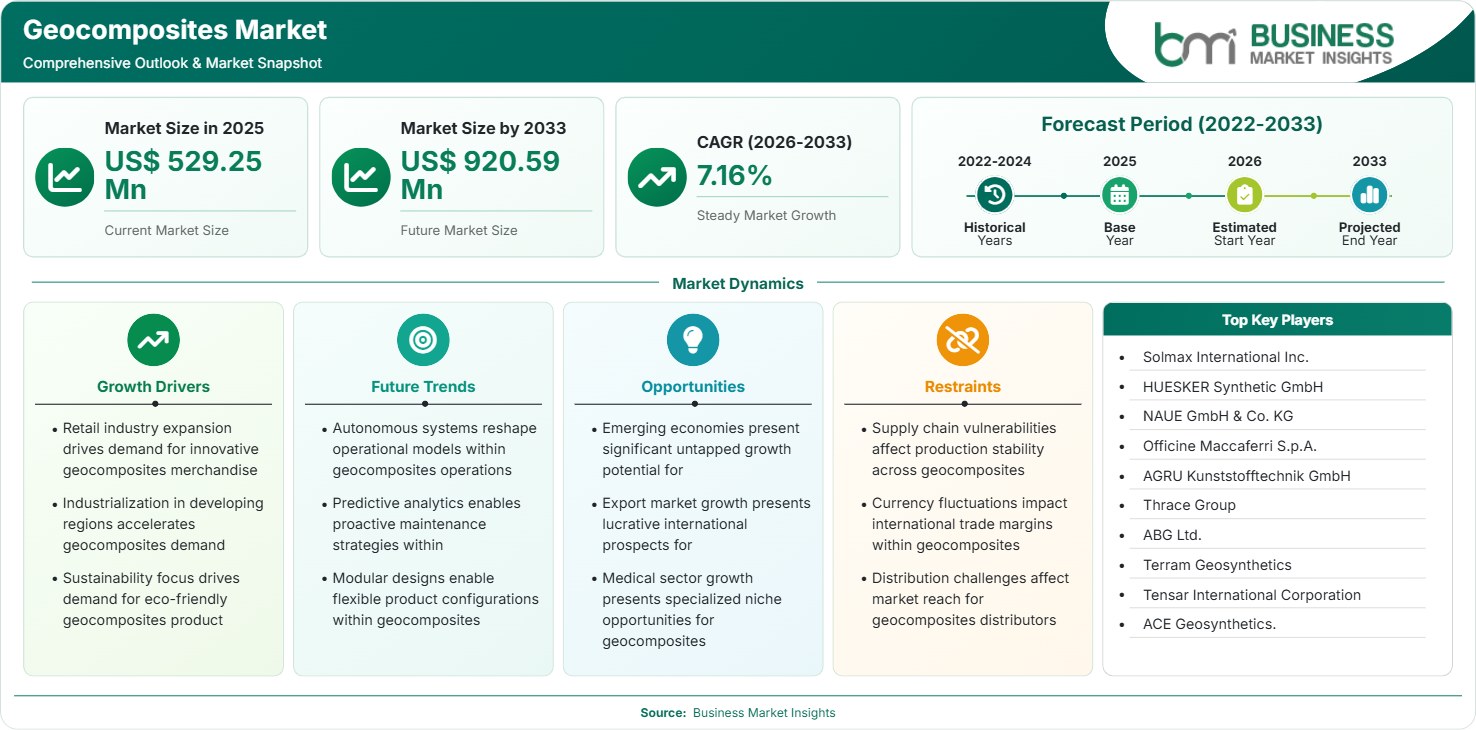
The Geocomposites Market size was valued at US$ 529.25 Million in 2025 and is projected to reach US$ 920.59 Million by 2033, growing at a CAGR of 7.16% during 2026–2033. Key drivers include transportation infrastructure upgrades, landfill engineering demand, water management investments, and reinforced soil applications. Emerging opportunities stem from climate-resilient infrastructure, mine rehabilitation projects, and advanced drainage systems.

Report Coverage
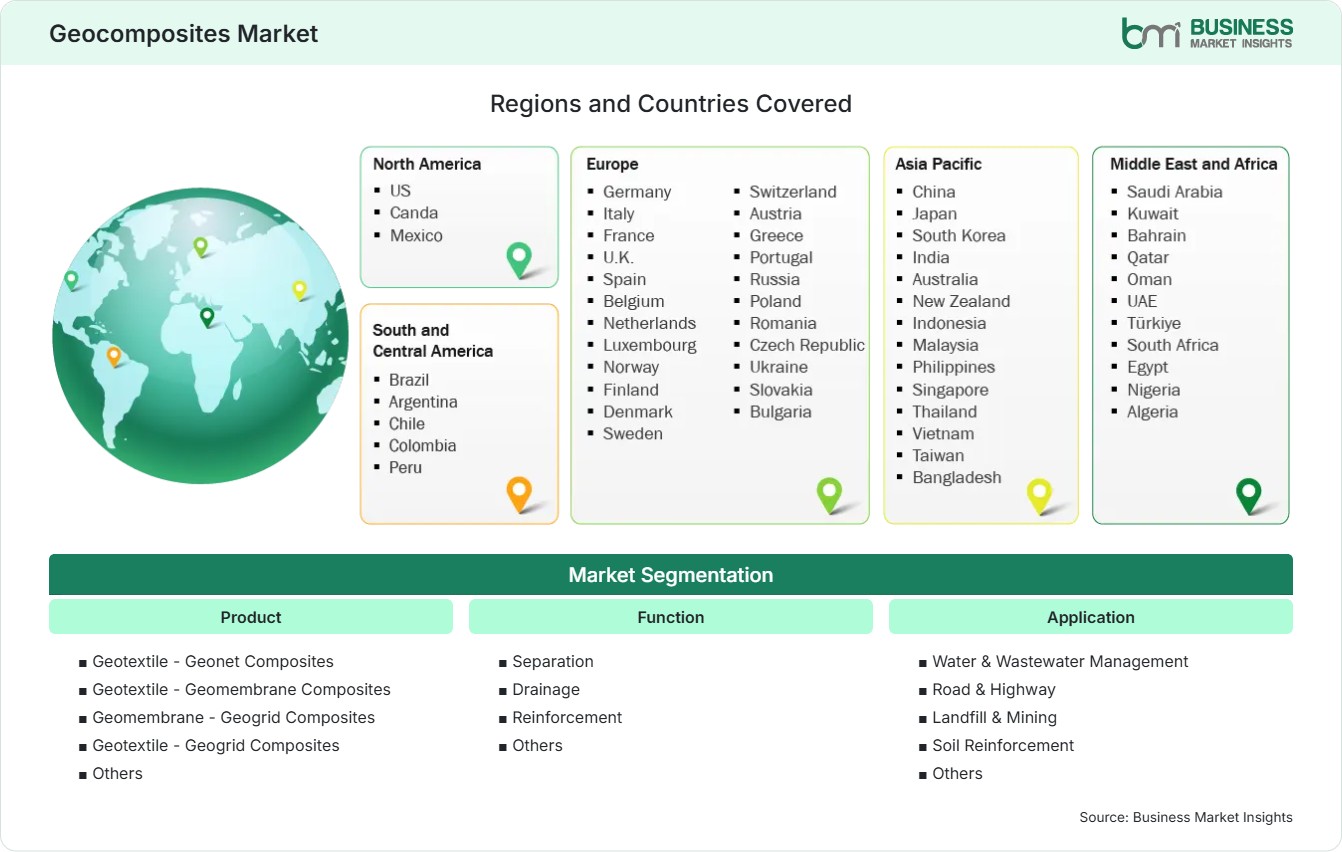
  • Product: Geotextile - Geonet Composites, Geotextile - Geomembrane Composites, Geomembrane - Geogrid Composites, Geotextile - Geogrid Composites, Others
  • Function: Separation, Drainage, Reinforcement, Others
  • Application: Water & Wastewater Management, Road & Highway, Landfill & Mining, Soil Reinforcement, Others
US$ 529.25 Mn Market size in 2025
US$ 920.59 Mn Market Size by 2033
7.16% CAGR, 2026 - 2033
2026-2033 Forecast Period

AI Overview

Geocomposites Market Summary

  • North America Region: North America holds a 34%–37% share of the Geocomposites Market in 2025, growing at a CAGR of 6.3%–6.8% during 2026–2033. Key drivers and opportunities include highway rehabilitation spending, landfill modernization programs, stormwater infrastructure upgrades, stricter environmental compliance requirements, engineered drainage adoption, sustainable construction practices, and resilient civil infrastructure investments. US demand benefits from transportation renewal programs and environmental containment projects, advancing at approximately 6.4%–6.9% CAGR.
  • Fastest Growing Region: Asia Pacific holds a 27%–30% share in 2025, growing at a CAGR of 8.2%–8.8% during 2026–2033. Key drivers and opportunities include rapid urbanization, metro construction expansion, mining investments, flood mitigation infrastructure, industrial wastewater projects, government infrastructure financing, coastal protection developments, and increasing geosynthetic specification adoption.
  • Leading Segment: Road & Highway accounts for 31%–34% of the Geocomposites Market share in 2025 and expands at a CAGR of 7.0%–7.5% during 2026–2033. Key drivers and opportunities include pavement stabilization requirements, lifecycle cost reduction goals, heavy traffic loading conditions, base reinforcement demand, drainage integration benefits, and durable infrastructure performance targets.
  • High Growth Segment: Water & Wastewater Management represents a 22%–25% share in 2025 and advances at a CAGR of 8.0%–8.6% during 2026–2033. Key drivers and opportunities include wastewater treatment expansion, stormwater management regulations, reservoir lining investments, drainage optimization needs, climate adaptation priorities, and increasing municipal infrastructure funding.
  • Key Market Opportunity: Expanding climate adaptation programs are increasing investment in drainage layers, erosion control systems, containment barriers, and reinforced earthworks, creating long-term opportunities across transportation, water infrastructure, mining, and environmental engineering projects.
  • Major Market Players: Solmax International Inc., HUESKER Synthetic GmbH, NAUE GmbH & Co. KG, Officine Maccaferri S.p.A., AGRU Kunststofftechnik GmbH, Thrace Group, ABG Ltd., Terram Geosynthetics, Tensar International Corporation, ACE Geosynthetics.
Strategic Insights

Geocomposites Market: Strategic Insights

Geocomposites Market Strategic Framework
FREE PDF
Request your free sample
Request free sample
Stakeholder View

Key Takeaways

  • The value chain is increasingly integrated, with polymer suppliers, geosynthetic manufacturers, engineering consultants, and infrastructure contractors collaborating to optimize project performance and reduce lifecycle costs.
  • Water management and transportation applications offer the strongest long-term upside due to climate adaptation funding, urban drainage requirements, and pavement rehabilitation programs.
  • Product innovation is moving toward multifunctional composites that combine reinforcement, filtration, and drainage capabilities while reducing installation time and aggregate consumption.
  • Asia Pacific offers the most compelling geographic expansion opportunity, supported by urban infrastructure development, industrial corridor investments, and public works spending.
  • Industry consolidation continues to strengthen global distribution networks, technical expertise, and product portfolios, enabling larger suppliers to address complex engineering requirements.
  • Sustainability metrics are becoming purchasing criteria as project owners increasingly evaluate carbon reduction, resource efficiency, and long-term infrastructure resilience.
Geographic Outlook

Geocomposites Market Regional Highlights

North America Geocomposites Market

North America accounted for approximately 34%–37% of global demand in 2025 and is projected to expand at a CAGR of 6.3%–6.8% through 2033. The region benefits from mature infrastructure programs, stringent environmental regulations, and strong adoption across transportation, landfill, and wastewater applications. The Geocomposites Market share remains highest in the region due to specification-driven engineering practices and continuous rehabilitation spending. Public investments targeting stormwater systems, transportation corridors, and environmental containment facilities continue supporting sustained demand across federal, state, and municipal infrastructure projects.

  • Highway modernization programs increasingly incorporate drainage composites to extend pavement life and improve performance under heavier traffic conditions.
  • Environmental regulations supporting landfill lining, leachate collection, and containment systems continue creating demand for advanced composite drainage solutions.
  • Mining operators are expanding use of engineered materials to improve tailings management, erosion control, and long-term environmental performance.
  • Municipal investments in water infrastructure upgrades support adoption of filtration and drainage systems across treatment and storage facilities.

US Geocomposites Market

The United States represents roughly 78%–82% of regional demand and advances at an estimated CAGR of 6.4%–6.9% through 2033. Infrastructure renewal initiatives, aging transportation assets, and environmental remediation requirements underpin adoption. Federal funding streams directed toward roads, bridges, and water systems continue expanding project pipelines. Engineering firms increasingly specify integrated geocomposites because they reduce excavation requirements and improve lifecycle economics. Demand remains particularly strong across transportation, landfill expansion, and stormwater management applications.

  • Transportation agencies increasingly emphasize resilient pavement designs that integrate drainage and reinforcement functionality while reducing long-term maintenance expenditure.
  • Growth in industrial wastewater projects is increasing deployment of engineered containment and drainage systems across manufacturing and processing facilities.
  • Landfill operators continue prioritizing geosynthetic solutions that improve leachate collection efficiency and environmental compliance outcomes.

Europe Geocomposites Market

Europe holds approximately 25%–28% of the Geocomposites Market share in 2025 and is forecast to expand at a CAGR of 6.5%–7.1% through 2033. The sustainable mandates, circular economic goals, and sophisticated engineering standards favor adoption. Germany is the dominant national market, while infrastructure construction in Eastern Europe contributes to modest demand growth. France and the UK are still significant buyers due to investments in transportation and environmental engineering projects. The governments favor construction practices that improve project performance and operational durability.

  • Germany maintains leadership through extensive transportation rehabilitation programs and strong specification of geosynthetic technologies in civil engineering applications.
  • Poland demonstrates higher expansion rates approaching 7.2%–7.8% due to transportation corridor development and public infrastructure funding.
  • Sustainable drainage systems are increasingly incorporated into urban development projects addressing changing precipitation patterns.
  • Landfill modernization efforts continue favoring engineered containment products that meet stringent environmental performance requirements.

Asia Pacific Geocomposites Market

Asia Pacific accounts for 27% to 30% of global consumption in 2025 and is projected to show the highest growth rate, with a CAGR of 8.2% to 8.8% through 2033. The region is expected to see higher demand driven by urbanization, transportation projects, industrialization, and water management systems. China leads steel consumption in the Asia-Pacific, while India shows a higher growth rate in the region. Subway, highway, airport, and flood-control projects are driving consumption. Governments are increasingly emphasizing durable infrastructure designs that reduce maintenance costs and improve environmental resilience across densely populated regions.

  • China remains the largest regional market supported by transportation, wastewater management, and industrial infrastructure development.
  • India is projected among the fastest-growing countries with estimated expansion near 8.8%–9.4% driven by national infrastructure programs.
  • Mining investments across Australia contribute demand for drainage, reinforcement, and containment applications in challenging environments.
  • Southeast Asian flood mitigation projects increasingly integrate engineered drainage systems to improve infrastructure resilience.

Rest of World Geocomposites Market

The Rest of World region accounts for approximately 10%–13% share in 2025 and is projected to grow at a CAGR of 7.3%–7.9% through 2033. South and Central America benefit from mining and transportation investments supporting product consumption.

The Middle East and Africa are becoming more active in water infrastructure, industrial construction, and major urban projects. There is an increase in the use of geosynthetics in countries such as Saudi Arabia and the UAE, while Chile is an important mining-driven market generating demand for drainage and reinforcement systems.

  • Chile's mining sector continues supporting adoption across tailings facilities, containment infrastructure, and site development projects.
  • Saudi Arabia benefits from major infrastructure initiatives requiring engineered drainage and soil stabilization technologies.
  • Water scarcity challenges across several Middle Eastern countries are accelerating investment in wastewater and storage infrastructure.
  • Transportation corridor construction and climate-resilience projects create opportunities across multiple emerging economies.
Global Market Geography
FREE PDF
Request your free sample
Request free sample
Segment Analysis

Geocomposites Market Segmentation

Product

The product segment accounts for almost 100% of market revenue. The segment caters to several civil infrastructure applications and composite products, gaining popularity owing to their multifunctionality. The Geocomposites Market is experiencing continued expansion as project owners seek an efficient system that integrates drainage, filtration, and reinforcement properties. Product innovation is the primary differentiating factor. However, share dominance is seen in drainage-oriented products. The segment's growth matches the market's 7.16% growth trajectory.

  • Geotextile - Geonet Composites: Widely deployed for drainage and leachate collection applications, offering high flow capacity, installation efficiency, and long-term hydraulic performance across landfill, transportation, and environmental engineering projects.
  • Geotextile - Geomembrane Composites: Preferred where containment and filtration functions are required simultaneously, supporting reservoirs, wastewater facilities, mining operations, and environmental protection projects with improved sealing performance.
  • Geomembrane - Geogrid Composites: Combines containment characteristics with structural reinforcement, enabling stronger performance across slope stabilization, mining infrastructure, and demanding geotechnical engineering environments.
  • Geotextile - Geogrid Composites: Increasingly specified in pavement structures and reinforced earthworks due to improved load distribution, soil stabilization, installation efficiency, and service-life enhancement.

Function

Functional requirements are influenced by infrastructure performance targets and life-cycle optimization objectives. The separation application has a market share of 29%-32% in 2025, and drainage remains a significant value generator. The market is anticipated to register a CAGR of 6.9% to 7.5% till 2033 as integrated engineering solutions gain acceptance across transportation, mining, and environmental projects.

  • Separation: Essential for preventing intermixing of soil layers, improving structural integrity, and supporting long-term performance in roads, railways, and embankment construction.
  • Drainage: High adoption across landfills, retaining structures, and water management systems where efficient flow control and hydraulic performance are critical.
  • Reinforcement: Increasing use in slope stabilization and pavement construction due to load-bearing improvements and reduced material requirements.

Application

The application requirements will continue to vary across infrastructure segments. The Road & Highway segment will have the largest market share in 2025, at 31%- 34%, and its CAGR will be in the range of 7.0%–7.5%. The Water & Wastewater Management segment will have the highest growth rate at 8.0%-8.6%. Geocomposites Market trends indicate growing adoption in projects emphasizing resilience, operational efficiency, and environmental compliance.

  • Water & Wastewater Management: Expanding municipal investments and stricter environmental standards support demand for drainage, filtration, and containment solutions across treatment facilities.
  • Road & Highway: Strong infrastructure rehabilitation activity and pavement optimization requirements continue driving adoption of multifunctional geosynthetic systems.
  • Landfill & Mining: Environmental protection requirements and operational efficiency objectives sustain usage across waste containment and resource extraction projects.
  • Soil Reinforcement: Increasing deployment in retaining structures and slope stabilization projects requiring improved load distribution and geotechnical reliability.
Market Forces

Geocomposites Market Dynamics

Key Market Drivers

Infrastructure Modernization and Transportation Expansion

Government-sponsored investment in transportation continues to be a main driver of demand. Road longevity, improved drainage, and lower lifecycle costs have been key concerns in infrastructure development programs in the US, India, China, and Europe. Engineers often prefer composites because they are less dependent on aggregates and perform better in tough soils. The investments the world is making in global infrastructure, along with the urbanization trend, continue to raise the specification rate for highways, railways, and airports. The ability of these materials to perform multiple functions in a single layer makes the construction process efficient and yields durable, economical transport facilities. This is one of the biggest factors influencing their future adoption.

Stricter Environmental Protection Requirements

Environmental compliance regulations are increasingly requiring engineered containment and drainage systems. There is an increasing need for solutions that manage liquid flow, minimize the risk of contamination, and enhance site stability. Environmental regulatory bodies across the globe are showing growing interest in groundwater protection and efficient waste management techniques. The advantages of composite systems stem from their built-in filtration, separation, and drainage mechanisms. Another reason is growing concerns about tailings disposal facilities and landfill operations, prompting people to seek out highly advanced technologies.

Climate Resilience and Water Infrastructure Investment

The rising variability of climatic conditions is increasing the significance of stormwater management systems, flood protection structures, and water conservation infrastructure. There is increasing investment in advanced drainage and protective engineering infrastructure, which enhances their resistance to extreme climatic conditions. Geocomposites help ensure proper performance in water conveyance, erosion control, and stabilization for infrastructure under adverse climatic conditions. Growing investments in infrastructure projects for wastewater treatment facilities, water storage, and flood-control structures expand the range of geocomposite applications.

Key Market Opportunities

Advanced Stormwater Management Systems

Urban development increases surface impermeability, placing greater strain on drainage systems and related infrastructure. Innovations in stormwater solutions that can improve runoff management and reduce the risk of flooding are being adopted by city governments. The use of composite drainage can offer opportunities for improved hydraulic behavior and reduced space and complexity in construction. Geocomposites Market Forecasts show increasing purchasing opportunities from urban infrastructure projects aimed at building resilience and sustainability. Companies capable of creating customized drainage systems are well-positioned to benefit from rising project activity and evolving environmental regulations globally.

Mining Tailings and Environmental Remediation Projects

The mining industry continues to invest in safer, more environmentally friendly waste management technologies. For instance, tailings dams should have effective drainage, reinforcement, and containment systems that perform better than ever before. Environmental rehabilitation activities involving contaminated soils and industrial lands represent additional potential uses for these composites. More and more companies demand products that make the installation process easier and improve the efficiency of environmental protection. High mining activity in Latin America, Australia, Africa, and some Asian countries will ensure future demand. Suppliers with proven technical expertise and specialized engineering support capabilities are likely to capture high-value opportunities.

Smart and Sustainable Infrastructure Development

Material assessment now includes sustainability, durability, and total cost considerations. Such an approach enables innovative systems that reduce resource use and enhance efficiency. Engineering specifications now include multifunctional systems that minimize excavation, transportation, and aggregate use. Innovation in product development regarding durability and hydraulic performance is opening new possibilities. The integration of sustainability considerations into procurement decisions means that manufacturers who can demonstrate such advantages may enjoy competitive advantages and larger infrastructure spending worldwide.

Market Restraints and Challenges

Raw Material Price Volatility and Margin Pressure

Factor: Most composite solutions rely on polymer-based inputs whose pricing is influenced by petrochemical markets, supply disruptions, and global trade conditions. Impact: Manufacturers face difficulties maintaining stable production costs and pricing strategies during periods of volatility. Construction projects are frequently budget-sensitive, limiting the ability to pass through higher costs immediately. Procurement delays may occur when contractors reassess material expenditures. Smaller suppliers can experience greater margin compression than diversified industry leaders. These dynamics create operational uncertainty, particularly for long-term infrastructure projects requiring extended bidding and execution timelines.

Limited Technical Awareness in Emerging Markets

Factor: Engineers, contractors, and project owners in some developing regions continue relying on conventional construction methods despite the availability of advanced alternatives. Impact: Adoption rates can remain below technical potential, slowing penetration across transportation and environmental applications. Insufficient training, limited design familiarity, and inconsistent specification standards may restrict project opportunities. Suppliers often need to invest heavily in technical education, demonstrations, and engineering support to overcome adoption barriers. The challenge is particularly relevant in regions where procurement decisions prioritize upfront costs over lifecycle performance and maintenance savings.

Company Analysis

Competitive Landscape

The Geocomposites Market analysis reflects competition among global geosynthetic manufacturers emphasizing product performance, technical support, and infrastructure-focused innovation.

Company Name

Overview

Products and Services relevant to this market

Solmax International Inc.

Global geosynthetics leader with broad manufacturing footprint and extensive infrastructure project experience.

Geocomposites, geomembranes, geotextiles, drainage solutions, containment systems, engineering support services.

HUESKER Synthetic GmbH

German specialist focused on high-performance geosynthetics for civil and environmental engineering.

Composite geosynthetics, reinforcement products, drainage systems, landfill and transportation solutions.

NAUE GmbH & Co. KG

International supplier recognized for sustainable geosynthetic technologies and infrastructure expertise.

Geocomposites, geogrids, geotextiles, erosion-control systems, environmental engineering products.

Officine Maccaferri S.p.A.

Engineering solutions provider serving infrastructure, mining, waterways, and environmental sectors.

Reinforcement composites, drainage products, retaining solutions, slope stabilization systems.

AGRU Kunststofftechnik GmbH

Manufacturer specializing in polymer engineering and environmental containment products.

Geomembranes, geocomposites, drainage layers, landfill and water management solutions.

Thrace Group

Diversified industrial producer with geosynthetics portfolio serving construction applications.

Geotextiles, composite materials, separation products, drainage and reinforcement applications.

ABG Ltd.

UK-based geosynthetic specialist supporting infrastructure and environmental projects.

Drainage composites, geotextiles, erosion-control products, engineering support solutions.

Terram Geosynthetics

Established geosynthetics supplier serving transport and environmental engineering markets.

Geocomposites, filtration systems, separation materials, drainage and stabilization products.

Tensar International Corporation

Infrastructure-focused company known for soil reinforcement technologies and engineering expertise.

Composite reinforcement systems, stabilization products, roadway improvement solutions.

ACE Geosynthetics

Asian manufacturer delivering engineered geosynthetic products across global markets.

Geocomposites, geogrids, geotextiles, retaining wall and reinforcement applications.

Trust & Transparency

Research Methodology

The market analysis combines proprietary research with secondary data from government agencies, company disclosures, regulatory filings, industry databases and expert interviews. Market estimates are validated through data triangulation, cross-market benchmarking and analyst review.

View Full Research Methodology

Questions Answered

Frequently Asked Questions

What is the biggest opportunity for suppliers over the forecast period?

Climate-resilient infrastructure development, particularly drainage, flood protection, wastewater systems, and environmental containment projects, presents substantial long-term procurement and specification opportunities.

Who are the major participants covered in this Geocomposites Market Report?

The report covers leading manufacturers including Solmax International, HUESKER Synthetic, NAUE, Officine Maccaferri, AGRU, Thrace Group, ABG Ltd., Terram Geosynthetics, Tensar International, and ACE Geosynthetics.

How do geocomposites support sustainability objectives?

They reduce raw material requirements, lower transportation needs, improve infrastructure longevity, and help manage water efficiently, contributing to resource conservation and reduced lifecycle environmental impacts.

Which application area is expected to expand fastest through 2033?

Water and wastewater management is projected to record the highest growth due to increasing investment in treatment infrastructure, stormwater systems, environmental compliance, and climate resilience initiatives.

What factors are driving adoption of geocomposites in transportation projects?

Integrated drainage, reinforcement, and separation performance help improve pavement durability, reduce aggregate use, accelerate installation, and lower lifecycle maintenance costs, making these materials attractive for modern transportation infrastructure.

Access the Full Geocomposites Market Report

Get segment-level forecasts, regional estimates, competitive benchmarking, company profiles and downloadable Excel datasets.

Access the full Geocomposites Market Report
350 pages PDF & Excel | 2026-08-31
Similar Research

Related Market Reports