
Genomics Market Outlook: Size, Share, Trends, Growth Analysis, Competitive Landscape & Forecast, 2026-2033

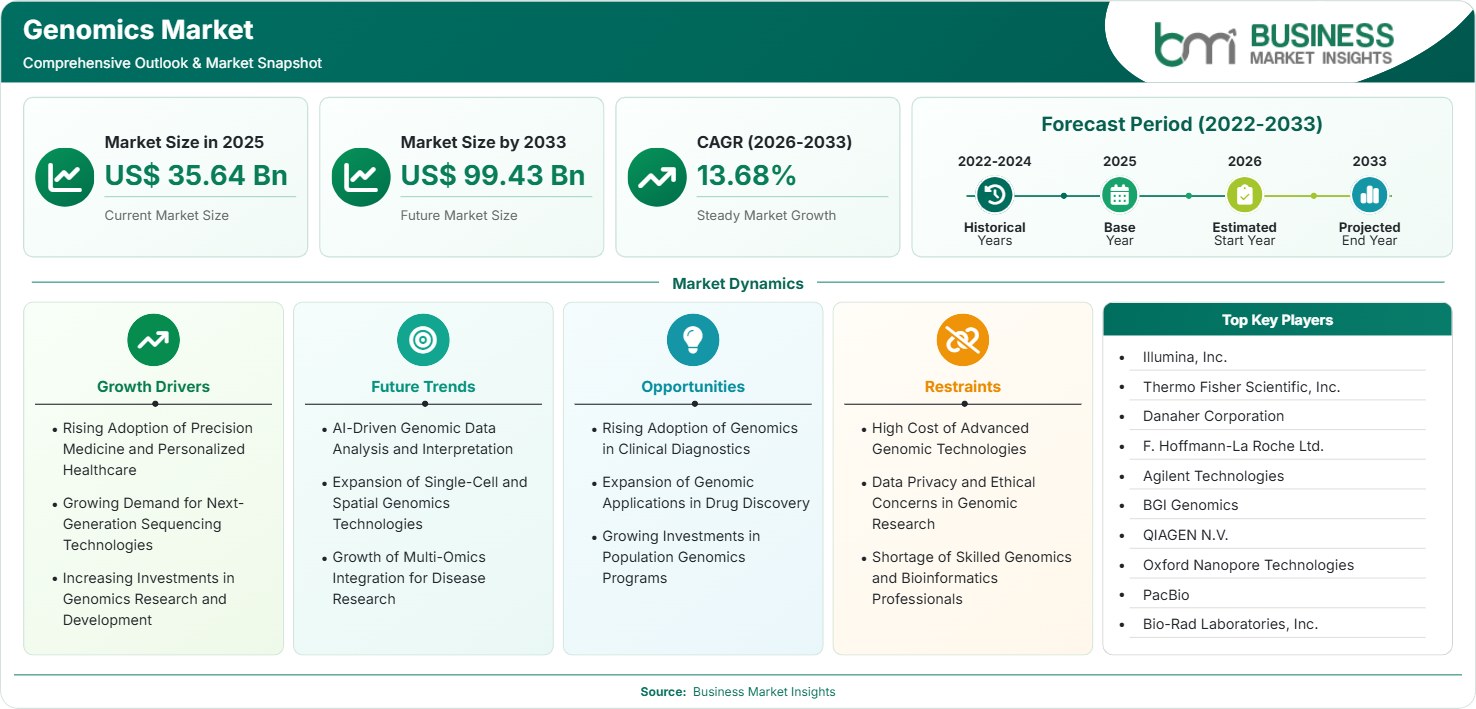
The Genomics Market size was valued at US$ 35.64 Billion in 2025 and is projected to reach US$ 99.43 Billion by 2033, growing at a CAGR of 13.68% during 2026–2033. Rising adoption of precision medicine, increasing investments in genomic research, growing demand for advanced diagnostic tools, and expanding utilization of sequencing technologies are supporting market growth globally.

Report Coverage
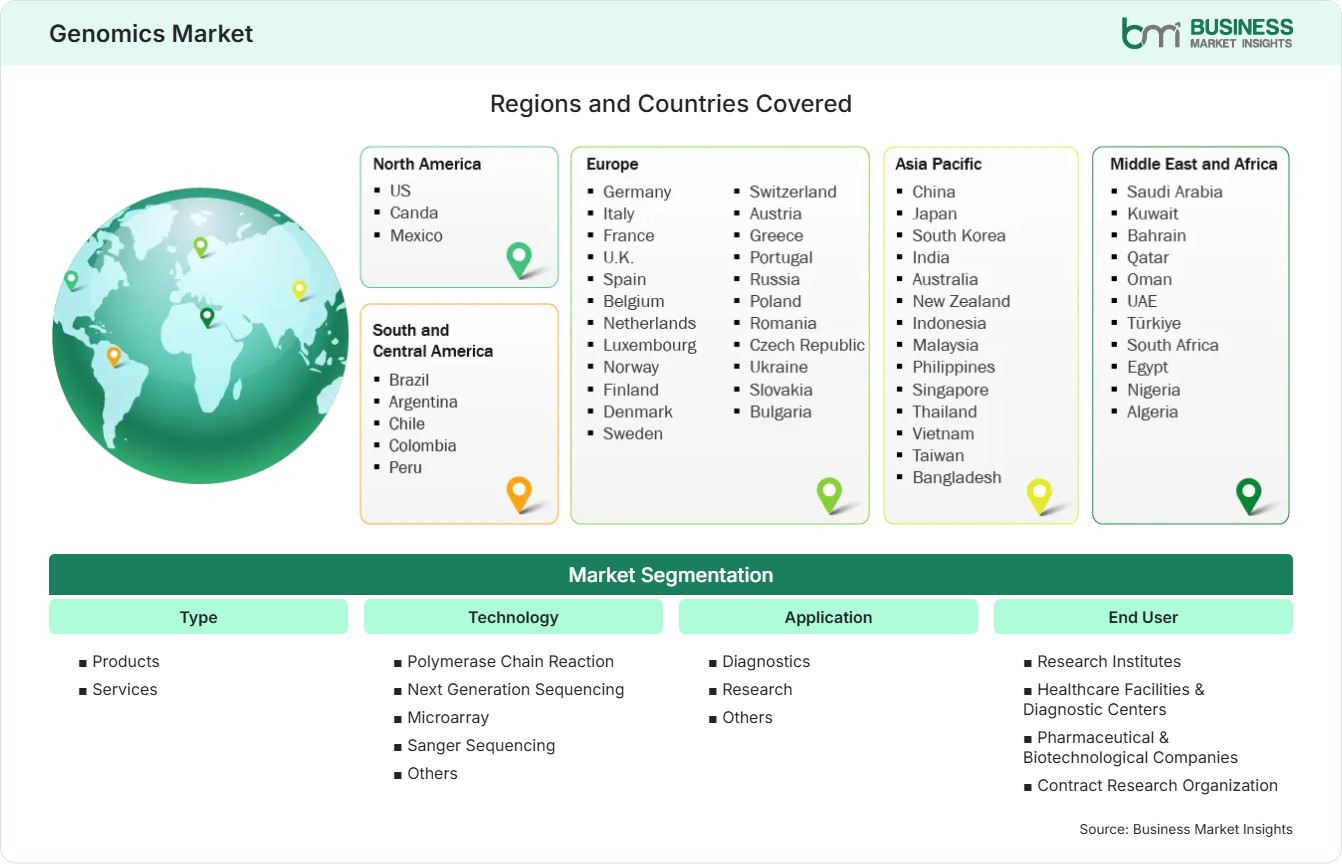
  • Type: Products, Services
  • Technology: Polymerase Chain Reaction , Next Generation Sequencing , Microarray, Sanger Sequencing, Others
  • Application: Diagnostics, Research, Others
  • End User: Research Institutes, Healthcare Facilities & Diagnostic Centers, Pharmaceutical & Biotechnological Companies, Contract Research Organization
US$ 35.64 Bn Market size in 2025
US$ 99.43 Bn Market Size by 2033
13.68% CAGR, 2026 - 2033
2026-2033 Forecast Period

AI Overview

Genomics Market Summary

  • North America Region: North America holds a genomics market share of 38%–41% in 2025, growing with a CAGR of 13.0%–13.7% during 2026–2033. Strong research infrastructure, increasing genomic testing adoption, and substantial biotechnology investments continue supporting regional leadership. The U.S. market is expected to register a CAGR of 13.2%–13.9%.
  • Fastest Growing Region: Asia Pacific accounts for 28%–31% share in 2025 and is projected to grow at a CAGR of 14.7%–15.4% through 2033. Expanding genomics research programs, healthcare modernization initiatives, and increasing biotechnology investments continue driving regional growth.
  • Leading Segment: Products represent 57%–60% share in 2025 and are expected to grow at a CAGR of 13.6%–14.3% through 2033. Increasing demand for sequencing systems, reagents, consumables, and genomic analysis tools continues supporting segment dominance.
  • High Growth Segment: Diagnostics accounts for 41%–44% share in 2025 and is forecast to grow at a CAGR of 14.2%–14.9% during 2026–2033. Expanding use of genomic testing in disease diagnosis and personalized medicine continues accelerating segment growth.
  • Key Market Opportunity: Expansion of precision medicine programs, increasing adoption of next-generation sequencing, and growing investments in population genomics initiatives are creating substantial growth opportunities.
  • Major Market Players: Illumina, Inc., Thermo Fisher Scientific, Inc., Danaher Corporation, F. Hoffmann-La Roche Ltd., Agilent Technologies, BGI Genomics, QIAGEN N.V., Oxford Nanopore Technologies, PacBio, and Bio-Rad Laboratories, Inc.
Strategic Insights

Genomics Market: Strategic Insights

Genomics Market Strategic Framework
FREE PDF
Request your free sample
Request free sample
Stakeholder View

Key Takeaways

  • Genomics is becoming a foundational technology for precision medicine and advanced healthcare.
  • Products continue dominating the market due to increasing demand for sequencing instruments and consumables.
  • Diagnostics remains the leading application segment supported by growing use of genomic testing.
  • Next-generation sequencing technologies continue transforming genomic analysis capabilities.
  • Pharmaceutical companies are increasingly utilizing genomics to accelerate drug discovery.
  • North America remains the leading genomics market due to strong biotechnology and healthcare research infrastructure.
  • Asia Pacific is projected to witness the fastest growth owing to increasing investments in genomics and biotechnology.
  • Population genomics and precision healthcare initiatives are expected to create significant future opportunities.
Geographic Outlook

Genomics Market Regional Highlights

North America Genomics Market

North America accounts for 38%–41% Genomics Market share in 2025 and is projected to grow at a CAGR of 13.0%–13.7% through 2033. The region benefits from advanced healthcare infrastructure, strong biotechnology ecosystems, extensive genomics research programs, and substantial public and private funding. Growing adoption of precision medicine and increasing integration of genomic testing into clinical care continue supporting regional market leadership.

  • Healthcare providers are increasingly incorporating genomic testing into routine diagnostics to improve disease detection, treatment selection, and patient outcomes across multiple therapeutic areas.
  • Biotechnology and pharmaceutical companies continue investing heavily in genomics research to accelerate drug discovery, biomarker identification, and precision medicine development initiatives.
  • Large-scale population genomics projects are generating significant demand for sequencing technologies, bioinformatics platforms, and genomic data analysis solutions.
  • Research institutions continue expanding genomic studies related to cancer, rare diseases, and inherited genetic conditions, supporting technology adoption.
  • Government funding and healthcare innovation programs continue strengthening genomics infrastructure and supporting long-term market growth.

US Genomics Market

The United States contributes approximately 86%–90% of North American revenue and is expected to register a CAGR of 13.2%–13.9% through 2033. The country remains a global leader in genomics innovation due to extensive research capabilities, strong biotechnology investment activity, and widespread adoption of advanced sequencing technologies. Growing demand for personalized healthcare, precision oncology, and genomic diagnostics continues supporting genomics market expansion across healthcare and research settings.

  • Precision medicine initiatives continue driving adoption of genomic technologies across hospitals, research institutes, and specialty healthcare centers.
  • Pharmaceutical companies are increasingly utilizing genomic data to support therapeutic development, clinical trial optimization, and target identification efforts.
  • Cancer genomics applications continue witnessing strong demand as healthcare providers focus on personalized treatment approaches and early disease detection.
  • Biotechnology investments remain robust, supporting innovation in sequencing platforms, molecular diagnostics, and genomic data analytics.

Europe Genomics Market

Europe represents 23%–26% of global revenue in 2025 and is anticipated to expand at a CAGR of 13.5%–14.2% through 2033. Strong investment in life sciences research, growing implementation of precision healthcare programs, and increasing adoption of molecular diagnostics continue supporting regional growth. Germany remains the leading genomics market while Poland demonstrates stronger growth momentum.

  • Germany continues leading regional demand through advanced healthcare infrastructure, strong biotechnology capabilities, and extensive genomic research initiatives.
  • Poland is among the fastest-growing markets and is estimated to register a CAGR of 14.5%–15.2% during the forecast period, supported by increasing healthcare modernization and research investments.
  • National genomics programs continue supporting widespread adoption of sequencing technologies across healthcare and research environments.
  • Pharmaceutical and biotechnology companies are increasingly utilizing genomic data to improve treatment development and disease understanding.
  • Growing acceptance of molecular diagnostics is contributing to broader clinical implementation of genomics technologies.
  • Public-private collaborations are accelerating genomics innovation and expanding access to advanced testing capabilities.

Asia Pacific Genomics Market

Asia Pacific accounts for 28%–31% of global revenue in 2025 and is expected to achieve the fastest CAGR of 14.7%–15.4% through 2033. Rising healthcare expenditure, growing biotechnology innovation, increasing genomics research activities, and expanding adoption of precision medicine continue supporting strong regional growth. Governments across the region are investing heavily in healthcare modernization, biotechnology infrastructure, and population genomics initiatives.

  • China remains the largest regional genomics market due to extensive genomics research programs, biotechnology investments, and large-scale sequencing initiatives.
  • India is projected to achieve approximately 15.6%–16.3% CAGR, supported by expanding healthcare infrastructure, increasing research activity, and rising awareness regarding personalized medicine.
  • Growing deployment of next-generation sequencing technologies is improving accessibility to advanced genomic analysis and diagnostic services.
  • Academic institutions and biotechnology companies continue increasing genomics research activities across multiple disease areas.
  • Government-led healthcare modernization programs are strengthening the ecosystem for genomic innovation and clinical adoption.
  • Increasing demand for molecular diagnostics and precision medicine solutions continues creating long-term market opportunities.

Rest of World Genomics Market

Rest of World accounts for 8%–11% of global revenue in 2025 and is projected to expand at a CAGR of 12.7%–13.4% through 2033. Growing investments in healthcare infrastructure, increasing awareness regarding genetic testing, and improving access to advanced diagnostics are supporting market development across Latin America, the Middle East, and Africa. Expanding research capabilities and healthcare modernization efforts continue creating favorable conditions for genomics adoption.

  • Brazil continues generating demand through expanding healthcare research activities, increasing molecular diagnostics adoption, and growing biotechnology investments.
  • The UAE is witnessing rising implementation of genomics programs focused on precision medicine, preventive healthcare, and advanced diagnostics.
  • Saudi Arabia is expected to achieve approximately 13.6%–14.3% CAGR through 2033, supported by healthcare transformation initiatives and biotechnology sector development.
  • Research organizations continue expanding genetic studies and molecular testing capabilities to improve healthcare outcomes.
  • Growing awareness regarding personalized medicine is encouraging wider adoption of genomic technologies across healthcare systems.
  • Investments in healthcare digitization and advanced laboratory infrastructure continue supporting market expansion.
Global Market Geography
FREE PDF
Request your free sample
Request free sample
Segment Analysis

Genomics Market Segmentation

Type

The type segment represents the core products and services utilized across genomics research, diagnostics, sequencing, and precision medicine applications. This segment accounts for approximately 57%–60% share in 2025 and is projected to grow at a CAGR of 13.6%–14.3% through 2033. Current Genomics Market Trends indicate strong adoption of advanced sequencing platforms, genomic databases, and bioinformatics-enabled solutions across healthcare and research environments.

  • Products: Products dominate the market due to increasing demand for sequencing instruments, reagents, consumables, microarrays, and genomic testing kits. Continuous technology advancements continue supporting segment growth.
  • Services: Services include sequencing, sample preparation, bioinformatics analysis, consulting, and genomic testing support. Growing outsourcing of genomic research activities continues driving adoption.

Technology

The technology segment highlights the major genomic analysis methods utilized across research, diagnostics, therapeutic development, and precision medicine applications. This segment accounts for approximately 44%–47% share in 2025 and is expected to register a CAGR of 14.1%–14.8% through 2033. Increasing demand for high-throughput analysis and improved accuracy continues accelerating technological innovation. The expanding Genomics Market Scope is supported by increasing adoption of genomic technologies, growing demand for genetic testing, and rising investments in precision healthcare initiatives

  • Polymerase Chain Reaction (PCR): PCR remains widely used for gene amplification, mutation detection, and molecular diagnostics. Broad clinical and research applications continue supporting demand.
  • Next Generation Sequencing (NGS): NGS represents the fastest-growing technology due to its ability to analyze large volumes of genetic information rapidly and efficiently. Expanding precision medicine applications continue driving adoption.
  • Microarray: Microarray technology is utilized for gene expression profiling and genomic research applications. Continued usage in research settings supports segment growth.
  • Sanger Sequencing: Sanger sequencing remains important for validation studies and targeted sequencing applications. Its accuracy continues supporting specialized use cases.
  • Others: Other technologies include CRISPR-based analysis platforms, single-cell genomics, and emerging sequencing approaches. Technological advancements continue expanding market opportunities.

Application

The application segment reflects the primary areas where genomic technologies are utilized to improve healthcare outcomes and biological understanding. This segment accounts for approximately 41%–44% share in 2025 and is projected to grow at a CAGR of 14.2%–14.9% through 2033. Rising adoption of genomic testing and precision healthcare continues supporting market expansion.

  • Diagnostics: Diagnostics lead the market due to increasing utilization of genomic testing for disease detection, risk assessment, and personalized treatment selection. Precision medicine initiatives continue supporting growth.
  • Research: Research applications utilize genomics technologies to understand disease mechanisms, identify biomarkers, and develop novel therapies. Growing funding for life sciences research supports demand.
  • Others: Other applications include agriculture, forensic sciences, reproductive health, and population genomics studies. Expanding use cases continue creating opportunities.

End User

The end-user segment highlights the organizations utilizing genomic technologies across clinical, research, and commercial environments. This segment accounts for approximately 46%–49% share in 2025 and is forecast to grow at a CAGR of 13.9%–14.6% through 2033. Increasing genomic data generation and growing precision medicine initiatives continue supporting adoption across end-user groups.

  • Research Institutes: Research institutes remain major adopters of genomics technologies for biological discovery and translational research. Increasing research funding continues supporting growth.
  • Healthcare Facilities & Diagnostic Centers: Healthcare providers are increasingly incorporating genomic testing into routine clinical practice. Growing precision diagnostics adoption continues driving demand.
  • Pharmaceutical & Biotechnological Companies: These organizations utilize genomics to support drug discovery, biomarker development, and therapeutic innovation. Rising R&D investments continue strengthening adoption.
  • Contract Research Organization (CROs): CROs provide genomic research, sequencing, and data analysis services for pharmaceutical and biotechnology clients. Increasing outsourcing trends continue supporting growth.
Market Forces

Genomics Market Dynamics

Key Market Drivers

Rising Adoption of Precision Medicine and Personalized Healthcare

Growing attention to precision medicine and personalized health care is driving demand for genomics technology. Health care providers are beginning to use genomic data to tailor treatment to patients' specific needs and characteristics, leading to improved treatment outcomes and fewer adverse effects. Genomics testing makes it possible to detect diseases, mutations, and other information that helps health care providers make more effective decisions about the treatment of their patients. The investments of governments, healthcare facilities, and drug companies into precision medicine initiatives are growing all the time.

Growing Demand for Next-Generation Sequencing Technologies

The advent of next-generation sequencing has revolutionized the fields of genomic research and diagnostics due to its efficiency, precision, and low cost in analyzing large volumes of genetic data. Today, researchers and practitioners are increasingly turning to the use of NGS systems for such tasks as disease diagnosis, development of new therapies, cancer characterization, and population genomics. The ongoing technological innovations are making sequencing faster, more precise, and accessible for a wide variety of tasks. The capability of acquiring valuable insights from the genome in an efficient way has turned next-generation sequencing into a key technology in life sciences and healthcare research.

Increasing Investments in Genomics Research and Development

Public and private sector organizations are significantly increasing investments in genomics research to accelerate scientific discoveries, improve healthcare outcomes, and advance therapeutic innovation. Governments are supporting national genomics initiatives, while biotechnology and pharmaceutical companies are funding research programs focused on disease understanding, drug discovery, and biomarker identification. Academic institutions and research organizations are also expanding genomics programs to address complex healthcare challenges. These investments are generating large volumes of genomic data that require advanced analytical tools and technologies. Continued expansion of genomics research activities is expected to remain a major growth catalyst for the market throughout the forecast period.

Key Market Opportunities

Rising Adoption of Genomics in Clinical Diagnostics

Clinical diagnostics is emerging as one of the most promising opportunities within the genomics industry. Healthcare providers are increasingly utilizing genomic testing to improve disease diagnosis, treatment planning, and patient monitoring across oncology, rare diseases, inherited disorders, and infectious diseases. Genomic technologies enable earlier detection and more precise therapeutic interventions, contributing to improved patient outcomes. Growing awareness among clinicians and patients regarding the benefits of genetic testing continues supporting adoption. As healthcare systems increasingly prioritize personalized medicine approaches, the use of genomics in clinical diagnostics is expected to expand substantially.

Expansion of Genomic Applications in Drug Discovery

Pharmaceutical and biotechnology companies are increasingly integrating genomics into drug discovery and development workflows. Genomic data helps researchers identify disease pathways, validate drug targets, discover biomarkers, and improve clinical trial design. The use of genomic insights can accelerate development timelines, improve success rates, and support the creation of precision therapies. Increasing demand for targeted treatments and personalized medicines continues strengthening the role of genomics within pharmaceutical research. These factors are creating significant opportunities for technology providers operating across the genomics value chain.

Growing Investments in Population Genomics Programs

Governments, healthcare organizations, and research institutions are increasingly investing in population genomics initiatives designed to improve understanding of genetic diversity, disease susceptibility, and healthcare planning. These programs involve large-scale sequencing efforts and the development of genomic databases capable of supporting long-term research and clinical applications. Population genomics studies are generating substantial demand for sequencing technologies, bioinformatics platforms, and genomic data management solutions. In addition, these initiatives support advancements in preventive healthcare and public health strategies. Long-term Genomics Market Forecast projections remain highly favorable as investments in population-scale genomics programs continue expanding across both developed and emerging economies.

Market Restraints and Challenges

High Cost of Advanced Genomic Technologies

Factor: Advanced genomic technologies such as next-generation sequencing platforms, bioinformatics infrastructure, genomic databases, and high-throughput analysis systems often require significant capital investment. Additional costs related to sample processing, data storage, and skilled personnel further increase overall implementation expenses.

Impact: High technology costs can limit adoption among smaller healthcare providers, research organizations, and institutions operating with budget constraints. Cost barriers may delay widespread access to advanced genomic capabilities, particularly in emerging markets.

Data Privacy and Ethical Concerns in Genomic Research

Factor: Genomic research involves the collection, storage, and analysis of highly sensitive genetic information. Concerns regarding patient privacy, unauthorized data access, informed consent, data ownership, and ethical use of genomic information continue creating challenges for stakeholders.

Impact: Privacy and ethical considerations can increase regulatory complexity, compliance requirements, and operational costs for organizations handling genomic data. These concerns may also affect public participation in genomic studies and influence the pace of technology adoption across certain healthcare and research environments.

Company Analysis

Competitive Landscape

The Genomics Market Analysis is characterized by intense competition among sequencing technology providers, molecular diagnostics companies, life sciences organizations, and genomic data analytics firms. Market participants are focusing on next-generation sequencing platforms, long-read sequencing technologies, molecular diagnostics solutions, bioinformatics capabilities, and precision medicine applications to strengthen their market positions. Rising adoption of genomic testing, increasing investments in precision healthcare, and expanding genomics research activities continue driving innovation across the industry. Companies are investing heavily in sequencing accuracy improvements, automation, AI-driven genomic analysis, and large-scale genomic data management solutions to address growing demand across healthcare, research, and pharmaceutical markets.

Company Name

Overview

Products and Services relevant to this market

Illumina, Inc.

Global genomics technology company specializing in sequencing and genomic analysis solutions.

Next-generation sequencing platforms, sequencing consumables, genomic testing solutions, and bioinformatics tools.

Thermo Fisher Scientific, Inc.

Life sciences technology company serving research, diagnostics, and biotechnology markets.

Sequencing systems, PCR technologies, genomic reagents, molecular diagnostics solutions, and bioinformatics platforms.

Danaher Corporation

Life sciences and diagnostics company providing genomic research solutions.

Sequencing technologies, molecular diagnostics systems, genomic analysis tools, and laboratory workflow solutions.

F. Hoffmann-La Roche Ltd.

Global healthcare company focused on diagnostics and precision medicine.

Genomic diagnostics, sequencing technologies, molecular testing platforms, and personalized healthcare solutions.

Agilent Technologies

Analytical and life sciences solutions provider serving healthcare and research sectors.

Microarray platforms, genomic analysis tools, sample preparation systems, and molecular diagnostics solutions.

BGI Genomics

Genomics company specializing in large-scale sequencing and genomic research services.

Sequencing services, genomic testing solutions, bioinformatics analysis, and population genomics programs.

QIAGEN N.V.

Molecular diagnostics and life sciences company focused on genomic technologies.

Sample preparation products, PCR technologies, sequencing workflows, and genomic testing solutions.

Oxford Nanopore Technologies

Genomic technology company specializing in nanopore sequencing platforms.

Long-read sequencing systems, portable sequencing devices, genomic analytics, and research solutions.

PacBio

Biotechnology company focused on advanced long-read sequencing technologies.

Long-read sequencing platforms, genomic research solutions, and structural variant analysis technologies.

Bio-Rad Laboratories, Inc.

Life sciences and clinical diagnostics company serving genomics applications.

PCR systems, genomic analysis tools, molecular testing solutions, and research laboratory technologies.

Trust & Transparency

Research Methodology

The market analysis combines proprietary research with secondary data from government agencies, company disclosures, regulatory filings, industry databases and expert interviews. Market estimates are validated through data triangulation, cross-market benchmarking and analyst review.

View Full Research Methodology

Questions Answered

Frequently Asked Questions

How is next-generation sequencing influencing the market?

Next-generation sequencing is transforming genomics by enabling faster, more accurate, and cost-effective genetic analysis. The technology supports precision medicine, disease diagnostics, drug discovery, population genomics initiatives, and advanced biological research applications.

What does this Genomics Market Report cover?

This report covers type analysis, technology assessment, application evaluation, end-user analysis, regional trends, competitive landscape analysis, market drivers, opportunities, restraints, challenges, and future growth prospects through 2033.

Why is Diagnostics the leading application segment?

Diagnostics leads the market because genomic technologies are increasingly utilized for disease detection, cancer profiling, inherited disease screening, risk assessment, and personalized treatment planning across healthcare systems worldwide.

Which type segment dominates the market?

Products dominate the market due to increasing demand for sequencing instruments, reagents, consumables, genomic testing kits, and molecular analysis technologies used across research and healthcare applications.

What is driving growth in the Genomics market?

Rising adoption of precision medicine and personalized healthcare, growing demand for next-generation sequencing technologies, increasing investments in genomics research and development, and expanding use of genomic testing in clinical diagnostics are major factors driving market growth.

Access the Full Genomics Market Report

Get segment-level forecasts, regional estimates, competitive benchmarking, company profiles and downloadable Excel datasets.

Access the full Genomics Market Report
350 pages PDF & Excel | 2026-08-31
Similar Research

Related Market Reports