
Gene Editing Market Outlook: Size, Share, Trends, Growth Analysis, Competitive Landscape & Forecast, 2026-2033

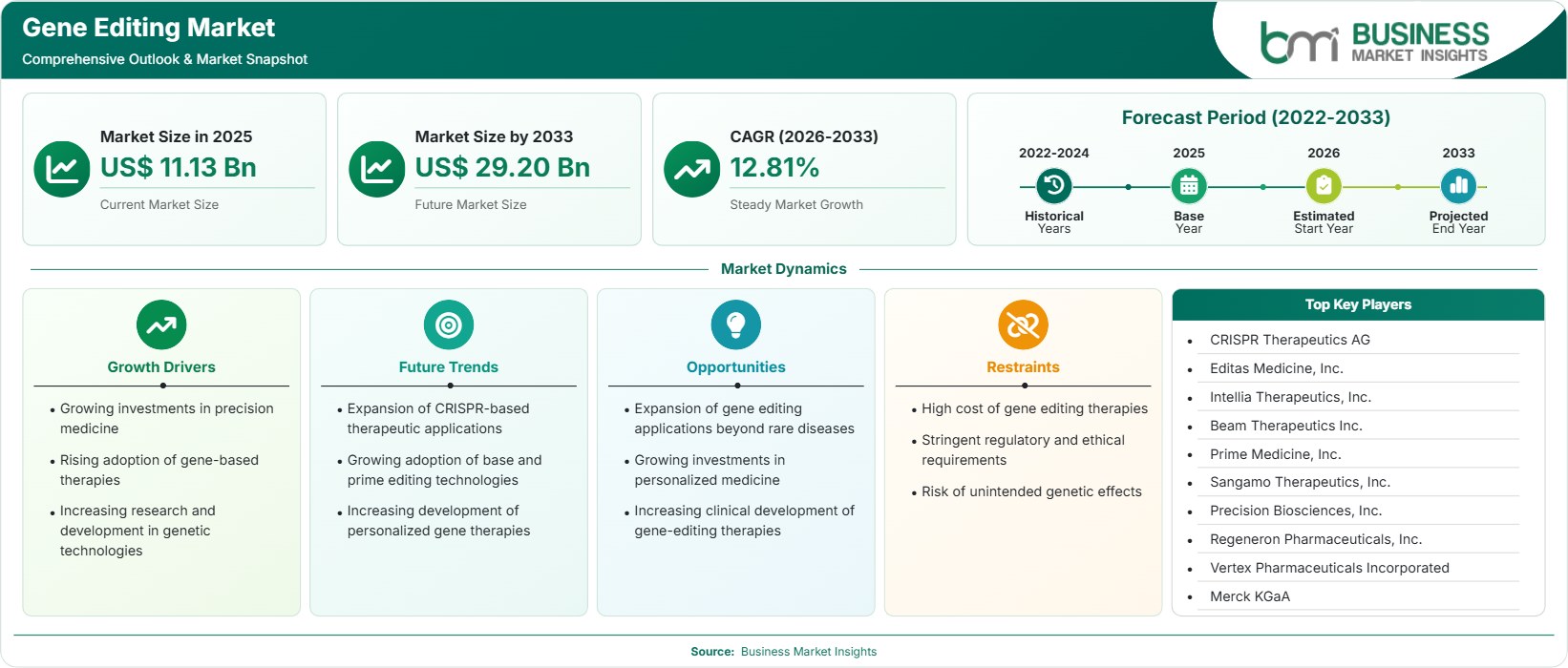
The Gene Editing Market size was valued at US$ 11.13 Billion in 2025 and is projected to reach US$ 29.20 Billion by 2033, growing at a CAGR of 12.81% during 2026–2033. Growth is driven by rising investments in precision medicine, increasing adoption of gene-based therapies, and expanding research activities in genetic technologies. Advancements in genomic engineering and clinical development programs are creating significant opportunities across biotechnology and healthcare sectors.

Report Coverage
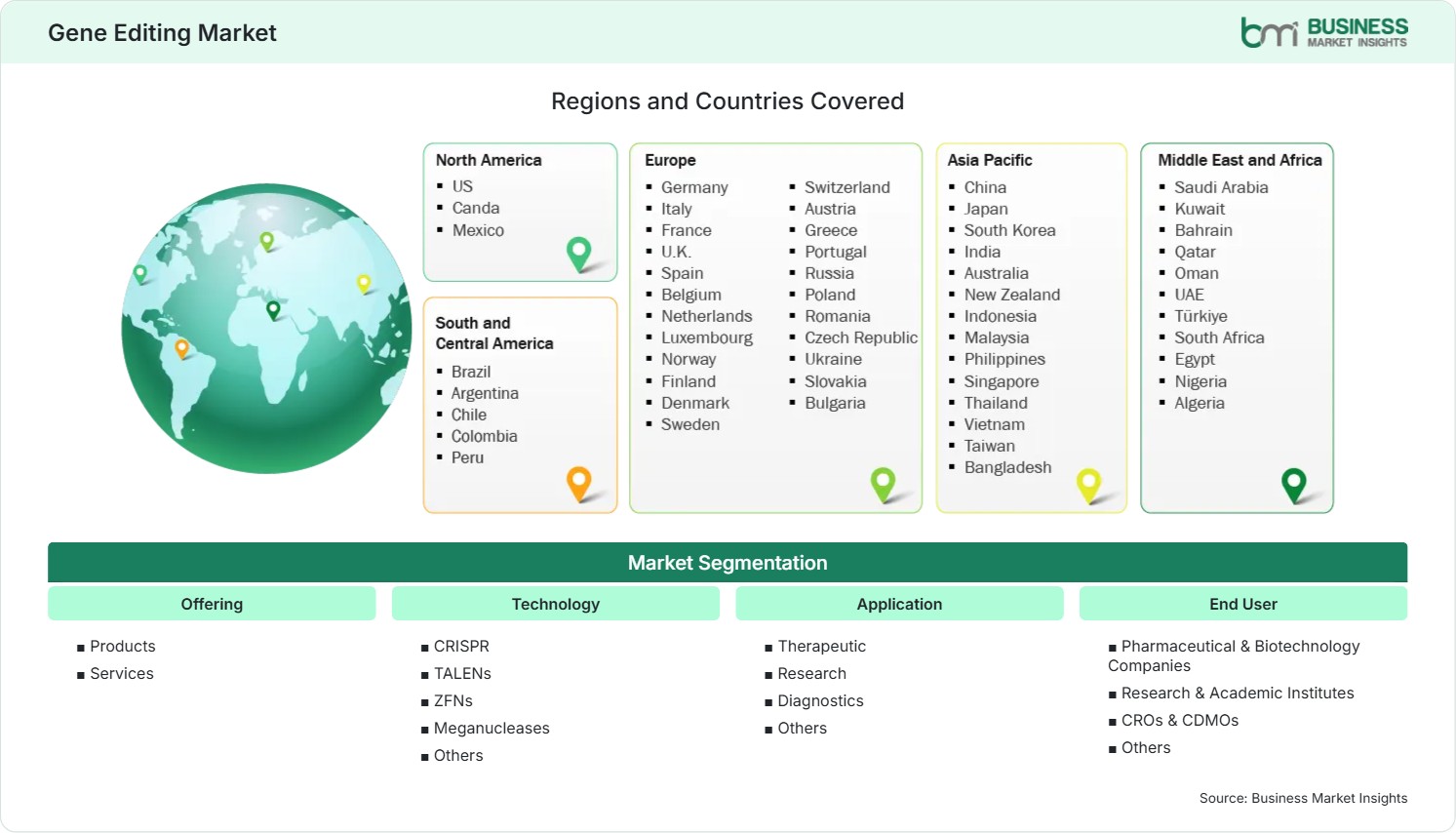
  • Offering: Products, Services
  • Technology: CRISPR, TALENs, ZFNs, Meganucleases, Others
  • Application: Therapeutic, Research, Diagnostics, Others
  • End User: Pharmaceutical & Biotechnology Companies, Research & Academic Institutes, CROs & CDMOs, Others
US$ 11.13 Bn Market size in 2025
US$ 29.20 Bn Market Size by 2033
12.81% CAGR, 2026 - 2033
2026-2033 Forecast Period

01 AI Overview

Gene Editing Market Summary

  • North America Region: North America holds a 41%–44% share in 2025 and is projected to expand at a 12.0%–12.6% CAGR during 2026–2033. Growth is supported by strong biotechnology funding, advanced healthcare infrastructure, increasing clinical research activities, expanding genomic medicine adoption, growing pharmaceutical investments, favorable research ecosystems, and rising demand for precision medicine solutions. The U.S. remains the dominant regional market, growing at a 12.1%–12.8% CAGR.
  • Fastest Growing Region: Asia Pacific accounts for 22%–25% share in 2025 and is anticipated to register a 14.1%–14.8% CAGR through 2033. Expanding biotechnology capabilities, increasing research funding, growing healthcare expenditure, and rising genomic medicine adoption continue supporting rapid expansion.
  • Leading Segment: CRISPR represents 46%–50% share in 2025 and is expected to grow at a 13.2%–13.9% CAGR during 2026–2033. High efficiency, ease of application, and expanding therapeutic research continue supporting segment leadership.
  • High Growth Segment: Therapeutic accounts for 38%–42% share in 2025 and is projected to expand at a 13.5%–14.2% CAGR through 2033. Increasing clinical development activities and growing focus on treatment of genetic diseases continue driving adoption.
  • Key Market Opportunity: Expanding use of gene editing technologies in personalized medicine, oncology, regenerative medicine, and complex disease treatment is creating substantial growth opportunities.
  • Major Market Players: CRISPR Therapeutics AG, Editas Medicine, Inc., Intellia Therapeutics, Inc., Beam Therapeutics Inc., Prime Medicine, Inc., Sangamo Therapeutics, Inc., Precision Biosciences, Inc., Regeneron Pharmaceuticals, Inc., Vertex Pharmaceuticals Incorporated, and Merck KGaA.
02 Strategic Insights

Gene Editing Market: Strategic Insights

Gene Editing Market Strategic Framework
FREE PDF
Request your free sample
Request free sample
03 Stakeholder View

Key Takeaways

  • The market ecosystem is increasingly centered on biotechnology companies, pharmaceutical developers, research institutes, contract research organizations, and genomic technology providers collaborating to accelerate clinical innovation and commercialization.
  • Therapeutic applications represent the most significant growth opportunity as gene-editing technologies advance from research-stage investigations to late-stage clinical development and commercial treatment pathways.
  • Innovation is increasingly focused on next-generation editing approaches, including base editing, prime editing, AI-assisted target identification, and precision genome engineering platforms.
  • Asia Pacific presents substantial investment opportunities due to expanding biotechnology infrastructure, growing government support for genomic research, and increasing healthcare innovation spending.
  • Strategic partnerships, licensing agreements, and research collaborations continue shaping competition as companies seek to accelerate technology development and broaden clinical pipelines.
  • Expanding adoption of precision medicine and personalized healthcare is creating long-term demand for advanced genetic engineering technologies across multiple therapeutic areas.
04 Geographic Outlook

Gene Editing Market Regional Highlights

North America Gene Editing Market

North America accounted for approximately 41%–44% share in 2025 and is projected to grow at a 12.0%–12.6% CAGR through 2033. The region benefits from advanced biotechnology infrastructure, strong research funding, and active clinical development programs. Pharmaceutical and biotechnology companies continue investing heavily in genomic medicine and gene-editing research. Extensive academic collaborations and supportive innovation ecosystems further strengthen adoption of advanced gene-editing technologies throughout healthcare and life sciences applications.

  • Significant biotechnology funding continues supporting development of innovative gene-editing platforms and therapeutic candidates across multiple disease indications.
  • The region benefits from a strong concentration of pharmaceutical companies, academic research institutions, and genomic technology developers.
  • Clinical trial activity remains robust as organizations advance gene-editing therapies targeting rare diseases and oncology applications.
  • Growing adoption of precision medicine strategies continues increasing demand for genomic technologies and analytical solutions.

US Gene Editing Market

The United States accounts for approximately 82%–86% share within North America and is anticipated to expand at a 12.1%–12.8% CAGR during 2026–2033. Strong venture capital activity, biotechnology innovation, and extensive genomic research continue driving market growth. The country remains a global leader in gene-editing clinical development, supported by advanced healthcare infrastructure and strong collaborative networks connecting industry and academia in Gene Editing Market.

  • Research organizations continue expanding investments in next-generation gene-editing technologies and therapeutic applications.
  • Pharmaceutical partnerships are accelerating clinical development programs across oncology, rare diseases, and genetic disorders.
  • Precision medicine initiatives continue supporting commercial adoption of genomic technologies and research tools.
  • Strong regulatory oversight contributes to continued advancement of safe and effective gene-editing therapies.

Europe Gene Editing Market

Europe represented approximately 27%–30% share in 2025 and is forecast to register a 12.4%–13.0% CAGR through 2033. Strong academic research capabilities, increasing biotechnology investment, and growing support for advanced therapies continue driving market expansion. Germany, the United Kingdom, and France remain leading contributors in Gene Editing Market, while increasing innovation activity across broader European markets strengthens regional competitiveness.

  • Germany continues leading regional research activity through strong biotechnology capabilities and academic collaborations.
  • The United Kingdom supports significant innovation in genomic medicine and gene-editing technology development.
  • Increasing investment in advanced therapy research is expanding commercialization opportunities across the region.
  • Cross-border research partnerships continue accelerating innovation and clinical development initiatives.

Asia Pacific Gene Editing Market

Asia Pacific accounted for approximately 22%–25% share in 2025 and is projected to witness the fastest growth at a 14.1%–14.8% CAGR through 2033. Rising healthcare expenditure, expanding biotechnology sectors, and increasing government support for genomic research continue fueling market development. Countries such as China, Japan, South Korea, and India are strengthening research capabilities and accelerating adoption of advanced genetic technologies.

  • China continues increasing investments in biotechnology innovation and genomic medicine research programs.
  • India is emerging as a high-growth market supported by expanding research infrastructure and biotechnology development.
  • Government support for advanced healthcare technologies continues encouraging genomic research activities.
  • Growing academic-industry collaboration is strengthening regional innovation ecosystems and commercialization capabilities.

Rest of World Gene Editing Market

The Rest of World region accounted for approximately 5%–7% share in 2025 and is expected to expand at a 12.6%–13.3% CAGR through 2033. Increasing awareness of genetic medicine, healthcare modernization efforts, and growing research investments are supporting market adoption. Emerging biotechnology ecosystems across South and Central America and the Middle East are creating opportunities for technology providers and research organizations in Gene Editing Market.

  • Healthcare modernization programs are encouraging investment in advanced life science technologies.
  • Research institutions are increasingly exploring genomic medicine and biotechnology innovation opportunities.
  • Expanding biotechnology collaborations are improving access to advanced genetic engineering solutions.
  • Growing demand for personalized healthcare approaches is supporting long-term market development.
Global Market Geography
FREE PDF
Request your free sample
Request free sample
05 Segment Analysis

Gene Editing Market Segmentation

Offering

The offering segment is dominated by products, accounting for approximately 62%–66% share in 2025 and anticipated to grow at a 12.9%–13.5% CAGR through 2033. Rising demand for advanced gene-editing workflows, expanding genomic research activities, and increasing clinical translation of genetic technologies continue supporting segment growth. Research institutions, biotechnology companies, and pharmaceutical organizations are investing heavily in laboratory infrastructure and analytical capabilities to enhance editing efficiency and data accuracy in Gene Editing Market.

  • Products: The largest offering category owing to increasing utilization of editing platforms, laboratory tools, reagents, and computational solutions across research and therapeutic development activities.
    • Instruments: Growing adoption is supported by expanding genomic research programs, automation requirements, and increasing demand for precision editing workflows.
    • Consumables: Represent a major revenue contributor due to recurring usage across research laboratories, biotechnology companies, and clinical development programs.
    • Software & Analytical Tools: Demand is increasing as organizations seek improved genomic analysis, target identification, data interpretation, and workflow optimization capabilities.
  • Services: Expanding adoption is driven by increasing outsourcing of genomic research, gene-editing validation, analytical support, and specialized development activities.

Technology

The technology segment is led by CRISPR, accounting for approximately 46%–50% share in 2025 and projected to expand at a 13.2%–13.9% CAGR through 2033. Superior efficiency, cost-effectiveness, scalability, and broad applicability across therapeutic and research settings continue supporting segment dominance. Continuous innovation in precision editing methodologies and genome engineering tools is further strengthening Gene Editing Market trends across biotechnology and healthcare applications.

  • CRISPR: The leading technology due to ease of design, high editing efficiency, broad therapeutic potential, and expanding clinical development programs.
  • TALENs: Utilized for highly targeted genome editing applications requiring strong specificity and customized genetic modifications.
  • ZFNs: Continue to support niche therapeutic and research applications where established intellectual property and precision editing capabilities provide advantages.
  • Meganucleases: Adopted for specialized editing applications due to their high DNA target specificity and controlled modification capabilities.

Application

The application segment is dominated by therapeutic use cases, accounting for approximately 38%–42% Gene Editing Market share in 2025 and expected to register a 13.5%–14.2% CAGR through 2033. Increasing clinical success in treating genetic disorders, rising investments in cell and gene therapies, and growing focus on precision medicine continue driving segment expansion. The therapeutic landscape remains a primary commercialization pathway for advanced gene-editing technologies.

  • Therapeutic: The leading application area supported by growing development of gene-editing therapies targeting inherited disorders, oncology indications, and rare diseases.
  • Research: Significant demand is generated by academic studies, functional genomics investigations, disease modeling, and biological pathway analysis.
  • Diagnostics: Adoption continues increasing as genomic technologies support disease detection, biomarker identification, and precision medicine initiatives.

End User

The end-user segment is led by pharmaceutical and biotechnology companies, accounting for approximately 43%–47% share in 2025 and projected to grow at a 13.0%–13.7% CAGR through 2033 in Gene Editing Market. Rising investments in drug discovery, advanced therapy development, and genomic research continue supporting segment demand. Increasing collaboration between industry participants and research organizations is further accelerating technology commercialization across healthcare applications.

  • Pharmaceutical & Biotechnology Companies: The largest end-user segment due to substantial investment in therapeutic development, clinical trials, and precision medicine innovation.
  • Research & Academic Institutes: Major contributors to technological advancement through fundamental genomic research, discovery programs, and translational studies.
  • CROs & CDMOs: Increasing adoption is driven by outsourcing trends, specialized technical expertise, and growing demand for cost-efficient development services.
06 Market Forces

Gene Editing Market Dynamics

Key Market Drivers

Growing Investments in Precision Medicine

There has been a tremendous increase in the number of precision medicine programs that have increased the need for sophisticated genomics technologies to help deal with the patient's genetics. Governments, hospitals, and private entities have invested heavily in developing personalized treatments, diagnostics, and therapies. Gene-editing technologies are important for enabling very precise interventions that enhance treatment while reducing side effects. As healthcare systems continue transitioning toward personalized treatment paradigms, investments in precision medicine are expected to remain a major catalyst supporting long-term expansion of the gene editing market forecasts.

Rising Adoption of Gene-Based Therapies

The use of gene therapies is becoming increasingly recognized as a potential treatments for genetic diseases, cancers, and rare illnesses. Advances in clinical practice, regulatory affairs, and healthcare awareness promote the adoption of innovative treatment strategies. Gene-editing technologies enable more effective modification of disease-associated genes than conventional treatment techniques. Pharmaceutical and biotech firms continue developing new pipelines of drugs aimed at genomic medicine. An increasing number of clinical trials with successful results enhances investor, healthcare practitioner, and regulator confidence in gene therapies.

Increasing Research and Development in Genetic Technologies

Research institutions and biotechnology organizations are expanding investments in next-generation genetic technologies to improve editing efficiency, specificity, and safety. Continuous advancements in genome engineering platforms are enabling development of innovative therapeutic approaches and research tools. The rise in financing for genetic research has led to rapid scientific progress and commercialization initiatives. Moreover, the increased interest in areas such as regenerative medicine, synthetic biology, agriculture, and more effective healthcare solutions is creating even more possibilities for application. As businesses continue to focus on innovation and scientific progress, R&D is expected to remain a crucial driver of global development.

Key Market Opportunities

Expansion of Gene Editing Applications Beyond Rare Diseases

The gene editing tools are evolving in leaps and bounds beyond their earlier specialization for use in rare diseases into other fields such as oncology, cardiology, neurology, autoimmune diseases, and regenerative medicine among others. Scientists and biotech firms have found an increasing number of applications that involve addressing diseases which affect vast numbers of people. The capability of these editing techniques allows for the precise manipulation of genetic material and therefore could lead to improved results for various diseases. With the continued discovery of genetic pathways, more business opportunities come to light. This widening application space is anticipated to generate considerable income for stakeholders during the forecast period.

Growing Investments in Personalized Medicine

The shift towards personalized medicine in the health care sector is bringing huge opportunities for the gene-editing tools. The need for treatment options based on the unique genetic makeup of an individual is growing among medical professionals and hence, gene editing will facilitate that shift because it provides scope for addressing diseases at their genetic level rather than treating their symptoms alone. There is rising investment by governments, private parties, pharmaceutical firms, and academic institutions in genomics-related projects. Clinical evidence supporting personalized treatment options is adding to that confidence of the market.

Increasing Clinical Development of Gene-Editing Therapies

The increasing number of gene-editing therapies being developed in preclinical and clinical trial stages is making it easier for companies to expand their market presence. Biotech and pharma companies are making huge investments in therapeutic approaches to treat genetic diseases, blood disorders, oncology cases, and other serious medical conditions. Several successes across various therapy areas have bolstered confidence in genome-editing techniques, thereby spurring further investment in this field. Regulators have also gained experience in assessing advanced genetic therapies, which makes it easier for developers to navigate through the pathway.

Market Restraints and Challenges

High Cost of Gene Editing Therapies

Factor: Gene editing therapies entail complex research processes, advanced manufacturing needs, laboratory facilities, clinical trials, and regulatory assessments. Personalized genetic therapies entail complex technological and scientifically trained requirements in their production, thereby raising the cost burden. Impact: The high cost of treatment could reduce its availability to both patients and health care providers, especially in economies where cost is a key consideration. Even though the drugs exhibit good clinical effectiveness, difficulties in obtaining reimbursement and other financial factors could reduce their acceptance rate. These issues could also affect the commercial viability of the therapy.

Stringent Regulatory and Ethical Requirements

Factor: Gene-editing technologies operate within a highly regulated environment due to concerns surrounding genetic modification, patient safety, long-term outcomes, and ethical implications. Regulatory agencies require extensive clinical evidence, safety validation, and ongoing monitoring before approving gene-editing therapies or related technologies. Impact: Lengthy approval processes, compliance requirements, and regulatory uncertainty can extend product development timelines and increase costs. Companies may face delays in commercialization, while varying regulatory approaches across regions can complicate international expansion strategies. These factors continue to present significant challenges for market participants seeking rapid innovation and widespread adoption.

07 Company Analysis

Competitive Landscape

The competitive landscape is characterized by strong investment in therapeutic innovation, intellectual property development, clinical research expansion, and strategic collaborations. The Gene Editing Market analysis indicates that market participants are focusing on expanding technology platforms, strengthening clinical pipelines, and accelerating commercialization of next-generation genomic therapies across multiple therapeutic indications.

Company Name

Overview

Products and Services relevant to this market

CRISPR Therapeutics AG

Pioneer in CRISPR-based therapeutics focused on developing transformative gene-editing treatments for serious diseases.

CRISPR gene-editing platforms, therapeutic development programs, genomic research technologies, and clinical-stage treatments.

Editas Medicine, Inc.

Biotechnology company dedicated to translating genome-editing science into innovative therapeutic solutions.

Gene-editing therapies, CRISPR technologies, research tools, and genetic medicine development programs.

Intellia Therapeutics, Inc.

Clinical-stage biotechnology company advancing in vivo and ex vivo genome-editing technologies.

CRISPR-based therapeutics, genetic engineering platforms, clinical development programs, and precision medicine solutions.

Beam Therapeutics Inc.

Developer of precision genetic medicines utilizing advanced base-editing technologies.

Base-editing platforms, therapeutic candidates, genomic engineering technologies, and precision medicine solutions.

Prime Medicine, Inc.

Biotechnology company focused on developing next-generation prime-editing therapies.

Prime-editing technologies, therapeutic programs, genomic engineering tools, and clinical development solutions.

Sangamo Therapeutics, Inc.

Genomic medicine company specializing in gene regulation and genome-editing technologies.

Zinc finger technologies, gene therapies, cell engineering solutions, and genomic medicine platforms.

Precision Biosciences, Inc.

Biotechnology company advancing precise genome-editing technologies for therapeutic applications.

Gene-editing platforms, therapeutic candidates, precision genome engineering solutions, and development services.

Regeneron Pharmaceuticals, Inc.

Global biotechnology company integrating genetics-driven approaches into therapeutic development.

Genomic medicine programs, therapeutic research solutions, gene-based drug development, and precision medicine technologies.

Vertex Pharmaceuticals Incorporated

Biopharmaceutical company investing heavily in genetic therapies and transformative treatment approaches.

Gene-editing therapies, rare disease treatments, clinical development programs, and precision healthcare solutions.

Merck KGaA

Science and technology company supporting genomic research and biotechnology innovation worldwide.

Gene-editing reagents, laboratory tools, analytical solutions, research services, and biotechnology products.

10 Trust & Transparency

Research Methodology

The market analysis combines proprietary research with secondary data from government agencies, company disclosures, regulatory filings, industry databases and expert interviews. Market estimates are validated through data triangulation, cross-market benchmarking and analyst review.

View Full Research Methodology

11 Questions Answered

Frequently Asked Questions

What challenges affect Gene Editing Market growth?

Major challenges include high therapy costs, strict regulatory requirements, ethical concerns, complex development processes, and the need for extensive clinical validation before commercialization.

Which region is expected to witness the fastest growth?

Asia Pacific is projected to record the highest growth due to expanding biotechnology infrastructure, increasing research funding, growing healthcare investments, and supportive innovation initiatives.

Why are pharmaceutical and biotechnology companies major end users?

These organizations invest heavily in therapeutic development, genomic research, clinical trials, and precision medicine programs, making them significant adopters of gene-editing technologies.

Which technology dominates the gene editing market report?

CRISPR is the leading technology segment due to its efficiency, precision, scalability, ease of use, and growing adoption across research and therapeutic applications.

What is gene editing?

Gene editing is a biotechnology process that enables researchers to modify, insert, remove, or replace specific DNA sequences within an organism's genome to study diseases or develop targeted therapies.

Access the Full Gene Editing Market Report

Get segment-level forecasts, regional estimates, competitive benchmarking, company profiles and downloadable Excel datasets.

Access the full Gene Editing Market Report
350 pages PDF & Excel | 2026-08-20