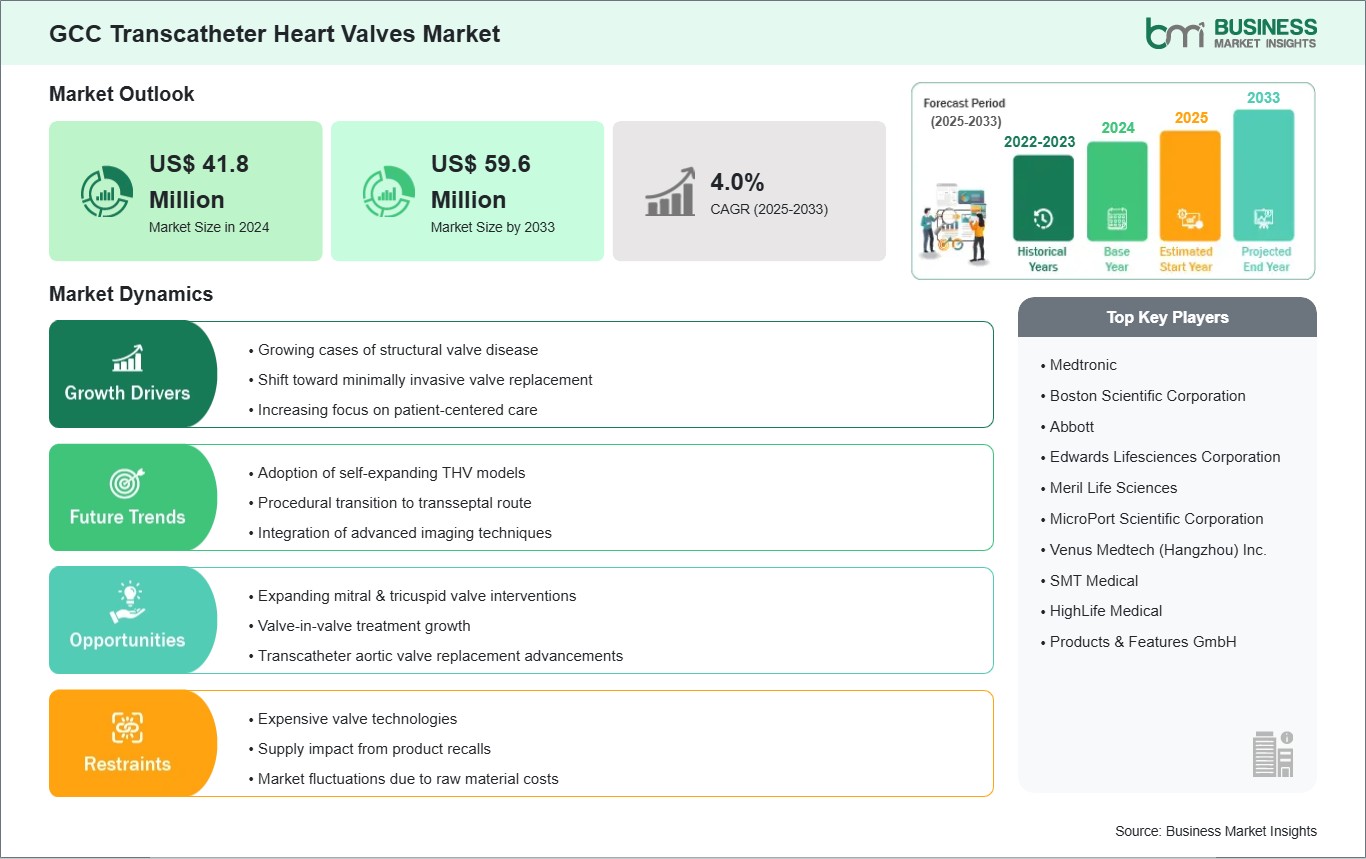
The GCC transcatheter heart valves market size is expected to reach US$ 59.6 million by 2033 from US$ 41.8 million in 2024. The market is estimated to record a CAGR of 4.0% from 2025 to 2033.
The Gulf Cooperation Council (GCC) transcatheter heart valves market is steadily advancing, shaped by rising cardiovascular disease prevalence, rapid healthcare modernization, and strong government investments in tertiary care. The region's demographic profile, characterized by aging populations and high rates of lifestyle-related conditions such as diabetes, hypertension, and obesity, has created significant demand for minimally invasive cardiac interventions. Saudi Arabia has emerged as the dominant market within the GCC, supported by its large patient base, ambitious healthcare reforms, and growing network of specialized cardiac centers.
Market momentum in the GCC is influenced by national strategies to diversify healthcare services, attract international expertise, and integrate advanced medical technologies into public and private hospitals. Partnerships with global medtech companies and the establishment of training programs for local cardiologists have accelerated adoption. However, challenges remain. High procedural costs and limited reimbursement frameworks can restrict accessibility, while disparities in access between urban centers and smaller cities continue to pose barriers. Additionally, dependence on imported devices and the need for more trained specialists across the region slow down widespread adoption. Despite these hurdles, the GCC market outlook is positive, with Saudi Arabia leading the way and other member states gradually expanding their capabilities.

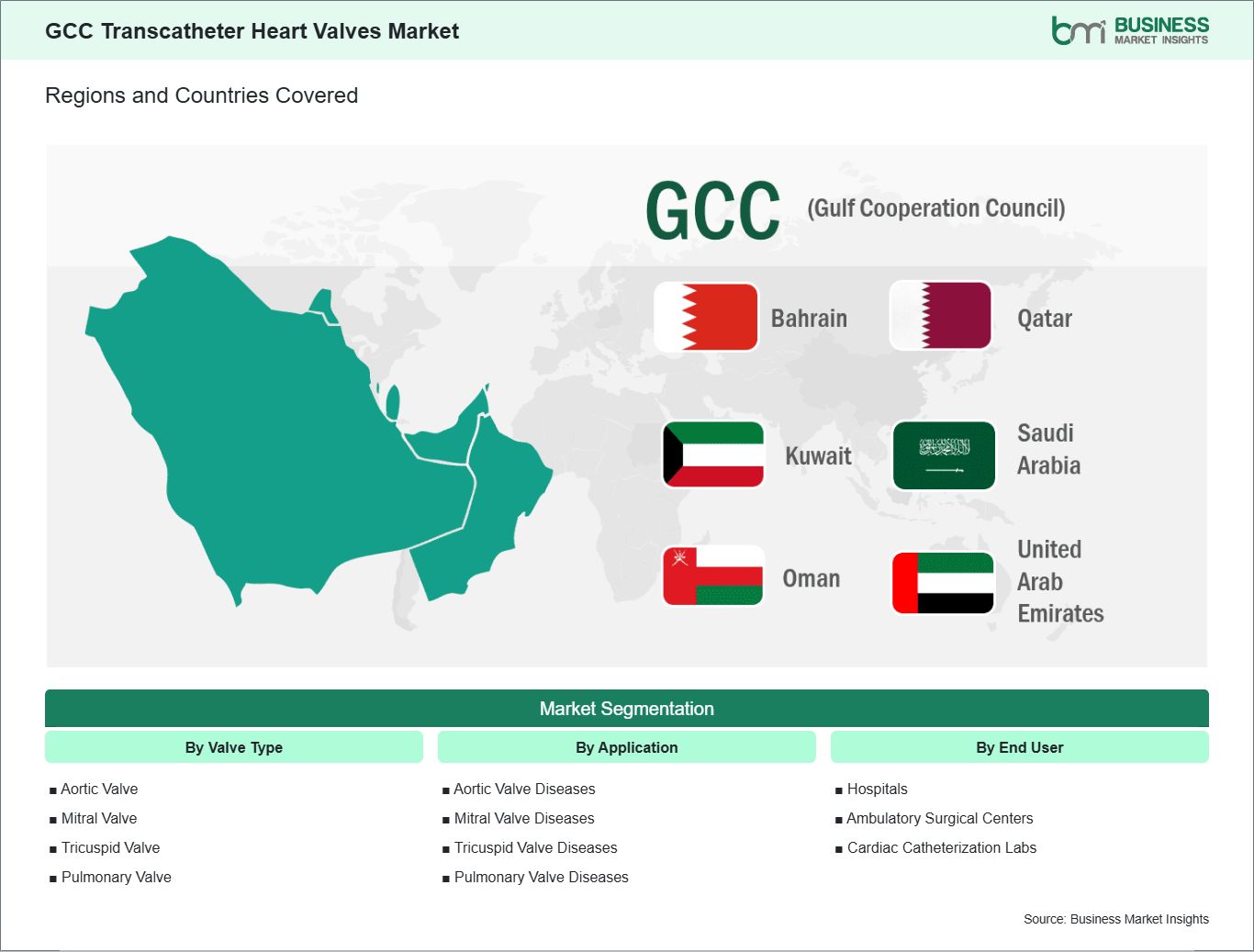
Key segments that contributed to the derivation of the GCC transcatheter heart valves market analysis are valve type, application, and end user.
In the GCC region, valvular heart disease is recognized as a growing health concern, especially among the aging population and individuals with lifestyle-related risk factors such as obesity, diabetes, and hypertension. While traditionally rheumatic heart disease was less common than in some other regions, the rise of non-communicable diseases is contributing to more cases of aortic and mitral valve dysfunction. Hospitals in major cities such as Riyadh, Dubai, and Doha are reporting higher numbers of patients requiring advanced valve interventions.
The region's healthcare systems are highly developed but concentrated in urban centers, meaning access to traditional open-heart surgery is sometimes limited for patients in smaller towns. Transcatheter heart valves offer a minimally invasive alternative, reducing hospital stay and surgical risks, which is especially important for older or high-risk patients. Well-equipped cardiac centers, specialist training programs, and growing clinical confidence in catheter-based procedures support the adoption of these therapies.
Government initiatives across the GCC are also helping drive adoption. Health authorities are supporting state-of-the-art cardiac care, including public and private partnerships that enhance access to advanced interventions. Awareness campaigns and early screening programs are improving diagnosis, leading to timely referrals. These factors make the rising prevalence of valvular heart disease a key driver of transcatheter heart valve adoption in the GCC market.
Historically, transcatheter procedures in the GCC focused primarily on aortic valve disease, but there is increasing attention on mitral and tricuspid valve disorders. Advanced imaging technologies and growing expertise among cardiologists in major cardiac centers are enabling earlier detection and assessment of these complex valve conditions. As physicians gain confidence in performing these procedures, hospitals are gradually expanding their offerings to include mitral and tricuspid transcatheter interventions, creating a significant market opportunity.
Many patients with mitral and tricuspid valve dysfunction are elderly or have multiple comorbidities, making conventional surgery less viable. Minimally invasive transcatheter therapies allow these patients to receive effective treatment with reduced risk and faster recovery. Cardiac centers in Dubai, Abu Dhabi, Riyadh, and Doha are performing these procedures, often supported by multidisciplinary heart teams and regional referral networks.
For medical device companies, this represents a promising opportunity to grow their presence in the GCC market. Providing training, clinical support, and procedural guidance can help hospitals expand their expertise and patient volume. As more clinicians and patients become aware of the benefits, mitral and tricuspid valve applications are poised to become an important segment of the region's transcatheter heart valve market.

The GCC Transcatheter Heart Valves market demonstrates steady growth, with size and share analysis highlighting evolving trends and competitive dynamics among key players. The report further examines subsegments categorized within valve type, application, and end user, offering insights into their contribution to overall market performance.
By valve type, the aortic valve subsegment dominated the market in 2024. The aortic valve segment dominated due to the high prevalence of aortic stenosis, growing preference for minimally invasive transcatheter aortic valve replacement (TAVR), and technological advancements ensuring improved patient outcomes and procedural safety.
In terms of application, the aortic valve disease subsegment dominated the market in 2024. Aortic valve disease dominated the market as rising cases of calcific aortic stenosis and aging populations increased demand for transcatheter interventions, making it the most treated condition requiring advanced valve replacement solutions.
By end user, the hospitals subsegment dominated the market in 2024. Hospitals serve as primary centers for complex cardiovascular procedures, offering advanced infrastructure, skilled cardiologists, and comprehensive patient care, making them the leading setting for transcatheter heart valve adoption.
| Report Attribute | Details |
|---|---|
| Market size in 2024 | US$ 41.8 Million |
| Market Size by 2033 | US$ 59.6 Million |
| CAGR (2025 - 2033) | 4.0% |
| Historical Data | 2022-2023 |
| Forecast period | 2025-2033 |
| Segments Covered | By By Valve Type
|
| Regions and Countries Covered | GCC
|
| Market leaders and key company profiles |
|
The "GCC Transcatheter Heart Valves Market Size and Forecast (2022–2033)" report provides a detailed analysis of the market covering below areas:
The geographical scope of the GCC Transcatheter Heart Valves market report is divided into: Saudi Arabia, the United Arab Emirates (UAE), Qatar, Kuwait, Bahrain, and Oman. Saudi Arabia held the largest share in 2024.
Saudi Arabia dominates the GCC transcatheter heart valves market due to its scale, investment capacity, and strategic healthcare reforms. The country's Vision 2030 initiative has prioritized healthcare modernization, resulting in significant investments in advanced cardiac care facilities across Riyadh, Jeddah, and Dammam. These centers have become focal points for transcatheter valve interventions, supported by collaborations with international medical device companies and the introduction of cutting-edge technologies.
Saudi Arabia's leadership is reinforced by its emphasis on medical training and knowledge transfer, with local physicians participating in specialized programs and international clinical trials. The expansion of private healthcare providers and insurance coverage has also improved patient access to advanced therapies, particularly among the urban middle class. Nonetheless, challenges persist. Rural populations often face limited access to specialized cardiac care, and the high cost of imported devices continues to be a barrier for broader adoption. Despite these limitations, Saudi Arabia remains the benchmark for transcatheter heart valve adoption in the GCC, setting the pace for innovation, clinical excellence, and regional growth in minimally invasive cardiac interventions.

The GCC Transcatheter Heart Valves market is evaluated by gathering qualitative and quantitative data post primary and secondary research, which includes important corporate publications, association data, and databases. A few of the key developments in the GCC transcatheter heart valves market are:
The GCC Transcatheter Heart Valves Market is valued at US$ 41.8 Million in 2024, it is projected to reach US$ 59.6 Million by 2033.
As per our report GCC Transcatheter Heart Valves Market, the market size is valued at US$ 41.8 Million in 2024, projecting it to reach US$ 59.6 Million by 2033. This translates to a CAGR of approximately 4.0% during the forecast period.
The GCC Transcatheter Heart Valves Market report typically cover these key segments-
The historic period, base year, and forecast period can vary slightly depending on the specific market research report. However, for the GCC Transcatheter Heart Valves Market report:
The GCC Transcatheter Heart Valves Market is populated by several key players, each contributing to its growth and innovation. Some of the major players include:
The GCC Transcatheter Heart Valves Market report is valuable for diverse stakeholders, including:
Essentially, anyone involved in or considering involvement in the GCC Transcatheter Heart Valves Market value chain can benefit from the information contained in a comprehensive market report.
Please tell us your area of interest
(Market Segments/ Regions and Countries/ Companies)