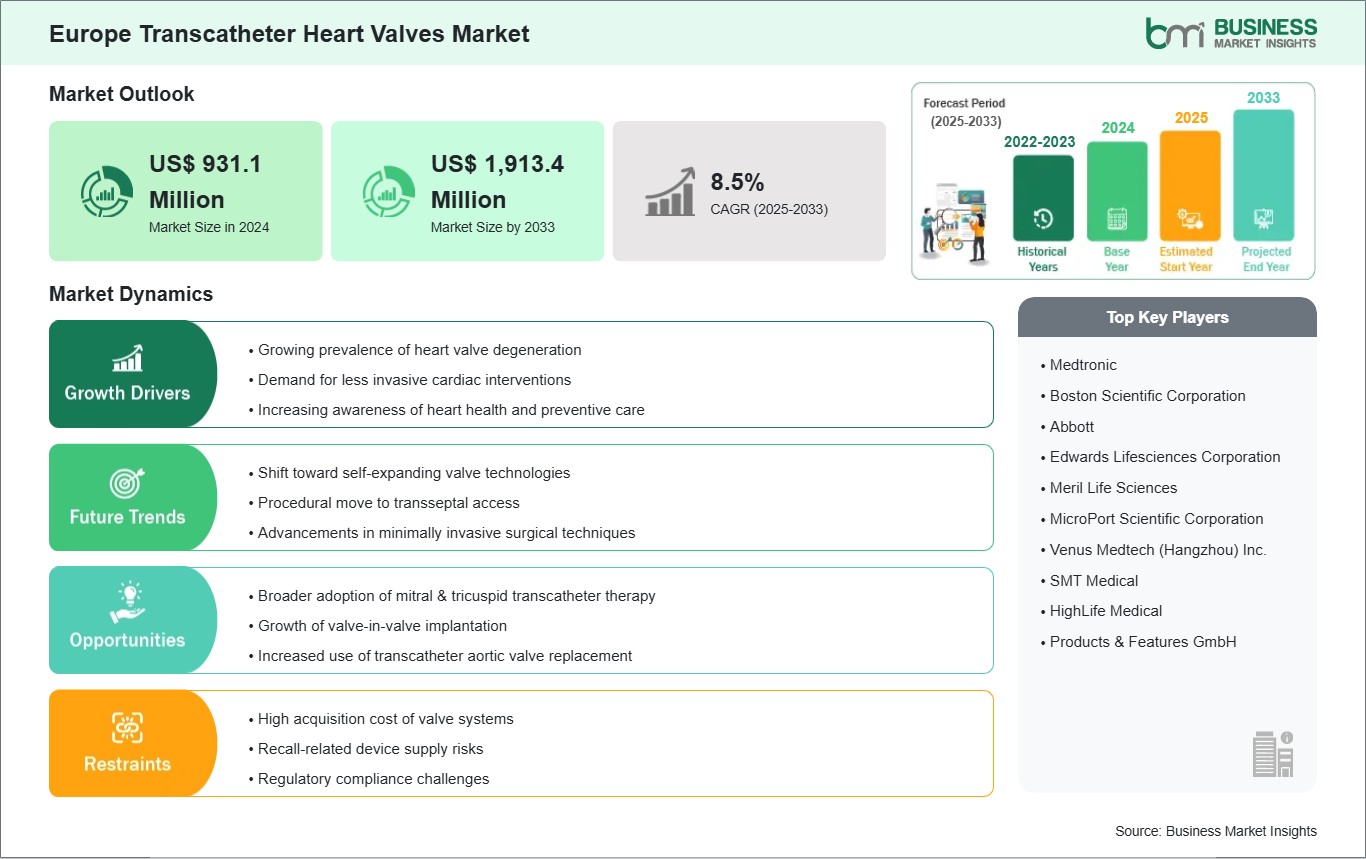
The Europe transcatheter heart valves market size is expected to reach US$ 1,913.4 million by 2033 from US$ 931.1 million in 2024. The market is estimated to record a CAGR of 8.5% from 2025 to 2033.
Europe transcatheter heart valves market is characterized by a high level of clinical maturity, strong institutional acceptance of minimally invasive cardiac interventions, and a well-established ecosystem for structural heart disease management. Across the region, transcatheter heart valve procedures are integrated into standard treatment pathways, reflecting a broader shift toward less invasive alternatives to conventional open-heart surgery. This transition is supported by Europe's aging population, where degenerative valvular disorders are diagnosed and often require timely intervention.
European healthcare systems, particularly in Western Europe, emphasize evidence-based medicine and early adoption of innovative technologies, which have encouraged cardiology teams to expand the use of transcatheter approaches beyond traditionally high-risk patients. The presence of specialized heart teams, advanced imaging capabilities, and hybrid operating environments supports market development. In addition, Europe benefits from strong collaboration between academic institutions, clinical research organizations, and medical device manufacturers, fostering continuous refinement of transcatheter valve technologies. However, the market faces certain restraints that shape its overall growth trajectory. Variability in healthcare infrastructure and access between Western, Central, and Eastern Europe leads to uneven adoption rates across the region. High procedural complexity, the need for specialized training, and budgetary pressures within public healthcare systems also limit faster penetration in smaller or less-equipped hospitals.

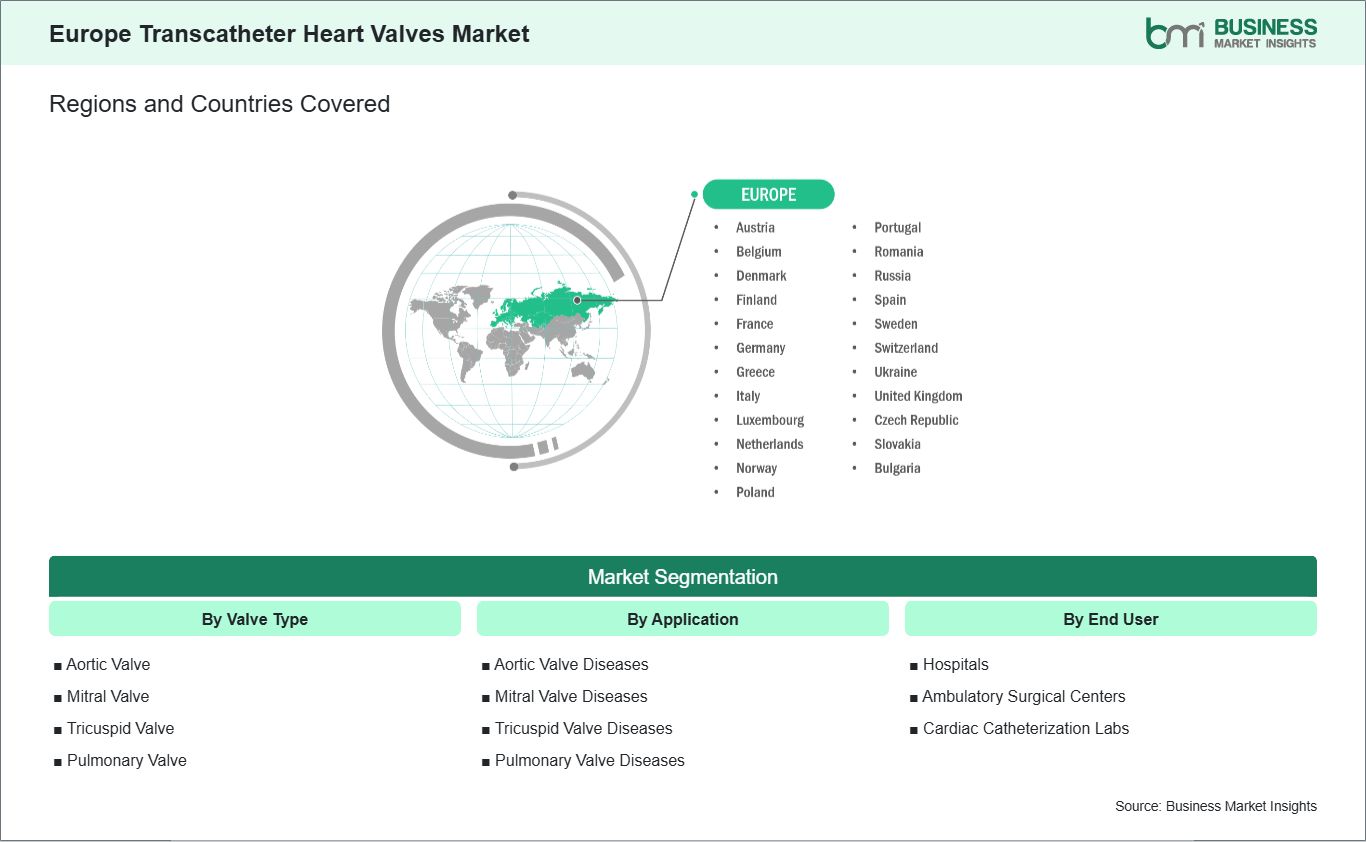
Key segments that contributed to the derivation of the Europe transcatheter heart valves market analysis are valve type, application, and end user.
Europe is facing a steadily rising burden of valvular heart diseases, particularly among older adults. Degenerative conditions, such as aortic stenosis and mitral regurgitation, are common in aging populations, creating sustained demand for minimally invasive treatment options such as transcatheter heart valves (THVs). As life expectancy rises across the continent, hospitals are seeing a growing number of patients who require timely interventions to prevent heart failure and other serious complications.
The high prevalence of valvular disorders has prompted healthcare systems to focus on early diagnosis and intervention. Routine echocardiography and advanced imaging are uncovering previously undiagnosed cases, driving the need for transcatheter solutions that can be delivered with reduced procedural risk. This shift aligns with broader trends in European cardiology toward precision medicine and patient-centered care, where clinicians aim to optimize outcomes while minimizing hospital stays.
Clinical guidelines and consensus statements from European cardiology societies emphasize minimally invasive approaches for high- and intermediate-risk patients. This endorsement has encouraged the adoption of THVs across major cardiac centers, reinforcing their role as a standard treatment option. Hospitals are thus aligning their structural heart programs with evidence-based protocols, ensuring that the infrastructure and training required for transcatheter procedures are widely available.
While aortic valve interventions remain the backbone of transcatheter procedures in Europe, mitral and tricuspid valve applications are emerging as important growth areas. Advancements in transcatheter mitral valve repair and replacement have allowed clinicians to treat patients who were previously considered inoperable due to age or comorbidities. These therapies are becoming integrated into clinical practice, supported by a growing body of evidence demonstrating safety and effectiveness.
Tricuspid valve interventions, once rare, are also gaining momentum in specialized European heart centers. Clinicians are leveraging new transcatheter technologies to manage right-sided valvular disease, particularly in patients with heart failure or pulmonary hypertension. The availability of dedicated devices and improvements in procedural techniques are expanding the range of patients who can benefit from minimally invasive solutions.
Innovations in device design and delivery systems are enhancing procedural efficiency and outcomes. Hybrid approaches, such as valve-in-valve techniques and combination repair-replacement strategies, are becoming more widely adopted, allowing heart teams to tailor interventions to individual patient anatomy and disease complexity. As European hospitals continue to build expertise in structural heart disease, the adoption of mitral and tricuspid transcatheter therapies is expected to accelerate, complementing established aortic programs.
The Europe Transcatheter Heart Valves market demonstrates steady growth, with size and share analysis highlighting evolving trends and competitive dynamics among key players. The report further examines subsegments categorized within valve type, application, and end user, offering insights into their contribution to overall market performance.
By valve type, the aortic valve subsegment dominated the market in 2024. The aortic valve segment dominated due to the high prevalence of aortic stenosis, growing preference for minimally invasive transcatheter aortic valve replacement (TAVR), and technological advancements ensuring improved patient outcomes and procedural safety.
In terms of application, the aortic valve disease subsegment dominated the market in 2024. Aortic valve disease dominated the market as rising cases of calcific aortic stenosis and aging populations increased demand for transcatheter interventions, making it the most treated condition requiring advanced valve replacement solutions.
By end user, the hospitals subsegment dominated the market in 2024. Hospitals serve as primary centers for complex cardiovascular procedures, offering advanced infrastructure, skilled cardiologists, and comprehensive patient care, making them the leading setting for transcatheter heart valve adoption.
| Report Attribute | Details |
|---|---|
| Market size in 2024 | US$ 931.1 Million |
| Market Size by 2033 | US$ 1,913.4 Million |
| CAGR (2025 - 2033) | 8.5% |
| Historical Data | 2022-2023 |
| Forecast period | 2025-2033 |
| Segments Covered | By By Valve Type
|
| Regions and Countries Covered | Europe
|
| Market leaders and key company profiles |
|
The "Europe Transcatheter Heart Valves Market Size and Forecast (2022–2033)" report provides a detailed analysis of the market covering below areas:
The geographical scope of the Europe Transcatheter Heart Valves market report is divided into: Germany, Italy, France, the UK, Spain, Belgium, the Netherlands, Luxembourg, Norway, Finland, Denmark, Sweden, Austria, Switzerland, Russia, Romania, Greece, the Czech Republic, Portugal, Ukraine, Poland, Slovakia, and Bulgaria. Germany held the largest share in 2024.
Germany represents the dominant country in the Europe transcatheter heart valves market, driven by its advanced healthcare infrastructure, strong clinical expertise, and long-standing leadership in cardiovascular medicine. The country is recognized for its early adoption of innovative medical technologies and its strong emphasis on minimally invasive treatment modalities, particularly in the field of interventional cardiology. German hospitals are equipped with state-of-the-art catheterization laboratories and hybrid operating rooms, enabling efficient and safe performance of transcatheter heart valve procedures. A well-structured referral system and the presence of multidisciplinary heart teams support accurate patient selection and consistent procedural outcomes, reinforcing physician and patient confidence in transcatheter therapies.
Germany's healthcare reimbursement environment plays a crucial role in facilitating access to these procedures, allowing hospitals to integrate transcatheter valve interventions into routine clinical practice. Furthermore, the country's active participation in clinical research, registries, and post-market surveillance initiatives contributes to continuous evaluation and optimization of treatment protocols. At the same time, the German market is influenced by increasing focus on long-term clinical outcomes, device durability, and cost-effectiveness, particularly as transcatheter therapies are considered for broader patient populations. Despite these considerations, Germany continues to set clinical and procedural benchmarks for transcatheter heart valve adoption across Europe.

The Europe Transcatheter Heart Valves market is evaluated by gathering qualitative and quantitative data post primary and secondary research, which includes important corporate publications, association data, and databases. A few of the key developments in the Europe transcatheter heart valves market are:
The Europe Transcatheter Heart Valves Market is valued at US$ 931.1 Million in 2024, it is projected to reach US$ 1,913.4 Million by 2033.
As per our report Europe Transcatheter Heart Valves Market, the market size is valued at US$ 931.1 Million in 2024, projecting it to reach US$ 1,913.4 Million by 2033. This translates to a CAGR of approximately 8.5% during the forecast period.
The Europe Transcatheter Heart Valves Market report typically cover these key segments-
The historic period, base year, and forecast period can vary slightly depending on the specific market research report. However, for the Europe Transcatheter Heart Valves Market report:
The Europe Transcatheter Heart Valves Market is populated by several key players, each contributing to its growth and innovation. Some of the major players include:
The Europe Transcatheter Heart Valves Market report is valuable for diverse stakeholders, including:
Essentially, anyone involved in or considering involvement in the Europe Transcatheter Heart Valves Market value chain can benefit from the information contained in a comprehensive market report.
Please tell us your area of interest
(Market Segments/ Regions and Countries/ Companies)