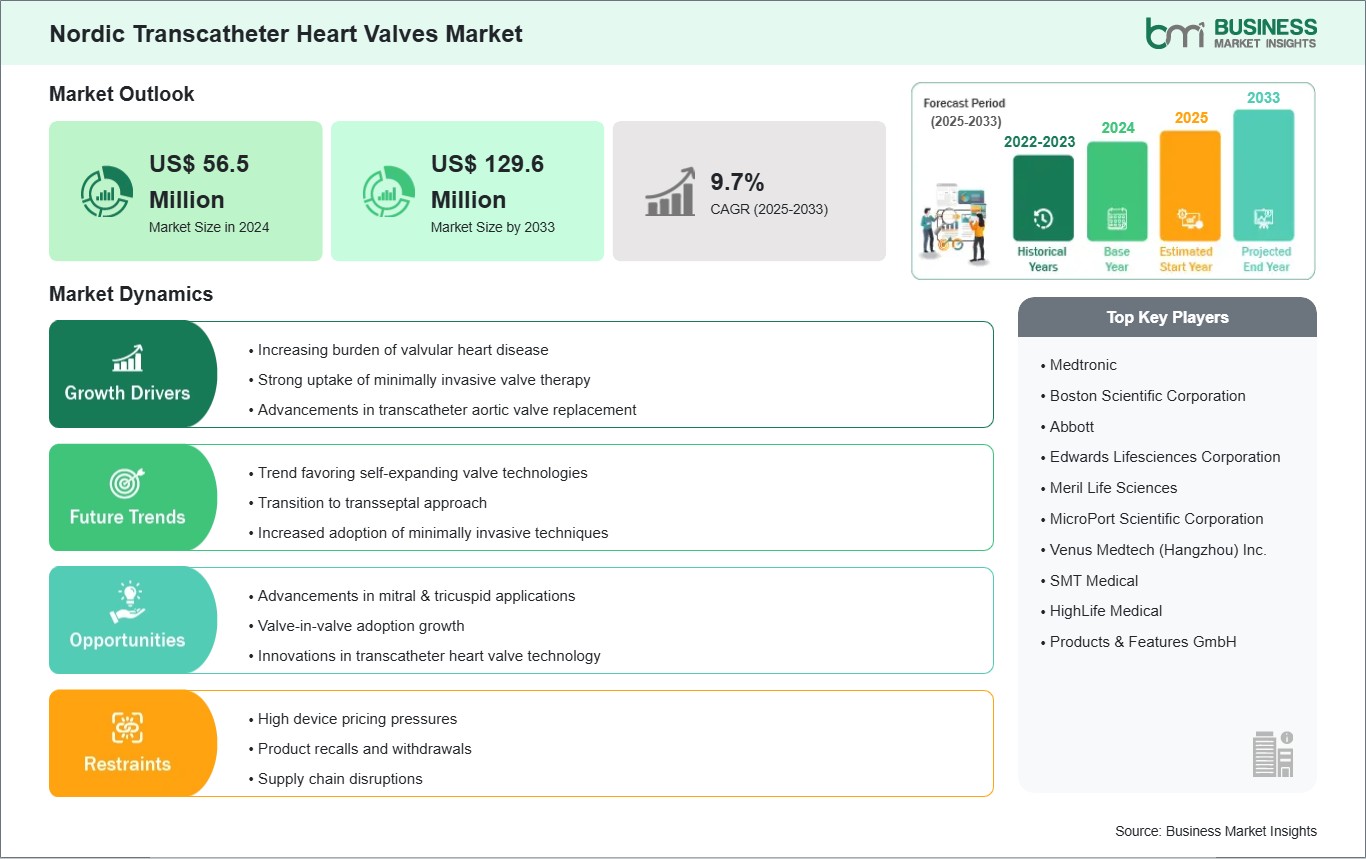
The Nordic transcatheter heart valves market size is expected to reach US$ 129.6 million by 2033 from US$ 56.5 million in 2024. The market is estimated to record a CAGR of 9.7% from 2025 to 2033.
The Nordic transcatheter heart valves market is distinguished by its advanced healthcare systems, strong emphasis on innovation, and widespread patient access to minimally invasive cardiac procedures. Countries such as Sweden, Denmark, Norway, and Finland have all invested heavily in modernizing cardiac care, but Sweden has emerged as the dominant market due to its robust hospital infrastructure, early adoption of transcatheter aortic valve replacement (TAVR), and strong clinical research environment.
The region's aging population, combined with high awareness of cardiovascular health, has created significant demand for advanced valve interventions. A culture of innovation and collaboration between hospitals, universities, and global medtech companies shapes market expansion in the Nordics. Sweden's leadership is reinforced by its active participation in international clinical trials and its reputation for pioneering new treatment protocols. However, challenges remain. High procedural costs and complex reimbursement pathways can limit accessibility for certain patient groups, while the need for continuous training to keep pace with evolving technologies places pressure on healthcare providers. Despite these hurdles, the Nordic market outlook is highly positive, with Sweden setting the standard for clinical excellence and innovation, while neighboring countries gradually expand their adoption of transcatheter valve technologies.

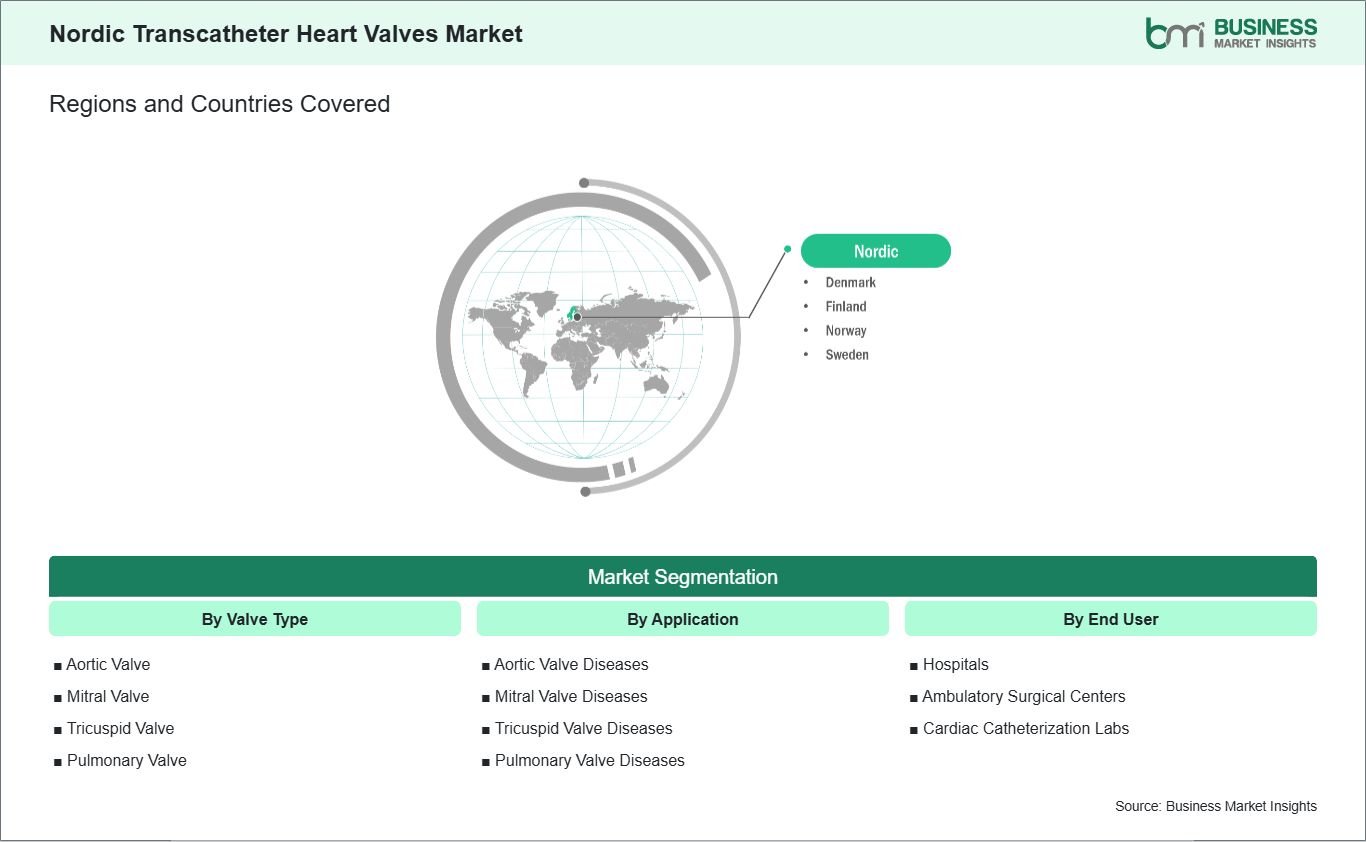
Key segments that contributed to the derivation of the Nordic transcatheter heart valves market analysis are valve type, application, and end user.
In the Nordic region, valvular heart diseases are becoming an important health issue, particularly among the aging population. Countries such as Sweden, Norway, and Finland have a high proportion of elderly individuals, which contributes to more cases of degenerative aortic and mitral valve disease. Advancements in routine health screening and widespread access to cardiac imaging have led to earlier detection, meaning more patients are being identified as candidates for intervention. Improved awareness among primary care physicians and cardiologists is also helping patients seek specialized treatment sooner.
Although the Nordic countries have well-developed healthcare systems with strong surgical programs, open-heart surgery can still pose challenges for older or high-risk patients. Transcatheter heart valve procedures offer a minimally invasive alternative that reduces recovery time and procedural risk. Many cardiac centers in cities such as Stockholm, Copenhagen, and Oslo have incorporated these procedures into their structural heart disease programs, making them accessible to patients who might otherwise face limited options due to age or comorbidities.
Government-supported healthcare infrastructure and well-established referral systems facilitate timely intervention for valvular heart disease in the region. Public awareness campaigns and advanced diagnostic networks are also contributing to earlier detection and treatment. The combination of a growing elderly population, robust healthcare systems, and increasing patient demand makes the rising prevalence of valvular heart disease a key driver for transcatheter heart valve adoption in the Nordic market.
While aortic valve interventions have historically dominated, there is increasing clinical interest in mitral and tricuspid valve disorders across Nordic. Advanced imaging technologies, including 3D echocardiography and CT scans, allow for more precise diagnosis of these complex valve conditions. Cardiology centers in major cities are gradually expanding transcatheter procedures beyond aortic valves, creating opportunities for healthcare providers and device manufacturers to introduce innovative solutions.
Patients with mitral or tricuspid valve dysfunction are often elderly or have comorbidities, making traditional surgery riskier. Minimally invasive transcatheter options allow these patients to undergo treatment with lower complication rates and faster recovery. Hospitals in the region are supported by multidisciplinary heart teams, which help optimize patient selection and procedural outcomes, fostering confidence in expanding these interventions.
For device companies, the growth in mitral and tricuspid valve applications represents a strong market opportunity. By offering physician training, procedural support, and clinical education, manufacturers can help accelerate adoption. As physician expertise grows and patients become more aware of minimally invasive options, mitral and tricuspid valve interventions are expected to become an important segment of the transcatheter heart valve market in the Nordic region.

The Nordic Transcatheter Heart Valves market demonstrates steady growth, with size and share analysis highlighting evolving trends and competitive dynamics among key players. The report further examines subsegments categorized within valve type, application, and end user, offering insights into their contribution to overall market performance.
By valve type, the aortic valve subsegment dominated the market in 2024. The aortic valve segment dominated due to the high prevalence of aortic stenosis, growing preference for minimally invasive transcatheter aortic valve replacement (TAVR), and technological advancements ensuring improved patient outcomes and procedural safety.
In terms of application, the aortic valve disease subsegment dominated the market in 2024. Aortic valve disease dominated the market as rising cases of calcific aortic stenosis and aging populations increased demand for transcatheter interventions, making it the most treated condition requiring advanced valve replacement solutions.
By end user, the hospitals subsegment dominated the market in 2024. Hospitals serve as primary centers for complex cardiovascular procedures, offering advanced infrastructure, skilled cardiologists, and comprehensive patient care, making them the leading setting for transcatheter heart valve adoption.
| Report Attribute | Details |
|---|---|
| Market size in 2024 | US$ 56.5 Million |
| Market Size by 2033 | US$ 129.6 Million |
| CAGR (2025 - 2033) | 9.7% |
| Historical Data | 2022-2023 |
| Forecast period | 2025-2033 |
| Segments Covered | By By Valve Type
|
| Regions and Countries Covered | Nordic
|
| Market leaders and key company profiles |
|
The "Nordic Transcatheter Heart Valves Market Size and Forecast (2022–2033)" report provides a detailed analysis of the market covering below areas:
The geographical scope of the Nordic Transcatheter Heart Valves market report is divided into: Sweden, Norway, Denmark, and Finland. Sweden held the largest share in 2024.
Sweden dominates the Nordic transcatheter heart valves market owing to its advanced healthcare ecosystem, strong research culture, and early adoption of minimally invasive cardiac procedures. Major hospitals in Stockholm, Gothenburg, and Malmö have become recognized centers of excellence for transcatheter valve interventions, offering patients access to cutting-edge technologies and highly skilled specialists. The country's leadership is reinforced by its active involvement in international clinical trials, which accelerates the introduction of new valve technologies and strengthens its role as a hub for innovation in Europe. Government support for healthcare modernization and favorable policies toward medical technology adoption have boosted Sweden's position.
The nation's emphasis on patient-centric care and preventive cardiology has also contributed to higher awareness and acceptance of advanced interventions. Nonetheless, accessibility challenges persist, particularly for patients outside major metropolitan areas, and the high cost of procedures continues to be a barrier for some groups. Despite these limitations, Sweden remains the benchmark for transcatheter heart valve adoption in the Nordics, setting the pace for innovation, accessibility, and regional growth in minimally invasive cardiac interventions.

The Nordic Transcatheter Heart Valves market is evaluated by gathering qualitative and quantitative data post primary and secondary research, which includes important corporate publications, association data, and databases. A few of the key developments in the Nordic transcatheter heart valves market are:
The Nordic Transcatheter Heart Valves Market is valued at US$ 56.5 Million in 2024, it is projected to reach US$ 129.6 Million by 2033.
As per our report Nordic Transcatheter Heart Valves Market, the market size is valued at US$ 56.5 Million in 2024, projecting it to reach US$ 129.6 Million by 2033. This translates to a CAGR of approximately 9.7% during the forecast period.
The Nordic Transcatheter Heart Valves Market report typically cover these key segments-
The historic period, base year, and forecast period can vary slightly depending on the specific market research report. However, for the Nordic Transcatheter Heart Valves Market report:
The Nordic Transcatheter Heart Valves Market is populated by several key players, each contributing to its growth and innovation. Some of the major players include:
The Nordic Transcatheter Heart Valves Market report is valuable for diverse stakeholders, including:
Essentially, anyone involved in or considering involvement in the Nordic Transcatheter Heart Valves Market value chain can benefit from the information contained in a comprehensive market report.
Please tell us your area of interest
(Market Segments/ Regions and Countries/ Companies)