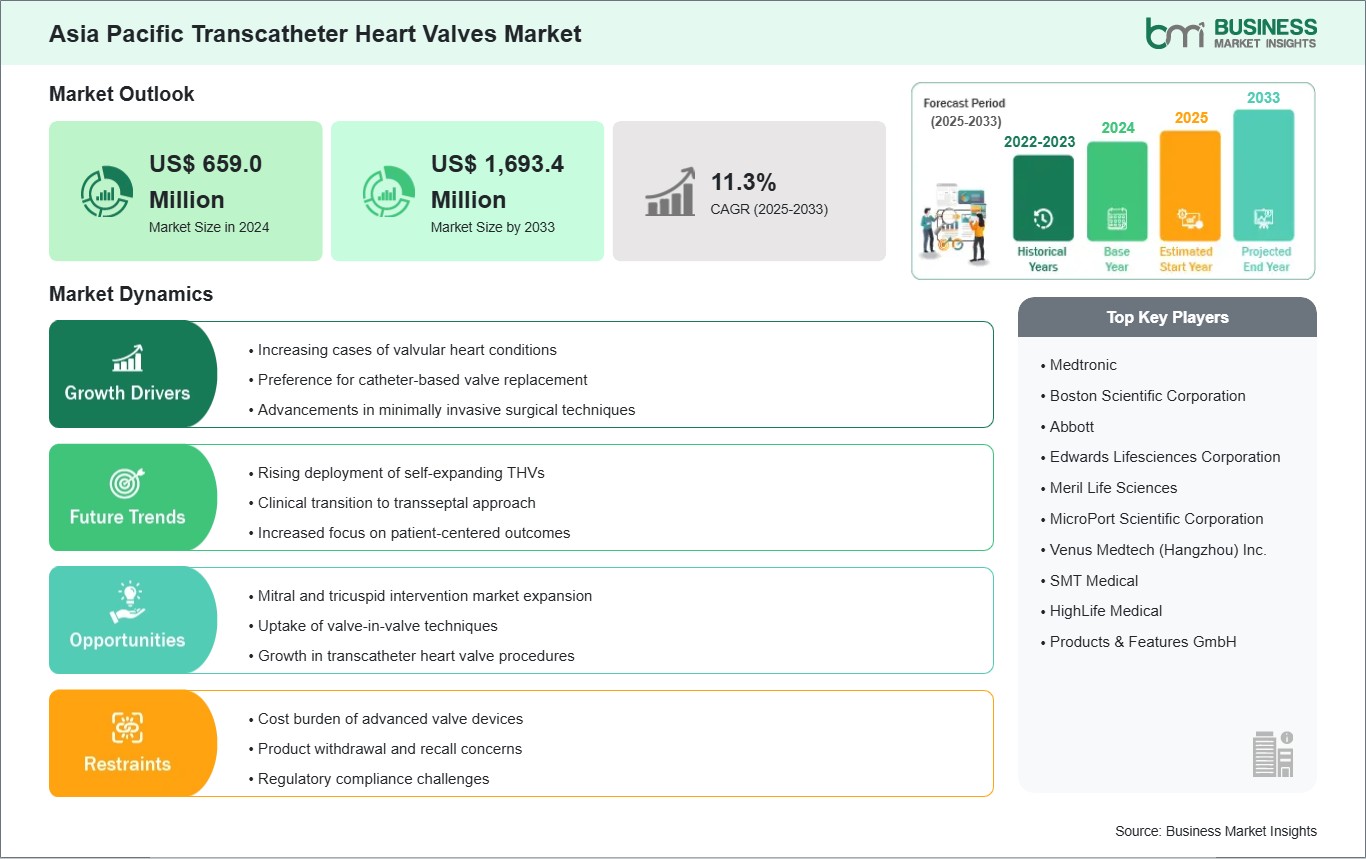
The Asia Pacific transcatheter heart valves market size is expected to reach US$ 1,693.4 million by 2033 from US$ 659.0 million in 2024. The market is estimated to record a CAGR of 11.3% from 2025 to 2033.
The Asia Pacific transcatheter heart valves market is experiencing robust growth, fueled by demographic shifts, rising cardiovascular disease prevalence, and rapid healthcare modernization across the region. Countries such as China, Japan, India, and Australia are witnessing increasing demand for minimally invasive cardiac procedures, with China emerging as the clear leader due to its large patient population and aggressive investments in healthcare infrastructure. The region's expanding middle class, coupled with heightened awareness of advanced treatment options, has accelerated adoption of transcatheter aortic valve replacement (TAVR) and related technologies.
Key drivers include government-backed initiatives to strengthen tertiary care facilities, growing collaborations between local hospitals and global medtech companies, and the rising availability of advanced imaging and diagnostic tools that support precise patient selection. Additionally, Asia Pacific benefits from a strong pipeline of clinical trials and technology transfer programs that bring cutting-edge valve innovations to the region. However, challenges remain significant. High procedural costs, uneven reimbursement frameworks, and disparities in access between urban and rural populations limit widespread adoption. Furthermore, the shortage of highly trained interventional cardiologists in emerging economies continues to be a restraint. Despite these hurdles, Asia Pacific's market outlook is highly positive, with China setting the pace for regional expansion.

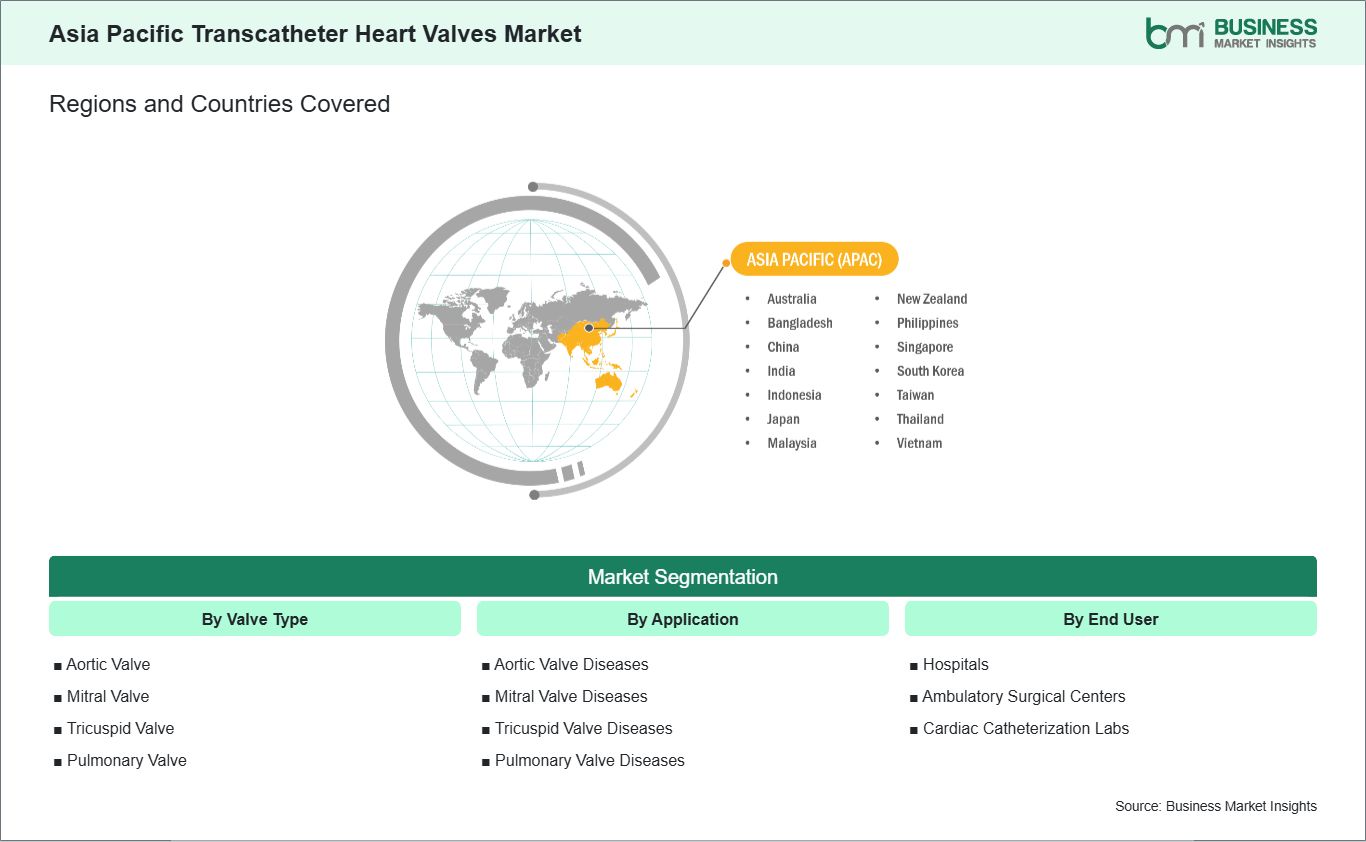
Key segments that contributed to the derivation of the Asia Pacific transcatheter heart valves market analysis are valve type, application, and end user.
In Asia Pacific, valvular heart diseases are being diagnosed more often than before. Improvements in health screening, particularly in urban centers, mean that more people are identified with conditions such as aortic valve narrowing or leakage at an earlier stage. The increase in heart disease is linked to aging populations in several countries, lifestyle factors like sedentary habits and rising blood pressure, and better detection through imaging tools. As a result, doctors in hospitals from Japan to Indonesia are seeing a larger group of patients who need advanced valve care.
At the same time, traditional open-heart surgery poses challenges across much of Asia Pacific. Many patients face long recovery times, and surgical risk is higher for older adults or those with other health issues. In areas with limited cardiac surgery facilities, especially in middle-income nations, transcatheter solutions offer a practical alternative. Physicians and heart centers are therefore turning more to catheter-based valve therapies because they require less recovery time and can be delivered in specialized cardiac suites without full surgical theaters.
This rising presence of valvular disease is pushing health systems to rethink treatment strategies. Public and private hospitals are investing in infrastructure and training that support minimally invasive heart care. Medical societies are also sharing best practices for patient selection and procedure planning. All these efforts are helping transcatheter heart valve procedures become a key part of managing the increasing burden of valve disease across Asia Pacific.
In Asia Pacific, most focus in the past has been on aortic valve disease, as it was easier to detect and treat with available tools. However, doctors are now paying more attention to problems in the mitral and tricuspid valves, especially as imaging technologies become more common in clinical practice. These valves play an important role in blood flow within the heart, and dysfunction can lead to serious symptoms like fatigue and fluid buildup. As cardiologists become more confident in recognizing these conditions, there is a growing interest in using transcatheter options for treatment.
Many patients with mitral and tricuspid valve disease in the region are older or have other illnesses that make traditional surgery risky. In countries where cardiac surgery capacity is limited outside capital cities, minimally invasive solutions allow patients to receive treatment closer to home. Hospitals in larger medical hubs, such as Seoul, Shanghai, and Sydney, are beginning to adopt devices and techniques designed specifically for mitral and tricuspid interventions. These procedures appeal to patients and physicians because they often mean shorter hospital stays and fewer complications.
For device makers and healthcare leaders, this shift represents a clear opportunity. By focusing on training, support, and outcomes data for mitral and tricuspid catheter-based procedures, they can help clinicians expand their skills. Partnerships with regional heart centers and educational programs can increase comfort with these newer therapies. As awareness grows among physicians and patients, mitral and tricuspid valve treatments are set to broaden the role of transcatheter solutions in Asia Pacific cardiac care landscape.

The Asia Pacific Transcatheter Heart Valves market demonstrates steady growth, with size and share analysis highlighting evolving trends and competitive dynamics among key players. The report further examines subsegments categorized within valve type, application, and end user, offering insights into their contribution to overall market performance.
By valve type, the aortic valve subsegment dominated the market in 2024. The aortic valve segment dominated due to the high prevalence of aortic stenosis, growing preference for minimally invasive transcatheter aortic valve replacement (TAVR), and technological advancements ensuring improved patient outcomes and procedural safety.
In terms of application, the aortic valve disease subsegment dominated the market in 2024. Aortic valve disease dominated the market as rising cases of calcific aortic stenosis and aging populations increased demand for transcatheter interventions, making it the most treated condition requiring advanced valve replacement solutions.
By end user, the hospitals subsegment dominated the market in 2024. Hospitals serve as primary centers for complex cardiovascular procedures, offering advanced infrastructure, skilled cardiologists, and comprehensive patient care, making them the leading setting for transcatheter heart valve adoption.
| Report Attribute | Details |
|---|---|
| Market size in 2024 | US$ 659.0 Million |
| Market Size by 2033 | US$ 1,693.4 Million |
| CAGR (2025 - 2033) | 11.3% |
| Historical Data | 2022-2023 |
| Forecast period | 2025-2033 |
| Segments Covered | By Valve Type
|
| Regions and Countries Covered | Asia Pacific
|
| Market leaders and key company profiles |
|
The "Asia Pacific Transcatheter Heart Valves Market Size and Forecast (2022–2033)" report provides a detailed analysis of the market covering below areas:
The geographical scope of the Asia Pacific Transcatheter Heart Valves market report is divided into: China, Japan, South Korea, India, Australia, New Zealand, Indonesia, Malaysia, the Philippines, Singapore, Thailand, Vietnam, Taiwan, Bangladesh, and the Rest of Asia. China held the largest share in 2024.
China dominates the Asia Pacific transcatheter heart valves market, driven by its vast patient base, rising incidence of valvular heart disease, and strong government commitment to healthcare modernization. Major urban centers such as Beijing, Shanghai, and Guangzhou have become hubs for advanced cardiac interventions, with leading hospitals performing TAVR and transcatheter mitral valve repair procedures. The country's leadership is reinforced by large-scale investments in medical technology, partnerships with global device manufacturers, and the establishment of specialized cardiac institutes that serve as training grounds for local physicians.
China's dominance is also supported by its growing participation in international clinical trials, which accelerates the introduction of new valve technologies and strengthens its role as a regional innovation hub. The expansion of national health insurance coverage has improved patient access to advanced therapies, particularly among the urban middle class. However, challenges persist, including disparities in healthcare access between urban and rural regions, reliance on imported devices, and the need for more trained specialists to meet rising demand. Despite these barriers, China continues to set the benchmark for Asia Pacific, positioning itself not only as the largest market but also as a key driver of innovation and adoption in transcatheter heart valve technologies.

The Asia Pacific Transcatheter Heart Valves market is evaluated by gathering qualitative and quantitative data post primary and secondary research, which includes important corporate publications, association data, and databases. A few of the key developments in the Asia Pacific transcatheter heart valves market are:
The Asia Pacific Transcatheter Heart Valves Market is valued at US$ 659.0 Million in 2024, it is projected to reach US$ 1,693.4 Million by 2033.
As per our report Asia Pacific Transcatheter Heart Valves Market, the market size is valued at US$ 659.0 Million in 2024, projecting it to reach US$ 1,693.4 Million by 2033. This translates to a CAGR of approximately 11.3% during the forecast period.
The Asia Pacific Transcatheter Heart Valves Market report typically cover these key segments-
The historic period, base year, and forecast period can vary slightly depending on the specific market research report. However, for the Asia Pacific Transcatheter Heart Valves Market report:
The Asia Pacific Transcatheter Heart Valves Market is populated by several key players, each contributing to its growth and innovation. Some of the major players include:
The Asia Pacific Transcatheter Heart Valves Market report is valuable for diverse stakeholders, including:
Essentially, anyone involved in or considering involvement in the Asia Pacific Transcatheter Heart Valves Market value chain can benefit from the information contained in a comprehensive market report.
Please tell us your area of interest
(Market Segments/ Regions and Countries/ Companies)