Market Summary
Executive Summary and Market Analysis
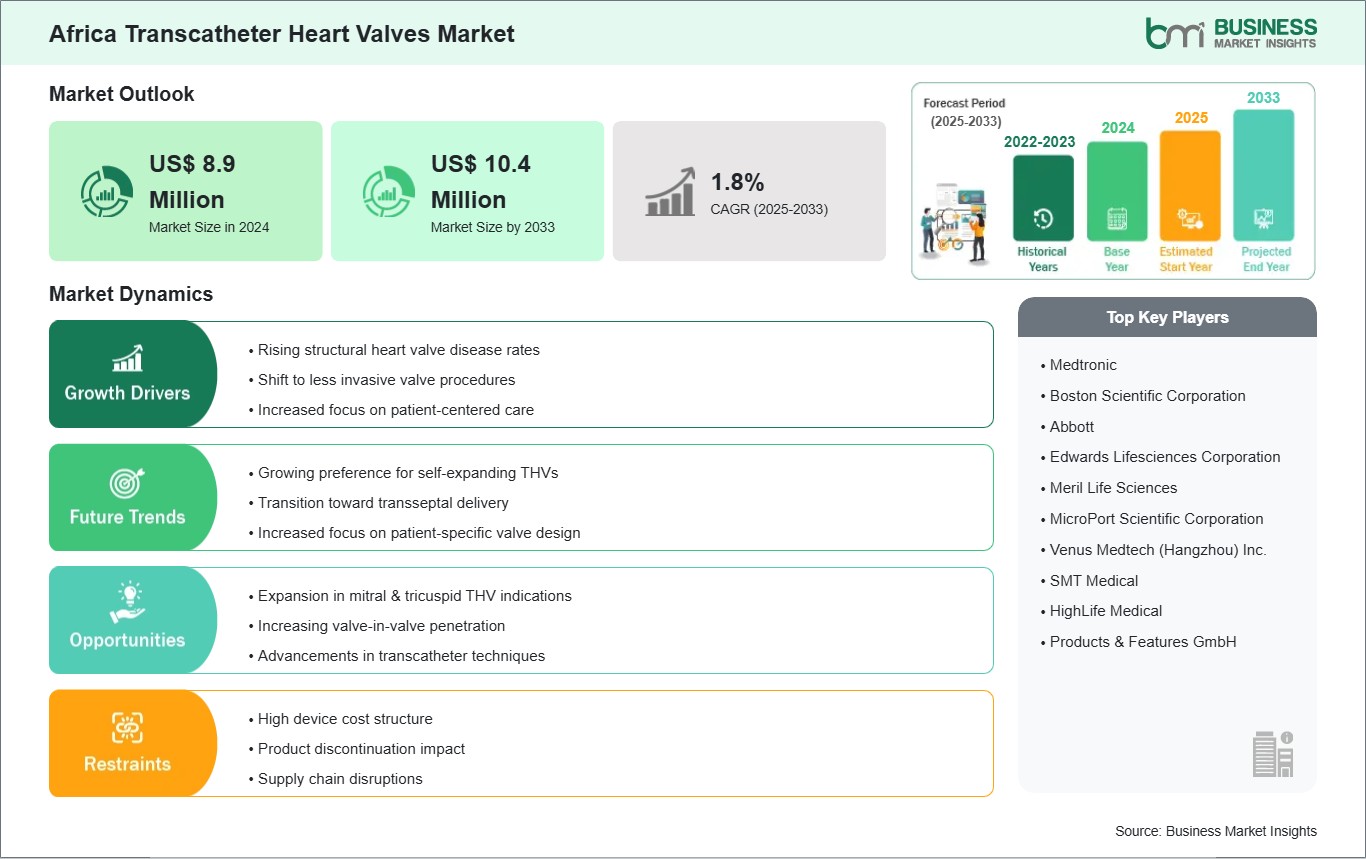
The African transcatheter heart valves market is gaining momentum as healthcare systems across the continent recognize the value of minimally invasive cardiac interventions. The rising prevalence of valvular heart diseases, particularly linked to aging populations and the lingering impact of rheumatic heart disease, is driving demand for advanced treatment options. South Africa, with its relatively well-developed healthcare infrastructure and access to specialized cardiac centers, has become the focal point for the adoption of transcatheter aortic valve replacement (TAVR) and related technologies. The broader African market is also benefiting from international collaborations, medical tourism, and the gradual expansion of training programs for interventional cardiologists.
Key drivers include the growing awareness of minimally invasive procedures, improvements in diagnostic capabilities, and the availability of advanced bioprosthetic valve technologies. However, restraints remain significant. Limited access to specialized cardiac care in many African countries, coupled with high procedural costs and uneven reimbursement frameworks, restricts widespread adoption. Additionally, the shortage of trained specialists and the limited availability of cutting-edge devices outside major urban centers pose challenges to market penetration. Despite these barriers, Africa’s market outlook is positive, with South Africa leading the way and other nations gradually following suit through partnerships and incremental healthcare investments.
Segment Analysis
Africa Transcatheter Heart Valves Market Segmentation
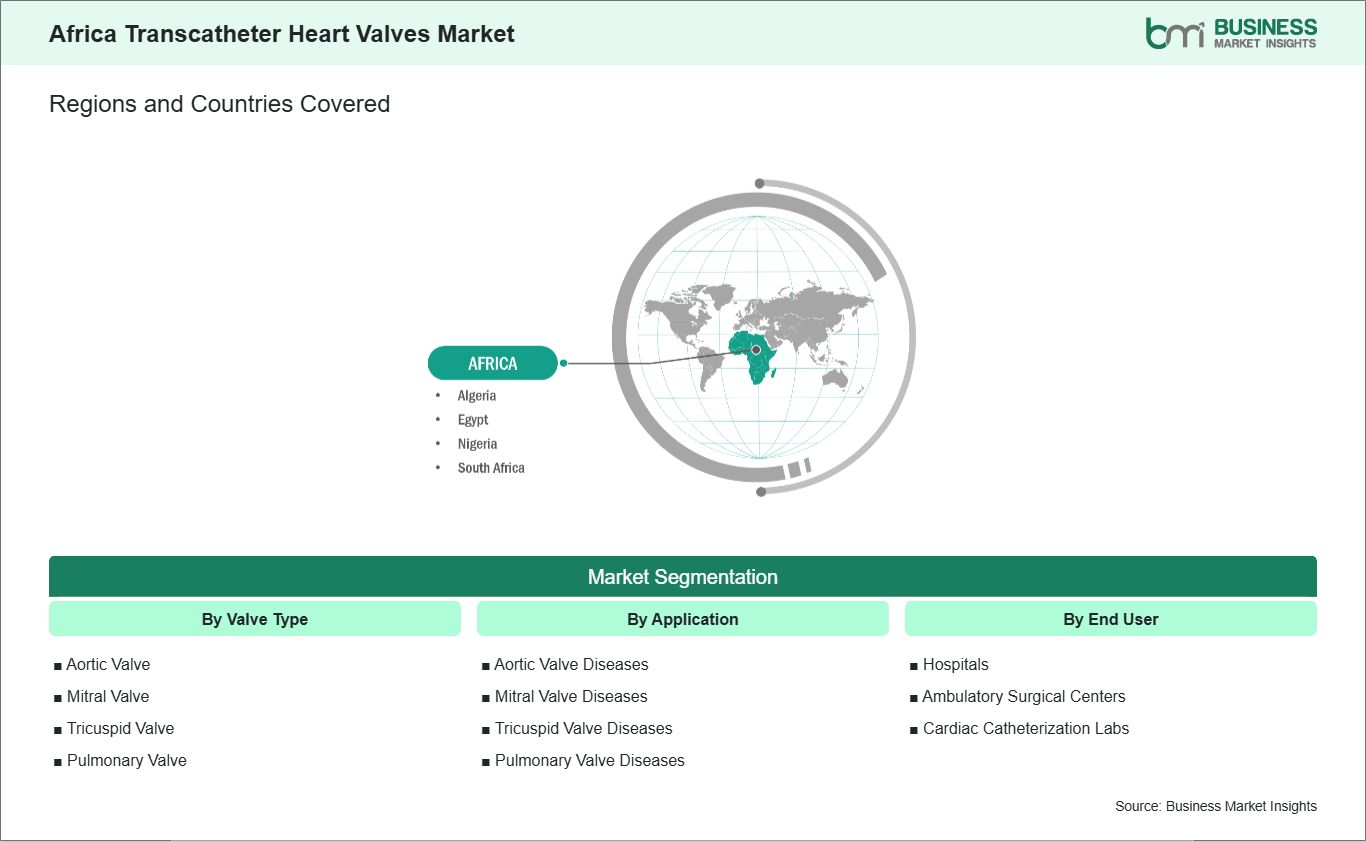
Key segments that contributed to the derivation of the Africa transcatheter heart valves market analysis are valve type, application, and end user.
- In terms of valve type, the transcatheter heart valves market is segmented into aortic valve, mitral valve, tricuspid valve, and pulmonary valve. The aortic valve segment dominated the market in 2024.
- By application, the transcatheter heart valves market is segmented into aortic valve diseases, mitral valve diseases, tricuspid valve diseases, and pulmonary valve diseases. The aortic valve disease segment dominated the market in 2024.
- Based on end user, the transcatheter heart valve market is segmented into hospitals, ambulatory surgical centers, and cardiac catheterization labs. The hospitals segment dominated the market in 2024.
Market Forces
Africa Transcatheter Heart Valves Market Drivers and Opportunities
Rising structural heart valve disease rates
The rise in conditions such as aortic stenosis and regurgitation has increased the need for minimally invasive treatments. Traditional open-heart surgery is often not feasible for many patients due to limited access to specialized surgical centers and long recovery times. Transcatheter heart valve solutions are seen as a viable alternative. This growing health issue is prompting doctors and hospitals across the region to explore catheter-based valve replacements more often than before.
The healthcare infrastructure in several African nations is gradually improving, with investments in cardiac care units and training programs for interventional cardiologists. As awareness grows among healthcare professionals about the benefits of transcatheter therapy, referrals for minimally invasive valve procedures are increasing. Many patients who were previously untreated due to risk concerns or lack of surgical options are becoming candidates for transcatheter valve intervention. This shift is building momentum in the adoption of transcatheter heart valves across the continent.
Patient awareness and diagnosis of valvular disease are also improving owing to public health campaigns and better access to diagnostic tools such as echocardiography. As more people are screened and diagnosed, the need for suitable treatment options rises. Transcatheter heart valves offer a much-needed solution for patients seeking effective and less invasive care, driving demand across both public and private healthcare systems in Africa.
Expansion in mitral & tricuspid THV indications
Transcatheter heart valve procedures in Africa were traditionally focused on aortic valve disease. However, there is a growing clinical interest in using transcatheter solutions for mitral and tricuspid valve disorders. These valve conditions are diagnosed due to better cardiac imaging and specialist training. With many African cardiac centers expanding their capabilities, doctors are beginning to adopt mitral and tricuspid transcatheter interventions, which were limited or unavailable in the region. This presents a clear opportunity for market expansion.
Healthcare providers are beginning to recognize that treating mitral and tricuspid valve disease with catheters can reduce patient trauma and shorten hospital stays. Many patients with these conditions are elderly or have other health challenges, making conventional open surgery risky. Transcatheter options provide a less invasive choice, which can be especially valuable in African healthcare settings where hospital resources are constrained. As clinical comfort and experience with these procedures grow, hospitals are more willing to offer them, creating an opening for medical device companies to introduce new products.
Manufacturers and distributors can support this growth by offering training programs, education, and partnerships with local cardiology centers. Increasing collaboration with regional heart institutes and government health initiatives can help integrate mitral and tricuspid transcatheter therapies into standard care protocols. This expanding clinical demand makes the mitral and tricuspid valve segment an attractive area for future investment and innovation within the African transcatheter heart valve market.
Size and Share Analysis
Africa Transcatheter Heart Valves Market Size and Share Analysis
The Africa Transcatheter Heart Valves market demonstrates steady growth, with size and share analysis highlighting evolving trends and competitive dynamics among key players. The report further examines subsegments categorized within valve type, application, and end user, offering insights into their contribution to overall market performance.
By valve type, the aortic valve subsegment dominated the market in 2024. The aortic valve segment dominated due to the high prevalence of aortic stenosis, growing preference for minimally invasive transcatheter aortic valve replacement (TAVR), and technological advancements ensuring improved patient outcomes and procedural safety.
In terms of application, the aortic valve disease subsegment dominated the market in 2024. Aortic valve disease dominated the market as rising cases of calcific aortic stenosis and aging populations increased demand for transcatheter interventions, making it the most treated condition requiring advanced valve replacement solutions.
By end user, the hospitals subsegment dominated the market in 2024. Hospitals serve as primary centers for complex cardiovascular procedures, offering advanced infrastructure, skilled cardiologists, and comprehensive patient care, making them the leading setting for transcatheter heart valve adoption.
Report Coverage
Africa Transcatheter Heart Valves Market Report Coverage and Deliverables
The "Africa Transcatheter Heart Valves Market Size and Forecast (2022–2033)" report provides a detailed analysis of the market covering below areas:
- Africa Transcatheter Heart Valves market size and forecast at regional and country levels for key market segments covered under the scope
- Africa Transcatheter Heart Valves market trends, as well as market dynamics such as drivers, restraints, and key opportunities
- Africa Transcatheter Heart Valves market analysis covering key market trends, regional framework, major players, regulations, and recent market developments
- Industry landscape and competition analysis covering market concentration, heat map analysis, prominent players, and recent developments for the Africa Transcatheter Heart Valves market
- Detailed company profiles, including SWOT analysis
Geographic Insights
Africa Transcatheter Heart Valves Market Geographic Insights
The geographical scope of the Africa transcatheter heart valves market report is divided into: Nigeria, Egypt, South Africa, and Algeria. South Africa held the largest share in 2024.
South Africa dominates the African transcatheter heart valves market due to its advanced healthcare ecosystem, relatively higher patient awareness, and established cardiac care facilities. The country has witnessed a notable increase in the adoption of transcatheter valve replacement procedures, driven by the rising incidence of degenerative valve diseases among its aging population. Major hospitals and specialized cardiac centers in Johannesburg, Cape Town, and Durban have become key hubs for performing TAVR and transcatheter mitral valve repair, supported by international collaborations and technology transfer from global medtech companies.
South Africa’s leadership in this market is also reinforced by its role as a training and innovation hub for the region.
Local cardiologists and surgeons are involved in clinical trials and pilot programs, which help accelerate the introduction of new valve technologies. Furthermore, the country’s relatively better reimbursement environment compared to other African nations supports patient access to advanced therapies. Nonetheless, challenges persist, including disparities in access between urban and rural populations, high device costs, and dependence on imported technologies. Despite these hurdles, South Africa continues to set the benchmark for transcatheter heart valve adoption in Africa, positioning itself as the gateway for broader regional growth in this sector.
Industry Activity
Recent Developments
The Africa Transcatheter Heart Valves market is evaluated by gathering qualitative and quantitative data post primary and secondary research, which includes important corporate publications, association data, and databases. A few of the key developments in the Africa transcatheter heart valves market are:
- In December 2025, MicroPort CardioFlow Medtech Corporation announced that its VitaFlow Liberty transcatheter aortic valve implantation (TAVI) system received market approval in Morocco, marking its first regulatory approval and commercial entry into the African continent and establishing a foundation for expansion of its TAVI/THV products across Africa.
- In November 2025, MicroPort CardioFlow Medtech Corporation announced that its VitaFlow TAVI system surpassed 1,000 overseas commercial implantations, supporting its strategic global expansion that includes adoption in markets spanning Europe, Latin America, Asia, and the Middle East & Africa.
Trust & Transparency
Research Methodology
The market analysis combines proprietary research with secondary data from government agencies, company disclosures, regulatory filings, industry databases and expert interviews. Market estimates are validated through data triangulation, cross-market benchmarking and analyst
review.
View Full Research Methodology
Key Sources Referred:
The World Bank World Health Organization (WHO) Center for Disease Control and Prevention (CDC) European Society of Cardiology American College of Cardiology American Heart Association Asian Pacific Society of Interventional Cardiology Company Websites Company Annual Reports Company Investor Presentations