
Food Supplement Ingredients Market Outlook: Size, Share, Trends, Growth Analysis, Competitive Landscape & Forecast, 2026–2033

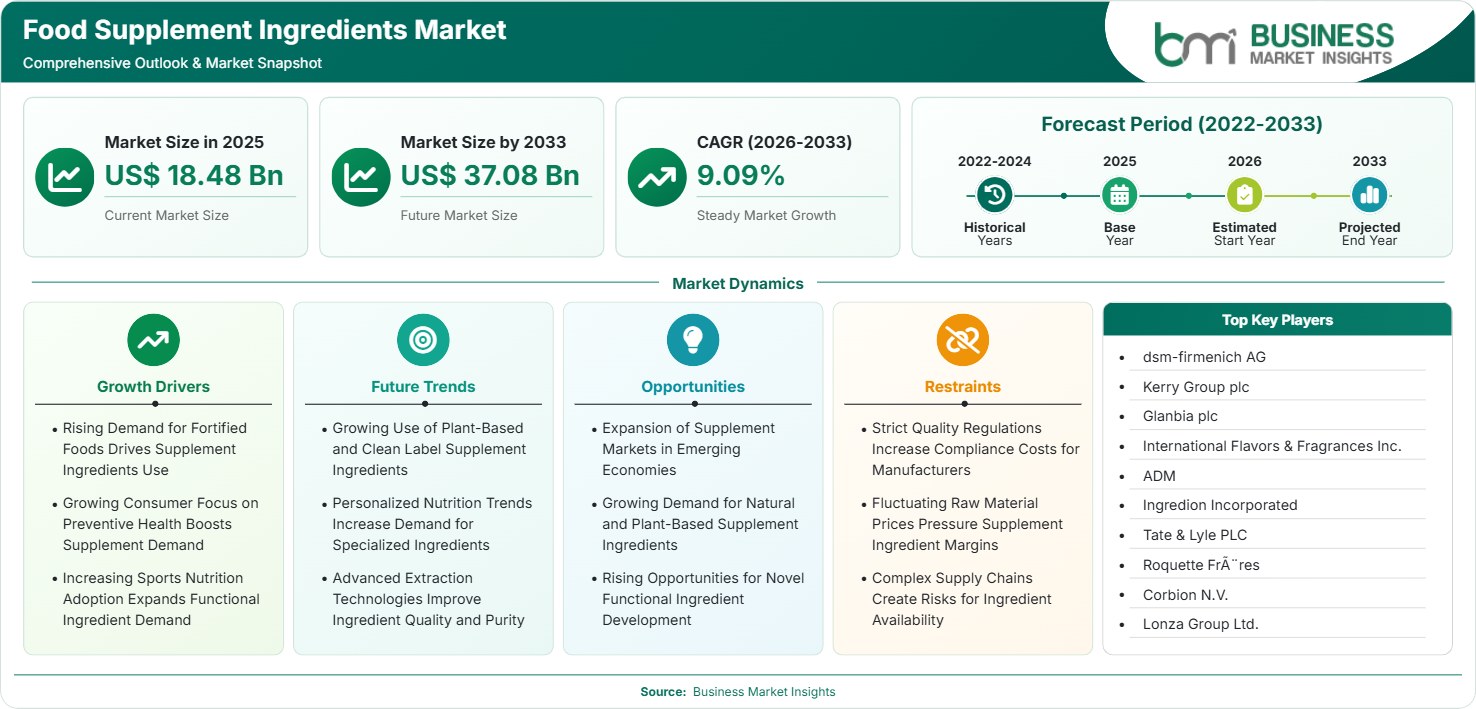
The Food Supplement Ingredients Market size was valued at US$ 18.48 Billion in 2025 and is projected to reach US$ 37.08 Billion by 2033, growing at a CAGR of 9.09% during 2026–2033, supported by preventive health, plant-based formulations, and functional ingredient innovation.

Report Coverage
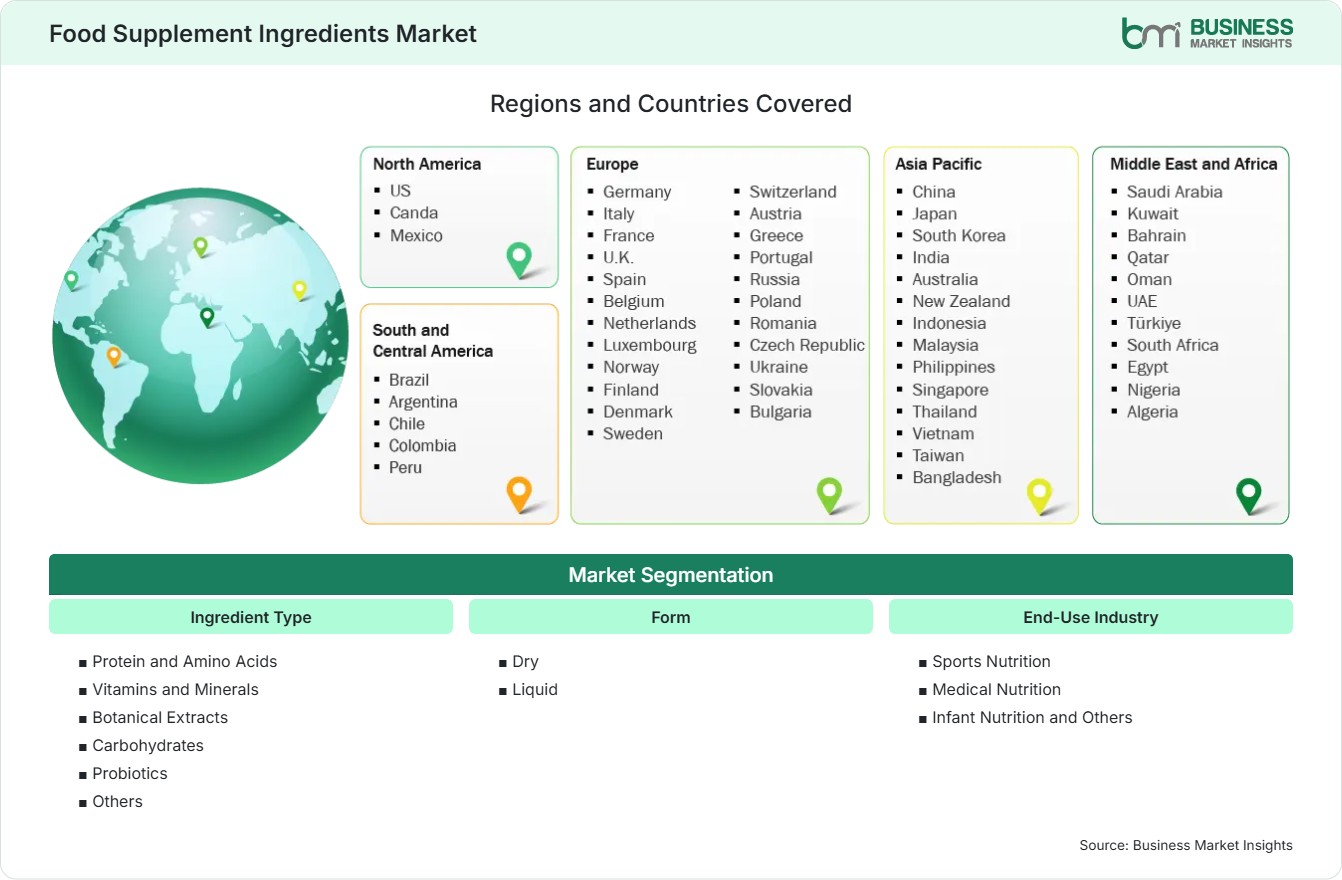
  • Ingredient Type: Protein and Amino Acids, Vitamins and Minerals, Botanical Extracts, Carbohydrates, Probiotics, Others
  • Form: Dry, Liquid
  • End-Use Industry: Sports Nutrition, Medical Nutrition, Infant Nutrition and Others
US$ 18.48 Bn Market size in 2025
US$ 37.08 Bn Market Size by 2033
9.09% CAGR, 2026 - 2033
2026-2033 Forecast Period

AI Overview

Food Supplement Ingredients Market Summary

  • North America: North America holds a 30%–33% Food Supplement Ingredients Market share in 2025, growing at a 7.8%–8.6% CAGR during 2026–2033, backed up by preventive nutrition, sports nutrition, enriched foods, well-established supplements, and the demand for clinically proven ingredients. The US market is backed up by advanced supplement consumption, ingredient innovation, private label development, and advanced formulation skills, enabling a 7.9%–8.7% CAGR by 2033.
  • Fastest Growing Region: Asia Pacific accounts for a 24%–27% share in 2025 and is advancing at a 10.2%–11.2% CAGR, driven by rising disposable incomes, urbanization, expanding wellness awareness, sports nutrition adoption, fortified foods, and broader availability of functional ingredients.
  • Leading Segment: Protein and Amino Acids holds a 29%–32% share in 2025 and is expanding at a 9.5%–10.4% CAGR, supported by sports nutrition, active lifestyles, high-protein foods, meal replacement products, and continued formulation development around plant and dairy proteins.
  • High Growth Segment: Probiotics represents a 12%–15% share in 2025 and is growing at a 10.8%–11.8% CAGR, supported by rising interest in digestive health, microbiome-focused products, immune support, functional beverages, and improved strain stability and delivery technologies.
  • Key Market Opportunity: The strongest opportunity lies in multifunctional, natural, and science-backed ingredients that combine nutritional value with convenient formats, enabling suppliers to serve preventive health, sports, medical, and everyday wellness applications.
  • Major Market Players: dsm-firmenich AG, Kerry Group plc, Glanbia plc, International Flavors & Fragrances Inc., Archer-Daniels-Midland Company, Ingredion Incorporated, Tate & Lyle PLC, Roquette Frères, Corbion N.V., and Lonza Group Ltd.
Strategic Insights

Food Supplement Ingredients Market: Strategic Insights

Food Supplement Ingredients Market Strategic Framework
FREE PDF
Request your free sample
Request free sample
Stakeholder View

Key Takeaways

  • The supply chain is moving toward closer integration between ingredient producers, formulation specialists, contract manufacturers, and finished-product brands.
  • Protein and Amino Acids offer the broadest commercial upside because they serve sports nutrition, medical nutrition, meal replacement, fortified foods, and everyday wellness products.
  • Probiotic systems, botanical extracts, fortified protein blends, and targeted micronutrient combinations are becoming important areas for formulation development.
  • Asia Pacific presents the strongest regional expansion opportunity as supplement consumption broadens across urban consumers and organized retail channels.
  • Strategic partnerships can help ingredient suppliers shorten development cycles while gaining access to new technologies and specialized customer segments.
  • Sustainability is becoming part of ingredient procurement decisions, particularly for plant-based proteins, botanical materials, and fermentation-derived ingredients.
Geographic Outlook

Food Supplement Ingredients Market Regional Highlights

North America Food Supplement Ingredients Market

North America accounts for a 30%–33% share in 2025 and North America Food Supplement Ingredients Market forecast to grow at a 7.8%–8.6% CAGR through 2033. The US remains the dominant country, while Canada provides additional demand for functional nutrition, natural ingredients, and specialty formulations. Increasing attention to ingredient quality and substantiated claims is strengthening demand for technically differentiated products.

  • Sports nutrition continues to support protein demand as manufacturers seek ingredients offering better solubility, taste, texture, and formulation stability across powders, bars, beverages, and convenient nutrition products.
  • Preventive health positioning is broadening demand for vitamins, minerals, botanical extracts, probiotics, and combination formulations designed around everyday wellness rather than narrowly defined nutritional deficiencies.
  • Regulatory oversight encourages stronger documentation, ingredient identity verification, manufacturing controls, and labeling discipline, increasing the value of suppliers with established quality systems and technical regulatory support.
  • Application development is becoming a competitive differentiator as brands seek faster formulation cycles, cleaner labels, improved sensory performance, and ingredients compatible with multiple product formats.

US Food Supplement Ingredients Market

The US Food Supplement Ingredients Market represents approximately 78%–82% of North American demand in 2025 and is growing at a 7.9%–8.7% CAGR through 2033. The market benefits from mature supplement channels, extensive sports nutrition demand, established ingredient suppliers, and strong product development activity.

  • Protein, probiotics, botanical extracts, and specialty micronutrients remain important formulation categories as brands develop products around fitness, healthy aging, digestive wellness, immunity, and daily nutrition.
  • FDA requirements covering dietary ingredients and manufacturing practices increase the importance of identity testing, quality documentation, appropriate labeling, and controlled production processes for ingredient suppliers.
  • Premium brands increasingly differentiate through sourcing transparency, recognizable ingredients, specialized blends, and formulation claims supported by technical documentation and consistent ingredient specifications.

Europe Food Supplement Ingredients Market

Europe Food Supplement Ingredients Market holds a 25%–28% share in 2025 and is expected to grow at a 7.5%–8.4% CAGR through 2033. Germany, France, Italy, the United Kingdom, and Spain represent leading demand centers, while Poland and selected Eastern European markets offer comparatively faster expansion at 8.5%–9.5% CAGR.

  • Germany remains an important market for vitamins, minerals, botanical ingredients, and functional nutrition products, supported by established health-oriented consumption and sophisticated food manufacturing capabilities.
  • France and Italy provide opportunities for botanical extracts, probiotics, and natural functional ingredients as consumers increasingly connect ingredient origin, product quality, and wellness positioning.
  • Plant-based formulations are encouraging greater use of alternative proteins, fibers, botanical ingredients, and fermentation-derived materials across food, beverage, and supplement applications.
  • Regulatory discipline raises documentation requirements and encourages suppliers to maintain detailed evidence covering safety, composition, sourcing, production controls, and permitted product positioning.
  • Eastern European markets provide comparatively faster expansion as modern retail, branded supplements, sports nutrition, and organized healthcare channels continue to develop.

Asia Pacific Food Supplement Ingredients Market

Asia Pacific Food Supplement Ingredients Market accounts for a 24%–27% share in 2025 and is forecast to expand at a 10.2%–11.2% CAGR through 2033. China, Japan, South Korea, India, and Australia are major markets, while India, Indonesia, and Vietnam can achieve approximately 11.0%–12.0% CAGRs as organized retail and wellness categories develop.

  • China remains a major manufacturing and consumption center, with opportunities across proteins, vitamins, minerals, probiotics, botanical extracts, and functional food formulations.
  • India is developing as an important growth market as sports nutrition, fortified foods, preventive wellness, and organized supplement distribution expand across urban consumer groups.
  • Japan and South Korea favor technically differentiated ingredients, including probiotics, specialty botanicals, functional proteins, and formulations designed around healthy aging and digestive wellness.
  • Southeast Asian markets provide new opportunities as modern retail, e-commerce, contract manufacturing, and branded nutrition products broaden access to functional ingredients.
  • Regional suppliers increasingly compete through localized formulation support, faster delivery, regulatory knowledge, and ingredient portfolios adapted to local dietary preferences.

Rest of World Food Supplement Ingredients Market

South and Central America represents a developing demand base, with Brazil and Mexico leading regional consumption and supporting an estimated 8.7%–9.6% CAGR. Expanding sports nutrition, fortified foods, organized retail, and wellness categories create opportunities for proteins, vitamins, minerals, and botanical ingredients. Local food manufacturers are also increasing interest in functional formulations that can be incorporated into everyday products without major processing changes. The Middle East and Africa provide a smaller but increasingly diverse opportunity, supported by urbanization, nutrition awareness, sports participation, and development of modern food distribution. The region is estimated to expand at an 8.4%–9.4% CAGR, with the UAE, Saudi Arabia, South Africa, and selected Gulf markets leading demand for premium and functional nutrition ingredients.

  • Brazil offers strong potential for botanical ingredients, proteins, vitamins, and functional food formulations supported by its large food manufacturing base and expanding wellness categories.
  • Mexico benefits from growing organized retail and food processing activity, creating opportunities for fortified foods, sports nutrition products, and convenient nutritional formats.
  • Gulf markets favor premium imported ingredients, specialized nutrition products, sports formulations, and wellness-oriented products supported by modern retail and healthcare infrastructure.
  • South Africa provides a regional entry point for functional nutrition products, with opportunities across vitamins, minerals, botanical extracts, and sports nutrition applications.
Global Market Geography
FREE PDF
Request your free sample
Request free sample
Segment Analysis

Food Supplement Ingredients Market Segmentation

Ingredient Type

Protein and Amino Acids lead with a 29%–32% Food Supplement Ingredients Market share in 2025 and a 9.5%–10.4% CAGR through 2033, supported by sports, medical, and everyday nutrition. Vitamins and Minerals maintain broad demand, while probiotics and botanical extracts gain from targeted wellness applications and functional product development.

  • Protein and Amino Acids: Broad application across sports nutrition, meal replacement, medical nutrition, and fortified foods supports demand for highly soluble, digestible, and sensory-optimized protein systems.
  • Vitamins and Minerals: Essential micronutrient applications sustain demand across fortified foods, supplements, medical nutrition, and infant products, with formulation quality and stability remaining key purchasing criteria.
  • Botanical Extracts: Consumer preference for recognizable and naturally positioned ingredients supports botanical use in wellness, healthy aging, digestive health, and functional nutrition formulations.
  • Carbohydrates: Specialty carbohydrates support energy delivery, texture, formulation performance, and nutritional balance across beverages, sports products, medical nutrition, and functional foods.
  • Probiotics: Interest in gut health and microbiome-focused nutrition supports probiotic development, with stability, strain selection, delivery format, and shelf-life performance shaping supplier competition.

Form

Dry ingredients account for an estimated 62%–66% share in 2025 and are projected to grow at a 8.5%–9.4% CAGR through 2033. Liquid ingredients remain important where rapid dispersion, beverages, and ready-to-consume products require convenient formulation.

  • Dry: Powders provide storage efficiency, formulation flexibility, transport advantages, and compatibility with tablets, capsules, bars, sachets, powdered beverages, and nutritional blends.
  • Liquid: Liquid ingredients suit beverages, concentrates, and ready-to-consume nutrition products where rapid dispersion and simplified consumer use are important formulation requirements.

End-Use Industry

Sports Nutrition leads with an estimated 36%–40% share in 2025 and a 9.8%–10.7% CAGR through 2033. Medical Nutrition and Infant Nutrition provide specialized demand, while broader food applications support diversification across ingredient suppliers and formulation partners.

  • Sports Nutrition: Protein, amino acids, carbohydrates, vitamins, minerals, and functional ingredients support performance, recovery, hydration, and convenient nutritional product development.
  • Medical Nutrition: Specialized ingredients address controlled nutritional requirements, supporting clinical formulations, fortified products, meal replacements, and targeted nutritional management applications.
  • Infant Nutrition: Strict quality requirements and formulation sensitivity support demand for carefully controlled proteins, carbohydrates, vitamins, minerals, and functional ingredients.
Market Forces

Food Supplement Ingredients Market Dynamics

Key Market Drivers

Rising Demand for Fortified Foods Drives Supplement Ingredients Use

Fortification has expanded the customer base of the ingredient providers by virtue of the fact that nutritional ingredients can be added to ordinary foods rather than being made available in special supplement forms. The selection of vitamins, minerals, proteins, probiotics, and specialty carbohydrates is becoming more selective based on stability, sensorial properties, bioavailability, and processability. This Food Supplement Ingredients Market growth is determined by the expertise in application, premixing, and quality control than by availability of ingredients.

Growing Consumer Focus on Preventive Health Boosts Supplement Demand

Preventive health is changing how consumers evaluate nutritional products, moving demand toward ingredients associated with everyday wellness, healthy aging, immunity, digestive health, energy, and cognitive support. This shift favors suppliers able to provide clinically supported ingredients and formulation systems rather than undifferentiated commodity materials. This dynamic is strengthening Food Supplement Ingredients Market trends around botanical extracts, probiotics, specialty proteins, and targeted micronutrient blends. Ingredient companies are consequently expanding application support and scientific capabilities to help brands develop differentiated formulations.

Increasing Sports Nutrition Adoption Expands Functional Ingredient Demand

Sports nutrition is driving an increased need for ingredient use not only in traditional protein powder but also in bars, drinks, hydration formulas, meal replacement, and recovery drinks. Proteins and amino acids benefit from the expansion of ingredient use, but vitamins, minerals, carbohydrates, probiotics, and plant-based ingredients are now being seen in multi-use products. It is helping to drive Food Supplement Ingredients Market growth for those companies that can offer their customers a complete formulation solution.

Key Market Opportunities

Expansion of Supplement Markets in Emerging Economies

Economies that are emerging have significant potential for penetration due to an increasing presence of modern retailing, e-commerce, healthcare services, and branded nutritional products. The suppliers can tap into such markets through localized products, local manufacture, and collaborations with food or supplement producers. The Asia Pacific region has a lot of appeal due to the increased presence of nutritional products in the general category of food and beverages. Other regions of interest include Latin America, Middle East, and Africa. where consumer awareness and product availability are improving.

Growing Demand for Natural and Plant-Based Supplement Ingredients

The trend towards natural and plant positioning is creating opportunities for botanical extracts, plant proteins, fermentation products, specialty carbohydrates, and other non-conventional alternatives. The trend goes beyond merely replacing ingredients; there are demands for improvement in areas such as taste, texture, digestibility, stability, and nutritional profile. Those suppliers who couple sustainable sourcing with consistency in composition and formulation expertise have greater customer attention. There are opportunities for adding value beyond simply supplying raw materials.

Rising Opportunities for Novel Functional Ingredient Development

Novel functional ingredients can create premium opportunities where conventional nutrients face limitations in absorption, stability, taste, dosage convenience, or consumer differentiation. Fermentation, biotechnology, targeted extraction, encapsulation, and improved delivery systems can support ingredients designed for specific wellness objectives. Probiotics and postbiotics are particularly suited to this direction because formulation performance increasingly depends on stability and delivery rather than strain availability alone. Ingredient suppliers can use such research relationships to build proprietary solutions and strengthen technical barriers to competition.

Market Restraints and Challenges

Strict Quality Regulations Increase Compliance Costs for Manufacturers

Factor: The ingredients used in dietary supplements need to be manufactured, identified, documented, labeled and tracked in a controlled manner. FDA requirements mandate that dietary ingredients and finished products meet all safety and labelling requirements and make it the obligation of the manufacturers and distributors. Impact: It raises compliance costs of testing, documentation, quality, auditing and regulation management, making it difficult for smaller suppliers.

Fluctuating Raw Material Prices Pressure Supplement Ingredient Margins

Factor: Ingredient producers are still vulnerable to fluctuations in the price of agriculture products, botanical raw materials, milk and plant proteins, fermenting media, minerals, energy, and transportation costs. Impact: Fluctuating costs can compress supplier margins and make it harder to enter into longer-term agreements with customers.

Company Analysis

Competitive Landscape

The Food Supplement Ingredients Market analysis shows competition shifting toward integrated ingredient portfolios, application laboratories, formulation expertise, scientific validation, and regional manufacturing capabilities. Large suppliers increasingly combine nutritional ingredients with technical services so customers can move from concept development to commercial formulation with fewer external dependencies.

Company Name

Overview

Products and Services relevant to this market

dsm-firmenich AG

Global nutrition and health supplier with broad ingredient and formulation capabilities serving food, beverage, and supplement manufacturers.

Vitamins, minerals, probiotics, omega ingredients, specialty nutrition solutions, premixes, formulation support, and application development.

Kerry Group plc

Global taste and nutrition company supplying functional ingredients and integrated formulation solutions across food and nutrition categories.

Protein solutions, nutritional systems, functional ingredients, premixes, enzymes, and formulation and application support.

Glanbia plc

Nutrition-focused company with strong capabilities in protein systems and ingredient technologies serving B2B and consumer nutrition markets.

Protein ingredients, premixes, nutritional systems, functional ingredients, flavor solutions, and application support.

International Flavors & Fragrances Inc.

Diversified ingredient supplier combining nutrition, bioscience, flavor, and specialty ingredient capabilities for formulation customers.

Probiotics, specialty nutrition ingredients, enzymes, functional systems, and technical formulation services.

Archer-Daniels-Midland Company

Global agricultural and nutrition company with extensive raw-material processing and ingredient production capabilities.

Plant proteins, amino acids, fibers, specialty carbohydrates, nutritional ingredients, and formulation support.

Ingredion Incorporated

Ingredient solutions provider with strong expertise in plant-based materials, texturizers, and functional carbohydrate systems.

Specialty starches, fibers, sweeteners, proteins, nutritional systems, and application development.

Tate & Lyle PLC

Global food and beverage ingredient company focused on nutritional, textural, and reformulation solutions.

Fibers, specialty carbohydrates, sweetening systems, texturants, and formulation services.

Roquette Frères

Specialty ingredient producer with strong capabilities in plant-based nutrition and pharmaceutical-grade ingredients.

Plant proteins, polyols, fibers, carbohydrates, amino acids, and functional nutrition ingredients.

Corbion N.V.

Sustainable ingredient company with expertise in fermentation, preservation, and functional ingredient technologies.

Algae-derived ingredients, fermentation-based solutions, specialty ingredients, and nutrition applications.

Lonza Group Ltd.

Life sciences company providing specialized development and manufacturing capabilities across nutrition and health-related applications.

Nutritional ingredients, specialty active systems, formulation development, and manufacturing services.

Trust & Transparency

Research Methodology

The market analysis combines proprietary research with secondary data from government agencies, company disclosures, regulatory filings, industry databases and expert interviews. Market estimates are validated through data triangulation, cross-market benchmarking and analyst review.

View Full Research Methodology

Questions Answered

Frequently Asked Questions

How are ingredient suppliers differentiating their offerings in Food Supplement Ingredients Market report?

Suppliers are differentiating through scientific validation, application laboratories, proprietary ingredient systems, formulation support, sustainability credentials, and regional production capabilities rather than competing only on ingredient price.

What is driving demand for plant-based supplement ingredients?

Demand is being supported by interest in natural formulations, plant-based nutrition, sustainability, and diversified protein sources. Ingredient suppliers are addressing sensory and functional limitations through improved extraction, processing, blending, and formulation technologies.

How are regulatory requirements affecting ingredient manufacturers?

Regulatory requirements are increasing the importance of traceability, ingredient identity, manufacturing controls, documentation, and labeling accuracy. Suppliers with established quality systems and regulatory expertise are better positioned to serve multinational customers.

Why are probiotics gaining importance among ingredient suppliers?

Probiotics are gaining importance because product development is increasingly centered on digestive health and microbiome-related wellness. Suppliers are focusing on strain selection, stability, delivery systems, and formulation compatibility to improve commercial performance.

Which ingredient type offers the strongest growth potential in the market?

Protein and Amino Acids offer the strongest growth potential because they serve sports nutrition, medical nutrition, while continued innovation is improving taste, solubility, digestibility, and formulation flexibility.

Access the Full Food Supplement Ingredients Market Report

Get segment-level forecasts, regional estimates, competitive benchmarking, company profiles and downloadable Excel datasets.

Access the full Food Supplement Ingredients Market Report
350 pages PDF & Excel | 2026-08-19