
Food Stabilizers Market Outlook: Size, Share, Trends, Growth Analysis, Competitive Landscape & Forecast, 2026-2033

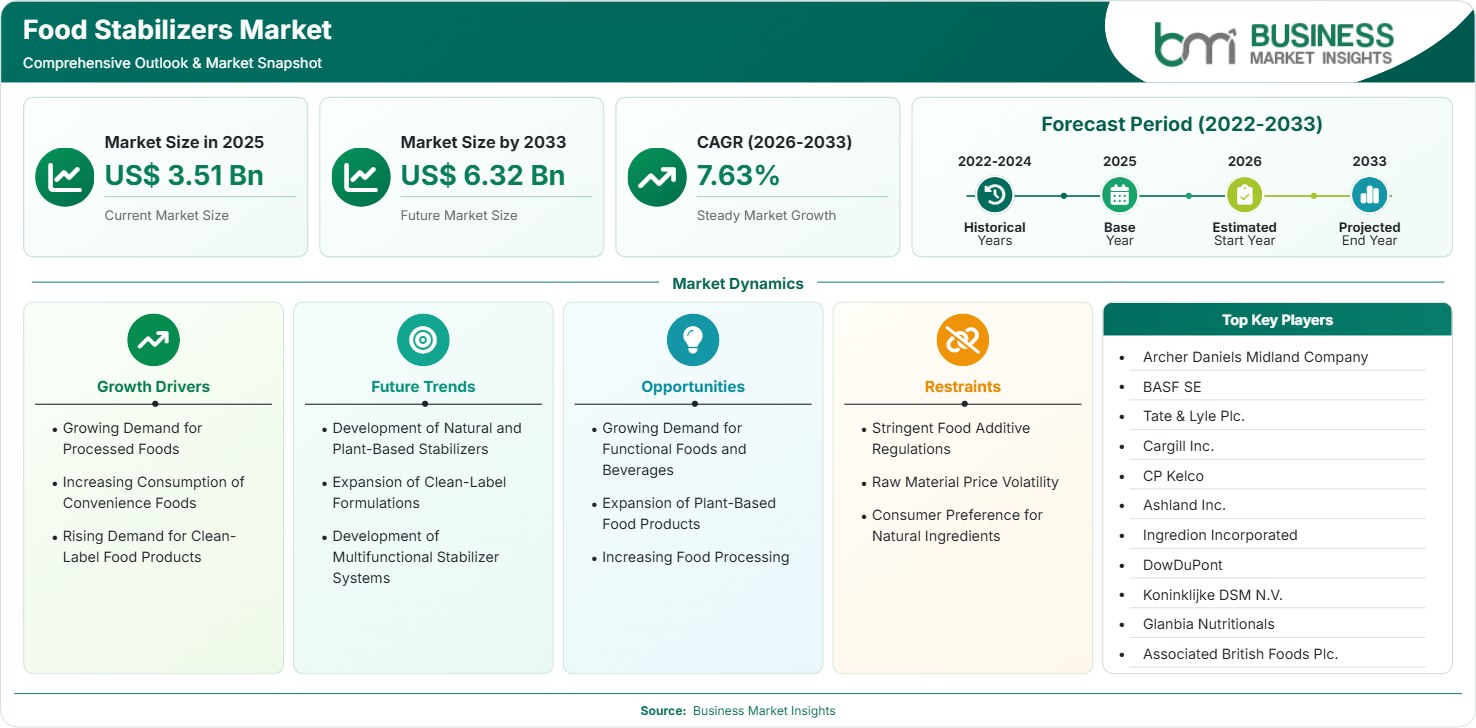
The Food Stabilizers Market size was valued at US$ 3.51 Billion in 2025 and is projected to reach US$ 6.32 Billion by 2033, growing at a CAGR of 7.63% during 2026–2033, driven by rising processed food consumption, growth in convenience foods, clean-label ingredient demand, functional food innovation, and expanding applications across bakery, dairy, and protein-based products.

Report Coverage
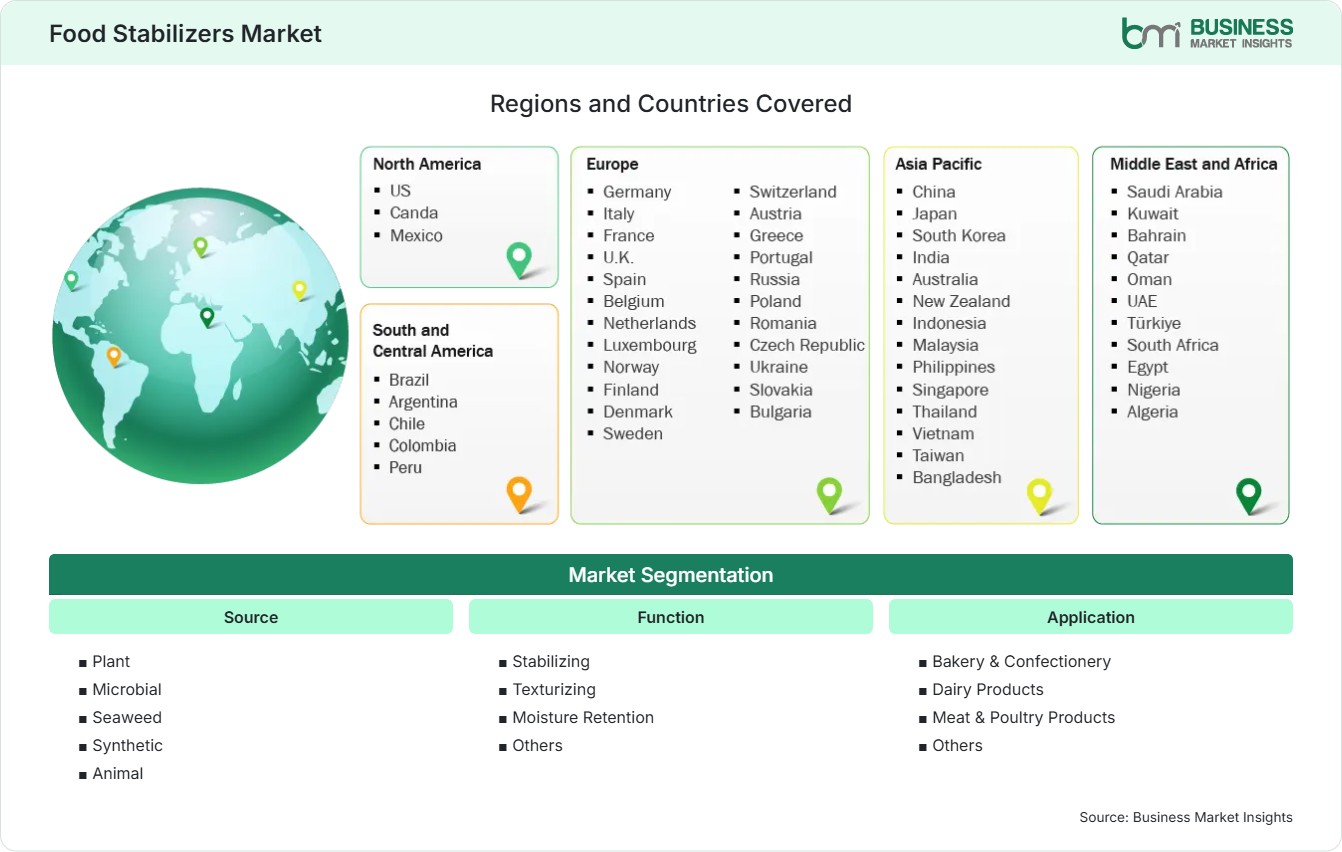
  • Source: Plant, Microbial, Seaweed, Synthetic, Animal
  • Function: Stabilizing, Texturizing, Moisture Retention, Others
  • Application: Bakery & Confectionery, Dairy Products, Meat & Poultry Products, Others
US$ 3.51 Bn Market size in 2025
US$ 6.32 Bn Market Size by 2033
7.63% CAGR, 2026 - 2033
2026-2033 Forecast Period

AI Overview

Food Stabilizers Market Summary

  • North America Region: North America holds a market share of 32%–35% in 2025, growing with a CAGR of 6.8%–7.3% during 2026–2033. Demand is supported by processed food innovation, clean-label reformulation, dairy product consumption, convenience food demand, advanced food manufacturing capabilities, ingredient innovation, and premium product development across multiple categories. The U.S. leads regional demand, supported by strong packaged food consumption and a CAGR of 6.9%–7.4%.
  • Fastest Growing Region: Asia Pacific accounts for 26%–29% share in 2025 and is projected to expand at a CAGR of 8.5%–9.1% during 2026–2033. Growth is driven by urbanization, processed food demand, expanding middle-class populations, food processing investments, convenience product adoption, dietary diversification, modern retail penetration, and increasing demand for quality food ingredients.
  • Leading Segment: Plant-based stabilizers command 43%–47% share in 2025 and are expected to grow at a CAGR of 7.5%–8.1% through 2033. Strong demand stems from clean-label preferences, natural ingredient adoption, vegan formulations, sustainable sourcing, product versatility, regulatory acceptance, and broad applicability across food and beverage categories.
  • High Growth Segment: Dairy products represent 30%–34% share in 2025 and are anticipated to achieve a CAGR of 8.2%–8.8% during 2026–2033. Growth is supported by premium dairy products, yogurt innovation, texture enhancement requirements, protein-enriched formulations, shelf-life optimization, and consumer demand for product consistency.
  • Key Market Opportunity: Manufacturers are developing multifunctional ingredient systems that combine stabilization, texture enhancement, moisture management, and clean-label positioning, enabling differentiation in premium food products and emerging functional nutrition categories.
  • Major Market Players: Archer Daniels Midland Company, BASF SE, Tate & Lyle PLC, Cargill, Incorporated, CP Kelco U.S., Inc., Ashland Inc., Ingredion Incorporated, DuPont de Nemours, Inc., DSM-Firmenich AG, Glanbia Nutritionals, Inc., and Associated British Foods plc.
Strategic Insights

Food Stabilizers Market: Strategic Insights

Food Stabilizers Market Strategic Framework
FREE PDF
Request your free sample
Request free sample
Stakeholder View

Key Takeaways

  • The integration of the supply chain is gaining importance since the suppliers of ingredients are interested in ensuring that their sourcing of plant-based raw materials and fermented ingredients is reliable and efficient.
  • Dairy applications and clean-label product formulations have emerged as the most significant income generating areas due to growing demand for stabilizer systems that offer texture enhancement and improved shelf life.
  • Innovation revolves around multi-functional ingredient combinations that can provide stability, viscosity regulation, moisture retention and improved sensory properties with lower complexity and less labeling.
  • Asia-Pacific provides the best regional investment prospects owing to development in the food processing industry, changing dietary habits, increase in disposable income levels and packaging requirements.
  • Strategic acquisitions and product development agreements are supporting the efforts of the ingredient companies to diversify their technology portfolios, enhance their distribution network, and penetrate emerging food sectors.
  • Sustainable practices are driving the use of plant-based ingredients and sustainable production technologies, which give competitive edge to those suppliers who practice transparent sourcing and sustainable development.
Geographic Outlook

Food Stabilizers Market Regional Highlights

North America Food Stabilizers Market

North America accounts for approximately 32%–35% of the Food Stabilizers Market share in 2025 and is projected to expand at a CAGR of 6.8%–7.3% through 2033. Demand is supported by strong packaged food consumption, advanced food processing infrastructure, premium dairy product innovation, and increasing adoption of clean-label ingredients.

  • Food manufacturers increasingly utilize multifunctional stabilizer blends to reduce formulation complexity while maintaining texture consistency, moisture control, and sensory performance in packaged products.
  • Strong demand for protein-fortified beverages and dairy alternatives is accelerating development of customized ingredient systems capable of delivering stability throughout processing and storage cycles.
  • Strategic investments in food innovation centers and ingredient research facilities continue supporting commercialization of next-generation stabilization solutions across multiple food categories.
  • Clean-label product development remains a major purchasing criterion among consumers, encouraging greater adoption of plant-derived and naturally sourced stabilizing ingredients.
  • Product premiumization trends across bakery, dairy, and ready-to-eat segments support long-term demand for advanced stabilization technologies.

US Food Stabilizers Market

The United States represents approximately 78%–82% of North American demand in 2025 and is expected to register a CAGR of 6.9%–7.4% during 2026–2033. The country's large processed food industry, extensive foodservice sector, and strong consumer preference for convenience products continue driving ingredient demand.

  • Rising demand for high-protein snacks and nutritional beverages is increasing utilization of advanced stabilization systems in innovative product formulations.
  • Food producers are reformulating products to address consumer preferences for ingredient transparency, reduced additives, and natural sourcing claims.
  • Expansion of plant-based food production supports growing use of specialty hydrocolloids and texture-enhancing ingredients across alternative protein categories.
  • Investments in food technology and ingredient innovation continue strengthening domestic manufacturing competitiveness and product development capabilities.

Europe Food Stabilizers Market

Europe holds approximately 27%–30% Food Stabilizers Market share in 2025 and is forecast to grow at a CAGR of 7.0%–7.5% through 2033. Strong regulatory frameworks, demand for clean-label formulations, and high consumption of bakery and dairy products support regional growth. Germany remains the leading market, while Poland is among the fastest-growing countries due to food processing investments and expanding packaged food consumption.

  • Germany leads regional demand through its extensive food manufacturing base and strong innovation activity in bakery, dairy, and specialty food segments.
  • Poland demonstrates robust expansion potential supported by increasing processing capacity and rising demand for convenience food products.
  • Manufacturers are investing in natural ingredient alternatives that align with evolving consumer expectations and regulatory requirements.
  • Functional food and beverage categories continue creating opportunities for value-added stabilization solutions with nutritional benefits.
  • Premium bakery and dairy product demand supports continued innovation in texture management and moisture retention technologies.

Asia Pacific Food Stabilizers Market

Asia Pacific accounts for approximately 26%–29% of revenue in 2025 and is anticipated to record the fastest CAGR of 8.5%–9.1% through 2033. Rapid urbanization, rising disposable incomes, changing dietary habits, and expansion of organized food retail are supporting market development. China remains the largest regional market, while India records the strongest growth trajectory.

  • China maintains leadership through its large-scale food processing industry and growing demand for convenience, dairy, and functional food products.
  • India represents the fastest-growing opportunity because of expanding packaged food consumption and rising investment in modern food manufacturing infrastructure.
  • Increasing consumer awareness regarding product quality and consistency is driving demand for advanced food ingredient technologies.
  • International food companies are expanding regional production facilities to address rising domestic and export-oriented demand.
  • Growing demand for premium beverages, yogurt products, and bakery items continues accelerating ingredient innovation and adoption.

Rest of World Food Stabilizers Market

The Rest of World region contributes approximately 8%–11% of global revenue in 2025 and is projected to expand at a CAGR of 7.2%–7.8% through 2033. South and Central America benefit from increasing processed food demand and modernization of food manufacturing facilities.

Middle East and Africa markets are supported by population growth, urbanization, and expanding investments in food processing industries. Demand for shelf-life enhancement technologies and quality ingredients continues increasing across regional food production networks.

  • Brazil remains the leading market in South and Central America due to its large food industry and growing processed food consumption.
  • Saudi Arabia is among the fastest-growing markets supported by investments in food security initiatives and domestic food manufacturing capacity.
  • Increasing retail modernization is encouraging greater demand for packaged and convenience food products across emerging economies.
  • Manufacturers continue introducing value-added ingredients to improve functional performance and support competitive product differentiation.
  • Rising investment in cold-chain and food distribution infrastructure supports expansion of advanced ingredient applications across regional markets.
Global Market Geography
FREE PDF
Request your free sample
Request free sample
Segment Analysis

Food Stabilizers Market Segmentation

Source

Source-based selection is increasingly influenced by consumer preference for natural ingredients, regulatory requirements, and product functionality. This segment accounts for approximately 38%–42% share in 2025 and is projected to expand at a CAGR of 7.7%–8.2% through 2033. Food manufacturers are emphasizing sustainable and label-friendly ingredients while maintaining formulation performance. The evolving Food Stabilizers Market scope reflects growing demand for plant-derived and fermentation-based alternatives across mainstream and premium food applications.

  • Plant: Widely adopted due to clean-label appeal, renewable sourcing, broad functionality, and compatibility with consumer preferences for naturally derived food ingredients.
  • Microbial: Increasingly utilized in modern food formulations because fermentation-derived stabilizers offer consistency, scalability, and suitability for specialized processing requirements.
  • Seaweed: Supports applications requiring viscosity control, gel formation, and texture enhancement, particularly across dairy, beverage, and confectionery products.
  • Synthetic: Maintains relevance in applications requiring consistent performance, standardized specifications, and cost-effective formulation support within industrial food manufacturing.
  • Animal: Used in selected applications where specific textural properties, stabilization performance, and product characteristics remain difficult to replicate through alternative sources.

Function

Functional performance remains a critical purchasing criterion as food producers seek ingredients capable of enhancing product quality and consumer acceptance. This segment represents approximately 34%–38% share in 2025 and is expected to achieve a CAGR of 7.4%–7.9% through 2033. Growing demand for texture optimization, shelf-life improvement, and moisture management continues supporting adoption. Current Food Stabilizers Market trends indicate increasing preference for multifunctional ingredients that simplify formulations while enhancing product performance.

  • Stabilizing: Essential for maintaining product uniformity, preventing ingredient separation, and preserving desirable sensory characteristics throughout shelf-life periods.
  • Texturizing: Supports mouthfeel enhancement, viscosity management, and consistency improvements across dairy, bakery, confectionery, and beverage applications.
  • Moisture Retention: Facilitates freshness preservation and quality maintenance by reducing moisture loss throughout production, storage, and distribution cycles.

Application

Application diversity continues expanding as manufacturers develop specialized ingredient systems tailored to distinct processing requirements and consumer expectations. This segment accounts for approximately 31%–35% share in 2025 and is forecast to grow at a CAGR of 7.9%–8.5% through 2033. Demand is supported by premium product innovation, convenience food growth, and increasing emphasis on texture consistency across food categories.

  • Bakery & Confectionery: Stabilizers improve moisture balance, product structure, shelf stability, and texture consistency while supporting premium product positioning.
  • Dairy Products: Strong demand originates from yogurt, cheese, flavored milk, and dessert formulations requiring stable texture, viscosity control, and enhanced sensory attributes.
  • Meat & Poultry Products: Ingredients support water retention, processing efficiency, texture control, and quality consistency across processed protein applications.
Market Forces

Food Stabilizers Market Dynamics

Key Market Drivers

Growing Demand for Processed Foods

The expansion of processed food consumption remains a fundamental demand driver for stabilizer ingredients. Due to urbanization, increasing disposable income levels, and changes in dietary habits, there is an increase in the consumption of packaged products that require an extended shelf life and consistency in texture. The need for stabilizers is essential in keeping the integrity of the food product in the process of manufacture, transportation, and storage. Investments in the production of processed food companies in emerging economies are bolstering demand dynamics. These industry developments continue reinforcing Food Stabilizers Market growth across dairy, bakery, beverage, and protein-based food categories globally.

Increasing Consumption of Convenience Foods

Convenience foods continue gaining popularity because of changing work patterns, urbanization, and increasing preference for ready-to-eat or ready-to-cook products. Stabilizers help manufacturers ensure consistent texture, prevent separation, improve moisture management, and enhance product shelf stability. The growth of frozen foods, meal kits, snack products, and instant beverages is creating increased demand for ingredient solutions tailored to modern food processing requirements. Foodservice expansion and retail modernization further contribute to product innovation. Manufacturers are investing in advanced formulations capable of meeting both performance and cost objectives. As convenience-driven consumption continues increasing worldwide, demand for high-performance stabilizer systems remains closely linked to evolving food production and distribution practices.

Rising Demand for Clean-Label Food Products

Consumers increasingly seek recognizable ingredients, natural formulations, and products with transparent labeling claims. Such trends are encouraging food processors to modify their recipes by using stabilizing agents obtained from plants, seaweeds, and fermentation. The Food Stabilizers Market trends reveal increasing tendency towards choosing ingredient systems that provide performance and clean label positioning. Rising regulatory requirements along with consumers' interest in ingredients used in foodstuffs contribute to the growth in demand for natural alternatives. Increasing popularity of premium, health-oriented, and organic foodstuffs encourages development of natural stabilization systems.

Key Market Opportunities

Growing Demand for Functional Foods and Beverages

Functional foods and beverages represent an attractive growth avenue for ingredient manufacturers. Consumers continue to opt for products that provide digestive support, immune boosting, protein fortification, and performance nutrition. These types of products need stabilization techniques that will maintain texture, suspensions of ingredients, and overall good sensory attributes. There is currently a trend toward the development of unique blends of ingredients suited for functional nutrition purposes. The Food Stabilizers Market Forecast due to consumer consumption behavior trends provides a strong reason for investing in new formulations techniques that will suit various functional food requirements.

Expansion of Plant-Based Food Products

The rapid expansion of plant-based dairy, meat alternatives, and functional beverages is generating new demand for texture-management and stabilization technologies. Specialized systems of ingredients are often needed for formulation of plant-based foods so that their mouthfeel, viscosity, and other characteristics mimic those of traditional animal-based foods. Increasingly, food companies are making more investments in R&D in order to enhance the sensory performance and maintain the clean-label profile. The growing consumer demand for sustainability, health, and variety is going to continue fueling category growth. Companies with expertise in providing tailored plant-based stabilization solutions are in a position to take advantage of premium pricing and collaboration opportunities.

Increasing Food Processing

Growth in global food processing capacity is creating substantial demand for ingredients that improve production efficiency and final product quality. Advancements in manufacturing technology, automation, and high processing technologies are making it more appealing to use multifunctional stabilizers. The Food Stabilizers Market is experiencing growth in packaged foods, thanks to urbanization and the development of retail stores. The use of stabilizers in formulations is becoming more common due to their processing capability, improved shelf-life performance, and sensory stability. With the growing consumer demands, the need for stable solutions keeps on increasing.

Market Restraints and Challenges

Stringent Food Additive Regulations

Factor: Regulatory authorities maintain strict approval and labeling requirements for food additives to ensure consumer safety and product transparency. Impact: Compliance issues tend to make development cycles long, testing expensive, and documentation cumbersome for companies that wish to bring new stabilizer technology to market. For multinational companies, dealing with different regulations in each country will cause additional complexity in launching products and managing their portfolio. Reformulations could be necessary in cases when new regulations appear or the thresholds of ingredients are revised.

Raw Material Price Volatility

Factor: Prices of plant-based gums, seaweed extracts, fermentation-derived ingredients, and specialty raw materials can fluctuate because of supply disruptions, weather conditions, agricultural variations, and geopolitical influences. Impact: Increased costs for inputs have implications for the economics of production and put pressure on profit margins along the value chain. Manufacturers could be faced with difficulties in keeping pricing steady amid customer requirements for affordability. Input price volatility might also have implications on procurement policies and decisions on stock control. Small suppliers tend to be more vulnerable to input price fluctuations because of their lack of bargaining power.

Company Analysis

Competitive Landscape

Competition is driven by formulation expertise, hydrocolloid innovation, application-specific ingredient systems, and global distribution capabilities. Current Food Stabilizers Market analysis indicates that suppliers are investing heavily in clean-label technologies, texture optimization solutions, functional ingredient platforms, and sustainable sourcing strategies to strengthen their positions across bakery, dairy, beverage, and protein applications.

Company Name

Overview

Products and Services Relevant to This Market

Archer Daniels Midland Company

Global food ingredient producer with extensive capabilities in nutrition, texture solutions, and food processing ingredients.

Stabilizer systems, texturizers, plant-based ingredients, hydrocolloids, specialty blends, and formulation support services.

BASF SE

Diversified chemical and nutrition company serving food manufacturers through specialty ingredient and functional solutions portfolios.

Functional ingredients, emulsification solutions, food processing aids, nutritional ingredients, and application development services.

Tate & Lyle PLC

Leading specialty food ingredient company focused on mouthfeel, fortification, and texture enhancement technologies.

Stabilizers, pectin, specialty gums, starches, texture solutions, and clean-label formulation systems.

Cargill, Incorporated

Global food ingredients supplier providing integrated solutions for food manufacturers and foodservice operators.

Texturizers, stabilizers, specialty starches, hydrocolloids, plant-derived ingredients, and customized food formulation solutions.

CP Kelco U.S., Inc.

Specialist producer of nature-based hydrocolloids and functional ingredients for food and beverage applications.

Pectin, carrageenan, xanthan gum, gellan gum, and multifunctional stabilizer systems.

Ashland Inc.

Specialty ingredients supplier serving food manufacturers with performance-enhancing formulation technologies.

Cellulosic stabilizers, texture modifiers, moisture management solutions, and specialty functional ingredients.

Ingredion Incorporated

Global leader in starch-based ingredients and texture solutions supporting innovation in processed foods and beverages.

Clean-label starches, stabilizers, texture systems, hydrocolloids, and formulation optimization services.

DuPont de Nemours, Inc.

Science-driven company with strong capabilities in food ingredients, cultures, enzymes, and specialty solutions.

Food stabilizers, texturizing systems, cultures, functional ingredients, and application-specific formulation platforms.

DSM-Firmenich AG

Nutrition and health company combining taste, texture, and formulation expertise across food and beverage segments.

Texture solutions, hydrocolloid blends, stabilizer systems, taste solutions, and dairy application technologies.

Glanbia Nutritionals, Inc.

Nutrition-focused ingredient provider serving food, beverage, and wellness markets globally.

Functional ingredient systems, protein applications, stabilizers, and customized food formulation solutions.

Associated British Foods plc

Diversified food ingredients supplier supporting industrial food production and consumer product innovation.

Specialty food ingredients, bakery solutions, stabilizing ingredients, and texture-enhancing technologies.

Trust & Transparency

Research Methodology

The market analysis combines proprietary research with secondary data from government agencies, company disclosures, regulatory filings, industry databases and expert interviews. Market estimates are validated through data triangulation, cross-market benchmarking and analyst review.

View Full Research Methodology

Questions Answered

Frequently Asked Questions

What information does a Food Stabilizers Market Report provide?

A comprehensive report analyzes market dynamics, growth drivers, regional demand patterns, competitive developments, application trends, technology innovations, and future business opportunities across key segments.

How are clean-label trends influencing product development of Food Stabilizers Market?

Manufacturers are increasingly replacing synthetic additives with plant-derived, seaweed-based, and fermentation-derived ingredients that provide comparable functionality while supporting transparent labeling claims.

Why is the dairy industry a major consumer of stabilizers?

Dairy products require stabilizers to improve texture, control syneresis, maintain viscosity, enhance mouthfeel, and ensure product consistency throughout shelf life.

Which source segment dominates industry demand?

Plant-based stabilizers lead demand because they align with clean-label preferences, sustainability objectives, and increasing consumer interest in naturally derived food ingredients.

What are food stabilizers primarily used for?

Food stabilizers help maintain texture, consistency, viscosity, moisture levels, and overall product quality while preventing ingredient separation during manufacturing, storage, and distribution.

Access the Full Food Stabilizers Market Report

Get segment-level forecasts, regional estimates, competitive benchmarking, company profiles and downloadable Excel datasets.

Access the full Food Stabilizers Market Report
350 pages PDF & Excel | 2026-09-15
Similar Research

Related Market Reports