
Food Service Market Outlook: Size, Share, Trends, Growth Analysis, Competitive Landscape & Forecast, 2026-2033

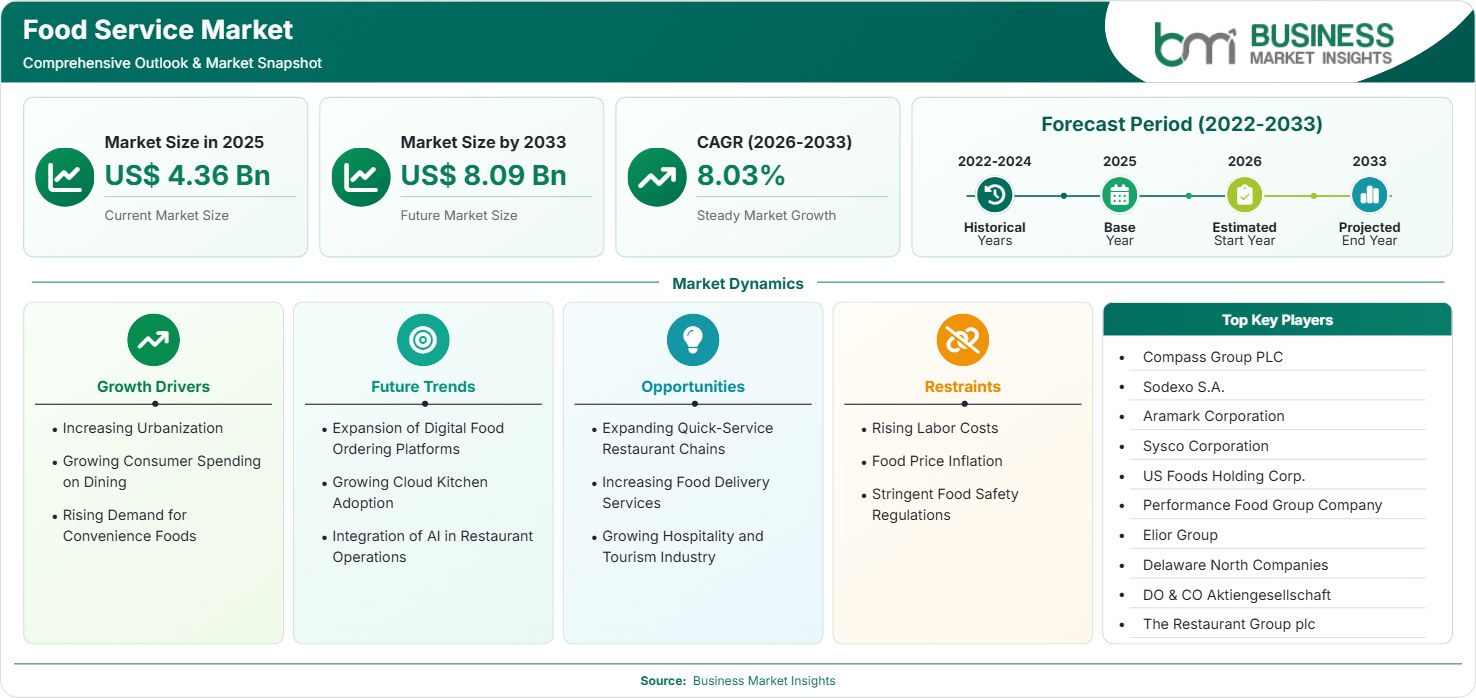
The Food Service Market size was valued at US$ 4.36 Billion in 2025 and is projected to reach US$ 8.09 Billion by 2033, growing at a CAGR of 8.03% during 2026–2033, driven by urbanization, digital ordering adoption, evolving dining preferences, expanding restaurant chains, and rising demand for convenient meal solutions.

Report Coverage
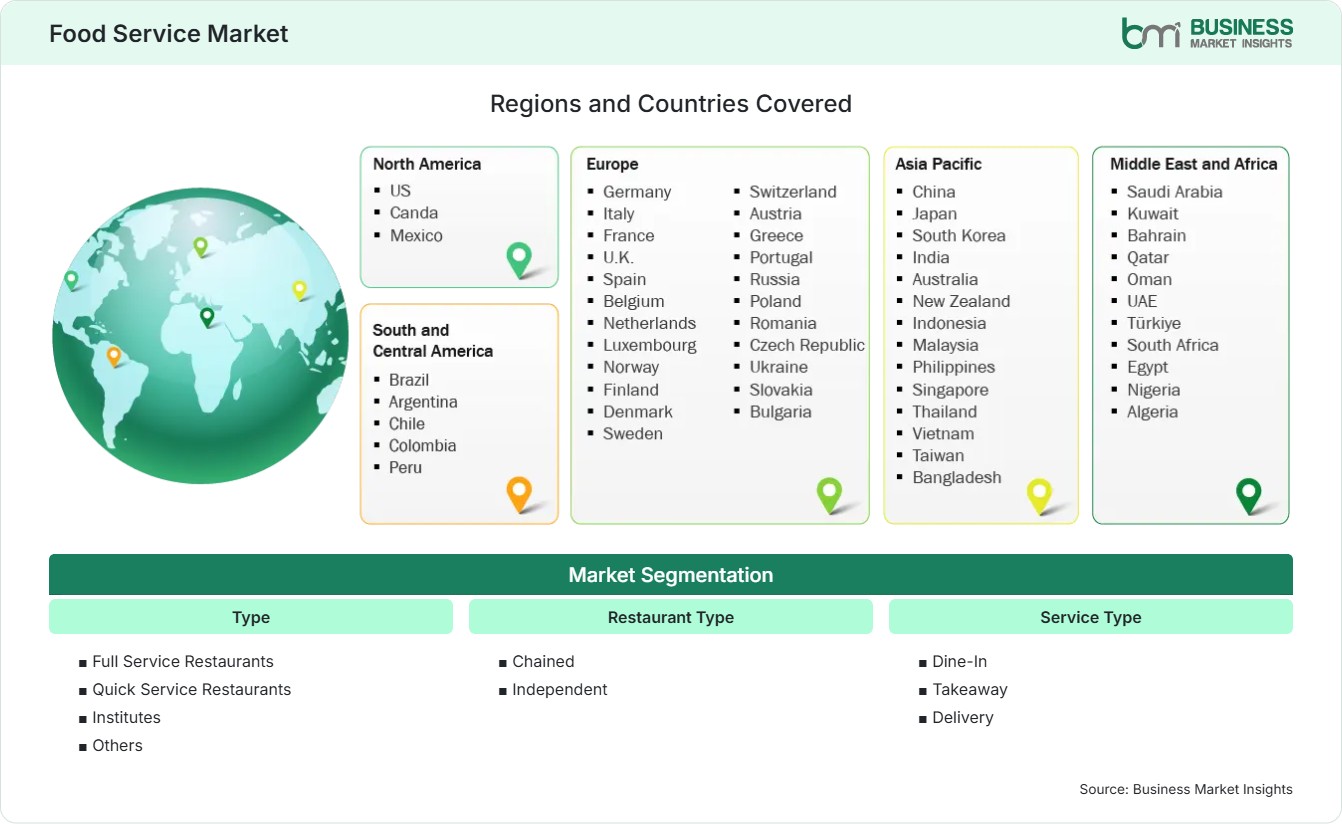
  • Type: Full Service Restaurants, Quick Service Restaurants, Institutes, Others
  • Restaurant Type: Chained, Independent
  • Service Type: Dine-In, Takeaway, Delivery
US$ 4.36 Bn Market size in 2025
US$ 8.09 Bn Market Size by 2033
8.03% CAGR, 2026 - 2033
2026-2033 Forecast Period

01 AI Overview

Food Service Market Summary

  • North America Region: North America holds 32%–35% share in 2025, growing at a CAGR of 7.2%–7.6% during 2026–2033, supported by established restaurant ecosystems, advanced delivery platforms, technology integration, consumer spending growth, and expanding premium dining concepts. The US market maintains leadership through strong restaurant networks, digital ordering adoption, and franchising models, expanding at a CAGR of 7.3%–7.7%.
  • Fastest Growing Region: Asia Pacific accounts for 28%–31% share in 2025 and is projected to grow at a CAGR of 9.2%–9.7% during 2026–2033, driven by urban population growth, increasing disposable incomes, rising food delivery penetration, expanding international restaurant brands, and rapid development of organized dining infrastructure.
  • Leading Segment: Quick Service Restaurants represent 38%–41% share in 2025, expanding at a CAGR of 8.5%–8.9% during 2026–2033, supported by affordability, faster service models, digital ordering solutions, franchising expansion, and increasing consumer preference for convenient dining experiences.
  • High Growth Segment: Delivery service is estimated to grow at a CAGR of 10.0%–10.5% during 2026–2033, supported by online platforms, mobile applications, changing consumer lifestyles, technology-enabled ordering systems, and increasing investments from restaurant operators seeking broader customer reach.
  • Key Market Opportunity: Growth opportunities are emerging through cloud kitchens, digital restaurant platforms, automated operations, personalized menus, and expansion across developing economies where organized dining infrastructure continues evolving rapidly.
  • Major Market Players: Compass Group PLC, Sodexo S.A., Aramark Corporation, Sysco Corporation, US Foods Holding Corp., Performance Food Group Company, Elior Group, Delaware North Companies, DO & CO Aktiengesellschaft, and The Restaurant Group plc.
02 Strategic Insights

Food Service Market: Strategic Insights

Food Service Market Strategic Framework
FREE PDF
Request your free sample
Request free sample
03 Stakeholder View

Key Takeaways

  • Value chains in the industry are getting integrated with food suppliers, restaurant chains, technology platform, logistics providers, and digital payment providers for increasing efficiency and customer satisfaction.
  • Quick Service Restaurants and delivery-focused models provide substantial expansion potential as consumers increasingly prioritize affordability, speed, convenience, and accessibility across urban and suburban locations.
  • Technology adoption is becoming a core competitive factor, with artificial intelligence, automation, digital ordering systems, and data analytics supporting improved forecasting, personalized services, and cost optimization.
  • Asia Pacific presents strong investment potential due to expanding middle-class populations, increasing restaurant modernization, rising food delivery adoption, and growing presence of international dining brands.
  • Strategic partnerships, acquisitions, and technology investments are reshaping competitive positioning as established operators seek geographic expansion, operational improvements, and digital capabilities.
  • Sustainability initiatives are influencing procurement strategies, packaging decisions, and operational practices as companies respond to evolving consumer expectations and environmental priorities.
04 Geographic Outlook

Food Service Market Regional Highlights

North America Food Service Market

North America accounted for 32%–35% share in 2025 and is expected to expand at a CAGR of 7.2%–7.6% during 2026–2033. The Food Service Market share remains supported by franchise expansion, premium dining concepts, technology adoption, and delivery platforms. The United States leads regional demand, while Canada demonstrates steady growth through restaurant modernization and evolving consumer preferences toward convenient dining solutions.

  • Restaurant operators are investing in digital ordering platforms, automated systems, and customer engagement technologies to improve operational efficiency and enhance dining experiences across urban markets.
  • Expanding franchise networks and multi-brand restaurant groups strengthen regional growth by increasing accessibility, improving brand recognition, and supporting standardized service models across diverse consumer segments.
  • Sustainability initiatives are influencing sourcing strategies, packaging solutions, and waste reduction programs as operators respond to environmental concerns and changing customer expectations.
  • Growth of delivery services and mobile applications continues reshaping restaurant operations, enabling businesses to reach broader audiences while optimizing order management and customer retention.

US Food Service Market

The United States represented 82%–85% of North American revenue in 2025 and is projected to grow at a CAGR of 7.3%–7.7% through 2033. Strong restaurant infrastructure, high consumer spending, and widespread adoption of digital dining solutions support market expansion. The country benefits from established quick-service chains, advanced logistics networks, and technology-driven restaurant operations.

  • Large restaurant chains are expanding digital capabilities through mobile applications, loyalty programs, and integrated ordering systems to improve customer engagement and operational performance.
  • Independent restaurants are adopting technology solutions and third-party delivery partnerships to compete effectively with established brands and reach digitally connected consumers.
  • Increasing demand for healthier menu options and sustainable practices is encouraging operators to diversify offerings and improve transparency across sourcing and preparation processes.

Europe Food Service Market

Europe accounted for 24%–27% Food Service Market share in 2025 and is anticipated to grow at a CAGR of 7.5%–7.9% during 2026–2033. The region benefits from strong hospitality infrastructure, tourism activities, food quality standards, and expanding restaurant modernization initiatives. Germany leads regional consumption, while the United Kingdom, France, and Italy demonstrate significant growth opportunities through evolving dining preferences, digital platforms, and increased adoption of convenient food service formats.

  • Germany maintains strong demand through established restaurant networks, corporate catering services, and increasing adoption of technology-based operational solutions.
  • The United Kingdom continues expanding through delivery platforms, restaurant innovation, and growing consumer acceptance of digital-first dining models.
  • France benefits from tourism-driven demand, premium dining experiences, and increasing investments in sustainable restaurant operations.
  • European operators are integrating automation, contactless services, and digital payment solutions to improve efficiency and customer satisfaction.

Asia Pacific Food Service Market

Asia Pacific represented 28%–31% share in 2025 and is projected to register the fastest CAGR of 9.2%–9.7% during 2026–2033. Rapid urbanization, rising disposable incomes, expanding middle-class populations, and increasing restaurant investments support regional development. China remains the largest contributor, while India and Southeast Asian economies demonstrate strong growth potential due to changing lifestyles, increasing food delivery adoption, and expansion of organized restaurant formats.

  • China dominates regional demand through extensive restaurant networks, digital payment adoption, and rapid expansion of online food delivery ecosystems.
  • India demonstrates strong growth due to urban population expansion, increasing disposable income, and growing acceptance of branded restaurants and convenience-focused dining options.
  • Southeast Asian countries are attracting investments through tourism growth, expanding food delivery platforms, and increasing presence of international restaurant chains.
  • Regional operators are adopting cloud kitchens, automation technologies, and digital ordering solutions to improve scalability and reduce operational costs.

Rest of World Food Service Market

Rest of World accounted for 10%–12% share in 2025 and is expected to expand at a CAGR of 6.8%–7.3% through 2033. South and Central America benefit from expanding urban centers, tourism activities, and increasing restaurant investments. Middle East and Africa markets are developing through hospitality expansion, food infrastructure improvements, and rising demand for organized dining experiences. Brazil leads regional growth, while Saudi Arabia and the United Arab Emirates present emerging opportunities.

  • Brazil continues expanding through restaurant chain development, tourism activities, and increasing adoption of digital ordering solutions among urban consumers.
  • Middle Eastern countries are investing in hospitality infrastructure and premium dining concepts supported by tourism development strategies and economic diversification programs.
  • African markets demonstrate gradual growth through improving food distribution networks, urbanization, and increasing consumer demand for convenient meal options.
  • Restaurant operators across emerging economies are developing partnerships with technology providers to improve delivery efficiency and customer accessibility.
  • Government initiatives supporting tourism, infrastructure development, and entrepreneurship are creating favorable conditions for organized food service expansion.
Global Market Geography
FREE PDF
Request your free sample
Request free sample
05 Segment Analysis

Food Service Market Segmentation

Type

The Type segment represents a critical component of industry structure, with Quick Service Restaurants leading adoption through speed, affordability, and digital integration. The segment held 38%–41% share in 2025 and is expected to grow at a CAGR of 8.5%–8.9% between 2026–2034. Increasing consumer preference for convenient meals, expanding franchise networks, and technology-enabled ordering platforms are supporting segment expansion. The Food Service Market scope continues widening as restaurants diversify formats to address changing lifestyles, urban consumption patterns, and demand for accessible dining solutions.

  • Full Service Restaurants: Full Service Restaurants provide complete dining experiences through table service, customized menus, and premium offerings. Growth is supported by experiential dining demand, hospitality expansion, and consumer preference for social dining environments.
  • Quick Service Restaurants: Quick Service Restaurants benefit from fast preparation, affordable pricing, standardized operations, and strong franchise models. Digital ordering, delivery integration, and automation adoption are strengthening competitive positioning across global markets.
  • Institutes: Institutional food service includes educational facilities, healthcare organizations, corporate cafeterias, and government establishments. Demand is influenced by outsourcing trends, nutritional requirements, and increasing focus on efficient large-scale meal management.

Restaurant Type

The Restaurant Type segment reflects changing ownership structures and operational approaches across the industry. Chained restaurants represented 55%–58% share in 2025 and are projected to expand at a CAGR of 8.4%–8.8% during 2026–2034. The Food Service Market trends indicate increasing preference for standardized operations, recognizable brands, and technology-driven customer engagement. Independent restaurants continue contributing through localized offerings, menu innovation, and personalized experiences catering to regional consumer preferences.

  • Chained: Chained restaurants benefit from established branding, centralized procurement, operational consistency, and scalable expansion strategies. Digital platforms, loyalty programs, and standardized menus support customer retention and profitability improvements.
  • Independent: Independent restaurants compete through unique culinary concepts, regional specialties, flexible operations, and personalized customer experiences. Increasing adoption of digital tools helps smaller operators improve visibility and market reach.

Service Type

Service Type segmentation highlights the transition toward flexible dining channels and evolving consumer purchasing behavior. Delivery services represent the fastest-growing category with a CAGR of 10.0%–10.5% between 2026–2034, supported by digital platforms and mobile ordering adoption. Dine-in remains significant due to social experiences, while takeaway continues expanding through convenience-focused consumption. The segment reflects changing expectations around accessibility, speed, and personalized food purchasing options across urban markets.

  • Dine-In: Dine-in services remain important for restaurants offering social experiences, premium environments, and customer engagement. Growth is supported by hospitality recovery, experiential dining concepts, and consumer demand for restaurant visits.
  • Takeaway: Takeaway services provide convenience through quick collection models, supporting busy consumers seeking efficient meal solutions. Restaurants are enhancing packaging, ordering systems, and pickup infrastructure to improve service efficiency.
  • Delivery: Delivery services are expanding through online platforms, mobile applications, and third-party logistics partnerships. Increased smartphone adoption, urban lifestyles, and demand for convenience are accelerating digital food ordering ecosystems.
06 Market Forces

Food Service Market Dynamics

Key Market Drivers

Increasing Urbanization

Urbanization is increasing the need for a structured solution to provide meals due to the rise in demand for convenient meal options among consumers residing in crowded urban settings. According to the report published by the United Nations, more than half of the world’s population currently resides in urbanized locations, thus creating an environment that fosters growth in the restaurant sector. Food Service Market growth can be attributed to changes in lifestyle habits, reduced cooking practices at home, and an increase in the demands for meals at work stations. Urban consumers have started using technology to order their food.

Growing Consumer Spending on Dining

The rise in disposable income and changes in lifestyle trends are contributing to higher spending of consumers on restaurants, premium foods, and convenient food products. Businesses have adjusted their strategies using diversification of menus, value-for-money offers, and personalization strategies. Food Service Market development is bolstered by higher expenditure from the younger age groups due to social and technological needs. Consumption trends have continued to shape market trends through investments in customer engagement and differentiation strategies.

Rising Demand for Convenience Foods

Demand for convenient food solutions is rising with the consideration of convenience being prioritized in terms of time-saving and accessibility. The increase in online order systems, ready meals, and food delivery service is changing the nature of restaurant business. As per the trends of Food Service Market, the use of technology-driven solutions that shorten waiting times and enhance customer experience is rising. The shift toward convenient food solutions helps in broadening the scope of the industry as restaurants opt for hybrid models.

Key Market Opportunities

Expanding Quick-Service Restaurant Chains

Expansion of the quick service restaurant chains presents many opportunities through the processes of franchising, standardization of operations, and scalability of business models in emerging economies. The growing population of urban centers and the need for low-cost food are motivating companies to set up their operations in areas where there is less competition. Firms are focusing on the development of localized food menus, digital ordering processes, and more efficient delivery channels to maximize market reach. The Food Service Market Forecast suggest that quick service restaurant formats will get investments due to flexibility and consumer acceptance.

Increasing Food Delivery Services

The food delivery companies are generating new opportunities for growth by connecting the restaurants with consumers who have gone digital through mobile apps and logistics networks. Increasing use of smartphones, adoption of payments online, and changes in consumer behavior are motivating restaurants to enhance their delivery services. The operators are focusing on cloud kitchens, automated ordering systems, and logistics partners to achieve this objective. The ecosystem of delivery is giving small restaurants the advantage of tapping into larger customer pools without growing physically.

Growing Hospitality and Tourism Industry

Expanding recovery of hospitality and tourism industries is providing openings for restaurants, catering services, and food service operations. The rising trend of tourism from the international market, corporate meetings, and tourism from leisure activities is providing support for various dining options. There is collaboration between hotels, airport facilities, and entertainment venues with food services providers for better customer services. Investments made in tourism facilities in developing countries are providing new avenues for opening of restaurant businesses.

Market Restraints and Challenges

Rising Labor Costs

Factor: Increasing wages, workforce shortages, and higher employee retention expenses are raising operational costs for restaurant operators. Impact: Companies have started to use automation, self-service facilities, and efficient workforce management software. The problem is becoming more complex for developed countries as labor laws and wage norms keep playing their role in shaping up the business strategies. It is important for restaurant owners to strike a balance between service efficiency and cost effectiveness. Technology has become a critical component for boosting productivity and minimizing manual intervention.

Food Price Inflation

Factor: Volatility in ingredient prices, supply chain disruptions, and changing commodity costs are increasing procurement challenges for food service operators. Impact: The increase in input costs may affect the pricing of the menu items, the affordability of the customers, and the profit margins. The firm is implementing strategic procurement methods, diversification of the suppliers, and inventory management methods to address cost concerns. The inflationary trends that have an impact on the costs of agriculture, logistics, and energy continue influencing business decisions. Larger restaurant firms enjoy economies of scale in their procurement process.

07 Company Analysis

Competitive Landscape

The Food Service Market analysis highlights increasing competition among global restaurant operators, catering providers, and integrated food solution companies. Leading participants are focusing on geographic expansion, digital transformation, sustainability initiatives, and operational efficiency improvements to strengthen market positioning.

Company Name

Overview

Products and Services relevant to this market

Compass Group PLC

Global food service provider specializing in contract catering and workplace dining solutions across multiple industries and regions.

Catering services, workplace food solutions, hospitality management, healthcare dining, education catering, and event food services.

Sodexo S.A.

International food and facilities management company providing integrated service solutions for corporate, healthcare, and institutional clients.

Food services, catering management, employee dining, healthcare nutrition solutions, and hospitality support services.

Aramark Corporation

Global provider of food, facilities, and uniform services serving education, healthcare, sports, and business sectors.

Contract dining, hospitality services, institutional catering, venue food operations, and workplace meal solutions.

Sysco Corporation

Leading food distribution company supplying restaurants, healthcare facilities, and hospitality businesses with comprehensive food products.

Food distribution, restaurant supplies, specialty ingredients, equipment solutions, and supply chain services.

US Foods Holding Corp.

Major foodservice distributor supporting independent restaurants, healthcare providers, and hospitality operators across North America.

Food products, culinary solutions, restaurant technology platforms, and supply chain support services.

Performance Food Group Company

Food distribution company serving restaurants, institutions, and convenience operators through broad product portfolios.

Foodservice distribution, customized culinary solutions, restaurant supplies, and operational support services.

Elior Group

International contract catering company operating across corporate, healthcare, education, and government food service segments.

Catering services, institutional dining, workplace meals, healthcare food solutions, and hospitality operations.

Delaware North Companies

Hospitality and food service operator managing dining operations across travel, entertainment, and sports venues.

Venue catering, airport dining, hospitality services, gaming food operations, and event management.

DO & CO Aktiengesellschaft

Premium catering and hospitality company serving airlines, events, and luxury dining segments globally.

Airline catering, event catering, premium restaurants, hospitality concepts, and gourmet food services.

The Restaurant Group plc

Restaurant operator managing multiple branded dining concepts across the United Kingdom.

Casual dining, restaurant operations, hospitality services, and branded food concepts.

10 Trust & Transparency

Research Methodology

The market analysis combines proprietary research with secondary data from government agencies, company disclosures, regulatory filings, industry databases and expert interviews. Market estimates are validated through data triangulation, cross-market benchmarking and analyst review.

View Full Research Methodology

11 Questions Answered

Frequently Asked Questions

Why are cloud kitchens gaining attention among operators?

Cloud kitchens reduce physical infrastructure requirements and enable restaurants to expand delivery capabilities efficiently. They support multi-brand operations and allow businesses to test new concepts with lower investment requirements.

What factors influence the Food Service Market Report outlook?

The report outlook is influenced by consumer spending patterns, technology adoption, restaurant expansion, supply chain developments, labor conditions, and changing dining preferences.

How are independent restaurants competing with large chains?

Independent restaurants are strengthening competitiveness through unique menus, localized concepts, personalized services, and adoption of digital platforms that improve visibility and customer engagement.

What role do sustainability initiatives play in restaurant strategies?

Sustainability initiatives influence sourcing decisions, packaging selection, waste reduction programs, and energy management practices. Restaurants are adopting environmentally responsible operations to meet consumer expectations and regulatory requirements.

How are digital technologies changing food service operations?

Digital technologies are improving ordering, payments, inventory management, customer engagement, and operational forecasting. Restaurants are adopting artificial intelligence, mobile applications, and automation tools to improve efficiency and create personalized customer experiences.

Access the Full Food Service Market Report

Get segment-level forecasts, regional estimates, competitive benchmarking, company profiles and downloadable Excel datasets.

Access the full Food Service Market Report
350 pages PDF & Excel | 2026-08-12