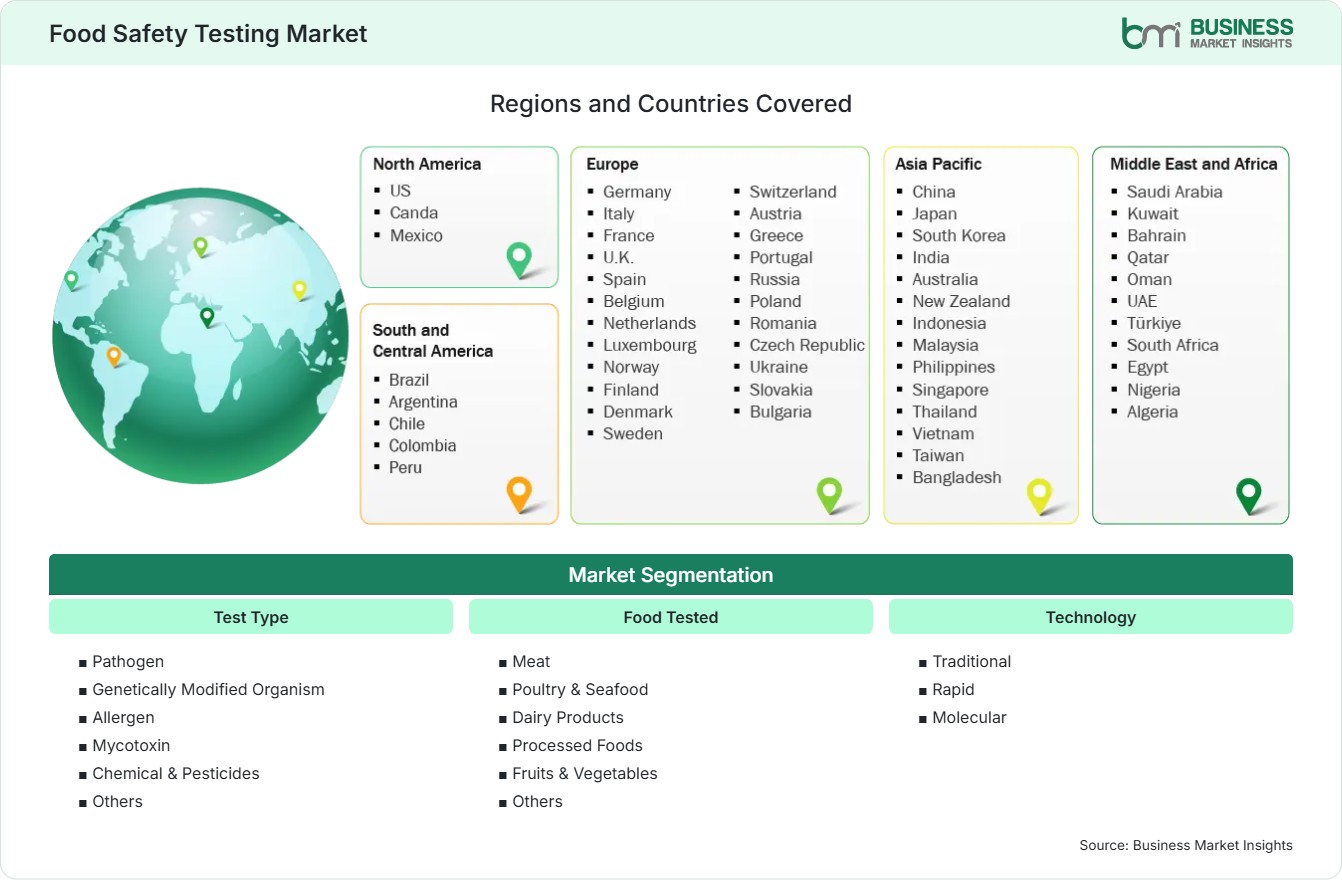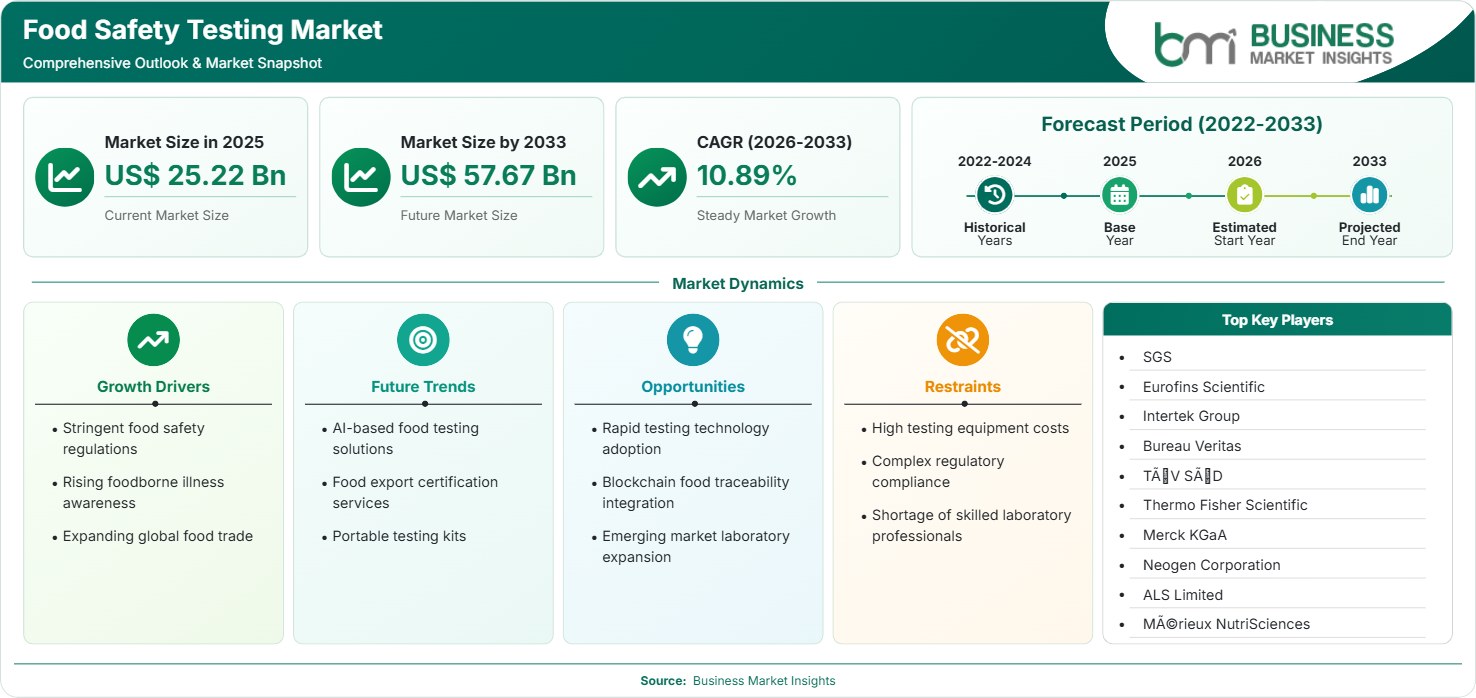
Food Safety Testing Market Regional Highlights
North America Food Safety Testing Market
North America accounted for 32%–35% of the global market in 2025 and is projected to expand at a 9.2%–9.8% CAGR during 2026–2033. The region maintains leadership due to advanced laboratory infrastructure, strict regulatory frameworks, and widespread adoption of analytical testing solutions across food manufacturing industries. The Food Safety Testing Market share in North America is supported by strong demand for pathogen detection, allergen screening, chemical residue analysis, and third-party testing services. Increasing investments in automation, rapid diagnostics, and digital laboratory systems continue improving testing efficiency across food supply chains.
- The United States represents the largest regional contributor due to strict food safety enforcement, extensive food processing industries, and increasing adoption of molecular testing platforms for contamination monitoring.
- Regulatory agencies continue strengthening food quality requirements, encouraging manufacturers to implement preventive testing programs, advanced monitoring systems, and comprehensive laboratory verification processes across production facilities.
- Rapid PCR, immunoassay technologies, and automated analytical systems are gaining adoption as food producers seek faster contamination detection and improved operational efficiency.
US Food Safety Testing Market
The U.S. accounted for approximately 25%–28% of global revenue in 2025 and is expected to grow at a 9.5%–10.0% CAGR through 2033. Strong regulatory oversight, advanced food processing capabilities, and increasing consumer awareness regarding contamination risks are supporting market expansion. The Food Safety Testing Market growth in the country is influenced by increasing testing requirements for pathogens, allergens, chemical residues, and genetically modified organisms. Growing adoption of automation, molecular diagnostics, and laboratory information management systems is further strengthening testing efficiency.
- Food manufacturers increasingly invest in preventive testing strategies to reduce recall risks, improve compliance performance, and maintain consumer trust.
- Demand for rapid pathogen identification technologies is increasing as companies prioritize shorter testing cycles and faster decision-making across production environments.
- Third-party laboratory service providers are expanding capabilities through specialized testing facilities, digital platforms, and advanced analytical technologies.
Europe Food Safety Testing Market
Europe represented approximately 24%–27% of the global Food Safety Testing Market in 2025 and is anticipated to register a 9.8%–10.5% CAGR during 2026–2033. The region benefits from stringent food safety legislation, established laboratory networks, and strong consumer focus on food quality. Germany, the United Kingdom, France, and Italy remain important markets due to advanced food industries and regulatory compliance requirements. Increasing demand for allergen testing, pesticide analysis, and microbiological screening continues supporting market development across European countries.
- Germany maintains regional leadership through advanced food manufacturing capabilities, strict quality standards, and widespread adoption of laboratory testing services.
- The United Kingdom demonstrates strong demand for contamination analysis due to retail quality requirements and increasing consumer awareness regarding food safety.
- France and Italy are expanding testing adoption through food export activities, premium food production, and regulatory-driven quality assurance programs.
Asia Pacific Food Safety Testing Market
Asia Pacific accounted for 27%–30% of global revenue in 2025 and is expected to grow at a 12.0%–12.8% CAGR during the Food Safety Testing Market forecast period. The region represents the fastest-growing market due to expanding food processing industries, increasing international food trade, rising contamination concerns, and improving regulatory infrastructure. China, India, Japan, and South Korea are key contributors, while Southeast Asian countries are witnessing increasing investments in laboratory facilities. The market growth across Asia Pacific is driven by modernization of food quality systems and rising demand for reliable testing services.
- China leads regional demand due to its large food production base, export-oriented industries, and increasing regulatory focus on contamination prevention.
- India demonstrates strong expansion potential through growing processed food consumption, food export development, and increasing adoption of international testing standards.
- Japan and South Korea continue investing in advanced molecular testing technologies to support high-quality food manufacturing systems.
Rest of World Food Safety Testing Market
The Rest of World region, including South & Central America and the Middle East & Africa, accounted for approximately 10%–13% of global Food Safety Testing Market revenue in 2025 and is projected to expand at a 10.0%–10.8% CAGR through 2033. Growth is supported by increasing food imports, expanding food processing industries, regulatory improvements, and rising awareness of contamination risks. Brazil, Mexico, Saudi Arabia, and the United Arab Emirates represent important markets due to growing food production activities and investments in quality assurance infrastructure.
- Increasing international trade participation is encouraging governments and companies across these regions to strengthen testing capabilities and adopt globally recognized food safety standards.
- Brazil leads Latin America through strong agricultural production, food exports, and increasing demand for contamination monitoring solutions.
- Mexico benefits from food manufacturing expansion and cross-border trade requirements that increase adoption of laboratory testing services.