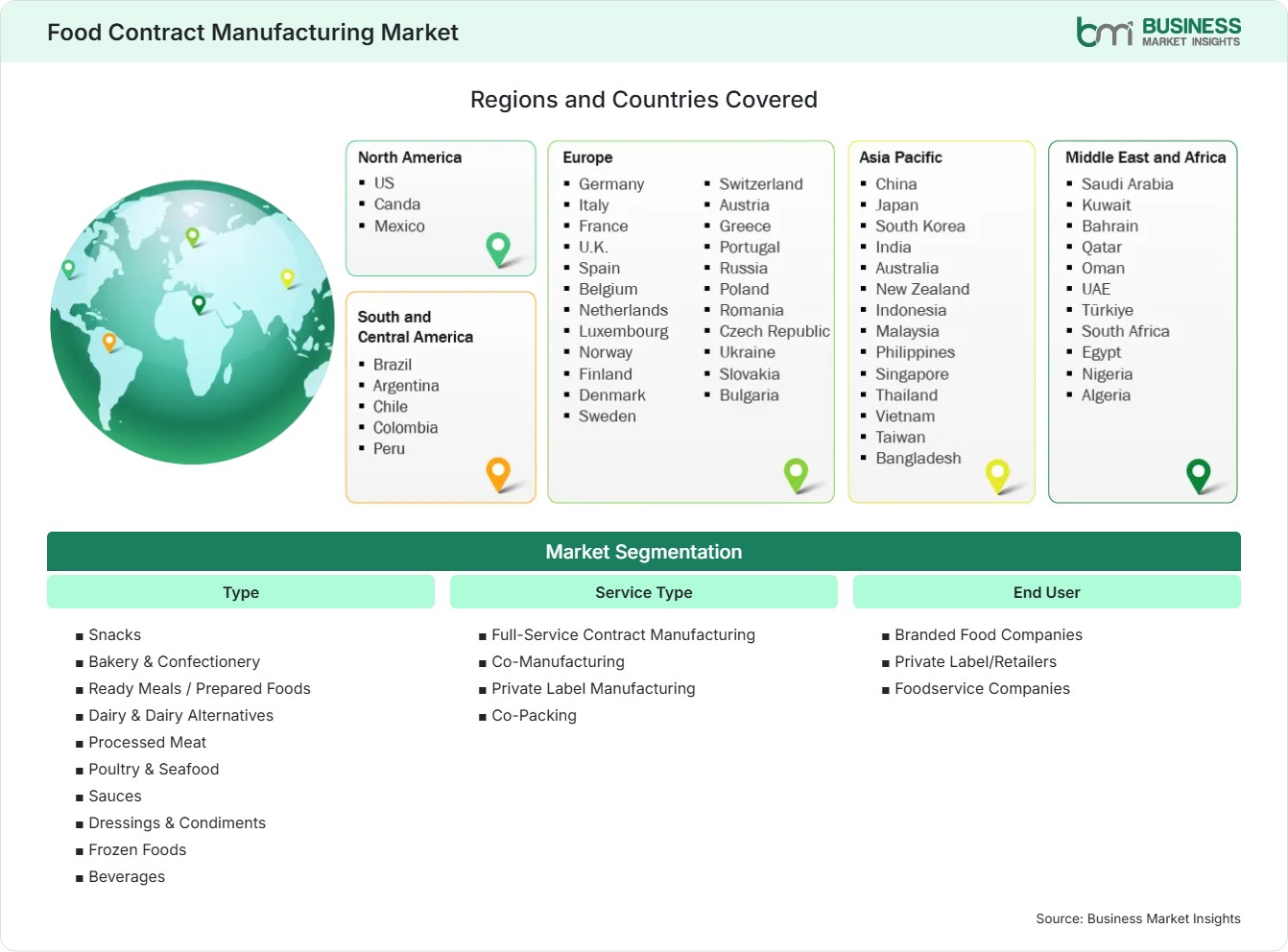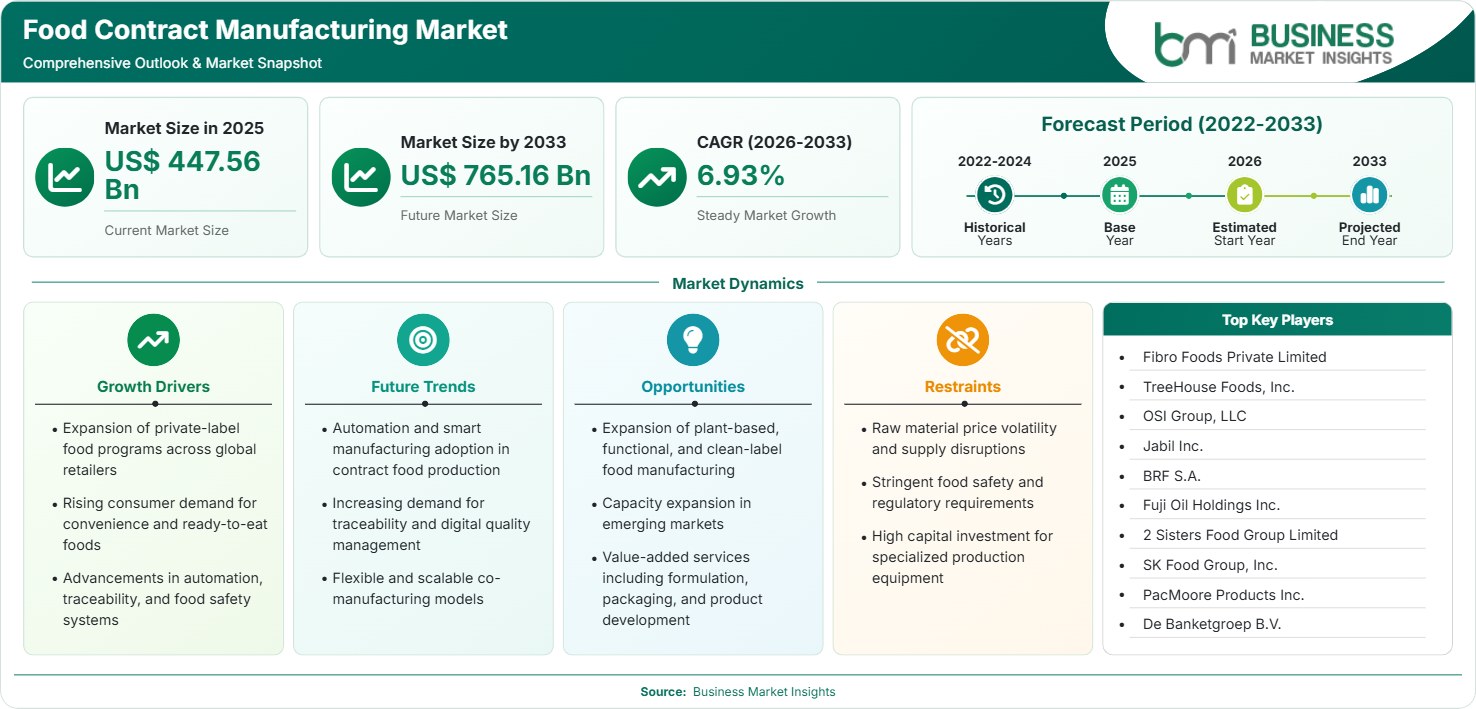
Food Contract Manufacturing Market Regional Highlights
North America Food Contract Manufacturing Market
North America accounted for approximately 33%–35% of global revenue in 2025 and is projected to grow at a 6.2%–6.8% CAGR during 2026–2033. The region benefits from mature packaged food industries, extensive private-label penetration, and sophisticated manufacturing infrastructure. Major retailers increasingly outsource production to specialized partners to improve flexibility and accelerate product innovation. Strong demand for convenience foods, frozen meals, snacks, and clean-label products supports sustained capacity utilization. The region also records the largest Food Contract Manufacturing Market share, supported by advanced automation adoption and regulatory compliance capabilities.
- Retail private-label expansion continues generating new production contracts as supermarkets strengthen proprietary product portfolios while improving margins and differentiation across competitive grocery categories.
- Automation investments across food processing facilities improve labor productivity, quality consistency, traceability compliance, and operational flexibility for manufacturers serving multiple customer brands.
- Growing demand for functional foods, protein-enriched snacks, and health-focused formulations encourages brands to partner with specialized production providers possessing formulation expertise.
- Increasing adoption of sustainable packaging solutions and waste reduction initiatives is influencing supplier selection criteria among major retailers and branded food companies.
- Consolidation activity among manufacturers enhances production scale, geographic reach, and service capabilities across multiple food categories.
US Food Contract Manufacturing Market
The United States represents approximately 74%–78% of the North American Food Contract Manufacturing Market revenue in 2025 and is forecast to grow at a 6.3%–6.9% CAGR through 2033. Strong consumer demand for packaged foods, extensive retailer networks, and advanced production capabilities support market expansion. Large food brands increasingly utilize contract manufacturing partnerships to manage product diversification and reduce operational complexity. Innovation in frozen foods, meal kits, bakery products, and private-label offerings continues driving outsourcing demand across the country.
- Leading food retailers are expanding private-label portfolios across premium and value-oriented categories, increasing reliance on specialized manufacturing partners.
- Investments in smart manufacturing systems strengthen productivity, quality management, and compliance with evolving food safety regulations.
- Growing demand for convenience-oriented food products supports expansion of co-manufacturing and co-packing agreements across multiple categories.
- Contract manufacturers increasingly provide product development support, helping brands accelerate commercialization and shorten launch timelines.
Europe Food Contract Manufacturing Market
Europe accounted for approximately 27%–29% of the global Food Contract Manufacturing Market revenue in 2025 and is expected to expand at a 6.0%–6.6% CAGR through 2033. Strong private-label adoption, stringent food safety regulations, and advanced food processing capabilities support market development. The United Kingdom and Germany remain leading revenue contributors, while Poland and Romania exhibit stronger growth rates due to manufacturing investments and competitive production costs. Sustainability objectives and clean-label product demand continue influencing outsourcing decisions across regional food value chains.
- The United Kingdom remains a leading regional market supported by extensive supermarket private-label programs and mature food manufacturing infrastructure.
- Germany benefits from advanced processing technologies, export-oriented production capabilities, and strong demand for premium packaged foods.
- Poland records among the fastest regional growth rates, supported by lower operating costs and increasing multinational manufacturing investments.
- Regulatory emphasis on food safety, traceability, and sustainability encourages modernization of manufacturing facilities across Europe.
- Rising plant-based and clean-label product demand creates opportunities for specialized contract production providers.
Asia Pacific Food Contract Manufacturing Market
Asia Pacific represented approximately 24%–26% of global Food Contract Manufacturing Market revenue in 2025 and is projected to register the fastest growth at a 8.1%–8.7% CAGR through 2033. Expanding urban populations, rising disposable incomes, and increasing consumption of packaged foods support market expansion. China and Japan remain major revenue contributors, while India and Vietnam exhibit stronger growth momentum due to investments in food processing infrastructure and export manufacturing. The region continues benefiting from multinational outsourcing strategies and expanding cold-chain logistics networks.
- China maintains significant production capacity across processed foods, beverages, snacks, and export-oriented manufacturing operations.
- Japan supports demand through advanced food technologies, premium product development capabilities, and strong quality management standards.
- India records rapid expansion driven by government food processing initiatives, increasing packaged food consumption, and manufacturing investments.
- Vietnam benefits from export-oriented food production growth and increasing participation in global supply chains.
- Expanding cold-chain infrastructure strengthens distribution capabilities for frozen foods, dairy products, and prepared meals.
Rest of World Food Contract Manufacturing Market
The Rest of World region accounted for approximately 11%–13% of global Food Contract Manufacturing Market revenue in 2025 and is expected to grow at a 6.8%–7.4% CAGR through 2033. South and Central America benefit from agricultural resource availability and expanding food processing industries, while Middle East and Africa markets are supported by increasing food imports, retail modernization, and investments in local production capabilities. Brazil remains the largest regional contributor, while Saudi Arabia and the United Arab Emirates demonstrate stronger investment-driven growth trends.
South and Central America continue attracting manufacturing investments due to competitive raw material availability and growing export opportunities. Middle Eastern economies increasingly support domestic food production to strengthen food security and reduce import dependence.
- Brazil remains the leading regional market supported by extensive food processing capabilities and strong export-oriented manufacturing operations.
- Mexico benefits from proximity to North American supply chains and increasing participation in packaged food production networks.
- Saudi Arabia invests heavily in food processing infrastructure as part of broader industrial diversification initiatives.
- The United Arab Emirates continues expanding food manufacturing capacity to enhance regional distribution and food security objectives.
- Retail modernization and growing packaged food consumption support outsourcing demand across emerging economies.