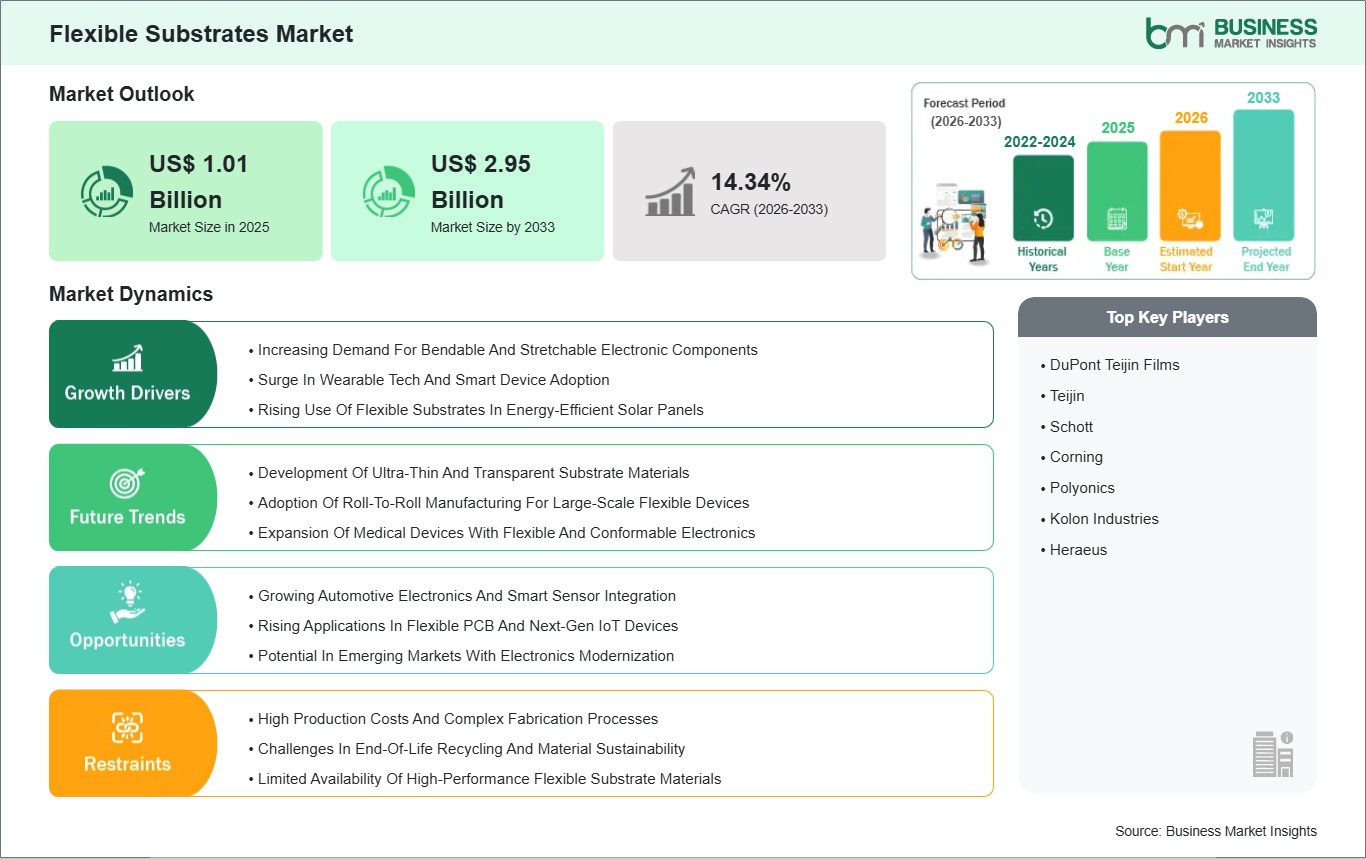
The Flexible Substrates Market size is expected to reach US$ 2.95 Billion by 2033 from US$ 1.01 Billion in 2025. The market is estimated to record a CAGR of 14.34% from 2026 to 2033.
The global flexible substrates market refers to the production and application of bendable, lightweight base materials used in advanced electronics and other high‑growth industries. Flexible substrates serve as foundational materials for printed electronics, flexible displays, wearable devices, photovoltaics, RFID tags, and sensors, owing to their excellent mechanical flexibility, thermal stability, and electrical performance. Growth in consumer electronics, increasing demand for thinner and more adaptable devices, and expanding adoption of IoT‑enabled systems are key drivers for this market.
As industries pursue miniaturization and multifunctionality, flexible substrates have become essential for creating innovative end products that meet evolving design and performance criteria. Technological developments in the substrates themselves, like polyimides, flexible glass, metal foil, and advanced polymer composites, are also moving rapidly. However, the market has some limitations. Some of the challenges faced by the flexible electronics market include challenges in entering this market due to the complexity and cost involved in creating advanced flexible materials.
Moreover, handling flexible materials also requires complex processes, thereby creating challenges in their integration. Another challenge could be inconsistencies in the supply chain, affecting the large-scale development of flexible electronics. However, with the developments in flexible electronics, optimism prevails regarding the future of this market on a global level, considering the partnerships being made in the electronics industry and the developments in emerging applications like automobile electronics, healthcare wearables, and industrial sensors.

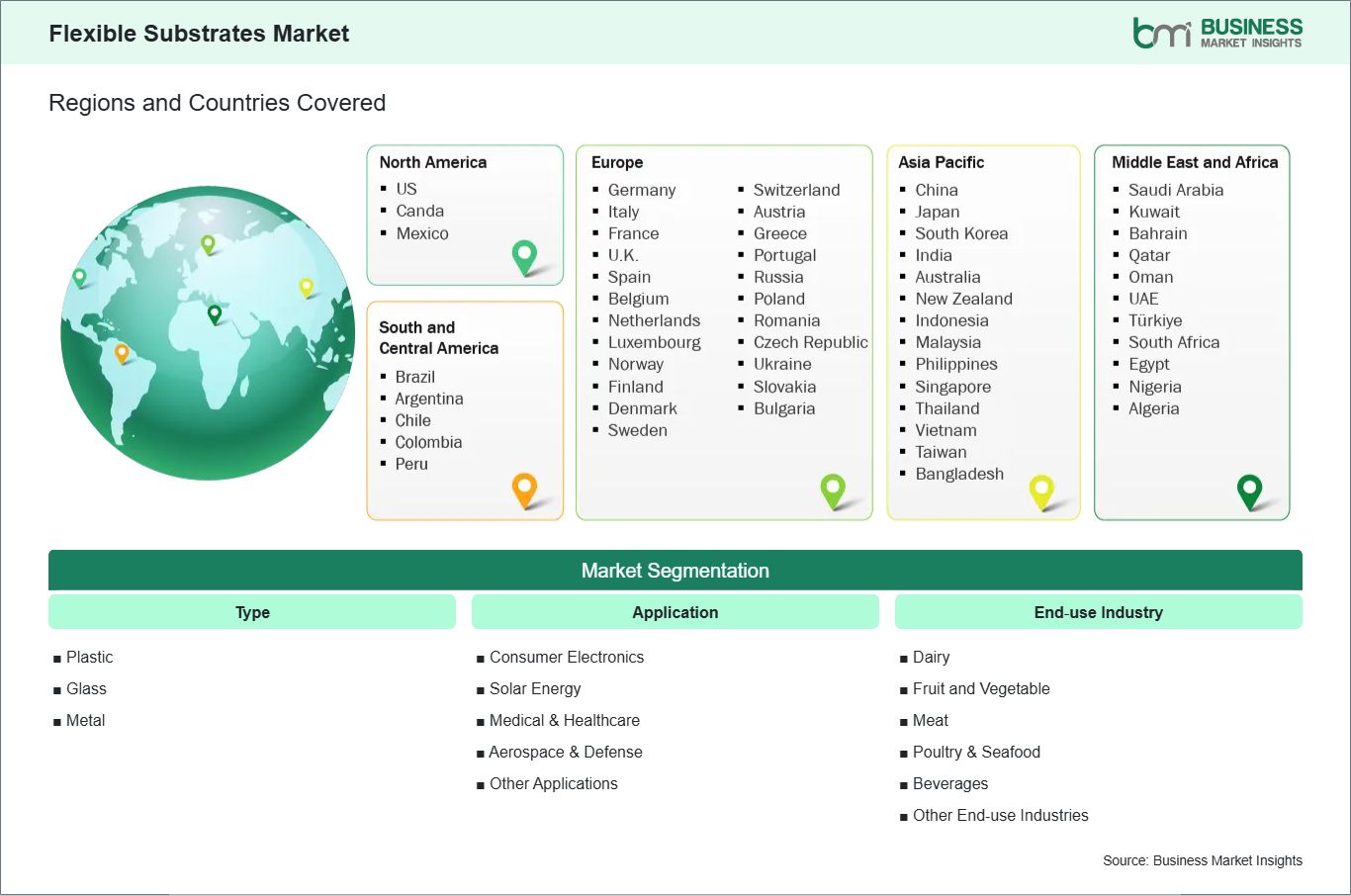
Key segments that contributed to the derivation of the flexible substrates market analysis are type and application.
The global flexible substrates market is being significantly driven by the rising demand for bendable, foldable, and stretchable electronic components across multiple industries. Flexible substrates provide the foundation for innovative electronics that can conform to various shapes and withstand repeated mechanical stress, making them essential for wearable devices, foldable displays, medical sensors, and consumer electronics. Their ability to support thin, lightweight, and high-performance electronic circuits allows designers to develop compact and portable devices, which aligns with growing consumer preference for convenience, mobility, and multifunctionality.
This is characterized by different patterns of adoption depending on the technological advancements and product needs in different regions. In regions with well-developed electronics manufacturing infrastructures, flexible substrates have become an essential part of foldable smartphones, smart wearables, and other high-tech electronic devices that need compact and flexible circuits for proper functionality. On the contrary, in regions with growing consumer electronics markets, flexible substrates have been utilized in the development of innovative product forms such as flexible lighting solutions, e-paper displays, and interactive display panels for product diversification in competitive markets. The flexibility of the substrates allows for the customization of electronic device designs for different market needs.
The trend towards sustainability and advanced material developments is also impacting the adoption of flexible substrates. Many manufacturers are looking to develop advanced materials, including recyclable and thermally stable substrates, to enable the production of flexible substrates. The trend towards sustainability is also driving many manufacturers to develop recyclable substrates, and the flexibility and electrical performance of substrates will ensure their continued importance as enabling technologies for advanced electronic components. As consumers increasingly demand multifunctional, compact, and robust electronic products, flexible substrates will continue to be at the forefront of the electronics industry.
The expansion of automotive electronics and the integration of smart sensors represent a major opportunity for the global flexible substrates market. Modern vehicles increasingly rely on flexible electronic components to support advanced driver-assistance systems, infotainment interfaces, and in-vehicle connectivity solutions. Flexible substrates allow circuits to be integrated into curved or confined spaces, enabling seamless embedding of sensors, displays, and control modules throughout vehicle interiors. Their ability to provide reliable performance under vibration, temperature variation, and mechanical stress makes them ideal for automotive electronics applications.
Regional variations in the adoption of automobile technology also reflect distinct trends in the automobile industry. In industrialized automobile industries, flexible substrates are integrated in automobile dashboards, steering mechanisms, safety monitoring devices, and passenger interfaces to provide advanced features in automobile technology. In regions with rapidly advancing automobile industries and increasing demand for smart automobiles, automobile manufacturers are increasingly integrating flexible substrates in smart automobile technology, including emerging automobile mobility solutions like electric automobiles, smart cars, and automobile fleet management systems.
The integration of flexible substrates and smart sensor integration has also opened avenues for advancing automobile safety, energy, and user experience. Flexible substrates provide automobile manufacturers with the opportunity to integrate lightweight and compact electronic devices in automobile technology, reducing automobile weight and enhancing automobile fuel efficiency. Moreover, flexible substrates also provide automobile manufacturers with the opportunity to design advanced automobile features like driver assistance and autonomous vehicles with greater accuracy and durability. In the future, automobile technology is likely to become increasingly smart and connected, and flexible substrates are likely to become integral to automobile electronics.

The flexible substrates market is experiencing steady growth, with market size and share analysis reflecting evolving treatment preferences and competitive dynamics among key players. The report evaluates important subsegments categorized within type and application, highlighting their respective contributions to overall market performance.
By type, the Plastic subsegment dominated the Flexible Substrate market in 2025. Plastic substrates offer lightweight, flexibility, and cost-effectiveness, making them highly suitable for a wide range of applications, which drives their widespread adoption.
Based on application, the Consumer Electronics subsegment dominated the Flexible Substrate market in 2025. Consumer electronics applications demand flexible, durable, and high-performance substrates for devices and components, making this segment highly suitable for the industry, which drives its widespread adoption.
| Report Attribute | Details |
|---|---|
| Market size in 2025 | US$ 1.01 Billion |
| Market Size by 2033 | US$ 2.95 Billion |
| Global CAGR (2026 - 2033) | 14.34% |
| Historical Data | 2022-2024 |
| Forecast period | 2026-2033 |
| Segments Covered | By Type
|
|
Regions and Countries Covered
| |
| North America | US, Canada, Mexico |
| Europe | Belgium, Austria, Finland, Denmark, Greece, Poland, Romania, Russia, Ukraine, Czech Republic, Slovakia, Bulgaria, Italy, Luxembourg, Germany, Switzerland, France, Netherlands, Norway, Portugal, Spain, Sweden, United Kingdom |
| Asia-Pacific | Australia, China, India, Japan, South Korea, Indonesia, Malaysia, Philippines, Singapore, Thailand, Vietnam, Bangladesh, New Zealand, Taiwan |
| South and Central America | Brazil, Argentina, Peru, Chile, Colombia |
| Middle East and Africa | Bahrain, Kuwait, Oman, Qatar, Saudi Arabia, United Arab Emirates, Turkiye, South Africa, Egypt, Algeria, Nigeria |
| Market leaders and key company profiles |
|
The "Flexible Substrates Market Size and Forecast (2022 - 2033)" report provides a detailed analysis of the market covering below areas:
The geographical scope of the Flexible Substrates market report is divided into five regions: North America, Asia Pacific, Europe, Middle East & Africa, and South & Central America. The Flexible Substrates market in North America is expected to grow during the forecast period.
North America is a dominant region in the global flexible substrates market, supported by advanced technology ecosystems, robust research and development infrastructures, and strong end‑user demand across multiple high‑growth sectors. The region benefits from the presence of major electronics and semiconductor manufacturers, research institutions, and startups that accelerate innovation in flexible electronics. Consumer demand for cutting‑edge products such as foldable displays, wearable health monitors, flexible sensors, and advanced packaging solutions fuels investment in new substrate technologies.
In addition, government support for innovation, intellectual property protection, and collaborations between industry and academia further strengthen North America`s leadership in flexible substrates. The region`s manufacturers are focused on the development of materials that can withstand high performance, durability, improved thermal tolerances, and mechanical flexibility. This ensures that the materials can withstand the demands of automotive electronics, aerospace, and medical devices. Strategic alliances are a key aspect in the region, which enables a smooth product development cycle.
Sustainability issues, such as recycling flexible materials and reducing hazardous materials, are also becoming key factors in the region`s product development cycle. Some of the challenges facing the region`s flexible materials industry include high production costs, manufacturing requirements, and competition from other regions. Nevertheless, considering the region`s technological base, diversified demand, and active innovation cycle, North America remains a key player in the flexible materials industry.

The flexible substrates market is evaluated by gathering qualitative and quantitative data post primary and secondary research, which includes important corporate publications, association data, and databases. A few of the key developments in the flexible substrates market are:
The Flexible Substrates Market is valued at US$ 1.01 Billion in 2025, it is projected to reach US$ 2.95 Billion by 2033.
As per our report Flexible Substrates Market, the market size is valued at US$ 1.01 Billion in 2025, projecting it to reach US$ 2.95 Billion by 2033. This translates to a CAGR of approximately 14.34% during the forecast period.
The Flexible Substrates Market report typically cover these key segments-
The historic period, base year, and forecast period can vary slightly depending on the specific market research report. However, for the Flexible Substrates Market report:
The Flexible Substrates Market is populated by several key players, each contributing to its growth and innovation. Some of the major players include:
The Flexible Substrates Market report is valuable for diverse stakeholders, including:
Essentially, anyone involved in or considering involvement in the Flexible Substrates Market value chain can benefit from the information contained in a comprehensive market report.
Please tell us your area of interest
(Market Segments/ Regions and Countries/ Companies)