
Fiberglass Market Outlook: Size, Share, Trends, Growth Analysis, Competitive Landscape & Forecast, 2026-2033

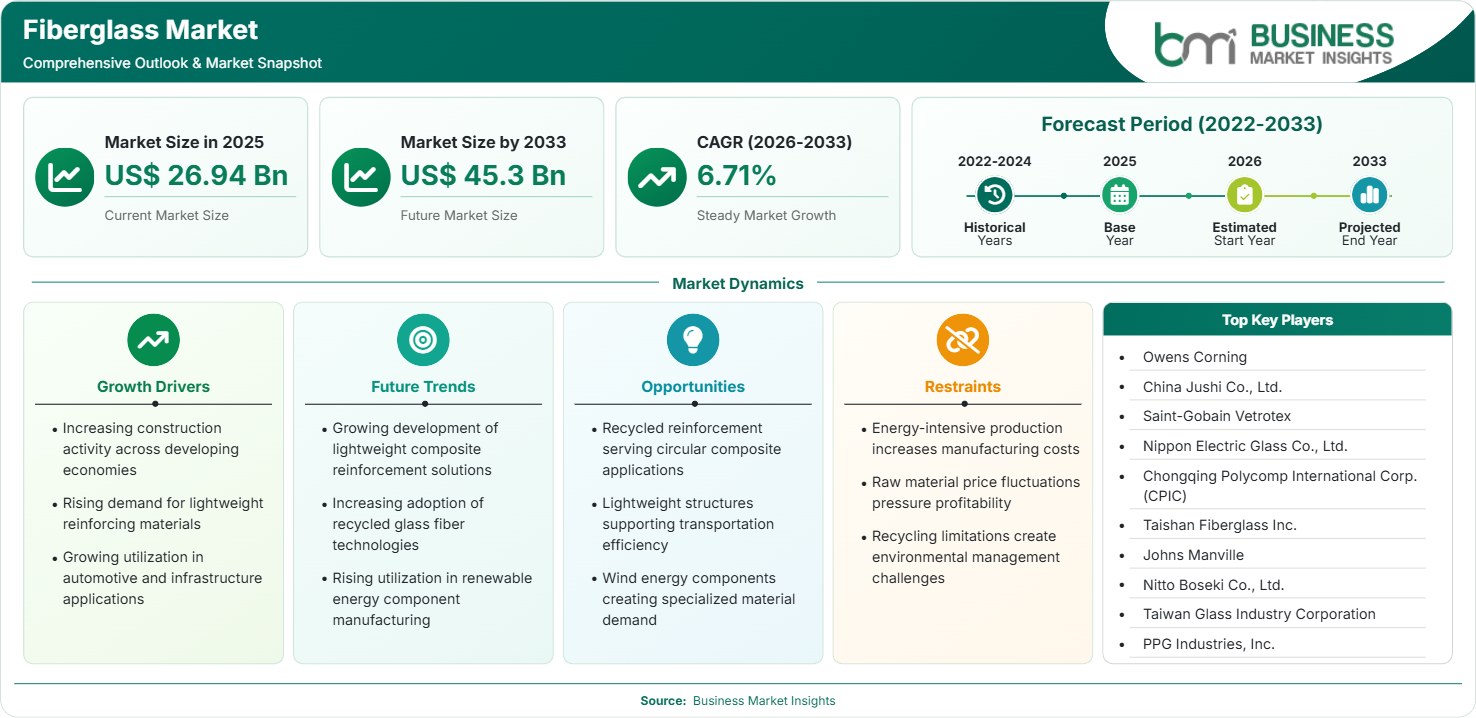
The Fiberglass Market size was valued at US$ 26.94 Billion in 2025 and is projected to reach US$ 45.3 Billion by 2033, growing at a CAGR of 6.71% during 2026–2033. Growth is supported by expanding wind energy installations, lightweight transportation materials, infrastructure modernization, electrical insulation demand, and opportunities across composite-intensive applications in emerging economies.

Report Coverage
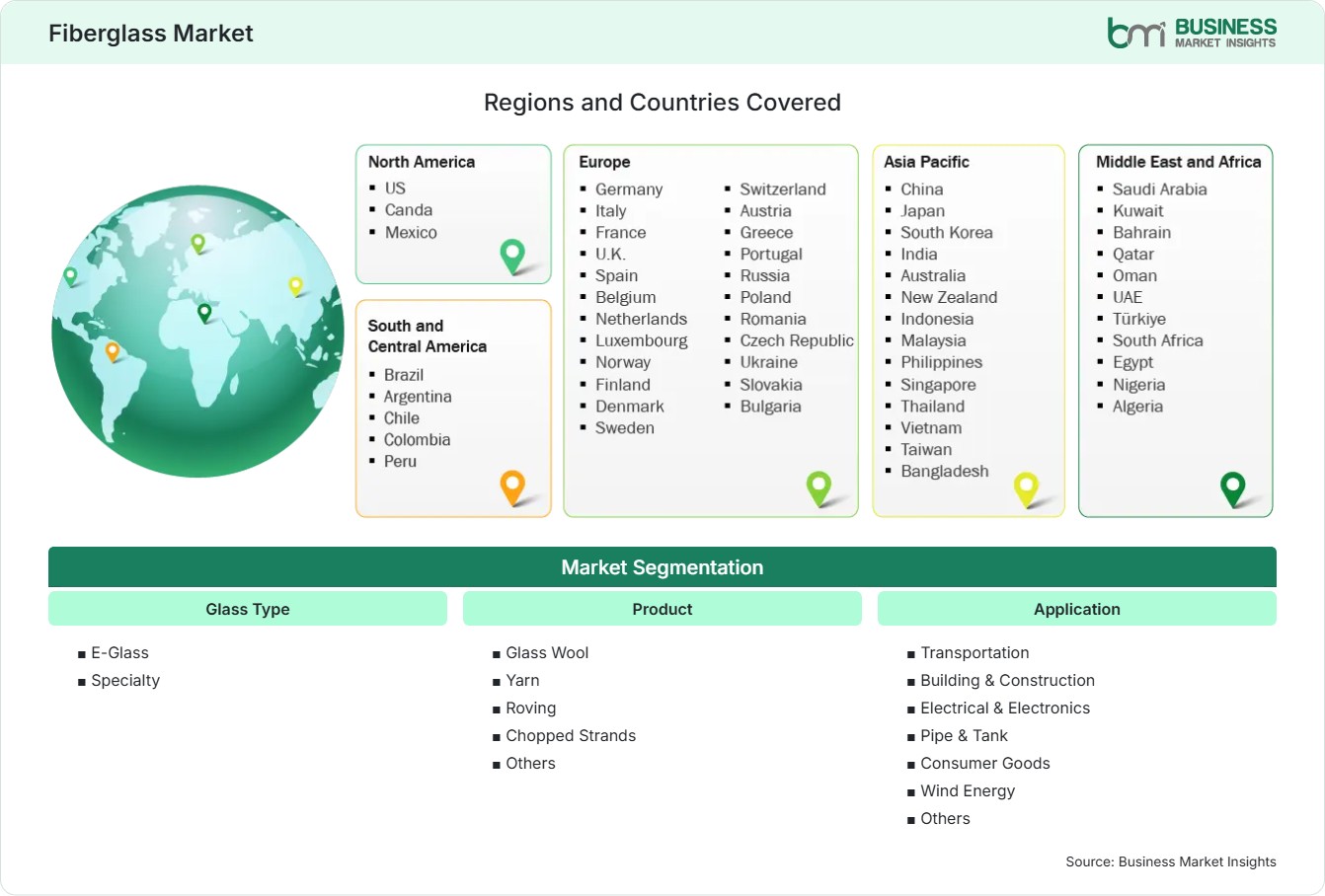
  • Glass Type: E-Glass, Specialty
  • Product: Glass Wool, Yarn, Roving, Chopped Strands, Others
  • Application: Transportation, Building & Construction, Electrical & Electronics, Pipe & Tank, Consumer Goods, Wind Energy, Others
US$ 26.94 Bn Market size in 2025
US$ 45.3 Bn Market Size by 2033
6.71% CAGR, 2026 - 2033
2026-2033 Forecast Period

AI Overview

Fiberglass Market Summary

  • North America Region: North America holds a Fiberglass Market share of 24%–27% in 2025 and is projected to grow at a CAGR of 5.8%–6.3% during 2026–2033. Demand is supported by wind blade manufacturing, non-residential construction upgrades, composite infrastructure adoption, transportation lightweighting initiatives, utility investments, advanced insulation requirements, resilient supply chains, sustainability goals, and manufacturing modernization programs nationwide. The U.S. represents over three-fourths of regional demand and is expected to advance at a CAGR of 5.9%–6.4%.
  • Fastest Growing Region: Asia Pacific accounts for 43%–46% market share in 2025 and is expected to expand at a CAGR of 7.5%–8.1%. Rising renewable installations, industrial expansion, transportation manufacturing, urban infrastructure projects, domestic composites production, export-oriented industries, grid upgrades, electronics manufacturing growth, and policy-backed investments support accelerated regional development.
  • Leading Segment: E-Glass holds 68%–72% share in 2025 and is anticipated to grow at a CAGR of 6.3%–6.8%. Broad acceptance across construction, transportation, electronics, industrial equipment, cost-effective reinforcement applications, reliable mechanical properties, scalable manufacturing capacity, established supply networks, and favorable performance-to-cost ratios support continued leadership.
  • High Growth Segment: Wind Energy represents a 12%–15% Fiberglass Market share in 2025 and is projected to grow at a CAGR of 8.4%–9.0%. Larger turbine blades, offshore installations, renewable energy targets, durability requirements, lightweight composite structures, government incentives, grid decarbonization initiatives, localized manufacturing investments, and long service life advantages accelerate adoption.
  • Key Market Opportunity: Increasing penetration of composite-intensive infrastructure, utility poles, storage tanks, bridge components, and renewable energy equipment creates long-term demand opportunities for advanced reinforcement materials across developing and developed economies.
  • Major Market Players: Owens Corning, China Jushi Co., Ltd., Saint-Gobain Vetrotex, Nippon Electric Glass Co., Ltd., Chongqing Polycomp International Corp. (CPIC), Taishan Fiberglass Inc., Johns Manville, Nitto Boseki Co., Ltd., Taiwan Glass Industry Corporation, PPG Industries, Inc.
Strategic Insights

Fiberglass Market: Strategic Insights

Fiberglass Market Strategic Framework
FREE PDF
Request your free sample
Request free sample
Stakeholder View

Key Takeaways

  • The value chain remains integrated across silica suppliers, glass fiber manufacturers, resin formulators, composite fabricators, and end-use industries, enabling large-scale production efficiencies and technical customization.
  • Wind energy, corrosion-resistant pipes and tanks, and advanced transportation components offer stronger upside potential than mature conventional reinforcement applications.
  • Product innovation increasingly focuses on high-strength specialty grades, improved filament consistency, recyclable composite solutions, and manufacturing processes that lower energy intensity.
  • India, Southeast Asia, and selected Gulf economies provide compelling investment prospects due to infrastructure expansion, renewable deployment, and industrial diversification initiatives.
  • Strategic investments emphasize capacity additions, plant modernization, regional supply-chain localization, and acquisitions that strengthen specialty composite portfolios.
  • Sustainability performance is becoming a competitive differentiator as customers increasingly evaluate lifecycle durability, maintenance savings, and carbon-reduction benefits.
Geographic Outlook

Fiberglass Market Regional Highlights

North America Fiberglass Market

North America accounted for approximately 24%–27% Fiberglass Market share in 2025 and is expected to grow at a CAGR of 5.8%–6.3% through 2033. Strong demand stems from infrastructure rehabilitation, wind energy manufacturing, utility modernization, and transportation lightweighting programs. Investments in composite materials for bridges, industrial tanks, and electrical applications continue supporting growth. The region benefits from established production capacity, advanced engineering capabilities, and favorable adoption of high-performance reinforcement materials across industrial and commercial sectors.

  • Wind blade manufacturing continues driving consumption of roving and specialty fibers across major renewable-energy supply chains.
  • Building insulation demand benefits from stricter efficiency regulations and refurbishment of aging commercial infrastructure.
  • Composite utility poles and corrosion-resistant infrastructure components gain traction among municipalities seeking lower maintenance costs.
  • Regional manufacturers prioritize production efficiency, automation, and premium-grade product development to enhance competitiveness.

US Fiberglass Market

The United States accounts for about 76%-80% of regional consumption and is growing at a CAGR of 5.9%-6.4%. Infrastructure development, increased transmission capacity, military uses, and alternative energy drive consumption. The local producers are focusing on strengthening their supply chains and material production capabilities. The rise in utility-scale energy projects and industrial sector modernization will continue to drive demand for reinforcement materials.

  • Composite materials increasingly replace traditional metal components in transportation and infrastructure projects.
  • Utility transmission expansion creates demand for durable electrical insulation and structural reinforcement applications.
  • Domestic manufacturing initiatives encourage investment in advanced material production capabilities and operational efficiency.
  • Energy-sector modernization supports long-term consumption of corrosion-resistant industrial equipment and storage systems.

Europe Fiberglass Market

The Europe Fiberglass Market accounts for about 22-25% of the market share and is expected to grow at a CAGR of 5.7-6.2%. Germany leads in market share, whereas Eastern European nations are growing faster. Factors boosting demand include the use of renewable energy sources, sustainable construction practices, and light-weighting in automobiles. Production processes that reduce energy consumption are now favored by manufacturers, and recyclable composite solutions are being adopted to align with regional climate objectives and industrial sustainability requirements.

  • Germany leads regional consumption through industrial manufacturing, transportation engineering, and advanced construction sectors.
  • Poland and other Eastern European economies demonstrate faster growth supported by infrastructure and renewable-energy investments.
  • EU efficiency regulations encourage adoption of insulation and high-performance reinforcement materials.
  • Offshore wind expansion sustains demand for specialty fibers used in larger turbine blade structures.
  • Industrial modernization projects support broader adoption of corrosion-resistant composite applications.

Asia Pacific Fiberglass Market

The Asia Pacific region holds a market share of 43%–46% and is projected to achieve the fastest growth rate, with a 7.5%–8.1% CAGR in 2025. China dominates as the largest market, while India has the highest growth rate among the major economies. Manufacturing strengths, infrastructure, renewable energy development, and electronics manufacturing make this region a leader. Domestic companies are continuously expanding their capacity to cater to domestic and export needs, strengthening the region's global position.

  • China leads regional demand through extensive composites manufacturing and renewable-energy equipment production.
  • India records strong expansion supported by infrastructure growth and increasing industrial investment.
  • Electronics manufacturing stimulates consumption across electrical and insulation applications.
  • Regional producers benefit from economies of scale and integrated supply-chain ecosystems.
  • Transportation manufacturing supports demand for lightweight, durable reinforcement materials.

Rest of World Fiberglass Market

Rest of World contributes 8%–11% share and is expected to grow at 6.6%–7.2% CAGR. South and Central America benefit from infrastructure investments and industrial development. The Middle East and Africa gain momentum through utility projects, desalination infrastructure, energy investments, and construction activity. Market expansion remains linked to economic diversification strategies and increasing adoption of corrosion-resistant materials in challenging operating environments.

  • Brazil leads South and Central American demand through industrial and construction sector investments.
  • Mexico benefits from manufacturing expansion and integration with North American supply chains.
  • Saudi Arabia demonstrates strong growth through infrastructure modernization and industrial diversification initiatives.
  • UAE investments in utilities and commercial construction support broader demand across composite applications.
  • Water-treatment and storage infrastructure projects increase consumption of pipes, tanks, and reinforced systems.
Global Market Geography
FREE PDF
Request your free sample
Request free sample
Segment Analysis

Fiberglass Market Segmentation

Glass Type

Glass Type was an important part of industry demand, with E-Glass accounting for the largest share. This market segment is advantageous due to its versatility of applications, affordability, and high scalability. The Fiberglass Market size has been growing, driven by special grades with improved mechanical, heat, and corrosion-resistant properties. The major segment accounted for 68%–72% in 2025, with a 6.3%–6.8% CAGR.

  • E-Glass: Widely adopted across construction, transportation, electrical equipment, and wind-energy applications due to balanced mechanical performance, affordability, and extensive manufacturing availability globally.
  • Specialty: Gains traction in aerospace, defense, advanced industrial systems, and high-performance engineering applications requiring enhanced thermal resistance, strength retention, and specialized operating characteristics.

Product

Product demand will be influenced by reinforcement needs, manufacturing process, and manufacturing efficiencies. Roving will continue to be the major product type due to its use in wind energy and industrial composites. The market held a 34%–38% share in 2025 and is projected to grow at a CAGR of 6.8%–7.4% as advanced composite manufacturing scales globally.

  • Glass Wool: Extensively used for thermal and acoustic insulation in residential, commercial, and industrial construction environments.
  • Yarn: Supports electrical insulation, woven fabrics, and specialty technical textile applications requiring dimensional consistency.
  • Roving: Serves as a critical reinforcement material for wind blades, automotive components, marine products, and infrastructure applications.
  • Chopped Strands: Preferred in molding compounds and composite manufacturing processes due to processing flexibility and reinforcement efficiency.

Application

The demand for applications is increasing due to the growing use of composites across industries, infrastructure, the renewable energy sector, and consumer markets. Building & Construction is the largest market, capturing 28%–32% by 2025 with a CAGR of 6.0%–6.5%. This paragraph also includes Fiberglass Market trends relating to energy efficiency and sustainability.

  • Transportation: Lightweighting initiatives improve fuel efficiency, electrification performance, and structural durability across vehicles.
  • Building & Construction: Strong insulation demand and corrosion-resistant reinforcement applications support widespread adoption.
  • Electrical & Electronics: Utilized in insulation components, circuit materials, and industrial electrical systems requiring reliability.
  • Pipe & Tank: Benefits from increasing deployment of corrosion-resistant infrastructure in industrial and municipal environments.
  • Consumer Goods: Supports recreational equipment, appliances, furniture, and durable consumer-product manufacturing.
  • Wind Energy: Expands rapidly through larger turbine blade requirements and renewable-energy capacity additions.
Market Forces

Fiberglass Market Dynamics

Key Market Drivers

Expansion of Global Wind Energy Capacity

According to the International Energy Agency, another significant driver of change in the power industry is the need for ongoing investment in renewable energy sources, which in turn drives demand for composite-based turbine parts. Turbines require high-quality reinforcing materials to provide strength and low weight to the blades. The production of offshore wind energy necessitates greater use of reinforcing materials due to growing blade sizes and emerging technical requirements. Manufacturers have begun producing larger volumes of rovings and specialty fibers in response to rising demand. The rise in renewable energy goals in Asia, Europe, and North America ensures continued growth in material consumption across wind-energy applications.

Infrastructure Modernization and Sustainable Construction

Governments around the world are allocating resources for building better transport networks, infrastructure, and utilities. Reinforced composites are finding applications in bridge construction, utility pole erection, storage structures, and water supply systems because of their superior corrosion resistance and reduced maintenance needs. The market development is being driven by regulations that favor the use of energy-efficient materials. Urbanization of developing countries is another factor creating demand for durable materials. Engineers are considering the performance of materials throughout their life cycles rather than focusing on costs alone, which makes the material more advantageous than competing materials.

Increased Adoption in Transportation Lightweighting

Automobile, railroad, maritime, and specialized transportation vehicle makers continue their efforts to reduce weight, resulting in greater energy efficiency and enhanced performance. Composites play an important role in reducing weight without compromising mechanical properties. Electric vehicles benefit from composites due to the potential for increased driving range associated with reduced component weight. Reinforced composites are used in the manufacture of body parts, panels, interior components, and other elements. Improved production technologies have increased the efficiency and feasibility of material substitution, which continues to support sustained industry expansion.

Key Market Opportunities

Advanced Grid Infrastructure and Utility Applications

Utility companies are investing more in resilient transmission and distribution infrastructure. Composite crossarms, poles, enclosures, and insulators have proven advantageous for longevity in challenging environmental conditions. Electrification initiatives in developing countries generate increased demand for infrastructure materials. Growing electricity networks for renewable energy generation are another area that will boost adoption opportunities. Long lifespan and low maintenance costs make composite components more economically viable for utility companies. Smart grids and distributed energy generation present promising growth opportunities for the composites market. Long-term Fiberglass Market forecasts are supported by trends in electrification, modernization, and infrastructure resilience objectives across multiple regions.

Growth of Corrosion-Resistant Industrial Systems

Increasingly reinforced composite pipes, tanks, ducting, and processing units have been used by industrial operators in chemical processing, water treatment plants, and the marine environment. Corrosion resistance reduces maintenance needs and increases service life. The increasing need for desalination plants, wastewater treatment facilities, and industrial storage systems provides a stable demand potential. Economies in the development stage have been investing resources in industrial ventures that provide opportunities for advanced materials. Organizations that manufacture customized products can benefit from high margins. This is an area of development separate from construction and transportation cycles.

Specialty Fiber Development for High-Performance Markets

There is a rising demand for products that could serve applications across the aerospace, defense, electronics, and industrial segments. Specialty fibers offer improved heat resistance, mechanical strength, and efficiency. Increased research activities lead to the development of a diversified product range and penetration into high-value applications. Clients have started looking for application-oriented solutions instead of generalized products. Companies that develop specialty grades will be able to boost margins and protect themselves from price pressures. Continued innovation creates opportunities for performance-driven market expansion and long-term competitive differentiation.

Market Restraints and Challenges

Energy-Intensive Production Costs Profitability

Factor: Production of glass fibers requires large amounts of energy for melting and processing. Impact: Energy price volatility can greatly affect the company's operating costs and margins. Companies located in areas with high energy costs may be at a disadvantage compared to other production centers with lower costs. The fluctuations may restrict the flexibility of investments and the expansion process. In addition, customers can delay their purchases when faced with uncertainty in the whole industry. Efficiency gains have lowered energy intensity, but the costs remain an issue. Long-term competitiveness depends on operational optimization, technological upgrading, and improved energy sourcing strategies.

Raw Material and Supply Chain Volatility Output

Factor: Manufacturing depends on a constant stream of minerals, chemicals, and transport, among others. Impact: Shortages of these resources can affect manufacturing, delivery times, and the ability to meet customers' needs. Geopolitical tensions, logistical challenges, and uncertainties in regional trade might make it difficult to obtain the necessary supplies. Such disruptions can result in increased costs and reduced flexibility in responding to demand fluctuations. Companies are responding by diversifying suppliers, adopting regional purchasing strategies, and improving inventory management. Yet, keeping smooth operations in global supply chains is a continuing struggle.

Company Analysis

Competitive Landscape

The competitive environment features global-scale manufacturers and specialized reinforcement suppliers. Current Fiberglass Market analysis indicates competition is centered on capacity expansion, specialty product development, energy efficiency, and regional supply-chain strengthening.

Company Name

Overview

Products and Services relevant to this market

Owens Corning

Global building materials and composites manufacturer with extensive glass fiber operations and broad geographic reach.

Glass fiber reinforcements, rovings, chopped strands, insulation solutions, composite materials.

China Jushi Co., Ltd.

One of the world's largest fiberglass producers with significant manufacturing scale and export presence.

E-glass products, rovings, yarns, chopped strands, composite reinforcement solutions.

Saint-Gobain Vetrotex

Specialty glass reinforcement business serving industrial, construction, and transportation markets.

Reinforcement fibers, mats, chopped strands, engineered composite solutions.

Nippon Electric Glass Co., Ltd.

Japanese advanced materials producer with diversified glass technology expertise.

Specialty glass fibers, electronic materials, industrial reinforcement products.

Chongqing Polycomp International Corp. (CPIC)

Major global supplier focused on composite reinforcement materials and innovation.

Rovings, fabrics, chopped strands, wind-energy reinforcement solutions.

Taishan Fiberglass Inc.

Large-scale manufacturer serving domestic and export composite markets.

E-glass fibers, yarns, rovings, specialty reinforcement products.

Johns Manville

Berkshire Hathaway subsidiary with strong insulation and engineered materials portfolio.

Glass fibers, insulation materials, industrial reinforcement applications.

Nitto Boseki Co., Ltd.

Advanced materials company focused on technical glass fiber performance.

Specialty yarns, electronic-grade glass fibers, reinforcement materials.

Taiwan Glass Industry Corporation

Diversified glass manufacturer with participation in reinforcement fiber markets.

Fiberglass products, industrial glass materials, composite solutions.

PPG Industries, Inc.

Materials technology company with established expertise in glass reinforcement products.

Glass fiber reinforcements, composite materials, industrial specialty products.

Trust & Transparency

Research Methodology

The market analysis combines proprietary research with secondary data from government agencies, company disclosures, regulatory filings, industry databases and expert interviews. Market estimates are validated through data triangulation, cross-market benchmarking and analyst review.

View Full Research Methodology

Questions Answered

Frequently Asked Questions

What does the Fiberglass Market Report cover?

The report covers market size, regional dynamics, segment analysis, competitive positioning, technology trends, opportunities, risks, and long-term industry outlook through 2033.

How does fiberglass support sustainability goals?

Its durability, lightweight characteristics, lower maintenance requirements, and contribution to energy-efficient buildings and renewable-energy systems support sustainability objectives.

Which application offers the fastest growth potential?

Wind energy presents the strongest growth outlook because larger turbines and offshore installations require substantial volumes of high-performance reinforcement materials.

Which region leads global consumption?

Asia Pacific leads global demand due to extensive manufacturing capacity, infrastructure spending, renewable-energy investments, and a strong composites production ecosystem.

What is driving demand for fiberglass across industries?

Demand is primarily supported by infrastructure modernization, renewable-energy deployment, transportation lightweighting, and increasing use of corrosion-resistant composite materials in industrial environments.

Access the Full Fiberglass Market Report

Get segment-level forecasts, regional estimates, competitive benchmarking, company profiles and downloadable Excel datasets.

Access the full Fiberglass Market Report
350 pages PDF & Excel | 2026-09-10
Similar Research

Related Market Reports