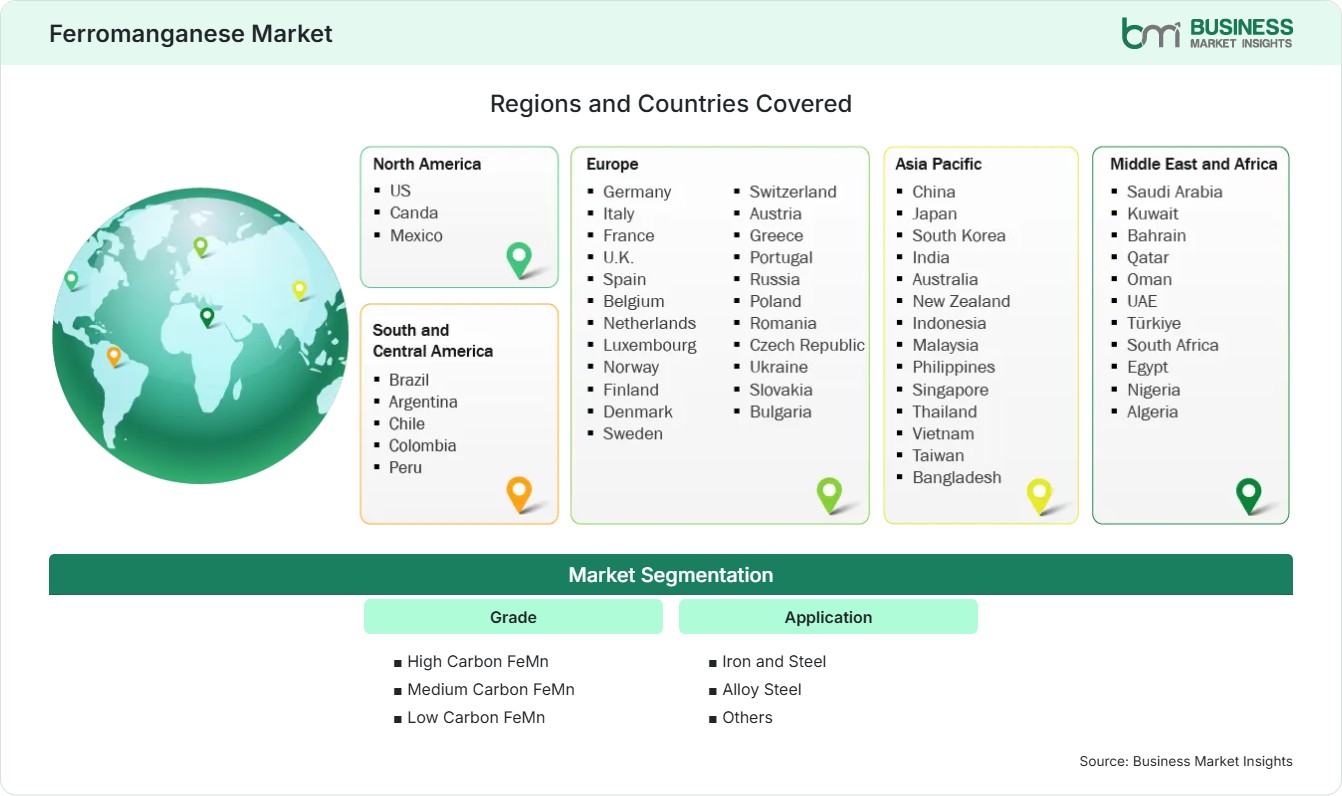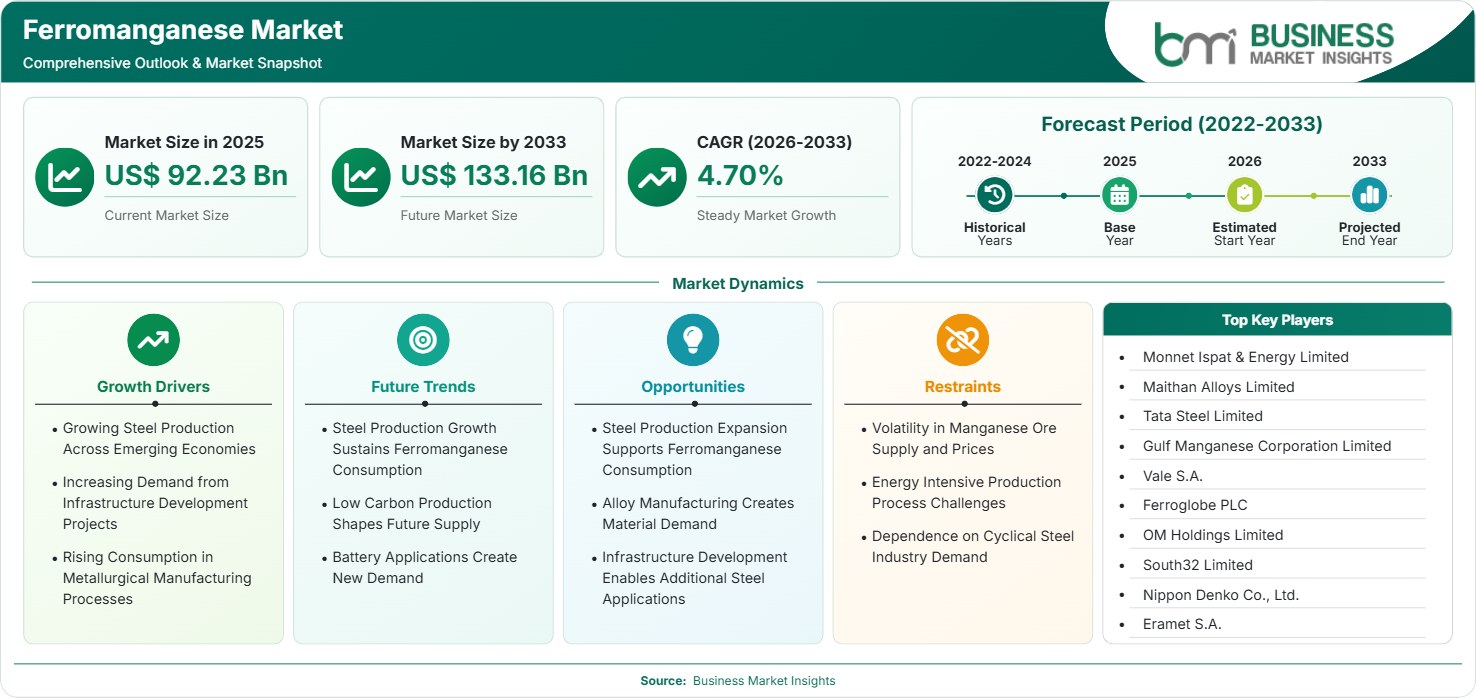
Ferromanganese Market Regional Highlights
North America Ferromanganese Market
North America accounted for approximately 13%–16% of global revenue in 2025 and is projected to expand at a CAGR of 3.8%–4.4% through 2033. Demand is closely tied to steel production for infrastructure, automotive manufacturing, and energy projects. The Ferromanganese Market share in the region remains supported by public infrastructure funding and investments in domestic manufacturing. Producers are increasingly focusing on supply chain localization and operational efficiency improvements to strengthen competitiveness. Continued investment in transportation networks and industrial modernization programs supports steady alloy consumption.
- Infrastructure rehabilitation initiatives across the United States and Canada are increasing steel requirements, supporting stable demand for manganese alloys used in construction-grade steel production.
- Steelmakers are investing in process modernization and productivity improvements, encouraging higher consumption of metallurgical additives that enhance steel quality and operational performance.
- Growth in renewable energy installations, transmission projects, and industrial equipment manufacturing continues supporting alloy demand across multiple end-use industries.
- Supply chain resilience strategies are encouraging domestic sourcing initiatives and strengthening relationships between alloy producers and regional steel manufacturers.
- Environmental compliance requirements are accelerating investments in energy-efficient production technologies and operational upgrades throughout the metallurgical value chain.
US Ferromanganese Market
The United States represented approximately 76%–80% of regional revenue in 2025 and is expected to advance at a CAGR of 3.9%–4.5% through 2033. Strong construction activity, transportation infrastructure spending, and industrial manufacturing investments support demand for steelmaking materials. Domestic steel production remains a critical consumption driver, while reshoring initiatives are encouraging new manufacturing investments. Demand for advanced steel grades used in energy, defense, and transportation sectors continues supporting manganese alloy utilization across diverse industrial applications.
- Federal infrastructure programs are creating sustained demand for structural steel products, indirectly supporting consumption of manganese-based alloying materials.
- Automotive manufacturing investments and electric vehicle production facilities are increasing requirements for specialty steel grades with enhanced performance characteristics.
- Industrial reshoring initiatives are stimulating domestic steel consumption, supporting long-term demand stability for metallurgical raw materials.
- Modernization of steelmaking facilities continues improving production efficiency while increasing adoption of advanced alloy technologies and process optimization solutions.
Europe Ferromanganese Market
Europe accounted for around 17% to 20% of the world's revenue share in 2025 and is estimated to grow at a CAGR of 3.6% to 4.2% until 2033. Europe has an excellent industrial infrastructure and a highly developed steel manufacturing sector. The leading market in Europe is Germany, owing to its strong presence in the automotive and machinery sectors; however, Eastern Europe is experiencing higher growth rates. The push towards decarbonization and investment in green steel has been positively shaping purchase decisions, encouraging the adoption of efficient alloy production technologies and supporting modernization across the regional metallurgical industry.
- Germany remains the largest regional consumer due to its extensive engineering, machinery, and automotive manufacturing industries that require high-quality steel products.
- Poland is among the faster-growing markets, supported by infrastructure development projects, industrial expansion, and increasing steel production capacity.
- Green steel initiatives are encouraging investment in cleaner metallurgical technologies and more energy-efficient production systems.
- Automotive manufacturers are increasing use of advanced steel grades, supporting demand for alloying materials that improve strength and durability.
- Industrial sustainability regulations continue encouraging modernization across mining, ferroalloy production, and steelmaking operations.
Asia Pacific Ferromanganese Market
Asia Pacific contributed around 54% to 58% of total market revenue in 2025 and is expected to grow at a CAGR of 5.3% to 6.0% during 2026-2033. The Asia Pacific region is regarded as the major driver of the Ferromanganese Market growth, supported by high steel production, infrastructure development, industrial manufacturing, and urbanization. China holds the leading position in consumption and production, whereas India shows tremendous growth potential due to its infrastructure and industrial development.
- China leads regional consumption through its extensive steelmaking industry, large-scale infrastructure projects, and significant manufacturing output.
- India is among the fastest-growing markets due to government infrastructure programs, industrial expansion initiatives, and increasing steel production capacity.
- Southeast Asian countries are attracting manufacturing investments that support rising demand for construction materials and alloy-enhanced steel products.
- Railway development, port expansion, and urban infrastructure projects continue strengthening long-term steel consumption across the region.
- Mining investments and smelting capacity additions are improving supply security and supporting regional competitiveness in global ferroalloy markets.
Rest of World Ferromanganese Market
Rest of World accounted for approximately 11%–14% of global revenue in 2025 and is expected to register a CAGR of 4.4%–5.0% through 2033. South & Central America benefits from strong mining resources and steel sector investments, with Brazil representing the leading market.
The Middle East and Africa are supported by infrastructure expansion, industrial diversification strategies, and mining development activities. South Africa remains a key producer and exporter of manganese resources, while Gulf economies are increasing investments in steel-intensive construction projects and industrial facilities.
- Brazil remains a major regional contributor due to abundant mineral resources, established mining operations, and a growing steel production industry.
- South Africa plays a strategic role in global manganese supply chains through significant mining output and export-oriented production activities.
- Saudi Arabia and the United Arab Emirates are increasing steel consumption through large-scale infrastructure and industrial diversification projects.
- Mining investment activity across Africa is strengthening raw material availability and supporting future alloy production opportunities.
- Regional governments continue prioritizing transportation, energy, and industrial development projects that require substantial steel consumption.