
Feed Carotenoids Market Outlook: Size, Share, Trends, Growth Analysis, Competitive Landscape & Forecast, 2026-2033

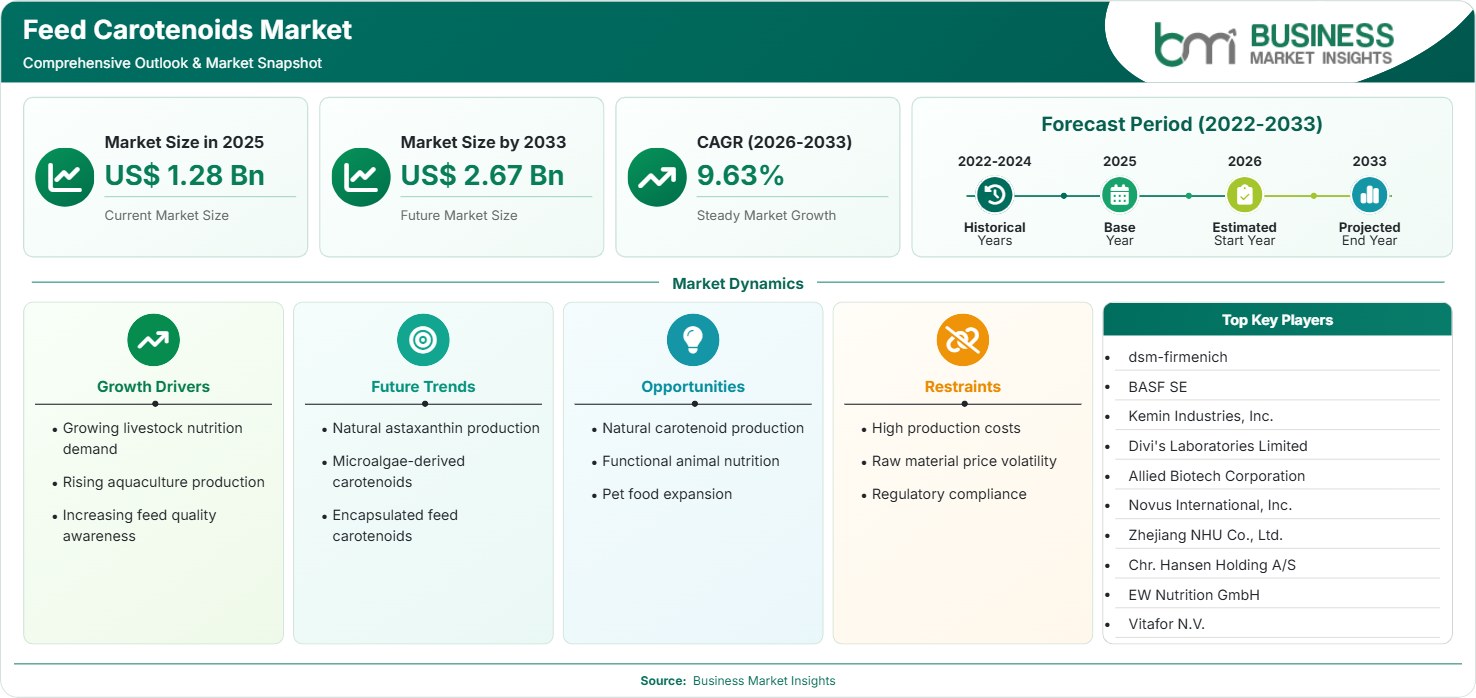
The Feed Carotenoids Market was valued at US$ 1.28 billion in 2025 and is projected to reach US$ 2.67 billion by 2033, growing at a CAGR of 9.63% during 2026–2033. Growth is supported by increasing livestock nutrition demand, rising aquaculture production, improving feed quality standards, expanding natural carotenoid production, functional animal nutrition trends, and pet food industry expansion.

Report Coverage
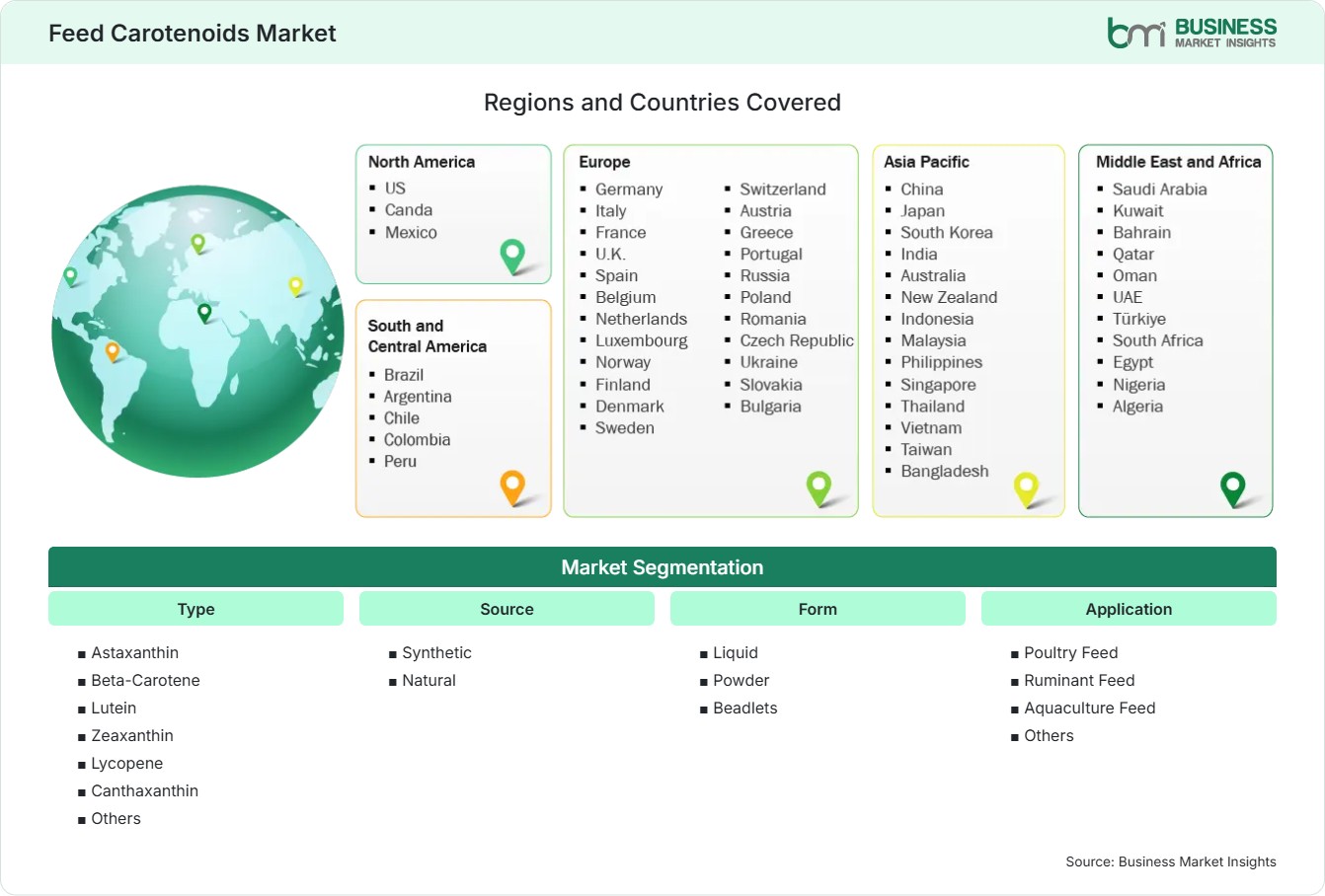
  • Type: Astaxanthin, Beta-Carotene, Lutein, Zeaxanthin, Lycopene, Canthaxanthin, Others
  • Source: Synthetic, Natural
  • Form: Liquid, Powder, Beadlets
  • Application: Poultry Feed, Ruminant Feed, Aquaculture Feed, Others
US$ 1.28 Bn Market size in 2025
US$ 2.67 Bn Market Size by 2033
9.63% CAGR, 2026 - 2033
2026-2033 Forecast Period

AI Overview

Feed Carotenoids Market Summary

  • North America Region: North America holds an estimated 30%–34% share in 2025 and is projected to register a CAGR of 9.2%–9.8% during 2026–2033. Strong commercial livestock production, advanced feed manufacturing, and premium animal nutrition support demand. The U.S. market remains the regional leader with a CAGR of 9.3%–9.9%, driven by poultry, aquaculture, and pet nutrition investments.
  • Fastest Growing Region: Asia Pacific accounts for approximately 34%–38% share in 2025 and is expected to expand at a CAGR of 10.2%–10.8% through 2033. Expanding livestock production, growing aquaculture farming, and increasing demand for high-quality feed additives continue to accelerate regional adoption.
  • Leading Segment: Natural source represents approximately 52%–56% share in 2025 and is forecast to grow at a CAGR of 9.8%–10.3% owing to rising preference for clean-label feed ingredients and sustainable animal nutrition.
  • High Growth Segment: Aquaculture Feed accounts for nearly 26%–30% share in 2025 and is projected to register a CAGR of 10.5%–11.1% due to increasing seafood production and pigmentation requirements.
  • Key Market Opportunity: Expanding natural carotenoid production, functional animal nutrition, sustainable livestock farming, and premium pet food formulations are creating long-term opportunities across global feed industries.
  • Major Market Players: dsm-firmenich, BASF SE, Kemin Industries, Inc., Divi's Laboratories Limited, Allied Biotech Corporation, Novus International, Inc., Zhejiang NHU Co., Ltd., Chr. Hansen Holding A/S, EW Nutrition GmbH, Vitafor N.V.
Strategic Insights

Feed Carotenoids Market: Strategic Insights

Feed Carotenoids Market Strategic Framework
FREE PDF
Request your free sample
Request free sample
Stakeholder View

Key Takeaways

  • Feed ingredient suppliers are increasingly partnering with premix manufacturers and livestock producers to strengthen value chains focused on functional nutrition and animal productivity.
  • Aquaculture and premium poultry nutrition continue to generate the strongest commercial opportunities due to increasing demand for pigmentation enhancement and healthier animal production.
  • Innovation is shifting toward fermentation-derived carotenoids, natural botanical extracts, microalgae cultivation, and improved bioavailability technologies.
  • Asia Pacific remains the strongest regional investment destination due to expanding livestock populations, feed production capacity, and aquaculture development.
  • Companies continue investing in sustainable production technologies, strategic acquisitions, and capacity expansion to strengthen their positions in premium feed additive markets.
Geographic Outlook

Feed Carotenoids Market Regional Highlights

North America Feed Carotenoids Market

North America accounted for approximately 30%–34% of global revenue in 2025 and is expected to expand at a CAGR of 9.2%–9.8% during 2026–2033. Strong commercial poultry production, advanced livestock nutrition practices, and increasing aquaculture investments continue supporting regional demand. The Feed Carotenoids Market share remains substantial due to growing adoption of premium feed ingredients and advanced feed formulation technologies.

  • The United States remains the largest contributor owing to commercial poultry production, premium pet nutrition, and strong feed manufacturing capabilities.
  • Canada continues expanding carotenoid utilization through sustainable livestock production and growing aquaculture investments.
  • Premium egg production increasingly relies on carotenoids to improve yolk pigmentation and nutritional quality.
  • Commercial feed producers continue investing in natural carotenoid formulations to satisfy evolving regulatory and consumer requirements.

US Feed Carotenoids Market

The United States represented nearly 26%–30% of global revenue during 2025 and is projected to record a CAGR of 9.3%–9.9% through 2033. Strong poultry production, expanding aquaculture activities, and premium livestock nutrition continue supporting market expansion. The Feed Carotenoids Market growth benefits from increasing investments in specialty feed ingredients, animal health, and sustainable production systems.

  • Poultry producers increasingly adopt carotenoids for pigmentation enhancement and improved product quality.
  • Pet food manufacturers continue incorporating premium nutritional ingredients into advanced formulations.
  • Feed manufacturers are investing in natural ingredient sourcing to support clean-label animal nutrition products.

Europe Feed Carotenoids Market

Europe held approximately 24%–28% share in 2025 and is forecast to register a CAGR of 8.9%–9.5% during the forecast period. Strong regulatory support for animal welfare, sustainable livestock farming, and reduced antibiotic usage continues driving adoption. Germany remains the leading regional market, while Poland demonstrates one of the fastest growth rates due to expanding poultry production and feed manufacturing.

  • Germany leads regional demand through advanced feed technology and commercial livestock production.
  • France maintains strong adoption across poultry and dairy nutrition applications.
  • Poland records rapid expansion owing to increasing poultry exports and feed production investments.
  • Feed manufacturers continue emphasizing natural carotenoids to comply with European sustainability objectives.

Asia Pacific Feed Carotenoids Market

Asia Pacific accounted for approximately 34%–38% of global revenue during 2025 and is projected to record the fastest CAGR of 10.2%–10.8% through 2033. Rapid livestock expansion, growing aquaculture production, rising protein consumption, and increasing feed quality standards continue driving regional demand. China leads the regional market, while India represents the fastest-growing country due to expanding commercial animal farming.

  • China dominates regional consumption through large-scale poultry and aquaculture production.
  • India demonstrates strong growth supported by commercial livestock expansion and increasing feed quality awareness.
  • Southeast Asia continues investing in aquaculture nutrition and sustainable feed technologies.
  • Regional producers increasingly adopt natural carotenoids to improve livestock productivity and export competitiveness.

Rest of World Feed Carotenoids Market

The Rest of World accounted for approximately 10%–14% share in 2025 and is anticipated to grow at a CAGR of 9.4%–10.0% during the forecast period. Brazil, Mexico, South Africa, and Gulf countries continue investing in commercial livestock production and aquaculture expansion. Rising demand for premium animal protein supports continued market development.

  • Brazil remains the leading Latin American market through large-scale poultry production.
  • Mexico continues increasing demand for advanced livestock nutrition products.
  • Middle Eastern countries are investing in food security initiatives supporting premium feed adoption.
  • South Africa continues expanding commercial livestock production using performance-enhancing feed ingredients.
  • Growing export-oriented meat production encourages broader adoption of carotenoid-enriched feed formulations.
Global Market Geography
FREE PDF
Request your free sample
Request free sample
Segment Analysis

Feed Carotenoids Market Segmentation

Type

The Type segment accounted for the entire market in 2025 and is projected to grow at a CAGR of 9.5%–10.0% through 2033. Demand is influenced by pigmentation requirements, antioxidant functionality, animal species, feed formulation strategies, and production economics. Natural and fermentation-derived carotenoids continue gaining popularity as livestock producers seek sustainable nutritional solutions. The Feed Carotenoids Market scope is expanding with innovations in extraction technologies, bioavailability enhancement, and improved stability for commercial feed applications.

  • Astaxanthin: Widely used in aquaculture feed to improve pigmentation, growth performance, antioxidant activity, and overall health of salmon, trout, shrimp, and other premium seafood species.
  • Beta-Carotene: Supports reproductive performance, immune function, and vitamin A supplementation across dairy cattle, poultry, and livestock nutrition programs.
  • Lutein: Increasingly incorporated into poultry feed formulations to enhance egg yolk pigmentation while supporting antioxidant protection and bird health.
  • Zeaxanthin: Utilized primarily for pigmentation enhancement in poultry and aquaculture while improving nutritional quality and commercial product appearance.
  • Lycopene: Growing adoption stems from antioxidant properties that support immunity, oxidative stress reduction, and overall livestock productivity.
  • Canthaxanthin: Extensively used for pigmentation in poultry meat, egg yolks, and aquaculture species to improve visual quality and consumer acceptance.

Source

The Source segment represented approximately 100% of total revenue in 2025 and is expected to register a CAGR of 9.6%–10.1% during the forecast period. Growing consumer preference for sustainable livestock production and natural feed ingredients is shifting industry demand toward naturally derived carotenoids. Synthetic variants continue maintaining commercial importance due to cost efficiency and consistent product quality across large-scale feed manufacturing operations.

  • Synthetic: Synthetic carotenoids remain widely adopted because they provide standardized quality, cost-effective manufacturing, and reliable pigmentation performance across commercial livestock production.
  • Natural: Natural carotenoids continue expanding through microalgae, yeast, marigold flowers, paprika extracts, and fermentation technologies that support sustainable animal nutrition.

Form

The Form segment accounted for the full market in 2025 and is forecast to grow at a CAGR of 9.6%–10.2% through 2033. Product selection depends on feed processing methods, storage stability, ingredient compatibility, and application requirements. Manufacturers continue introducing advanced encapsulation technologies to improve stability, bioavailability, and uniform distribution across commercial feed formulations while supporting operational efficiency.

  • Liquid: Liquid formulations enable easier blending within specialized feed manufacturing processes and are preferred for selected livestock nutrition applications.
  • Powder: Powder formulations remain the most commonly utilized format due to storage convenience, production flexibility, and compatibility with compound feed manufacturing.
  • Beadlets: Beadlet technologies improve carotenoid stability, oxidation resistance, shelf life, and controlled nutrient release during feed processing and storage.

Application

The Application segment represented approximately 100% of market demand in 2025 and is expected to expand at a CAGR of 9.7%–10.3% during the forecast period. Rising meat, dairy, seafood, and egg consumption continue increasing demand for advanced feed additives that improve animal performance, pigmentation, immunity, and nutritional value. Commercial producers increasingly utilize carotenoids to achieve higher productivity while meeting stringent food quality standards.

  • Poultry Feed: Poultry remains the largest application owing to egg yolk pigmentation, broiler health improvement, enhanced productivity, and commercial meat quality.
  • Ruminant Feed: Dairy and beef producers utilize carotenoids to improve reproductive efficiency, immune performance, and overall livestock productivity.
  • Aquaculture Feed: Aquaculture represents the fastest-growing application due to increasing seafood production, premium pigmentation requirements, and expanding global fish farming industries.
Market Forces

Feed Carotenoids Market Dynamics

Key Market Drivers

Growing Livestock Nutrition Demand

The rising importance being given to the productivity of animals and their health is one of the main factors that is contributing to the demand for feed carotenoids all over the world. The nutritional composition of feed is being developed in order to improve immunity, fertility, efficiency in the conversion of feed into products, and quality of the products. As per Food and Agriculture Organization (FAO), the demand for animal protein is constantly rising along with the rise in population and income levels. Current Feed Carotenoids Market trends indicate increasing utilization of carotenoids across poultry, dairy, swine, and specialty livestock production to enhance productivity while reducing dependence on antibiotic growth promoters.

Rising Aquaculture Production

Global aquaculture expansion continues to generate strong demand for carotenoid-enriched feed formulations, particularly for salmon, trout, shrimp, and ornamental fish production. The FAO reports that aquaculture remains one of the fastest-growing food production sectors worldwide, supporting increased demand for specialty nutritional ingredients. Carotenoids improve pigmentation, antioxidant activity, disease resistance, and commercial value of farmed seafood products. Growing seafood consumption, export-oriented fish farming, and sustainable aquaculture practices are encouraging feed manufacturers to increase production of premium carotenoid formulations. Continued investments in intensive aquaculture systems across Asia Pacific and Latin America are expected to reinforce long-term market expansion.

Increasing Feed Quality Awareness

Growing awareness regarding animal nutrition, food safety, and livestock performance is encouraging producers to adopt premium-quality feed additives. Consumers increasingly demand healthier meat, dairy, seafood, and egg products produced using scientifically balanced nutrition programs. Regulatory agencies are also promoting improved feed standards to enhance food safety and animal welfare. Feed manufacturers continue investing in innovative carotenoid technologies that provide better stability, higher bioavailability, and consistent pigmentation performance. Premium livestock production systems are becoming increasingly dependent on functional nutritional ingredients that improve productivity while supporting sustainable agricultural practices and higher-quality food production.

Key Market Opportunities

Natural Carotenoid Production

Natural carotenoid production represents a major growth opportunity as feed manufacturers increasingly transition toward sustainable and naturally sourced ingredients. Microalgae cultivation, yeast fermentation, botanical extraction, and biotechnology innovations are improving commercial availability of naturally derived carotenoids. These production methods support consumer demand for clean-label animal nutrition while reducing dependence on synthetic alternatives. Manufacturers investing in advanced fermentation and cultivation technologies can strengthen competitiveness through environmentally sustainable production processes. Rising regulatory support for natural ingredients is expected to further accelerate adoption across poultry, aquaculture, and livestock nutrition applications.

Functional Animal Nutrition

The increasing emphasis on preventive animal healthcare is expanding opportunities for functional feed ingredients that provide benefits beyond basic nutrition. Carotenoids support immune function, reproductive health, oxidative stress reduction, and overall animal performance, making them valuable components of advanced feed formulations. Livestock producers are increasingly adopting precision nutrition strategies to maximize productivity while improving product quality. Growing investment in scientifically validated feed ingredients is expected to encourage wider adoption of carotenoid-enriched nutrition programs across commercial farming operations. Feed Carotenoids Market Forecasts continue to indicate sustained investment in premium functional nutrition products.

Pet Food Expansion

The rapid growth of premium pet food is creating attractive opportunities for carotenoid manufacturers. Pet owners increasingly seek functional nutrition products supporting immunity, skin health, vision, and overall wellness. Premium pet food manufacturers are incorporating natural antioxidants and specialty nutritional ingredients into formulations designed for companion animals. Rising pet ownership, humanization trends, and increased spending on pet healthcare continue supporting demand for advanced nutritional solutions. Companies developing highly bioavailable carotenoid formulations specifically designed for companion animal nutrition are expected to benefit from expanding premium pet food markets worldwide.

Market Restraints and Challenges

High Production Costs

Factor: Manufacturing natural carotenoids requires sophisticated cultivation, extraction, purification, and stabilization technologies that significantly increase production expenses.

Impact: Higher production costs limit affordability for feed manufacturers operating in price-sensitive markets, particularly in developing economies. Natural carotenoids generally remain more expensive than synthetic alternatives, reducing adoption among cost-conscious livestock producers. Manufacturers must continuously improve production efficiency through biotechnology innovations, fermentation optimization, and scale expansion to lower costs. Without significant manufacturing improvements, premium pricing may restrict broader commercialization despite growing demand for sustainable feed ingredients across global livestock industries.

Raw Material Price Volatility

Factor: Fluctuating prices of agricultural feedstocks, botanical materials, algae biomass, chemicals, and energy create uncertainty throughout carotenoid production.

Impact: Raw material volatility affects manufacturing costs, supply chain stability, and long-term pricing strategies for feed additive producers. Price fluctuations reduce profit margins while increasing procurement complexity for manufacturers supplying global feed markets. Companies are responding through diversified sourcing strategies, long-term supplier agreements, vertical integration, and investment in alternative production technologies. Effective supply chain management and production optimization will remain essential for maintaining competitive pricing and stable product availability across international livestock nutrition markets.

Company Analysis

Competitive Landscape

The competitive landscape consists of global nutrition ingredient manufacturers, specialty carotenoid producers, biotechnology companies, and feed additive suppliers competing through product innovation, fermentation technologies, sustainable sourcing, and strategic capacity expansion. The Feed Carotenoids Market analysis indicates that companies are focusing on natural carotenoid production, bioavailability enhancement, and customized feed solutions to strengthen their positions across poultry, aquaculture, livestock, and pet nutrition markets.

Company Name

Overview

Products and Services relevant to this market

dsm-firmenich

Global leader in nutritional ingredients, feed additives, and life science solutions.

Feed carotenoids, vitamin premixes, animal nutrition ingredients, sustainable feed solutions, and specialty nutritional products.

BASF SE

International chemical company with a strong portfolio of feed nutrition products.

Carotenoids, feed additives, vitamins, antioxidants, and livestock nutrition ingredients.

Kemin Industries, Inc.

Specialty ingredient manufacturer serving global animal nutrition markets.

Natural carotenoids, feed antioxidants, poultry nutrition products, and aquaculture feed solutions.

Divi's Laboratories Limited

Pharmaceutical and specialty ingredient manufacturer expanding nutritional ingredient capabilities.

Carotenoid intermediates, specialty ingredients, nutritional compounds, and process manufacturing solutions.

Allied Biotech Corporation

Biotechnology company specializing in carotenoid production technologies.

Beta-carotene, lycopene, lutein, zeaxanthin, and specialty carotenoid ingredients for feed applications.

Novus International, Inc.

Animal nutrition company delivering advanced feed solutions worldwide.

Feed additives, nutritional supplements, performance enhancers, and livestock productivity solutions.

Zhejiang NHU Co., Ltd.

Major global producer of vitamins and carotenoid ingredients.

Feed-grade carotenoids, vitamins, beta-carotene, canthaxanthin, and nutritional additives.

Chr. Hansen Holding A/S

Bioscience company focused on microbial and natural ingredient technologies.

Natural fermentation solutions, microbial ingredients, feed cultures, and sustainable nutrition technologies.

EW Nutrition GmbH

Animal nutrition company specializing in feed efficiency and health solutions.

Feed additives, carotenoid formulations, gut health products, and performance nutrition solutions.

Vitafor N.V.

Nutrition ingredient supplier serving global feed and animal health industries.

Feed supplements, carotenoid ingredients, nutritional premixes, and specialty animal nutrition products.

Industry Activity

Recent Developments

June 2026

DSM-Firmenich marked the 40th anniversary of CAROPHYLL Pink, its astaxanthin-based feed additive for salmon aquaculture. Since its launch in 1985, the product has become a widely used and essential nutrient for salmonids, providing pigmentation, antioxidant protection, and stress management benefits.

February 2026

DSM-Firmenich entered into an agreement with CVC Capital Partners to divest its Animal Nutrition & Health business, including its carotenoids activities, for an enterprise value of approximately €2.2 billion (US$2.62 billion). The business will be split into two standalone companies: a Solutions Company and an Essential Products Company, which will include vitamins, carotenoids, and aroma ingredients.

October 2025

BASF SE announced that it is evaluating strategic options for its feed enzymes business within its Nutrition & Health division. The move is intended to identify a strategic partner to accelerate innovation and profitable growth in animal nutrition while allowing BASF to focus on its core nutrition portfolio, including vitamins and carotenoids.

March 2025

Kemin Industries launched a new feed pathogen control solution, PROSIDIUM at VIV Asia in Bangkok, Asia's largest feed and animal production tradeshow.

Trust & Transparency

Research Methodology

The market analysis combines proprietary research with secondary data from government agencies, company disclosures, regulatory filings, industry databases and expert interviews. Market estimates are validated through data triangulation, cross-market benchmarking and analyst review.

View Full Research Methodology

Questions Answered

Frequently Asked Questions

What does the Feed Carotenoids Market Report include?

The report provides comprehensive analysis of market size, forecasts, regional trends, competitive landscape, segmentation, key drivers, restraints, opportunities, company profiles, and recent industry developments.

Which application is expected to grow the fastest?

Aquaculture feed is projected to record the fastest growth because of increasing global seafood consumption, expanding fish farming operations, and rising demand for premium pigmentation solutions.

Why are carotenoids important in animal feed?

Carotenoids improve pigmentation, antioxidant protection, immune function, reproductive performance, and overall animal health while enhancing the commercial quality of meat, eggs, milk, and seafood products.

Which source segment leads the market?

Natural carotenoids represent the leading source segment due to increasing demand for sustainable, clean-label feed ingredients and expanding adoption across premium livestock and aquaculture nutrition.

What is driving the Feed Carotenoids Market?

Growth is driven by increasing livestock nutrition demand, expanding aquaculture production, rising awareness of feed quality, and growing adoption of functional nutritional additives that improve animal health and productivity.

Access the Full Feed Carotenoids Market Report

Get segment-level forecasts, regional estimates, competitive benchmarking, company profiles and downloadable Excel datasets.

Access the full Feed Carotenoids Market Report
350 pages PDF & Excel | 2026-07-29