
Extracorporeal Membrane Oxygenation Market Outlook: Size, Share, Trends, Growth Analysis, Competitive Landscape & Forecast, 2026-2033

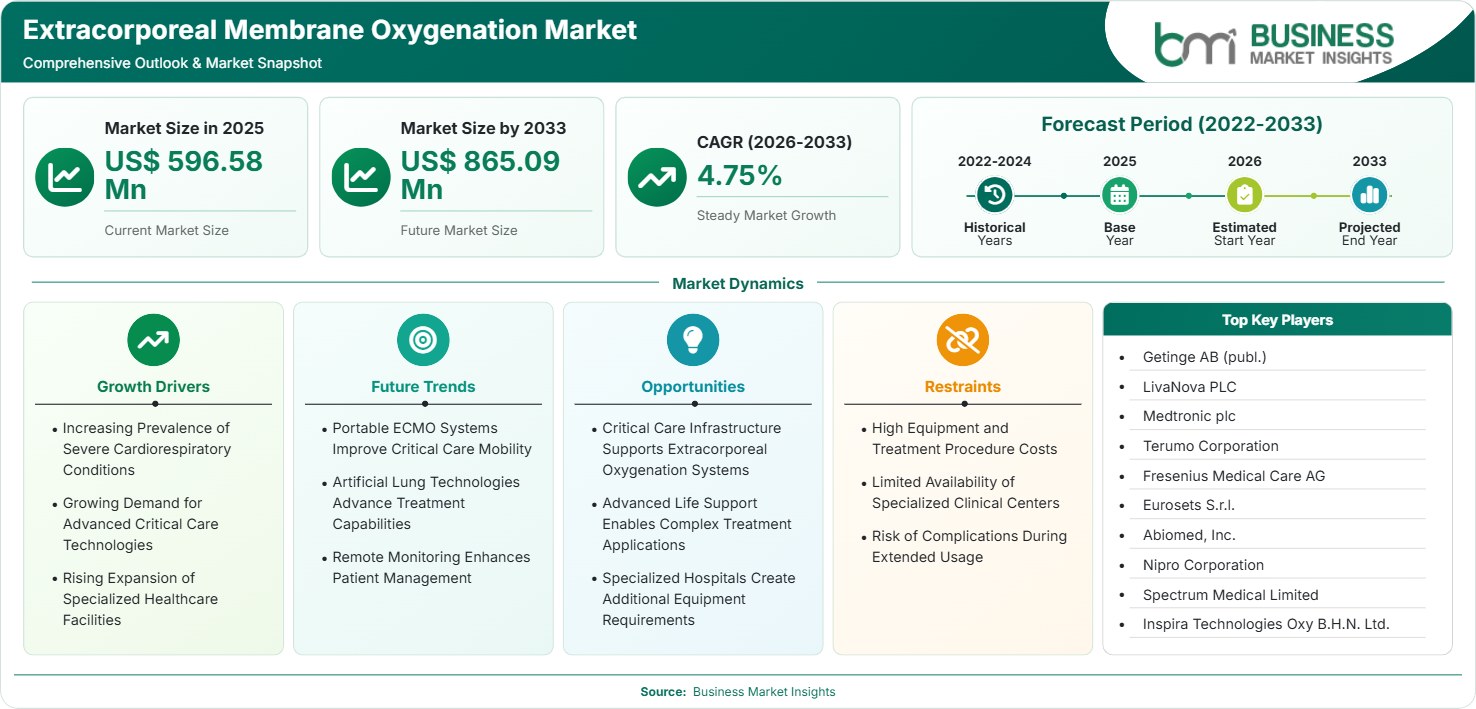
The Extracorporeal Membrane Oxygenation Market size was valued at US$ 596.58 Million in 2025 and is projected to reach US$ 865.09 Million by 2033, growing at a CAGR of 4.75% during 2026–2033, driven by critical-care demand, advanced oxygenators, portable systems, neonatal applications, and wider ECMO-center adoption.

Report Coverage
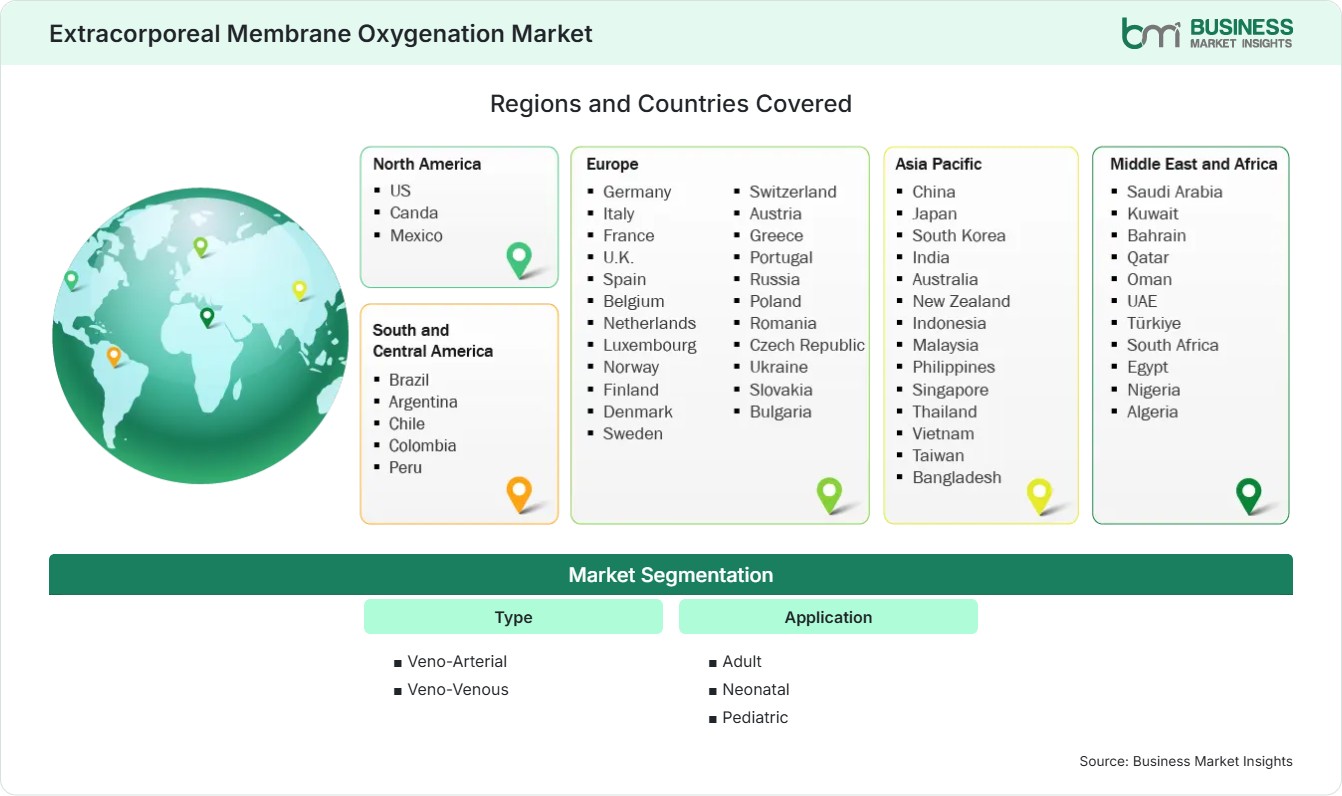
  • Type: Veno-Arterial, Veno-Venous
  • Application: Adult, Neonatal, Pediatric
US$ 596.58 Mn Market size in 2025
US$ 865.09 Mn Market Size by 2033
4.75% CAGR, 2026 - 2033
2026-2033 Forecast Period

AI Overview

Extracorporeal Membrane Oxygenation Market Summary

  • North America Region: North America holds a market share of 36%–38% in 2025, growing with a CAGR of 4.2%–4.8%, influenced by established ECMO centers, specialized clinicians, replacement consumables, cardiac indications, respiratory failure, reimbursement capabilities, clinical research, and technology investments.
  • Fastest Growing Region: Asia Pacific holds a market share of 23%–25% in 2025, growing with a CAGR of 5.8%–6.4%, supported by expanding critical-care infrastructure, increasing tertiary hospitals, improving specialist training, medical-device investment, and wider adoption.
  • Leading Segment: Veno-Arterial ECMO holds a market share of 55%–59% in 2025, growing with a CAGR of 4.4%–4.9%, supported by cardiogenic shock management, cardiac surgery, extracorporeal resuscitation, circulatory support, and increasing integration with mechanical circulatory support strategies.
  • High Growth Segment: Neonatal applications represent a market share of 8%–12% in 2025, growing with a CAGR of 5.8%–6.5%, supported by neonatal respiratory failure, congenital cardiac conditions, specialist centers, improved cannulation practices, and dedicated pediatric ECMO programs.
  • Key Market Opportunity: The strongest opportunity lies in compact, monitored, transportable ECMO platforms combining oxygenation, pressure sensing, temperature management, connectivity, and simplified circuits for regional hospitals and mobile critical-care networks.
  • Major Market Players: Getinge AB (publ.), LivaNova PLC, Medtronic plc, Terumo Corporation, Fresenius Medical Care AG, Eurosets S.r.l., Abiomed, Inc., Nipro Corporation, Spectrum Medical Limited, and Inspira Technologies Oxy B.H.N. Ltd.
Strategic Insights

Extracorporeal Membrane Oxygenation Market: Strategic Insights

Extracorporeal Membrane Oxygenation Market Strategic Framework
FREE PDF
Request your free sample
Request free sample
Stakeholder View

Key Takeaways

  • Market structure insight: The value chain is moving toward integrated ECMO ecosystems involving oxygenators, pumps, cannulas, consoles, sensors, tubing sets, monitoring software, training, technical support, and disposable replacement cycles. Suppliers capable of coordinating these components can strengthen hospital relationships and recurring revenue exposure.
  • Growth opportunity insight: Veno-arterial therapy remains the largest application pathway because cardiogenic shock, extracorporeal cardiopulmonary resuscitation, and postoperative cardiac support require dependable circulatory assistance. Neonatal and pediatric programs provide additional upside where specialized equipment and trained teams can support higher-value clinical workflows.
  • Innovation trend: Product development is increasingly focused on compact architecture, integrated sensing, lower circuit complexity, improved hemocompatibility, and better transportability. The objective is to give clinicians more actionable information without expanding the number of external monitoring devices around an already complex bedside environment.
  • Regional opportunity: Asia Pacific offers the most attractive capacity-building opportunity because ECMO availability remains concentrated in advanced tertiary institutions while critical-care infrastructure continues expanding. Japan, China, South Korea, Australia, India, and selected Southeast Asian markets can support differentiated strategies based on training, local partnerships, and service networks.
  • Investment and M&A trend: Strategic investment is increasingly directed toward adjacent cardiovascular technologies, perfusion systems, monitoring, oxygenation, and digital connectivity rather than isolated ECMO components. This creates opportunities for partnerships between established manufacturers and smaller technology companies developing sensors, portable systems, and next-generation oxygenation architectures.
  • Operational insight: Standardized training and simulation are becoming commercial differentiators because hospitals must maintain clinician competency, emergency response capability, and multidisciplinary coordination. Vendors that combine devices with education, technical support, simulation, and lifecycle services can create stronger customer retention than equipment-only suppliers.
Geographic Outlook

Extracorporeal Membrane Oxygenation Market Regional Highlights

North America Extracorporeal Membrane Oxygenation Market

North America holds a 36%–38% Extracorporeal Membrane Oxygenation Market share in 2025 and is projected to expand at a 4.2%–4.8% CAGR through 2033. The region is characterized by the presence of developed tertiary care facilities, ECMO programs, perfusion services, cardiovascular centers, and relatively good capability to purchase medical devices. The United States is the leading national market for the region, whereas Canada adds to the market through specific cardiopulmonary and neonatal centers. The demand in the region is driven by the replacement of oxygenators and circuits, training, technological upgrades, and ECMO expansion beyond academic medical institutions.

  • Mature ECMO centers support recurring demand for oxygenators, tubing sets, cannulas, pumps, monitoring equipment, and technical services, creating predictable replacement-driven revenue opportunities for established suppliers.
  • Clinical specialization is expanding the addressable base beyond conventional intensive-care use, particularly through cardiogenic shock programs, extracorporeal cardiopulmonary resuscitation, transplantation pathways, and complex postoperative cardiac management.
  • Digital monitoring and integrated sensors are gaining commercial relevance because ECMO teams require continuous visibility into pressure, temperature, oxygen saturation, flow, and circuit performance during high-risk support.
  • Regional manufacturers and distributors increasingly compete through service quality, clinician education, product availability, and rapid technical assistance rather than relying exclusively on device specifications.

US Extracorporeal Membrane Oxygenation Market

The US represents approximately 70%–73% of the North American Extracorporeal Membrane Oxygenation Market demand in 2025 and is projected to grow at a 4.1%–4.7% CAGR through 2033. Its position is determined by a high number of tertiary hospitals, existing infrastructure for cardiac surgery, critical care expertise, and a relatively developed medical device industry. The uptake of products is becoming more driven by efficiency and monitoring. Medtronic, Getinge, LivaNova, and other market incumbents are competing using technology, clinical support, disposables, regulation, and relationships with specialized ECMO centers.

  • US demand is supported by advanced cardiovascular and respiratory critical-care programs where ECMO can function as rescue therapy for selected patients with severe cardiopulmonary failure and refractory shock.
  • Integrated monitoring is becoming more important as clinicians seek fewer external measurement devices and clearer visibility into circuit performance during prolonged or transport-related procedures.
  • Hospital purchasing decisions increasingly evaluate lifecycle economics, training requirements, disposables, technical support, and interoperability alongside oxygenator performance and pump characteristics.

Europe Extracorporeal Membrane Oxygenation Market

Europe accounts for a 29%–31% Extracorporeal Membrane Oxygenation Market  share in 2025 and is projected to register a 4.5%–5.0% CAGR through 2033. Germany, Italy, France, the UK, Spain, and the Netherlands comprise key mature markets, whereas Poland and some Central European nations offer high-growth prospects. The demand in Europe comes from cardiac care centers, pediatric care, harmonized regulations, research and development, and advanced perfusion techniques. Innovation within products includes portable systems, extended time oxygenators, mobility, and circuit monitoring. The development of portable ECLS technology by Eurosets took place in 2025, which shows the emphasis placed on mobility and rescue in this region.

  • Germany and Italy remain important manufacturing and clinical hubs, supporting product development, specialist expertise, hospital procurement, and export-oriented supply chains across European markets.
  • The United Kingdom and France provide established critical-care infrastructure, while demand is increasingly connected to specialist referral pathways and multidisciplinary ECMO service models.
  • Italy demonstrates strong innovation activity in oxygenators and ECLS systems, including portable configurations designed for rescue scenarios and difficult-to-reach environments.
  • Poland and selected Central European countries can record comparatively faster adoption as tertiary hospitals expand specialist intensive-care capabilities and professional training.

Asia Pacific Extracorporeal Membrane Oxygenation Market

Asia Pacific accounts for a 23%–25% Extracorporeal Membrane Oxygenation Market share in 2025 and represents the fastest-growing regional market, with a projected CAGR of 5.8%–6.4% through 2033. The key markets are Japan, China, Australia, and South Korea, whereas India and Southeast Asian economies present considerable growth opportunities. Japan has an advantage in terms of medical device production and experience in ECMO technology. China is developing its tertiary care facilities, and Australia has highly advanced specialist programs. India and Southeast Asian economies have good long-term prospects because of hospitals investing in equipment and training.

  • Japan combines mature cardiovascular infrastructure with strong domestic manufacturing capabilities, supporting oxygenator development, specialist training, clinical adoption, and technology refinement across sophisticated hospital systems.
  • China represents a major capacity-expansion opportunity as tertiary hospitals strengthen intensive-care infrastructure and invest in advanced cardiovascular and respiratory support technologies.
  • India provides a broad emerging opportunity because metropolitan hospitals increasingly develop advanced critical-care programs, while regional networks can extend ECMO referral and transport capabilities.
  • Australia and South Korea benefit from established specialist centers, clinical expertise, and structured training, creating demand for advanced systems with reliability, monitoring, and transport functionality.

Rest of World Extracorporeal Membrane Oxygenation Market

South and Central America account for a smaller portion of global demand, with Brazil, Mexico, Chile, and Colombia serving as important adoption centers. Growth is driven by the availability of tertiary hospitals and specialists, cost-effective devices and supplies, and adequate disposables. The biggest potential in the region is Brazil, whereas Chile and Colombia may facilitate targeted growth with specialist referral networks. Training is key because ECMO necessitates a multidisciplinary approach and management of the circuit.

The Middle East and Africa represent an emerging opportunity, with Saudi Arabia, the United Arab Emirates, Israel, and South Africa leading specialized adoption. The combined Rest of World region represents a 9%–11% share in 2025 and is projected to grow at a 4.9%–5.5% CAGR through 2033. High-growth markets can benefit from centralized procurement, specialist partnerships, and training programs.

  • Brazil and Mexico provide the strongest Latin American opportunities because of their relatively developed tertiary-care networks and concentration of advanced cardiovascular hospitals.
  • Chile and Colombia can expand through regional referral systems, specialist education, and collaborations between established ECMO centers and hospitals developing new programs.
  • Saudi Arabia and the United Arab Emirates are investing in advanced critical-care infrastructure, creating demand for sophisticated extracorporeal support systems and specialist services.
  • South Africa remains an important African hub, while Israel contributes advanced medical-device expertise and specialized critical-care capabilities to the regional ecosystem.
Global Market Geography
FREE PDF
Request your free sample
Request free sample
Segment Analysis

Extracorporeal Membrane Oxygenation Market Segmentation

Type

Type segmentation is led by veno-arterial systems, which account for 55%–59% in 2025 and are projected to grow at a 4.4%–4.9% CAGR during 2026–2034. There is evidence for adoption through cardiogenic shock, cardiac surgery, cardiopulmonary resuscitation, and circulatory assistance. The venovenous systems provide respiratory support and are aided by the severe acute respiratory failure program, specialty ICU expansion, and advanced dual-lumen cannulation techniques.

  • Veno-Arterial: Veno-arterial ECMO provides combined cardiac and respiratory support, making it important for cardiogenic shock, extracorporeal resuscitation, postoperative failure, and selected transplant-related critical-care pathways.
  • Veno-Venous: Veno-venous ECMO primarily supports severe respiratory failure while preserving native cardiac function, with adoption influenced by advanced ICU programs, respiratory disease burden, cannulation innovation, and specialist expertise.

Application

Application segmentation spans adult, neonatal, and pediatric care, with adult treatment representing the largest installed-use base. Neonatal care is the fastest-growing application, supported by specialist centers and advances in neonatal respiratory and cardiovascular support. Pediatric programs benefit from improved cannulas, oxygenators, monitoring systems, and structured follow-up. The broader Extracorporeal Membrane Oxygenation Market scope is therefore influenced by age-specific device design, clinical protocols, training, and hospital specialization.

  • Adult: Adult ECMO is driven by cardiogenic shock, severe respiratory failure, extracorporeal cardiopulmonary resuscitation, complex cardiac surgery, and critical-care programs requiring advanced temporary organ support.
  • Neonatal: Neonatal ECMO addresses severe respiratory and cardiac conditions in newborns, with adoption dependent on specialized equipment, experienced clinicians, neonatal ICUs, referral networks, and structured follow-up programs.
  • Pediatric: Pediatric ECMO supports children with severe cardiopulmonary failure, requiring age-appropriate cannulation, oxygenation, monitoring, dosing, and multidisciplinary expertise within dedicated pediatric critical-care centers.


Market Forces

Extracorporeal Membrane Oxygenation Market Dynamics

Key Market Drivers

Integrated Monitoring and Circuit Simplification

The industry is undergoing a transformation due to the development of oxygenators that perform gas exchange along with integrated pressure, temperature, and oxygen saturation monitoring. The Nautilus Smart ECMO module from Medtronic represents such an evolution by integrating oxygenator performance and monitoring data into the oxygenator's design, rather than relying exclusively on external monitoring sensors. This can lead to reduced circuit complexity, improved bedside workflow, and earlier detection of performance changes. Getinge also noticed increased demand for the consumables used in ECLS therapy in the fourth quarter of 2025, which proves that the disposables also have commercial value. The resulting Extracorporeal Membrane Oxygenation Market trends favor suppliers capable of combining hardware, monitoring, consumables, service, and training into coherent clinical solutions.

Expansion of Cardiogenic Shock and Rescue-Care Programs

Cardiogenic shock and extracorporeal cardiopulmonary resuscitation are crucial demand triggers for VA-ECMO. According to an analysis of 7,950 adults with cardiogenic shock who underwent VA-ECMO in 2025, the survival rate at discharge for patients with a well-defined physiologic management package was 55.9%, whereas for those without the entire package, it was 39.4%. This result emphasizes the importance of standardization of management and infrastructure for critical care, and not just the availability of the device itself. With improvements in patient selection protocols and the formation of shock teams, the focus has shifted to reliable equipment. This supports broader Extracorporeal Membrane Oxygenation Market growth by strengthening the clinical infrastructure surrounding high-acuity cardiac support and encouraging hospitals to develop integrated pathways for rapid initiation, monitoring, escalation, and weaning.

Standardized ECMO Training and Clinical Competency

Training is becoming an organizational factor, as the success of ECMO treatment is contingent on a multidisciplinary team trained in circuit management, emergency handling, cannula management, patient monitoring, and weaning strategies. The training model proposed by the ELSO for 2025 focuses on competency-based training, hands-on simulation, standardized testing, team training, and professional development for adult, neonatal, and pediatric healthcare professionals. This training model underscores the increasing awareness of the dangers of having new equipment with insufficient clinical capabilities. This dynamic strengthens demand for simulation platforms, training services, procedure support, and standardized operating protocols. The resulting Extracorporeal Membrane Oxygenation Market trends favor suppliers with broad clinical ecosystems, particularly where emerging ECMO centers require structured assistance during implementation and early-stage program development.

Key Market Opportunities

Portable ECMO Platforms for Interhospital Transport

A portable system offers an enticing prospect, as more and more critically ill patients need to be moved from one hospital to another, between the operating room and the intensive care unit, and to other specialized ECMO centers. Small consoles, integrated energy solutions, robust circuits, and easy monitoring can alleviate logistics concerns in patient transport. The 2025 Xtreme Rescue from Eurosets is an example of such a development that offers both portability and extracorporeal cardiopulmonary support systems, with its focus on rescue operations in hard-to-reach locations. Future procurement will increasingly favor transportation capability, in addition to bedside use. The Extracorporeal Membrane Oxygenation Market Forecasts, therefore, include an expanding commercial opportunity in mobility, decentralized access, transport teams, compact equipment, battery management, and integrated monitoring, all designed for high-risk patient transfers.

Emerging Asia Pacific ECMO Infrastructure

Asia Pacific provides an important investment opportunity because specialist ECMO capability is concentrated in major hospitals, while many secondary centers lack complete programs. The creation of a regional network using a hub hospital could allow companies to sell their equipment while also providing training, maintenance services, consumables sales, emergency transport, and clinical training. While Japan is experienced in technical expertise, China is involved in tertiary care expansion on a large scale, and India provides an extensive base of emerging advanced private and public hospitals. Terumo's 2025 corporate report notes growing market demand for ECLS and ECMO systems, as well as its capabilities in oxygenators, hollow-fiber technology, training, clinical collaboration, and manufacturing across the globe. This gives the company an opportunity to localize servicecurring consumables demand while improving long-term customer retention.

Digital Connectivity and Data-Enabled ECMO Management

Connectivity represents a developing opportunity as ECMO platforms generate increasingly valuable information about flow, pressure, temperature, oxygenation, and circuit performance. The next step would be to securely upload appropriate device information into hospital patient-monitoring environments, thereby enabling trend analysis and better cross-disciplinary communication. It was noted that the launch of the Xenios 2.0 console by Fresenius Medical Care in April 2025 offered features for the incorporation of machine information in patient monitoring. This is an example of how ECMO devices can be incorporated into an overarching digital critical care solution. Software providers can create differentiated software solutions for data visualization, alerts, remote support, predictive maintenance, and workflow logging, creating revenue streams through software services and helping hospitals standardize processes in ECMO centers.

Market Restraints and Challenges

Clinical Complexity and Specialized Workforce Requirements

Factor: ECMO requires multidisciplinary teams with expertise in perfusion, critical care, cardiology, surgery, respiratory therapy, nursing, cannulation, anticoagulation, emergency troubleshooting, and weaning. ELSO’s updated education guidance identifies variability in training practices and emphasizes competency-based frameworks because time-based education alone may not establish sufficient proficiency.

Impact: hospitals without experienced personnel may delay program development, limit utilization, or concentrate treatment in a small number of specialist centers. The workforce constraint can therefore slow geographic expansion even when equipment is commercially available. Manufacturers must address this barrier through structured education, simulation, certification support, technical assistance, and standardized workflows. The challenge also increases implementation costs for smaller hospitals and makes service capability an important component of purchasing decisions. Without adequate staffing, higher equipment availability does not automatically translate into proportionate procedure growth.

Bleeding, Thrombosis, and Procedure-Related Safety Risks

Factor: ECMO requires invasive vascular access, extracorporeal circulation, anticoagulation management, and continuous circuit surveillance, creating exposure to bleeding, thrombosis, infection, vascular injury, neurological complications, and device-related events. Medtronic’s safety information specifically identifies complications including hemorrhage, hypoxia, anemia, infection, stroke, organ failure, and death.

Impact: clinical risk can influence patient selection, hospital protocols, procurement decisions, and the pace at which lower-volume centers adopt ECMO. Suppliers therefore face pressure to improve biocompatibility, circuit design, monitoring, cannulation, alarms, and troubleshooting. Safety concerns also reinforce the need for specialist training and standardized protocols. As technology becomes more sophisticated, manufacturers must demonstrate that added functionality improves workflow without introducing additional points of failure or creating excessive complexity for already highly specialized clinical teams.

Company Analysis

Competitive Landscape

The Extracorporeal Membrane Oxygenation Market analysis indicates competition is moving from individual oxygenators and pumps toward integrated extracorporeal platforms. Companies differentiate through oxygenator performance, circuit design, monitoring, cannulation, portability, clinical education, consumables, regulatory reach, and service infrastructure. Established manufacturers retain advantages in hospital relationships and global distribution, while specialist innovators are targeting compact systems, connectivity, and next-generation oxygenation. The competitive environment therefore rewards companies that combine reliable hardware with lifecycle support and clinically relevant workflow improvements.

Company Name

Overview

Products and Services relevant to this market

Getinge AB (publ.)

Swedish medtech company with extensive intensive-care and cardiovascular expertise and a broad global hospital presence.

Cardiohelp ECMO and ECLS solutions, oxygenators, circuits, consumables, monitoring capabilities, training, and clinical support.

LivaNova PLC

Global cardiovascular and neuromodulation company with longstanding cardiopulmonary perfusion expertise and ECMO-related cannulation technologies.

ProtekDuo cannula, cardiopulmonary systems, perfusion technologies, extracorporeal support accessories, and clinical resources.

Medtronic plc

Global medical-device manufacturer developing integrated extracorporeal technologies focused on simplified circuits and monitored oxygenation.

Nautilus ECMO oxygenators, Nautilus Smart ECMO module, VitalFlow ECMO system, cannulation accessories, and training.

Terumo Corporation

Japanese cardiovascular technology company with strong oxygenator, hollow-fiber, surgical, and extracorporeal support capabilities.

ECMO systems, oxygenators, hollow-fiber technologies, cardiovascular products, perfusion equipment, and professional training.

Fresenius Medical Care AG

German healthcare technology company associated with Xenios extracorporeal support technologies and advanced critical-care connectivity.

Xenios ECMO systems, consoles, extracorporeal support platforms, oxygenation technologies, connectivity, and clinical workflow solutions.

Eurosets S.r.l.

Italian specialist manufacturer focused on extracorporeal cardiopulmonary support and advanced disposable medical-device solutions.

A.L.ONE ECMO oxygenators, pediatric and neonatal modules, tubing sets, Landing systems, and portable ECLS platforms.

Abiomed, Inc.

US cardiovascular technology company focused on temporary mechanical circulatory support and therapies used alongside ECMO.

Impella heart pumps and technologies supporting cardiogenic shock management and combined ECMO-mechanical circulatory support strategies.

Nipro Corporation

Japanese diversified medical-device manufacturer with global production, research, distribution, and healthcare technology capabilities.

Extracorporeal circulation components, blood-management technologies, medical disposables, dialysis expertise, and related critical-care products.

Spectrum Medical Limited

UK specialist manufacturer providing perfusion technologies and monitoring solutions for cardiopulmonary bypass and ECMO environments.

Quantum centrifugal pumps, perfusion monitoring, circuit-management technologies, data systems, and extracorporeal support solutions.

Inspira Technologies Oxy B.H.N. Ltd.

Israeli respiratory-support technology company developing extracorporeal oxygenation and blood-monitoring platforms.

INSPIRA ART systems, blood oxygenation technologies, HYLA blood sensors, cannulation concepts, and next-generation respiratory-support platforms.

Trust & Transparency

Research Methodology

The market analysis combines proprietary research with secondary data from government agencies, company disclosures, regulatory filings, industry databases and expert interviews. Market estimates are validated through data triangulation, cross-market benchmarking and analyst review.

View Full Research Methodology

Questions Answered

Frequently Asked Questions

What is the strategic value of training services for suppliers?

The Extracorporeal Membrane Oxygenation Market Report highlights that Training supports safe equipment adoption, improves clinician familiarity, strengthens customer relationships, and helps hospitals establish standardized ECMO workflows. Vendors offering education, simulation, technical support, and lifecycle services can differentiate beyond hardware performance.

What role will portable ECMO systems play in emerging markets?

Portable systems can enable retrieval from hospitals without ECMO capability, facilitate transfers to specialist centers, and support decentralized critical-care networks. Compact equipment can therefore expand the addressable population without requiring every hospital to operate a full program.

Why is neonatal ECMO an attractive growth opportunity?

Neonatal ECMO requires specialized oxygenators, cannulas, circuits, and highly trained teams. Expansion of neonatal intensive-care capacity and referral networks can increase adoption where specialist programs become available.

How is digital connectivity changing ECMO workflows?

Connected consoles can transfer device information into monitoring environments, improving visibility of pressure, temperature, oxygenation, alarms, and equipment status while supporting standardized documentation and multidisciplinary communication.

What factors will influence ECMO equipment procurement through 2033?

Procurement will increasingly consider integrated monitoring, circuit simplicity, oxygenator durability, portability, disposable availability, clinical training, technical support, interoperability, and total lifecycle economics rather than equipment price alone.

Access the Full Extracorporeal Membrane Oxygenation Market Report

Get segment-level forecasts, regional estimates, competitive benchmarking, company profiles and downloadable Excel datasets.

Access the full Extracorporeal Membrane Oxygenation Market Report
350 pages PDF & Excel | 2026-09-21
Similar Research

Related Market Reports